




Extreme heat in West Africa does not simply reduce farm labour but reshapes household labour allocation – often increasing reliance on women and children and reducing hired labour – while the overall response varies significantly across countries, depending on local economic and institutional conditions.
West Africa is one of the fastest warming regions on earth. For the hundreds of millions of smallholder farmers who depend on rain-fed agriculture, rising temperatures are not a distant threat but a daily reality. Heat affects crop yields, pests, and growing conditions. But it also reshapes something less visible yet equally important: how rural households allocate labour (Feriga et al. 2025).
Tabe-Ojong, Kakpo, and Lokossou (2026) fill this gap by asking a deceptively simple question: how do farming households in West Africa adjust their labour in the face of these extreme temperatures? Using a combination of satellite-derived earth observation data and household microdata from Ghana, Mali, and Nigeria – three countries that together represent a wide range of agroecological zones, institutional environments, and levels of economic development – we document a set of findings that are as nuanced as they are policy-relevant.
Extreme heat does not simply reduce labour
A common assumption is that higher temperatures reduce labour supply. When it is too hot, workers slow down or stop working altogether. While this may hold in some settings, it does not capture the full reality for smallholder farmers. Our analysis reveals that extreme heat triggers a far more complex set of household responses that operate through multiple, sometimes offsetting, channels simultaneously. Higher temperatures encourage the spread of pests, weeds, and crop diseases. Farmers must therefore spend more time on tasks such as manual weeding, pesticide application, and crop management. At the same time, households may expand cultivated land or adopt climate-resilient seeds to compensate for yield losses, which further increases labour requirements. These forces create two competing effects:
- A productivity effect, where heat lowers returns to labour and discourages work
- An adaptation effect, where households increase labour to protect crops and stabilise production.
Which force dominates depends heavily on context and local conditions.
Labour responses differ sharply across countries
One of the most striking findings of our research is how differently households respond to extreme heat across the three countries – a finding that has direct consequences for how policies should be designed and targeted (Table 1).
In Nigeria, extreme heat exposure leads to a net reduction in the number of household members engaged in farm work. Households appear to pull some workers off the land, possibly reflecting the physical toll that high temperatures take on adults working outdoors in an already hot climate. But simultaneously, those household members who remain engaged work longer and harder. Particularly concerning is the finding that child labour rises in Nigeria under extreme heat conditions. This suggests that households compensate for lost adult labour or income by involving children more heavily in farm work, potentially affecting schooling and long-term human capital.
Table 1: Effects of extreme heat on farm labour across countries
| Outcome | Pooled | Nigeria | Mali | Ghana |
| Total labour participation | ↓ | ↓ | ↑ | 0 |
| Total days worked | ↑ | ↑ | ↑ | 0 |
| Male labour participation | ↓ | ↓ | ↓ | 0 |
| Male days worked | 0 | ↑ | 0 | 0 |
| Female labour participation | ↑ | ↓ | ↑ | 0 |
| Female days worked | 0 | ↓ | ↑ | 0 |
| Child labour participation | ↑ | ↑ | ↑ | ↓ |
| Child days worked | ↑ | ↑ | ↑ | 0 |
Note: ↑ Increase under extreme heat; ↓ Decrease under extreme heat; 0 No statistically significant effect.
In Mali, the overall picture is one of expanded labour supply. Extreme heat is associated with an increase in total household labour deployed on the farm, with the effects concentrated among women and children. Mali's predominantly Sahelian farming systems, which already operate at the margins of agricultural viability, appear to require households to mobilise every available member when heat-induced agronomic stress escalates. The burden of this response falls disproportionately on women and children.
In Ghana, the picture is markedly different. The labour effects of extreme heat are, in most cases, statistically indistinguishable from zero, with the notable exception of a decline in child labour. One possible explanation is that Ghana's stronger institutional environment, greater market integration, and higher average incomes may afford households more options to buffer against heat shocks without restructuring their labour use. This points to the important role that economic development and market access play in mediating climate vulnerability.
A common thread: The retreat from hired labour
Despite the cross-country differences, one result appears consistently across all three countries. Extreme heat leads to a decline in hired labour and animal traction use. This finding reflects a core household economics mechanism. When heat strikes, it compresses household income expectations, leading to low yields and higher uncertainty. At precisely the moment when defensive agricultural tasks are expanding, households find themselves liquidity-constrained and unable or unwilling to bear the cash costs of hiring external workers or renting draft animals. The response is a substitution: unpaid family labour (predominantly women and children) steps in to replace the paid labour that heat makes unaffordable.
Unpacking the mechanisms: The adaptation imperative
To understand why labour responds the way it does, we examine several adaptation channels that households employ under heat stress. The evidence confirms that, as temperatures rise, farmers increase pesticide use while simultaneously reducing fertiliser use and engaging in more manual weeding. Households also expand cultivated areas, adopt more climate-resilient crop varieties, and engage in crop diversification. Critically, these adaptation strategies are themselves labour-intensive (Figure 1). Expanding cropland requires clearing, planting, and tending additional plots. Switching to new seed varieties often involves more careful management. Pesticide application demands repeated trips across fields. These demands are precisely what drives the upward pressure on household labour in contexts like Mali where market access and income buffers are thinner. The net labour effect of extreme heat is thus the outcome of two competing forces: the direct productivity effect that depresses the return to farm work, and the indirect adaptation effect that drives up the demand for defensive labour. Which force dominates depends on local agronomic conditions, market access, and household resources.
Figure 1: The labour implications of farm inputs
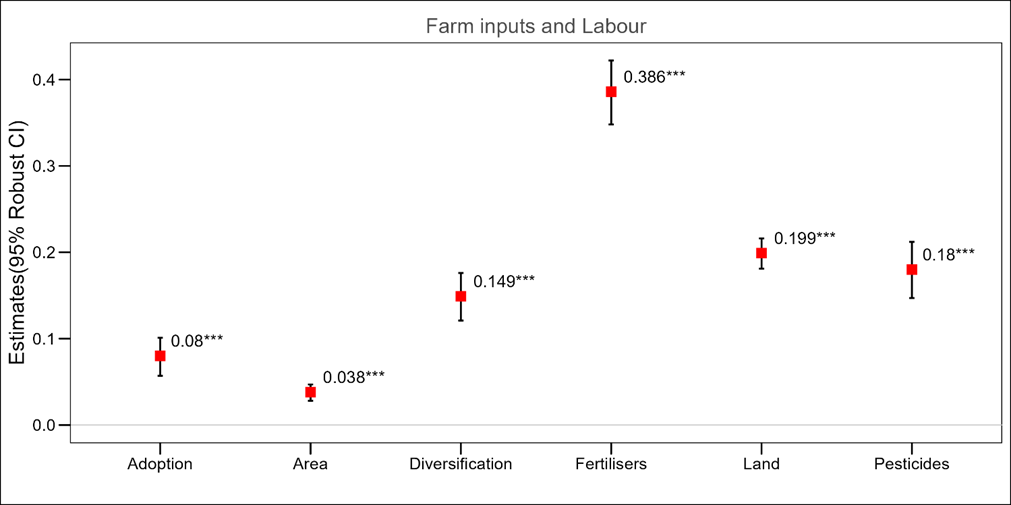
Notes: This figure presents the association between key farm inputs and labour. *, **, and *** indicate statistical significance at the 10%, 5%, and 1% levels, respectively. The dots represent point estimates. The error bars represent the 95% confidence intervals. Estimates by Tabe-Ojong et al. (2026). Shared with permission from the authors.
Adaptation comes with hidden costs
But adaptation is not without cost. Shifting agricultural burdens onto women and children imposes welfare losses that aggregate data on crop yields and household income will never fully capture. Child labour comes at the direct expense of school attendance and cognitive development. Women's increased unpaid farm work crowds out leisure and sleep, with well-documented consequences for physical and mental health. Cropland expansion can accelerate deforestation and soil degradation. Increased pesticide use raises health risks for farm workers who often lack protective equipment. In other words, adaptation generates new vulnerabilities.
Implications for development policy
Our findings carry several clear messages for policymakers working at the intersection of climate change, agriculture, and human development in West Africa.
Climate responses must be context-specific. A uniform intervention designed to support labour market adjustment will almost certainly be appropriate for some settings and entirely misdirected in others. The contrasting experiences of Nigeria, Mali, and Ghana underscore the importance of tailoring responses to local agronomic conditions, labour market structures, and household livelihood strategies.
- Social protection systems should become climate responsive. The rise in child labour under extreme heat in Nigeria, and the mobilisation of women and children in Mali reflect households' inability to smooth income and to absorb shocks without sacrificing their welfare. Support programmes that can be triggered during heat events could significantly reduce these welfare costs.
- Labour-saving agricultural technologies are critical. Affordable mechanical weeding equipment, improved pest-resistant seed varieties, and expanded access to extension services that help farmers manage biotic stress more efficiently could all reduce the pressure that extreme heat places on household labour.
- Strengthening rural financial markets matters. The retreat from hired labour during heat shocks reflects, in part, households' inability to access credit to finance additional labour costs. Strengthening rural financial inclusion can give households the flexibility needed to respond to climate shocks without sacrificing the welfare of their household members.
Ultimately, our findings show that climate change is not just an agricultural productivity problem; it is a labour market problem, a gender problem, and a child welfare problem, all at once. Policies that treat these dimensions separately will fall short.
References
Feriga, M, N L Gracia, and P Serneels (2025), "The impact of climate change on work: Lessons for developing countries," The World Bank Research Observer, 40(1): 104–146.
Tabe-Ojong, M P, A T Kakpo, and J C Lokossou (2026), "Turning up the heat: Extreme heat and labor implications in West Africa," Journal of Development Economics, 179: 103683.