







Often presented as game-changing solutions, agricultural technologies like improved seeds or fertilisers can lead farmers to adopt one at the expense of others, only to disadopt when the expected gains, based on overly optimistic assumptions about reduced need for complementary inputs, fail to materialise.
Editor’s note: For a broader synthesis of themes covered in this article, check out Issue 2 of our VoxDevLit on Agricultural Technology in Africa.
Sub-Saharan Africa faces a critical challenge: how to sustainably increase food production on shrinking land while navigating growing climatic stresses (Tilman et al. 2011). Part of the solution, it is often claimed, lies in climate-smart agricultural technologies, especially improved seed varieties that offer higher yields, drought resistance, and pest tolerance (Evenson and Gollin 2003). Unfortunately, adoption of improved inputs and technologies in the region appears to be stagnant, or at least progressing more slowly than hoped (Suri and Udry 2022, Suri et al. 2024).
Many interventions have been based on the belief that once key constraints, such as cost, perceived risk, and access, are addressed, farmers will adopt and continue using these innovations over time. Yet in practice, adoption is often short-lived: farmers try a new input once or twice, then return to familiar methods that have served them for years (Moser and Barrett 2006).
Low complementary input and technology use in agriculture
New agricultural technologies rarely succeed in isolation. A high-yielding maize variety only fulfils its promise if paired with adequate fertiliser, pest control, timely weeding, and proper planting. Yet in Uganda, many farmers adopt improved seeds expecting them to deliver higher yields with the same or even fewer complementary inputs. In a sense, farmers seem to believe that improved seed varieties are some kind of miracle seed.
These beliefs are not entirely unreasonable. Modern agricultural technologies such as improved seed varieties are expensive, and their marketing often emphasises extraordinary traits: bumper yields, drought tolerance, pest resistance. When cash is tight and choices have to be made, it's not surprising that farmers might reduce input use (e.g. less fertiliser, less pesticide, less labour) believing the improved traits of the seed variety will compensate.
But in reality, this strategy often backfires. When harvests disappoint, many farmers blame the seed itself, not the lack of complementary investment. As a result, they may disadopt, sometimes for extensive periods until fundamentals change.
Improving agricultural technology adoption in Uganda
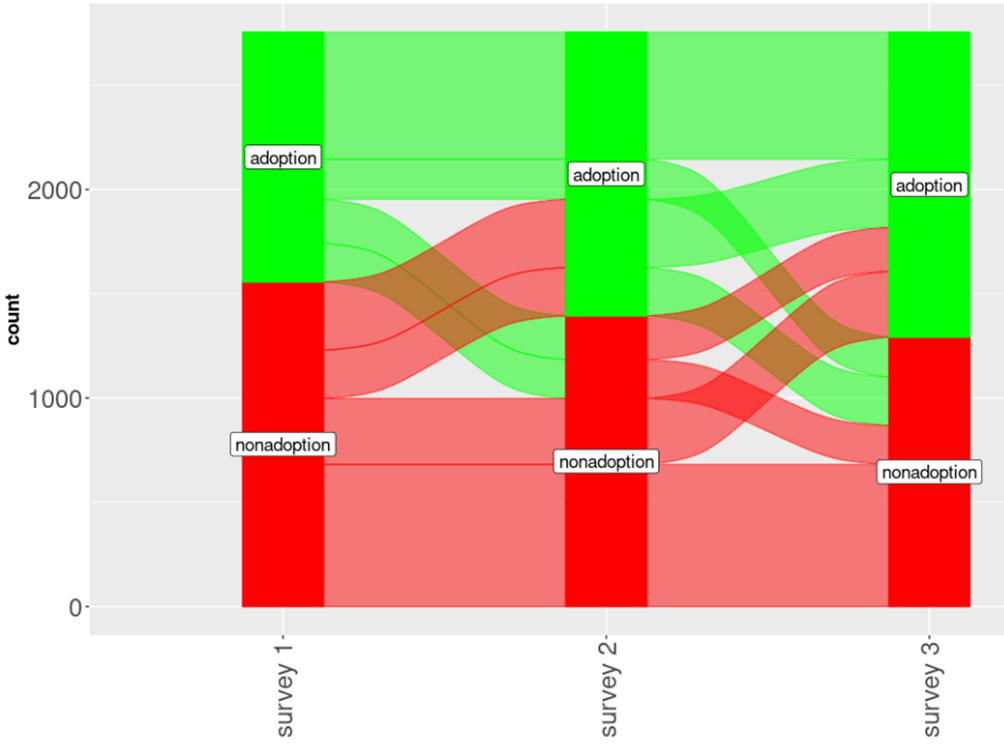
To test this hypothesis, we conducted a large-scale field experiment with nearly 3,500 smallholder maize farmers in eastern Uganda (Miehe et al. 2025). Figure 1, based on surveys over three successive seasons, shows that these farmers typically have some experience with hybrid seed or Open Pollinated varieties, and over time, adoption steadily increases. At the same time, substantial numbers of farmers shift adoption status over time.
Figure 1: Seed adoption over survey rounds
To test if adoption dynamics are caused by inflated expectations and related underinvestment in complementary inputs and effort, we developed a simple information intervention. All farmers watched a short video promoting good agricultural practices, but for half the group the video carried a critical additional message that improved seeds are not miracle seeds and explicitly highlighted the need for complementary practices such as weeding and fertiliser application to achieve the expected gains. We then tracked farmers through the seasons, capturing their knowledge, adoption decisions, use of complementary inputs and practices, and yield expectations.
Providing information reduced technology adoption
Somewhat surprisingly, we found that farmers who watched the message about the need for complementary inputs were actually less likely to adopt improved seed varieties in the following season. Compared to the control group, they were more likely to stick with local varieties.
At the same time, these farmers scored higher on knowledge quizzes and reported that their actual harvests better matched what they expected. In short, correcting inflated expectations seemed to have led to more realistic decision-making and, at least in the short run, lower adoption.
A behavioural model of agricultural technology adoption
To make sense of these findings, we developed a simple theoretical model and tested its predictions by looking at differences in treatment effects for different groups of farmers. The basic idea behind the model is that there are different groups of farmers who differ in their mental models of how production works with improved seeds. In particular, some farmers believe in ‘miracle seeds’, expecting high returns without changing other inputs or practices. Others understand the need for complements, but may find the costs too high to justify adoption. A third group may be sceptical of improved seeds altogether, perhaps due to prior disappointment.
Our treatment video effectively moved farmers from the first category to the second. They updated their beliefs, but instead of investing more in complementary inputs, most farmers simply opted out of adopting the improved seed, at least in the short run.
Implications for agricultural policy and practice
Our findings challenge the prevailing wisdom that ‘information leads to adoption’. In this case, better information led to less adoption but potentially better decisions. It shows that interventions designed to account for farmers’ expectations can help them avoid costly mistakes and eventually build trust in technologies that truly work for them.
Our study has potentially important implications for policymakers, extension agents, agro-dealers, and private seed and agro-input companies.
- Stop selling single technologies as silver bullets. Marketing modern agricultural technologies as miracle solutions can backfire. It inflates expectations, leads to disappointing outcomes, and undermines long-term trust. A more honest message (e.g. “this works if you do X, Y, and Z”) may slow initial uptake but foster more sustainable adoption.
- Promote integrated bundles, not standalone inputs. In our example, seed was just one part of the equation. Farmers need access to affordable fertilisers, pest control, and often financial services to support complementary investments. Bundled interventions that lower the cost and cognitive burden of assembling these inputs can be far more effective than distributing seed alone (Barrett et al. 2022).
- Account for behavioural biases in extension strategies. Many farmers are not irrational—they are just working with incomplete or misleading mental models. Extension efforts must address these models directly, and not just with agronomic facts, but with relatable messaging that speaks to farmers’ lived experiences and constraints.
- Measure success by informed decisions, not just adoption rates. Disadoption is not always a failure. In our case, it reflects more accurate beliefs and more rational choices. If adoption is not profitable given current input costs and risks, then choosing not to adopt is the smart move. Programmes should be evaluated on whether they help farmers make better-informed decisions—not just on how many packages are distributed.
Conclusion: A better path to better seeds
Improved seeds are no miracle. But they can be powerful tools when used with the right inputs, at the right time, under the right conditions. Our research suggests that the main obstacle to sustainable adoption is not stubborn tradition or lack of interest—it is misinformation and mismatched expectations. By designing interventions that respect the complexity of farmers’ decision-making and focus on full production systems, as opposed to only inputs, we can help usher in a new era of adoption grounded in realism, not hype.
References
Barrett, C B, T Benton, J Fanzo, M Herrero, R J Nelson, E Bageant, E Buckler et al. (2022), "Socio-technical innovation bundles for agri-food systems transformation", Springer Nature.
Evenson, R E and D Gollin (2003), “Assessing the impact of the Green Revolution, 1960 to 2000”, Science, 300(5620): 758–762.
Miehe, C, B Van Campenhout, L Nabwire, R Sparrow, and D J Spielman (2025), “Miracle seeds: Biased expectations, complementary input use, and the dynamics of smallholder technology adoption”, Economic Development and Cultural Change (forthcoming).
Moser, C M and C B Barrett (2006), “The complex dynamics of smallholder technology adoption: The case of SRI in Madagascar”, Agricultural Economics, 35(3): 373–388.
Suri, T, C Udry, J C Aker, C B Barrett, L Falcao Bergquist, M Carter, L Casaburi, R Darko Osei, D Gollin, V Hoffmann, T Jayne, N Karachiwalla, H Kazianga, J Magruder, H Michelson, M Startz, and E Tjernström (2024), “Agricultural technology in Africa”, VoxDevLit, 5(2), March.
Suri, T and C Udry (2022), “Agricultural technology in Africa”, Journal of Economic Perspectives, 36(1): 33–56.
Tilman, D, C Balzer, J Hill, and B L Befort (2011), “Global food demand and the sustainable intensification of agriculture”, Proceedings of the National Academy of Sciences, 108(50): 20260–20264.