






Previous research finds that peer-to-peer learning can successfully promote technology adoption, making participatory approaches that emphasise iterative, two-way communication now common in agricultural development. We examine whether this peer learning extends to a digital framework and find that it does when users employ the platform, but keeping users engaged remains a key challenge.
Editor’s note: For a broader synthesis of themes covered in this article, check out Issue 2 of our VoxDevLit on Agricultural Technology in Africa.
As mobile phones proliferate across the developing world, digital delivery of agricultural advice is positioned to play a transformative role in increasing agricultural productivity and improving livelihoods for smallholder farmers (Fabregas et al. 2019, Fabregas et al. 2025). Meanwhile, evidence shows that peer-to-peer learning, at least in person, can successfully promote technology adoption (BenYishay and Mobarak 2018). Participatory approaches that emphasise iterative, two-way communication have become common in agricultural extension. As interest in and potential for mobile extension rises, the social networking capacity of information communication technologies (ICTs) makes digital farmer-to-farmer-extension (F2FE) an alluring prospect. However, while ICTs overcome many of the logistical barriers associated with in-person extension, there exists little empirical research on whether users of a digital network engage with information in a way that leads to adoption.
Building a digital discussion forum for conservation agriculture practices
We partnered with Sokoine University of Agriculture and Telerivet, a mobile communications platform that manages interactive SMS campaigns for businesses and NGOs internationally, to build ShambaChat: a low-cost platform for farmers in rural Tanzania to discuss agricultural practices and extension advice via SMS-based chat groups on basic mobile phones. We evaluated this tool using a randomised controlled trial among maize farmers, measuring its impact compared to a one-way SMS campaign (Lasdun et al. 2025). All participants received the same SMS content, but only the treatment group could interact with others. By randomising this interactive feature, we isolated the effect of peer discussion.
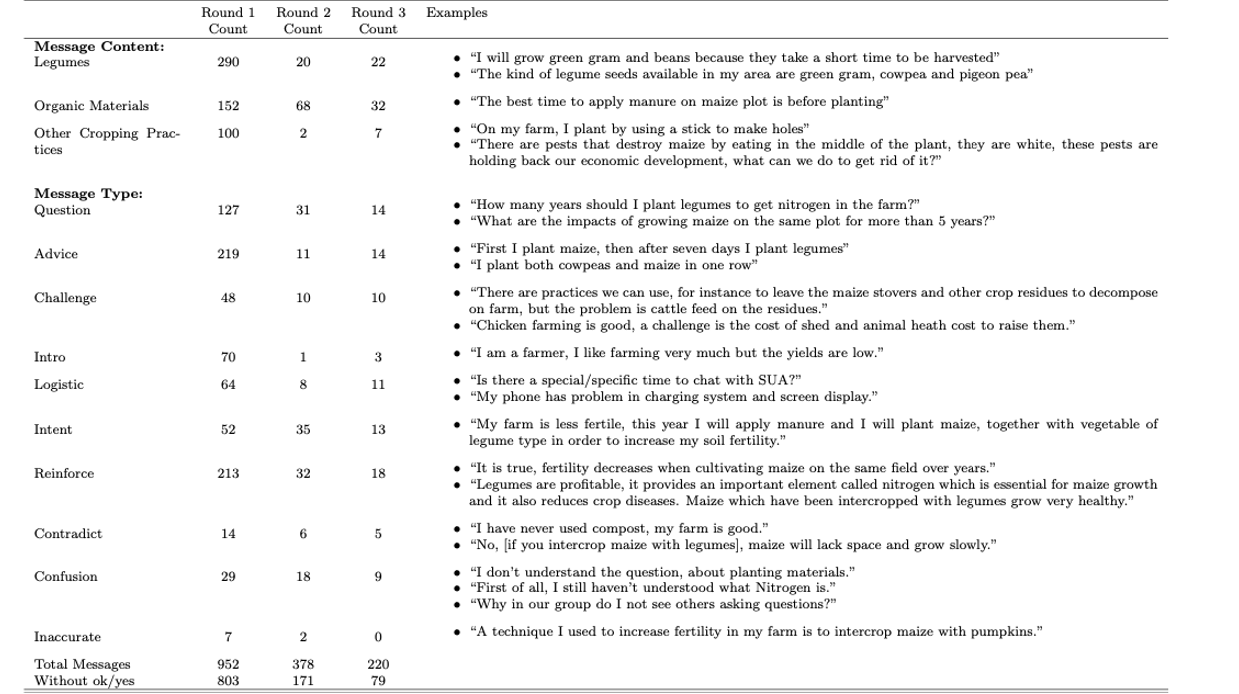
The ShambaChat SMS course was divided into three rounds, each lasting one month and tailored to the agricultural calendar. The first round focused on legume intercropping and saw the highest volume of chat activity. The second and third rounds introduced more complex practices—such as composting and residue incorporation—but coincided with a steep decline in participation. Farmers sent 952 messages in round one, compared to 378 and 220 in the following rounds. Text analysis of chat transcripts revealed farmers used the chat groups to share concrete, implementable strategies—listing legume varieties by name, identifying nearby seed sellers, and giving planting timelines. This not only reinforced the content of the extension broadcasts, but allowed farmers to co-construct practical knowledge. Among the 803 substantive messages exchanged in round one, 69% directly responded to extension messages and 36% were replies to fellow farmers. Fewer than 1% of messages contained misinformation, while over 250 reinforced the broadcast content. Table 1 presents a selection of different types of messages exchanged.
Table 1: Message content
The impact of peer learning on technology adoption
Farmers with access to peer discussion groups were 18 percentage points more likely to intercrop legumes with maize and 15 percentage points more likely to make organic compost from farm waste. These are large effects, particularly for practices that require coordination and local adaptation. However, when these conversations tapered off in later treatment rounds, adoption effects also faded, highlighting the role of active engagement.
We also observed strong spillover effects: control farmers in the same villages as treated participants were more likely to adopt the promoted practices, suggesting that even digital peer learning can reverberate through local social networks.
Why was peer learning effective in promoting agricultural technology adoption?
The success of in-person F2FE is attributed to the relatability of role models, in terms of socioeconomic status as well as agronomic know-how. Furthermore, information situated within a personally relevant context has been shown to increase its motivational salience and engage the attention and processing capacity of recipients. Our results suggest that these factors extend to the digital sphere. ShambaChat likely worked by making information more relatable and actionable. Farmers were more likely to engage with advice that came from peers facing similar challenges. Group chats allowed participants to move beyond generic advice, sharing context-specific details about what worked in their environment.
There are several plausible mechanisms behind the observed effects. First, the group setting may have increased the salience of the information. Messages were no longer received in isolation—they became topics of conversation, visible to peers, and part of a social process. Second, the chat groups may have lowered the perceived risk of adopting new practices by enabling farmers to ask questions and receive immediate feedback. Third, the group dynamic may have generated a sense of accountability or peer encouragement, nudging farmers toward action.
The future of digital peer learning
The ease of social networking on digital platforms points to the suitability and potential of ICTs for F2FE, which is predicated on the ability to connect and communicate with others. Indeed, a number of agricultural networking websites and mobile platforms have emerged and gained popularity across SSA (e.g. FarmAfrica, WeFarm, M-Farm), providing targeted information and facilitating knowledge transfer among users, as well as connecting producers with local buyers and input sellers. Our research suggests that digital peer learning can be a powerful complement to standard extension services, especially when designed with farmers’ needs, habits, and capacities in mind. By leveraging existing social dynamics and basic mobile phones, digital F2FE platforms could offer a promising way to support adoption of complex agricultural practices at scale.
Adding peer discussion to digital extension services is affordable and scalable. Unlike in-person farmer-to-farmer extension, it does not require recruiting or training facilitators. Our pilot cost just US$0.55 per farmer per month—and would have been cheaper on a larger scale. Still, careful design is needed to keep users engaged, as participation dropped sharply after the first month of our study. Future iterations must focus on simplicity, clarity, and incentives to sustain discussion.
References
BenYishay, A and A M Mobarak (2019), “Social learning and incentives for experimentation and communication”, Review of Economic Studies, 86(3): 976–1009.
Fabregas, R, M Kremer, and F Schilbach (2019), “Realizing the potential of digital development: The case of agricultural advice”, Science, 366: 6471.
Fabregas, R, M Kremer, M Lowes, R On, and G Zane (2025), “Digital information provision and behavior change: Lessons from six experiments in East Africa”, American Economic Journal: Applied Economics, 17(1): 527–566.
Lasdun, V, A Harou, C Magomba, and D Guereña (2025), “Peer learning and technology adoption in a digital farmer-to-farmer network”, Journal of Development Economics, 103496.