





Sustained, classroom-based media literacy improved the ability of teenagers in rural India to resist misinformation. The effects are large, lasting – and even spill over to parents.
Editor’s note: For a broader synthesis of themes covered in this article, check out our VoxDevLit on Political Polarisation. The authors have made slides available here.
From vaccine rumours to conspiracy theories about political opponents, misinformation is among the defining challenges for societies around the world, threatening democratic discourse and public health alike (Cruz et al. 2025, Blair et al. 2024). In response, governments and organisations are rolling out classroom-based media and information literacy programmes in schools, hoping to equip young people with the ability to critically assess and responsibly share information. Several jurisdictions, including New Jersey, California, Estonia, Finland, and Brazil, now mandate media literacy education in schools.
Despite an increasing number of education systems betting on these comparatively costly interventions, there is a lack of causal evidence evaluating their impact. The academic evidence base is lacking in at least two ways:
- Most experimental research on misinformation countermeasures only assesses brief online interventions: inoculation games, short online courses, or a one-off ‘accuracy nudge’ (Guess et al. 2020, Pennycook and Rand 2018, Roozenbeek et al. 2022).
- The existing evidence typically focuses on adults in advanced economies.
There is a lack of evidence on long-term, classroom-based, teacher-led programmes that governments are implementing worldwide.
Our work thus serves as the first experimental evaluation of a sustained, classroom-based media literacy curriculum aimed at countering misinformation (Amar, Badrinathan, Chauchard, and Sichart 2025). Through a randomised controlled trial (RCT), we partnered with Jeevika, a state-run rural development agency in Bihar, India, to deliver a four-session course to more than 13,000 teenagers across 583 villages and to assess its impacts over time.
The state of misinformation in Bihar
Bihar presents a challenging case for any information intervention, especially one that relies on existing institutional structures for delivery. The state has a population of around 127 million, one-third of which lives below the poverty line. Public services, including schools and health facilities, are stretched thin. Only about one in ten students in our sample reported owning a personal mobile phone, and only 19% reported using the internet. In such contexts, most information flows occur offline or through traditional media, necessitating an in-person intervention.
At the same time, health and political misinformation in India is rampant. For instance, 55% of students in our control group believe that exorcism can cure snakebites. Past research shows that such beliefs are actively promoted by political elites (Siddiqui 2020). Additionally, enduring Hindu-Muslim cleavages play a significant role in belief formation in Bihar (Brass 2011, Chauchard and Badrinathan 2025), suggesting that resulting beliefs should be especially resistant to correction (Nyhan 2021).
An effective education-based intervention in such an environment would be encouraging for policymakers considering similar programmes elsewhere.
An intervention on information and media literacy
Our intervention, the Bihar Information and Media Literacy Initiative (BIMLI), was delivered in 100 government-run community libraries across 32 districts in Bihar. Within a 3-km radius of each library, we sampled nearby villages and randomly assigned them to either receive the media literacy curriculum or to a placebo control group. In total, around 13,500 students aged 13–18, in grades 8–12, were enrolled in the study.
We partnered with the Bihar Rural Livelihoods Promotion Society (commonly known as Jeevika) to roll out the programme as a free, official government course in these villages. Classes were held after school in libraries, which ensured that basic infrastructure (seating, blackboards, electricity) across classrooms was standardised.
Students in both treatment and control conditions attended four 90-minute sessions over roughly 14 weeks, with homework between sessions. The control group received basic English-language instruction, designed to hold constant engagement with a long-term curriculum and class attendance, and to vary only the lecture content. Treatment students received our bespoke Media and Information Literacy curriculum, which we co-designed with local educators and NGOs.
The curriculum targeted three primary objectives:
- Strengthening factual knowledge about health and science.
- Building practical skills for evaluating information – assessing sources, recognising emotional manipulation, and verifying claims.
- Shifting norms about responsible sharing and correcting misinformation.
Teaching emphasised interactive participation rather than rote memorisation. Role-plays, for example, rehearsed how a student might gently question a parent sharing a dubious health rumour – mirroring real-world social dynamics.
The impact of media literacy on students
Our evaluation involved three surveys: one at baseline, a first endline in the weeks following the final session, and a second endline conducted about four months later. Our primary outcomes capture: accuracy discernment (ability to tell true from false news), sharing discernment (preference to share true over false stories), source discernment (ability to tell good sources from bad sources), health-related preferences, and engagement with misinformation countermeasures. Within each outcome family, we compute a summary index, where higher values indicate better performance.
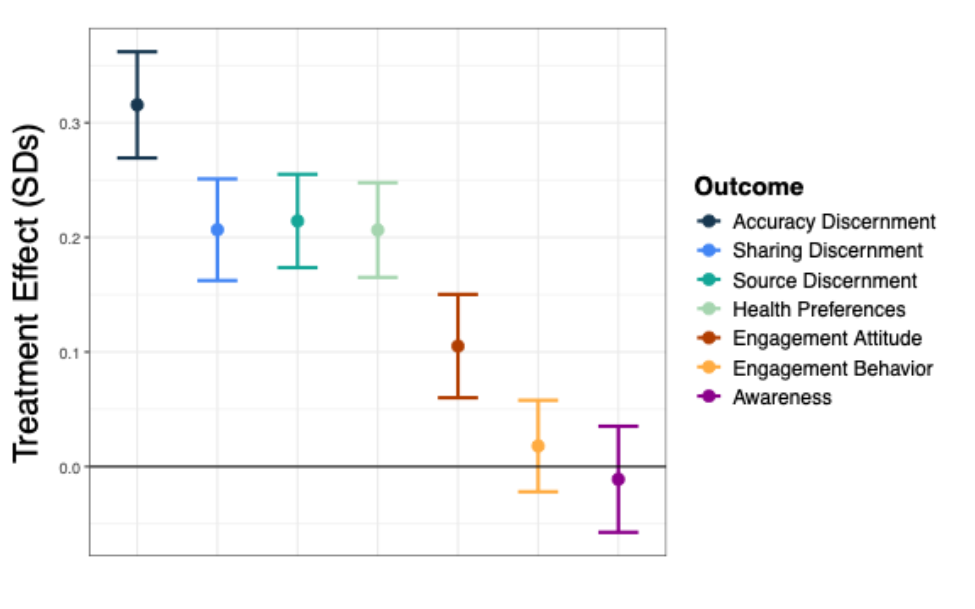
Figure 1 presents the effect of enrolment in the Media and Information Literacy class on these indices. Overall, the intervention was highly effective. The largest treatment effects are in accuracy discernment: students in treatment villages are around one-third of a standard deviation better able to tell true from false health news than students in control villages. The initiative also improves sharing discernment (0.2 SDs): treated students are equally likely to state that they should pass on true news and much less likely to state that they would share false stories. We find effects of similar magnitude on source discernment and health preferences. We see smaller but still positive effects on engagement attitudes (for instance, reporting that checking information before sharing is important), while changes in engagement behaviour were modest.
Figure 1: Treatment effects on key indices (standard deviations)
Did the effects last, and do they extend to non-health outcomes?
Four months after classes ended, the treatment effects remained robust. In the second endline, treated students continued to outperform control students by roughly one quarter of a standard deviation on the overall discernment index.
Crucially, the skills transferred beyond health. The follow-up survey included political news stories – none of which appeared in class and many of which invoked political or identity divisions. Even so, treated students were one-third of a standard deviation better at identifying true versus false political news. This suggests students internalised generalisable evaluative skills rather than a narrow set of facts.
Spillovers to parents
In the four-month follow-up, we also surveyed one guardian for each student in the subsample. Even though these individuals were never treated directly, we find that parents of the Bihar Information and Media Literacy Initiative students performed noticeably better on the same true-false news batteries (health-specific and political) than parents of control teenagers. In other words, the programme seems to generate ‘trickle-up’ socialisation: children learn to question dubious claims and indirectly improve parents’ ability to navigate a challenging information environment.
Policy implications for education
Two lessons stand out for policymakers considering classroom-based media literacy:
- The intervention worked in a setting with low literacy, limited digital access, and deeply rooted identity-based misinformation. That the initiative generated large and persistent effects under these constraints underscores the power of repeated, interactive, offline instruction delivered by trusted local institutions.
- The acquired skills are transferable. Students did not merely memorise health facts; they learned how to evaluate information more broadly, applying those skills even to political news that was never discussed in class. This kind of transfer is critical for policy relevance: governments need programmes that prepare students for a wide array of evolving misinformation threats.
References
Amar, P, S Badrinathan, S Chauchard, and F Sichart (2025), “Countering misinformation early: Evidence from a classroom-based field experiment in India,” American Political Science Review: 1–21.
Blair, R A, J Gottlieb, B Nyhan, L Paler, P Argote, and C J Stainfield (2024), “Interventions to counter misinformation: Lessons from the Global North and applications to the Global South,” Current Opinion in Psychology, 55: 101732.
Brass, P R (2011), The production of Hindu–Muslim violence in contemporary India, University of Washington Press.
Cesi Cruz, H, H Larreguy, and E Tiburcio (2025), “Political polarisation,” VoxDevLit, 19(1).
Chauchard, S, and S Badrinathan (2025), “The religious roots of belief in misinformation: Experimental evidence from India,” British Journal of Political Science, 55: e109.
Guess, A M, M Lerner, B Lyons, J M Montgomery, B Nyhan, J Reifler, and N Sircar (2020), “A digital media literacy intervention increases discernment between mainstream and false news in the United States and India,” Proceedings of the National Academy of Sciences, 117: 15536–15545.
Nyhan, B (2021), “Why the backfire effect does not explain the durability of political misperceptions,” Proceedings of the National Academy of Sciences, 118: e1912440117.
Pennycook, G, T D Cannon, and D G Rand (2018), “Prior exposure increases perceived accuracy of fake news,” Journal of Experimental Psychology: General, 147: 1865.
Roozenbeek, J, S van der Linden, B Goldberg, S Rathje, and S Lewandowsky (2022), “Psychological inoculation improves resilience against misinformation on social media,” Science Advances, 8: eabo6254.
Siddiqui, N (2020), “Who do you believe? Political parties and conspiracy theories in Pakistan,” Party Politics, 26: 107–119.