




Using surnames, we show that colonial-era hierarchies continue to shape access to Colombia’s best schools and elite social networks, limiting intergenerational mobility through both education and marriage.
Education is widely seen as one of the most powerful tools for expanding opportunity. But that promise depends on a condition that many countries struggle to meet: broad access to high-quality schooling. In many unequal societies, rich and poor alike, school quality is stratified: affluent families concentrate in better-performing institutions, while disadvantaged students are disproportionately enrolled in lower-performing schools. When this happens, education does not just reflect existing inequality; it can actively reproduce it, weakening intergenerational mobility and hardening social divides.
In recent years, evidence from multiple contexts has highlighted a common pattern: expanding enrolment is not sufficient if learning outcomes remain unequal (Abebe et al. 2026). The policy challenge is therefore not simply ‘more schooling’, but who gets access to the schools that produce strong learning and open doors to higher education and good jobs (Estrada et al. 2025).
Historical social structures have persistent effects
In Jaramillo-Echeverri and Álvarez (2025), we examine whether elite and ethnic ancestries predict access to high-quality education in Colombia. Preliminary evidence indicates that the rigid social hierarchy established during the Spanish colonial era persists in modern Colombia, where Indigenous and Afro-descendant populations occupy the lowest rungs on the socioeconomic ladder and experience the worst economic and political outcomes. Empirical research has shown that the colonial regime set up the types of institutions whose impacts we would expect to be persistent, and that extractive institutions such as the encomienda and slavery had long-term negative effects at the national and subnational levels (Baldomero-Quintana et al. 2025, Björkman-Nyqvist et al. 2024).
How can surnames be used as longitudinal data?
Given the lack of reliable longitudinal data, it has been challenging to demonstrate whether contemporary disparities in education access are linked to these historical social structures. However, using rare surnames is a very productive way to circumvent the problem of scarce longitudinal data (Dupraz and Simson 2024, Santavirta and Stuhler 2024).
Our analysis uses rare surnames to follow multiple generations and leverages the availability of rich contemporary administrative datasets, such as the universe of students enrolled in schools from 1996 to 2016 and historical information from various sources to associate surnames with ethnic minorities, early and late colonial elites, and republican elites.
Students’ surnames offer us a way to infer their ancestry, as family names are passed down through generations and often reflect the socioeconomic position of a familial dynasty. However, not all surnames provide an accurate link to ancestry. Rare surnames, in particular, are more likely to represent distinct familial lineages, making them a valuable tool for studying intergenerational patterns. Focusing on rare surnames improves the accuracy and reliability of the analysis, as these names are less likely to be confounded by unrelated individuals sharing the same surname.
Ancestry predicts access to the best – and the worst – schools
To understand whether historical ancestry still shapes access to education today, we ask whether students from different ancestral backgrounds are systematically sorted into better or worse schools, and whether this sorting is especially strong at the top or bottom of the education system. This allows us to see whether historical status primarily limits access to elite institutions, increases exposure to low-quality schools, or both.
Figure 1 summarises the central result. Students with surnames associated with ethnic minorities are consistently enrolled in substantially lower-ranked schools than students with rare surnames that are not linked to any historical or ethnic group. In contrast, students with surnames tied to historical elites are systematically overrepresented in higher-quality schools. These patterns are not subtle: ancestry is strongly associated with where students end up in the national school quality ranking. Importantly, not all elite groups benefit equally. While early and late colonial elites attend better schools on average, the advantage is particularly pronounced for the republican elite. This suggests that the persistence of educational advantage is not merely a colonial legacy, but one that was reshaped and, in some cases, reinforced during the republican period.
The gap between the historical extremes, ethnic minorities and persistent elites is especially striking. In the middle of the school quality distribution, students with ethnic minority surnames attend schools ranked roughly 360 places lower than the reference group, while students with elite surnames attend schools ranked about 305 places higher. Taken together, this implies a gap of approximately 650 positions in the national school ranking between these two groups. Given that each decile of the school quality distribution contains roughly one thousand schools, this difference amounts to systematic sorting into entirely different tiers of the education system.
Figure 1: Historical ancestry and access to school quality today
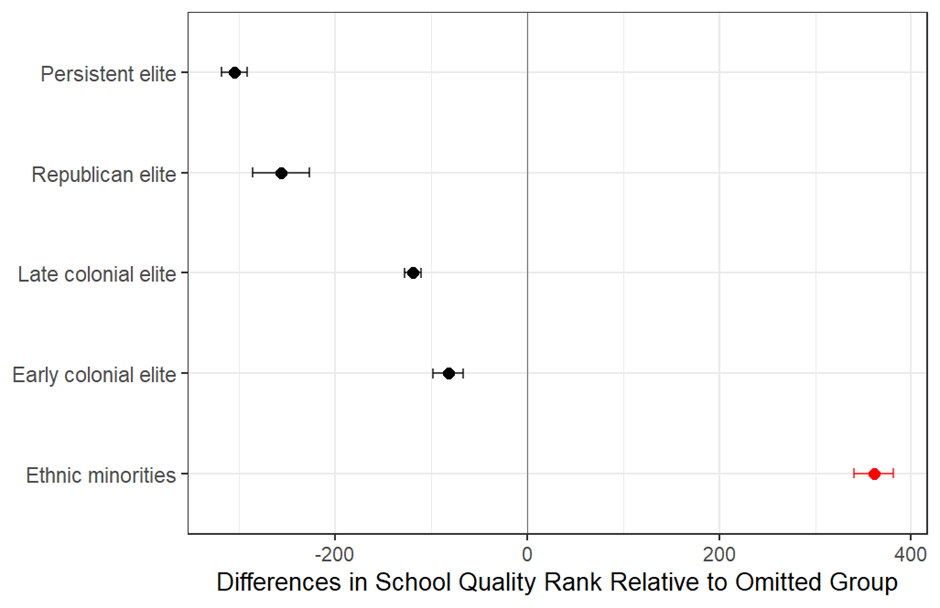
Notes: The figure shows differences in average school quality rank by historical ancestry group, relative to students with rare surnames not associated with any historical or ethnic group (the omitted category). Positive values indicate attendance at lower-ranked schools, while negative values indicate attendance at higher-ranked schools. Points represent estimated differences in national school rankings, and horizontal lines indicate 95% confidence intervals.
School quality gaps matter for skills and credentials, but they can also affect mobility through a second channel: social interactions. The educational system shapes peer groups, as well as networks that matter for later opportunities. When access to high-quality education is uneven across social groups, these patterns can extend beyond schooling and influence outcomes in other domains. We explore this channel by studying marriage-market patterns.
We exploit the official rule, inherited from Spanish naming customs, that children be registered with both their paternal and maternal surnames, to provide a new picture of the marriage market in Colombia. We show that assortative marriage, which refers to the tendency of individuals to choose partners from their same social group even when other options are available, reflects disparities in opportunities to access education across historical groups. Given that enrolment in schools differs between elites and historically marginalised groups, the possibility of encounters between those groups is reduced.
Figure 2 illustrates how marriage patterns differ sharply depending on the type of school individuals attended. Each panel shows the frequency with which paternal and maternal surnames from different historical groups are paired, separately for high-quality private schools and low-quality public schools. Darker cells indicate more frequent matches between two groups.
Two contrasts stand out immediately. In low-quality public schools (left panel), marriages across historical groups are relatively common. Afro-Colombian surnames, in particular, frequently appear paired with surnames from other groups, including elite lineages. This suggests that these schools bring together students from more diverse backgrounds, increasing opportunities for interaction and partnership across historical lines. Indigenous surnames, however, remain an exception: they are overwhelmingly paired with other Indigenous surnames, indicating limited mixing even in these settings.
Patterns look very different in high-quality private schools (right panel). Here, marriages are much more concentrated within historical elite groups. Surnames associated with persistent, republican, and colonial elites are strongly matched with one another, while pairings with ethnic minority surnames are rare. Indigenous and Afro-Colombian surnames are largely absent from these marriage networks, reflecting their limited presence in these institutions to begin with. The implication is that unequal access to high-quality schooling may create a ‘double persistence’ mechanism. It not only affects educational outcomes; it also influences the social networks that shape family formation and, ultimately, the transmission of advantage across generations.
Figure 2: Marriage patterns by historical ancestry and school type
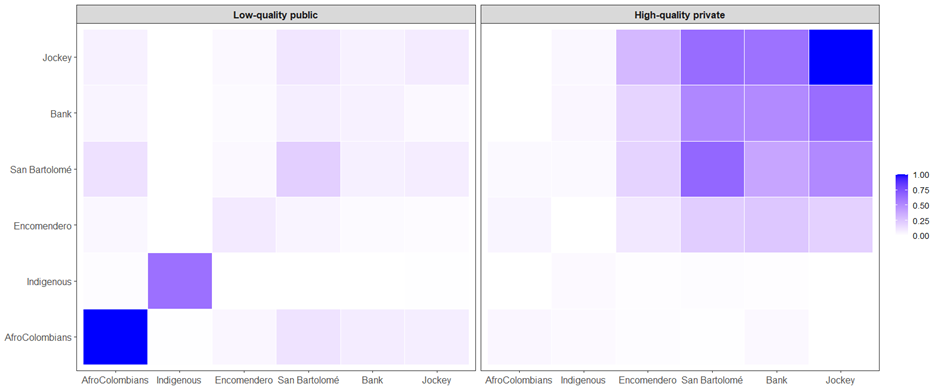
Notes: The figure shows the relative frequency of marriages between paternal and maternal surnames from different historical groups, separately for high-quality private schools and low-quality public schools. Darker colours indicate more frequent matches.
Policy implications for intergenerational mobility
Our results show that educational disparities in Colombia remain closely linked to the historical origins of surnames, with roots extending back to the colonial period. At the same time, existing evidence indicates that programmes expanding access to elite universities for students from disadvantaged backgrounds have generated substantial upward mobility among their beneficiaries (Laajaj et al. 2022, Machado et al. 2025).
Mobility will not improve simply by expanding enrolment or raising average test scores. What matters is whether disadvantaged students can access high-quality learning environments. This requires sustained investment in public school quality, deliberate efforts to improve access to top schools, and early interventions that prevent learning gaps from compounding long before students reach high-stakes exams.
Our findings suggest that policies that lower barriers to high-quality education can weaken long-standing patterns of social persistence. They also highlight the need for further research to identify which groups remain excluded and how access-expanding programmes can be more effectively targeted.
A further implication concerns social mixing early in the education pipeline. When students from different backgrounds are separated into distinct school environments, inequalities in learning are compounded by unequal peer groups and unequal networks. Policies that promote social mixture in early grades – for instance, through catchment design, transport support, and inclusive access to high-quality early schools – can help weaken the ‘mobility traps’ created when educational and social segregation reinforce each other.
References
Abebe, G, M Fafchamps, M Koelle, S Quinn, and R Schwantje (2026), “Management style under the spotlight: Evidence from studio recordings,” Unpublished manuscript.
Baldomero-Quintana, L, L G Woo-Mora, and E De la Rosa-Ramos (2025), “Infrastructures of race? Colonial indigenous segregation and contemporary land values,” Regional Science and Urban Economics, 110: 104065.
Björkman-Nyqvist, M, M Callen, S Caria, C Cruz, P Davila, and O Hanney (2024), “How Daron Acemoglu, Simon Johnson and James Robinson have contributed to development economics,” VoxDev.
Dupraz, Y, and R Simson (2024), “Elite persistence in Sierra Leone: What can names tell us?” Journal of Development Economics, 171: 103333.
Estrada, R, J Gignoux, and A Hatrick (2025), “Learning about opportunity: Spillovers of elite school admissions in Peru,” Economic Journal, 135(671): 2220–2241.
Jaramillo-Echeverri, J, and A Álvarez (2025), “Does ancestry shape access to education? Evidence from surnames in Colombia,” Journal of Development Economics, 103626.
Laajaj, R, A Moya, and F Sánchez (2022), “Equality of opportunity and human capital accumulation: Motivational effect of a nationwide scholarship in Colombia,” Journal of Development Economics, 154: 102754.
Machado, C, G Reyes, and E Riehl (2025), “The direct and spillover effects of large-scale affirmative action at an elite Brazilian university,” Journal of Labor Economics, 43(2): 391–431.
Santavirta, T, and J Stuhler (2024), “Name-based estimators of intergenerational mobility,” Economic Journal, 134(663): 2982–3016.