


A large-scale experiment in Gujarat shows that emissions trading markets can dramatically reduce air pollution, improve compliance, and lower costs in developing countries – proving that market-based environmental regulation can work effectively where pollution is most severe.
Editor's note: This episode of VoxDevTalks is available on Spotify and Apple Podcasts.
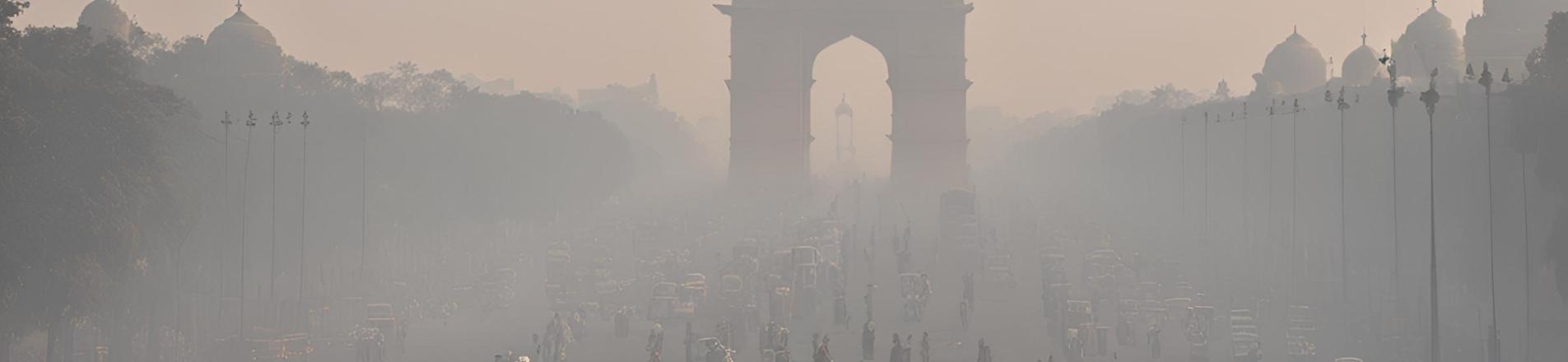
If you have ever woken up in a major city in the developing world and looked out of the window to find the skyline swallowed by haze, you have seen one of the defining public health challenges of our time. In parts of India, that haze is not an occasional disruption but a persistent reality.
Air pollution from particulate matter is not just unsightly; it is deadly. Globally, the average person loses around two years of life expectancy due to long-term exposure. Yet because pollution damages health gradually, and because it is closely tied to economic activity, it is often tolerated as an unfortunate by-product of growth.
Governments have not ignored the problem. Most rely on traditional “command-and-control” regulation: setting standards, requiring factories to install specific abatement equipment, and threatening penalties for non-compliance. But in rapidly growing economies, enforcement can be politically and practically difficult. The result is often widespread non-compliance, high costs for firms, and limited improvements in air quality.
This raises a fundamental policy question: is there a better way to regulate pollution – one that protects public health without undermining economic growth?
In high-income countries, economists have long argued that market-based instruments, such as emissions trading systems, can reduce pollution more efficiently than rigid regulation. But until recently, these “pollution markets” had rarely been tried in the places where pollution is now most severe. In this episode of VoxDevTalks, Michael Greenstone discusses a groundbreaking experiment in Gujarat, India, that tested whether emissions trading could work in a developing country context – and what happened when it did.
Why traditional regulation has struggled
Given the scale and visibility of the problem, why has it been so difficult to tackle? Part of the answer lies in how environmental law is framed and enforced.
In the US, the Clean Air Act is explicitly designed “to protect the public health”. That phrase may sound technical, but it embeds the idea that cleaner air brings tangible human benefits, which can be weighed against economic costs. Greenstone argues that this framing is largely absent from Indian legislation. Pollution control is often treated as a technical or engineering challenge – and an expensive one – rather than a public health imperative.
The dominant approach in many countries has been “command-and-control” regulation: governments set standards and require firms to install specific pollution control equipment. As Greenstone puts it, regulation in rich countries in the 1970s and 1980s often boiled down to whether equipment had been installed, not whether emissions had actually fallen.
In emerging economies, enforcement is further complicated. Regulators often have limited tools: they can issue warnings, or in extreme cases shut down a plant entirely. But closing factories in rapidly growing economies carries high economic and political costs. The result is what Greenstone describes as a “very clunky system”, leading to “widespread noncompliance”.
Even where expensive abatement equipment is purchased, it may not be used. Inspectors can verify that a device is present; it is much harder to ensure it is switched on and functioning properly.
Can pollution markets work in developing countries?
Economists have long argued that markets can reduce pollution more efficiently than rigid regulation. The classic example is the US sulphur dioxide trading scheme of the 1990s, which sharply reduced acid rain at far lower cost than anticipated. Similar emissions trading systems now operate in the UK and across the EU.
The logic is simple: rather than dictating how each firm must reduce pollution, government sets an overall cap. Firms receive or buy permits allowing them to emit a certain amount. Those that can cut emissions cheaply do so and sell surplus permits; those facing higher costs can buy permits instead. What matters is total emissions, not how reductions are achieved.
These systems have worked well in high-income countries. But until recently, they had barely been tested in the places where pollution is now most severe. “This super awesome tool called markets had not been applied in them”, Greenstone notes. “It was only being applied in our relatively pristine places”.
When Greenstone and his colleagues began proposing pollution markets in India, they encountered scepticism. There was a sense that such schemes were “not for us” or would not work in that context. That scepticism led to a bold experiment.
The Gujarat experiment: A randomised trial of emissions trading
Working with the Gujarat Pollution Control Board, Greenstone and co-authors designed a randomised controlled trial in the city of Surat.
Around 300 coal-burning textile plants were identified. Using a random number generator, 150 were placed into a new emissions trading market, while 150 continued under the existing regulatory system. The trial ran for five years, covering around ten compliance periods.
The results were striking. Under the status quo, non-compliance with emissions limits was widespread. Under the market, compliance became “basically perfect”. Overall pollution fell by 20–25% among participating plants. Even more remarkably, the cost of complying with the law fell by around 12% for firms in the market.
In Greenstone’s words, “It was a win, win, win”. A cost–benefit analysis suggested that the public health benefits dwarfed the administrative and compliance costs, by roughly 100 to 200 times. As he notes, economists often celebrate benefit–cost ratios of 1.3 to 1. Here, the ratio was orders of magnitude higher, reflecting the enormous health burden of particulate pollution.
Importantly, the success was not merely statistical. Firms in the control group reportedly asked to be moved into the market, preferring its flexibility to the rigidity of traditional regulation.
Monitoring, enforcement, and making markets credible
A crucial ingredient of the scheme was high-quality monitoring. “There’s no market without monitoring”, Greenstone emphasises. Continuous emissions monitoring systems were installed, allowing regulators to observe pollution levels in real time.
The credibility of enforcement was tested early on. In the first compliance period, two large and well-connected firms failed to hold enough permits to cover their emissions. The rules specified substantial penalties – around ten times the permit price.
This episode underlines a broader lesson: markets require clear rules and consistent enforcement. Without them, trust and compliance evaporate.
Scaling up emissions trading in India and beyond
The Gujarat results did not remain confined to a single pilot. Encouraged by the evidence, the state expanded the scheme to include the original control plants, effectively doubling the market in Surat. A second market was launched in Ahmedabad.
Interest has since spread. Discussions are under way to introduce emissions markets in other Indian states, including Maharashtra and Rajasthan, and even to explore applications to water pollution. There are advanced conversations in Pakistan and Brazil.
To support this expansion, Greenstone and colleagues have established the Emissions Market Accelerator, an organisation dedicated to scaling up market-based environmental policy. The goal is to move beyond isolated academic pilots and embed emissions trading in real-world regulatory systems.
For Greenstone, the most important takeaway is not just the percentage reduction in pollution or the impressive cost–benefit ratio. It is the proof of concept.
“Markets can work in places where they hadn’t been used before, but happened to be where all the pollution is.”