


How can simple changes to transport policy improve the efficiency and quality of informal transit networks in developing countries?
Editor's note: You can find other podcasts recorded at STEG Annual Conferences on the STEG website: STEG Podcasts. This episode of VoxDevTalks is also available on Spotify, Apple Podcasts, and YouTube.
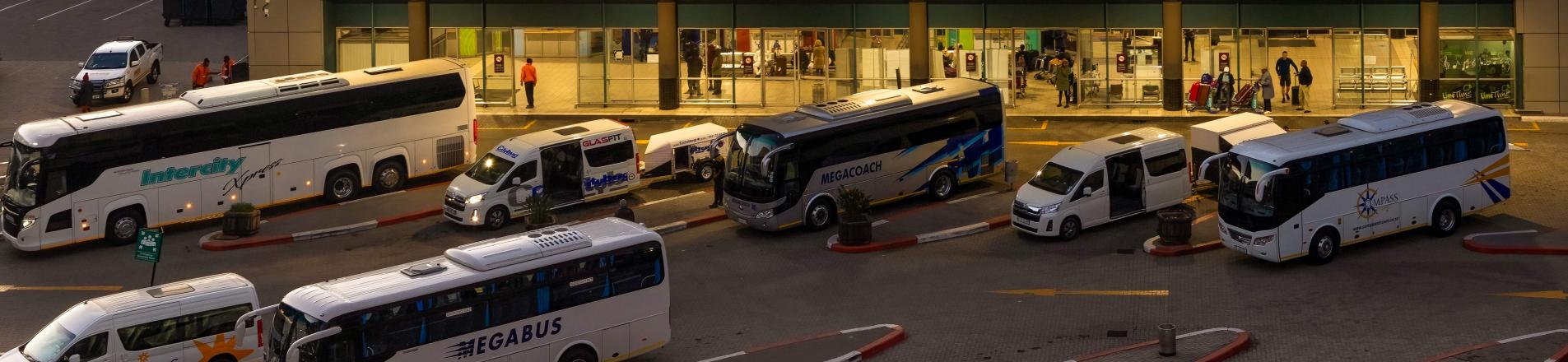
In this episode of VoxDevTalks, recorded at the fifth annual Structural Transformation and Economic Growth (STEG) conference, Lucas Conwell discusses his research on informal minibus transport systems in developing countries, with a focus on Cape Town, South Africa. Minibuses play a critical role in urban transport in many LMICs, but their structure and efficiency present unique challenges and opportunities.
“You have really this almost miraculous network of minibus or other informal transport routes, connecting not only the city centre to outlying suburbs, but often suburbs and townships and informal settlements directly with each other.”
Despite the seemingly chaotic nature of these systems, they are surprisingly well-organised and essential for urban mobility in places where government-run public transport is minimal or absent.
The informal structure of minibus networks
Minibus transport systems are typically operated by associations or collectives of vehicle owners. Each route is controlled by a specific association that manages the supply of minibuses, regulates operations, and organises pick-up points known as taxi ranks.
Conwell highlights that although these are referred to as informal systems, they are far from being unregulated free-for-alls.
“Even though it's sometimes called informal transport, that doesn't necessarily mean that it's really every driver for themselves.”
The operation is based on the ‘fill and go’ model, where minibuses depart only when full. This system can lead to long waiting times, particularly on less popular routes. As Conwell notes, “a problem people often have is that the buses only leave when they're full”, leading to frustrations for passengers who may spend considerable time waiting either in queues or on stationary buses.
Why informal minibuses dominate urban transport
Minibus systems have emerged as a practical solution in cities with sprawling, low-density urban layouts and limited public funds. According to Conwell, this model thrives in areas where “city and national governments have low fiscal or state capacity, where they would struggle to raise the funds to invest in every infrastructure.”
He explains that these small, flexible transport options are well-suited to cities where transit demand is dispersed across large areas and where building formal infrastructure like metro systems or bus rapid transit would not be financially feasible.
Furthermore, minibuses often form a crucial part of urban life for lower-income commuters who cannot afford private vehicles.
“Any policy that improves this privatised transit is going to be a very pro-poor policy, one that makes the cities work better for, say, newly arrived migrants from rural areas.”
Key challenges of public transport: Efficiency, quality, and safety
Despite their essential role, minibus transport systems face several significant drawbacks. Conwell summarises the most common passenger complaints, including:
- Long waiting times due to the ‘fill and go’ system.
- Overcrowding, with minibuses frequently carrying “twice as many people as seats.”
- Concerns about crime, especially at busy taxi ranks.
- Poor driving standards that raise safety concerns.
These issues not only affect passenger comfort but also deter wider usage. Moreover, the system’s structure creates inefficiencies. Conwell finds that “there are actually too few buses on almost every route”, primarily because the minibus associations, granted exclusive rights to routes, function like monopolies and limit supply to maximise their own profits.
How data collection and modelling can improve public transport
To understand system dynamics and identify potential improvements, Conwell and his team gathered extensive field data in Cape Town using a hands-on, low-tech approach. They employed a group of enumerators to track passenger flows and minibus frequency by hand at various stations.
To capture commuter preferences, they used a stated preference survey technique. This method involved presenting passengers with hypothetical transport scenarios to assess their willingness to trade off factors such as waiting time, cost, and safety. This allowed Conwell to quantify, for example, how much commuters would value the presence of security guards at minibus stations.
His model incorporated both the supply decisions of minibus associations and the queuing dynamics faced by passengers, providing a more realistic picture of how the system responds to policy interventions.
Transport policy recommendations: Small tweaks, big gains
Conwell’s research suggests that rather than overhauling minibus systems, modest adjustments can significantly improve their efficiency and appeal. He proposes a policy in which cities retain the existing route allocation but set regulated fares and subsidise additional minibus services to reduce waiting times.
“You would have the city telling the minibus association exactly which prices they can charge, and those prices will be chosen in such a way that they would induce just the right amount of demand to optimise wait times.”
Additionally, Conwell advocates for the introduction of security personnel at minibus stations to address widespread concerns about crime, noting that the stated preference surveys reveal a strong willingness to pay for improved safety.
Importantly, these policies require relatively low investment compared to the billions typically needed for new infrastructure projects.
“When you take the benefit net of cost, then that ends up looking quite similar to this around the edge, if you will, optimisation of the minibus system.”
Broader relevance: Urban transport planning
Conwell’s findings hold relevance for many cities across sub-Saharan Africa and Latin America, where similar minibus systems are prevalent. While each city has its own unique characteristics, the general structure and challenges of these informal transport networks are remarkably consistent.
“Although the specific parameters, the specific complaints or frictions, if you will, to efficient commuting in different cities are going to, of course, be context specific, the overall contours of this minibus network, this informal transit system, are actually quite general.”
He encourages policymakers to recognise the value of improving existing systems rather than focusing exclusively on costly large-scale transit projects. Cities like Dakar, Senegal have successfully piloted the types of formalisation programmes Conwell recommends, offering a model for others to follow.
“I wouldn't advocate that cities should not build any heavy transit infrastructure, but rather that it's certainly they should start by optimising the transit they have.”