



Male internal migration in India expands women’s roles and increases their political engagement by easing day-to-day restrictions even in the absence of their financial empowerment.
Internal migration is a significant yet understudied demographic phenomenon
While international immigration most often makes newspaper headlines, it is internal migration (i.e. within-country migration) that occurs at a much larger scale. According to UNDP (2009), internal migrants constitute 10% of the global population (Bhavnani and Lacina 2015). Most internal migrants move for employment; this remains especially true in many parts of South Asia, including India.
Every year, over a 100 million migrants in India migrate temporarily for employment and spend several months away from home working in other parts of the country. Remittance data also reveals the substantial scale and spread of out-migration, with estimates suggesting that 60% of the annual US$10 billion in remittances comes from intra-state transfers (Tumbe 2011). However, given the difficult living conditions in migrant receiving regions, migrants travel alone and leave behind their wives and families. An often-missed consequence of male migration is its impact on the millions of women who live for extended periods without their spouses.
Figure 1: District-wise share of household receiving remittances

Note: Author's own calculation. Source: NSSO (2007-08), which is the last time an official national level survey on migration was conducted in India.
Male migration as the absence of women’s primary gatekeepers
Male migration creates the routine yet temporary absence of men in women’s lives. While the study of the politics of internal migration has focused on migrants themselves, we know little about how this form of male absence can shape women’s political engagement (Bhavnani and Lacina 2015, Thachil 2017). In highly patriarchal contexts like India, this implies that women spend multiple months without their husbands or primary gatekeepers. This absence can bring about significant shifts in household dynamics and create pathways for women’s political engagement, ranging from interactions with state actors to access welfare services to gaining knowledge and experience in making entitlement claims.
We know from prior research on long-term male absence due to genocide or war in other contexts that the absence of men transformed politics in these regions (e.g. post-conflict Africa, Khmer Rouge in Cambodia) as women became more active and occupied positions of power (Gaikwad et al. 2023, Hughes and Tripp 2015, Tripp 2015).
Although internal migration only creates a temporary absence of men, it can have important consequences for women’s political lives within a context that is marked by significant gender gaps in political engagement and low female labour force participation (Afridi et al. 2018, Jayachandran 2015, Prillaman 2023).
Examining female political engagement in migrant sending regions
In Kumar (2025), I use data from a face-to-face survey experiment with 642 women in Bihar, India (circled on Figure 1), a prominent state in the north-eastern high migration corridor in the country, to explore gender dynamics within the household and restrictions on women’s political engagement. I supplement this analysis with an original survey of 1,900 women in the same context to compare the different political engagement repertoires women undertake in migrant and non-migrant households.
Absence of migrant husbands eases restrictions on women’s lives
The survey experiment presented respondents with a vignette about the household structure of a hypothetical woman in their neighbourhood. The vignette randomly varied the presence of the woman’s husband and her in-laws, in addition to varying the age of her son (8 or 16 years). It was followed by a statement about a contextually sensitive political activity related to engaging with the state. The experiment also randomly presented one of four political activities in each vignette. Once the vignette was read to the respondent, she was asked to rank each family member (husband, in-laws, the woman herself, possibly her son) based on the likelihood of them being engaged in the randomised political activity. The set up was as follows:
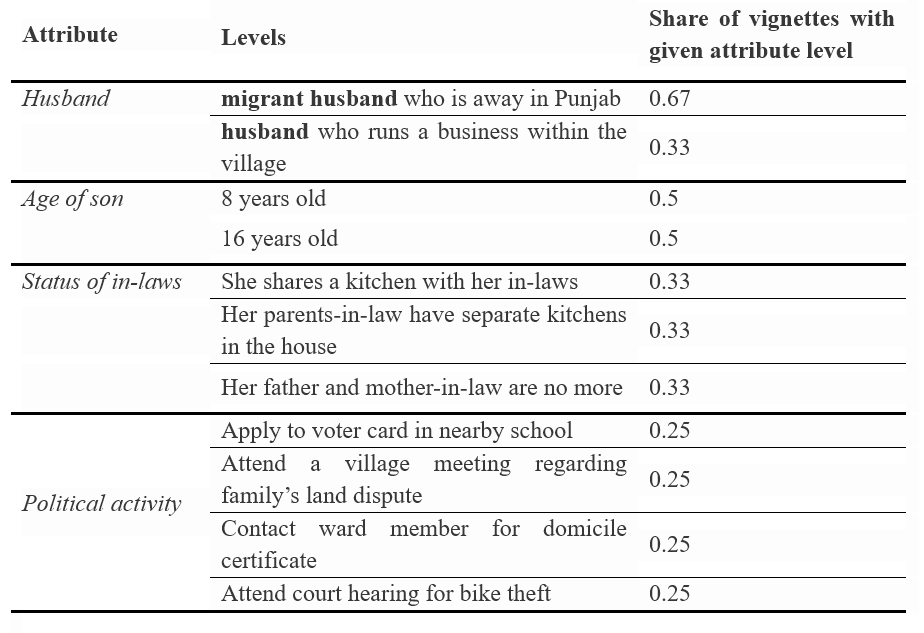
By randomising who was present in this hypothetical household, we can estimate how the presence (or absence) of gatekeepers can shape people’s perceptions of women’s political engagement. In Figure 2, I present the likelihood of the woman being picked to engage with the state. The results are split by whether the husband was ‘present’ in that hypothetical scenario.
Figure 2: Likelihood of woman being ranked number one to participate in each political engagement activity
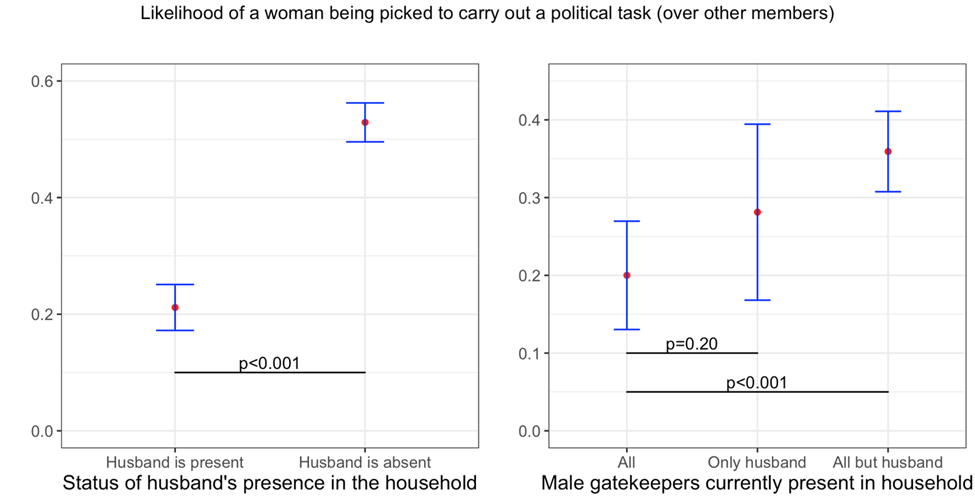
Note: All: teenage son, in-laws, husband; Only husband: young 7-year-old son at home and in-laws are dead and All but husband: teenage son and in-laws present.
The presence of a woman’s husband is restrictive irrespective of whether her in-laws are present or absent. In the left panel, women are identified as only 20% likely to engage in each political engagement activity in their husband’s presence. However, in her husband’s absence (i.e. when he migrates), this likelihood increases to 55%. These results are striking and reveal how male migration, by making men absent in a woman’s life, eases norm-based restrictions to their public facing roles. These results continue to hold even after we split it up by other household structures. While the absence of other family members, with the husband present, can ease some restrictions and increase the likelihood of the woman being ranked number one to 28%, the increase is not statistically significant. However, in the scenario that the husband is absent while other members are present, the likelihood increases to 35% and this difference (from the most restrictive scenario when all are present) is statistically significant.[1]
Engagement is gendered
Next, using my cross-sectional survey, I provide a rich descriptive account of how women’s presence in otherwise male dominated arenas is leading to the feminisation of everyday engagement with the state.
Figure 3: Feminisation of political engagement
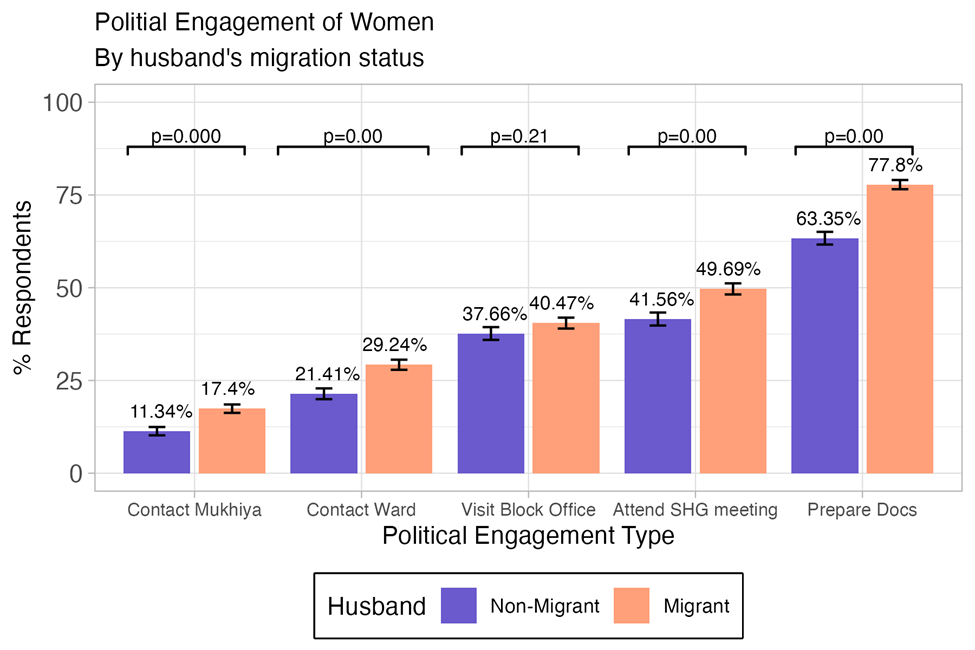
This account is important in a context like India with a large welfare state, specifically in economically poorer regions from where migrants originate. Access to these services permeates every aspect of an individual’s life, including food, shelter, and employment. Given the inefficiencies within the functioning of the state and bureaucracy, routine engagement to make claims on welfare benefits (Kruks-Wisner 2018) has defined lives in rural areas. Consequently, the most significant shift in politics due to male migration is the visible presence of women in these arenas as they serve as the primary interlocutors for their families. While seemingly innocuous and routine, these negotiations form the basis of citizenship and access to entitlements in these regions.
Based on the survey, women in migrant households exhibit higher levels of engagement with the state across a range of contextually sensitive measures of claim-making and other civic engagement. Though one could argue that households with migrants are more likely to need benefits and therefore more likely to contact their representative or prepare documents than non-migrant households. Importantly, these differences hold for more sustained forms of participation like attending women’s self-help groups. When triangulated with results from the survey experiment and other observational data, these results point to the shifting contours of local engagement in high migration regions.
These results must be seen in combination with the broader finding that feminisation of political engagement on account of male migration occurs even in the absence of their economic empowerment. Due to the paucity of jobs in migrant sending areas, women have fewer employment options to start from. While women partake in managing agriculture, this is often limited to their own farms, and I find minimal shifts to working in agricultural labour. However, male migration creates conditions that are like what women experience when they participate in the labour force.
Towards a gender inclusive state
By highlighting the shifting contours of political engagement, the results presented here provide insights for policymakers to make bureaucratic process and spaces accessible to women. For example, processes can be explained to cater to a low literacy population. Or bureaucrats can be given gender sensitivity training to deal with women and increase female street level bureaucrats and data operators dealing with government procedures. Additionally, these results highlight that while improving women’s financial empowerment is critical to gender equality, simultaneously tackling gender biased norms either at the state, school, or societal level can shape women’s political engagement and consequently shape governance.
References
Afridi, F, T Dinkelman, and K Mahajan (2018), “Why are fewer married women joining the workforce in rural India? A decomposition analysis over two decades,” Journal of Population Economics 31(3): 783–818.
Bhavnani, R R, and B Lacina (2015), “The effects of weather-induced migration on sons of the soil riots in India,” World Politics 67(4): 760–794.
Bhavnani, R R, and B Lacina (2019), “Nativism and economic integration across the developing world: Collision and accommodation,” Cambridge University Press.
Gaikwad, N, E Lin, and N Zucker (2023), “Gender after genocide: How violence shapes long-term political representation,” World Politics 75(3): 439–481.
Hughes, M M, and A M Tripp (2015), “Civil war and trajectories of change in women’s political representation in Africa, 1985–2010,” Social Forces 93(4): 1513–1540.
Jayachandran, S (2015), “The roots of gender inequality in developing countries,” Annual Review of Economics 7(1): 63–88.
Kruks-Wisner, G (2018), “The pursuit of social welfare: Citizen claim-making in rural India,” World Politics 70(1): 122–163.
Kumar, R (2025), “Left behind or left ahead? Male migration and female political engagement in India,” Journal of Politics, forthcoming.
National Sample Survey of India (NSSO) (2008), “Employment, unemployment and migration survey [Dataset],” Ministry of Statistics and Programme Implementation (MOSPI), Government of India.
Prillaman, S A (2023), “Strength in numbers: How women’s groups close India’s political gender gap,” American Journal of Political Science 67(2): 390–410.
Thachil, T (2017), “Do rural migrants divide ethnically in the city? Evidence from an ethnographic experiment in India,” American Journal of Political Science 61(4): 908–926.
Tripp, A M (2015), “Women and power in post-conflict Africa,” Cambridge University Press.
Tumbe, C (2011), “Remittances in India: Facts and issues,” IIM Bangalore Research Paper (331).
UNDP (2009), “Human Development Report 2009: Overcoming barriers – Human mobility and development,” New York.