



International sanctions are used as a powerful tool of statecraft, but their broader societal consequences are often overlooked. Since 2012, comprehensive sanctions on Iran have drastically eroded its middle class, undoing decades of social progress and undermining a key engine of economic stability and political moderation.
Editor's note: The authors have made slides available to accompany this research here.
The idea that a booming middle class is the basis of a stable and prosperous society has ancient roots. Over two millennia ago, Aristotle observed:
“Thus it is manifest that the best political community is formed by citizens of the middle class, and that those states are likely to be well-administered, in which the middle class is large . . . where the middle class is large, there are least likely to be factions and dissension.” Aristotle 306 BC, quoted in Easterly (2001)
This ancient wisdom remains a cornerstone of modern development economics. A robust middle class is broadly seen to support entrepreneurship, increase consumption, demand good governance, and act as a crucial buffer between the rich and the poor (Banerjee and Duflo 2008, Feng 2003). Its health is linked to achieving several of the UN’s Sustainable Development Goals (SDGs), from reducing poverty and inequality (SDGs 1 and 10) to promoting decent work and economic growth (SDG 8).
Against this backdrop, our recent research (Farzanegan and Habibi 2025) examines the profound impact of one of the most significant economic pressures applied by the US, EU, UN, and other parties: the international sanctions on Iran. Until the Russian war against Ukraine, Iran was the most sanctioned country in the world (Farzanegan and Batmanghelidj 2023). We thus sought to answer a critical question: how did the severe sanctions imposed after 2012, such as the financial sanctions on Iran’s commercial banks, the Central Bank of Iran as well as sanctions on Iran’s energy exports, targeting Iran's nuclear programme (Obama White House 2012, EIA 2013), affect the size of its middle class?
Consider a teacher in Tehran. Her salary, fixed in Iranian Rials, may have provided a comfortable life in 2010 (given a 10% inflation rate). She could afford to pay rent, own a car, and maybe even pay for private tutoring for her children. By 2019, after the currency had collapsed and inflation had soared to 40% (WDI 2025), that salary would barely cover rent. Her family had to sell their car, move to a smaller apartment in a less desirable neighbourhood, and cut back on essentials like meat and fresh fruit. She was still a teacher, but her economic status had been forcibly downgraded from middle class to working poor (Agence France-Presse 2022, Iran International 2023).
Or consider an entrepreneur who owned a small business assembling electronics, relying on imported parts. Before 2012, his business was growing and he employed a dozen people. After the sanctions, he could no longer access foreign currency to buy parts, or the international banking channels to pay his suppliers. His supply chain was severed; his business declined and eventually closed (Memar 2025). He not only lost his own middle-class standing but was forced to lay off his employees, pushing them down the economic ladder with him.
Isolating the effect of sanctions: A ‘synthetic’ Iran
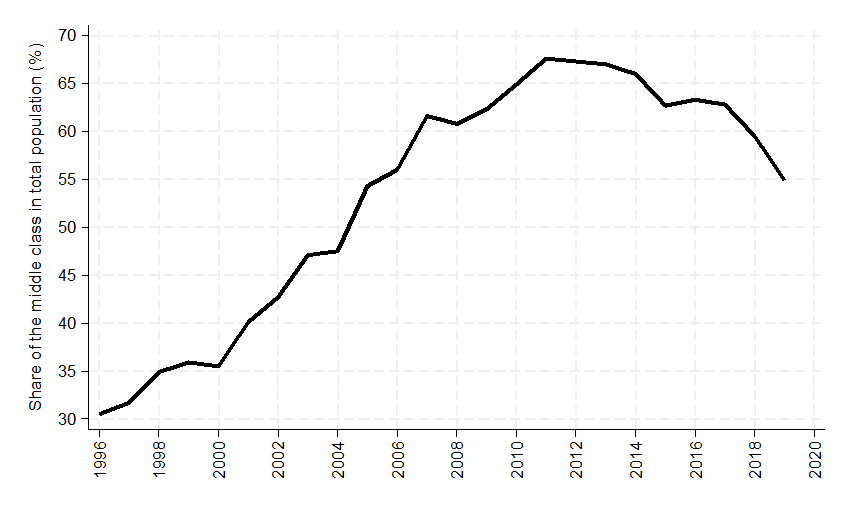
Attributing causal effects to sanctions is difficult. A simple before-and-after comparison is insufficient, as it cannot disentangle the effects of sanctions from other domestic or global shocks that may have occurred simultaneously (Figure 1). To overcome this, we employed the Synthetic Control Method (SCM), a statistical technique that allows for more robust causal analysis (Abadie 2021).
This method involves constructing a ‘counterfactual’ or ‘synthetic’ Iran from a weighted average of other countries. The synthetic control was ultimately composed of a weighted combination of similar countries that were, crucially, not subjected to international sanctions during the period of study (1996-2019).
This ‘synthetic’ Iran provides an estimate for the path Iran's middle class would have taken in the absence of the post-2012 sanctions. Here, the middle-class is defined as the number of people living in households earning or spending between US$11 and $110 per person per day.[1] By comparing the trajectory of the actual Iranian middle class with its synthetic counterpart after 2012, we can isolate the sanctions' total impact. This effect is twofold: it includes the direct harm from external pressure, but also the government's own policy responses to that pressure, which resulted in resource misallocation, corruption, and rent-seeking.
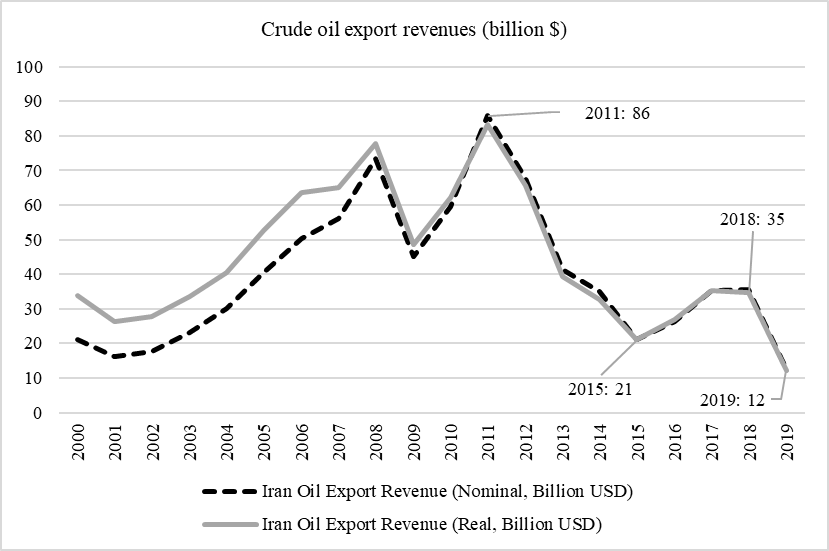
Examples of direct harm from external pressure include the collapse of oil exports (Figure 2, Kimball 2025), financial isolation through the Swift cut-off (Swift 2012), declines in foreign direct investment, supply chain disruptions, and currency devaluation. Indirect harm arises from government policy responses, such as promoting a ‘resistance economy’, prioritising ideological and security-related spending, and allocating more resources to defence programmes and regional allies. To circumvent sanctions, networks of middlemen, front companies, and politically connected individuals were empowered to manage informal trade (Farzanegan 2013), thereby deepening inequalities. The infamous case of Babak Zanjani, who was enlisted to bypass oil sanctions and ended up embezzling billions, is the ultimate example of this dynamic (Majidyar 2016). The creation of multiple exchange rate systems under sanctions further stimulated illicit trade and rent-seeking (Zamani et al. 2021, Farzanegan 2009).
Figure 1: Iran's middle class as a percentage of total population
Source: Farzanegan and Habibi (2025).
Figure 2: Crude oil export revenues of Iran (2000-2019)
Source: Farzanegan and Habibi (2025).
A steep, sustained decline in Iran’s middle class
Our findings are stark. As Figure 3 shows, prior to 2012, the size of the middle class in actual Iran and in its synthetic version tracked each other closely. After 2012, however, their paths diverged sharply. While the middle class in the synthetic, sanction-free Iran was projected to continue its gradual expansion, the middle class in actual Iran entered a steep and sustained decline.
Figure 3: The size of the middle class: Iran versus ‘synthetic’ Iran
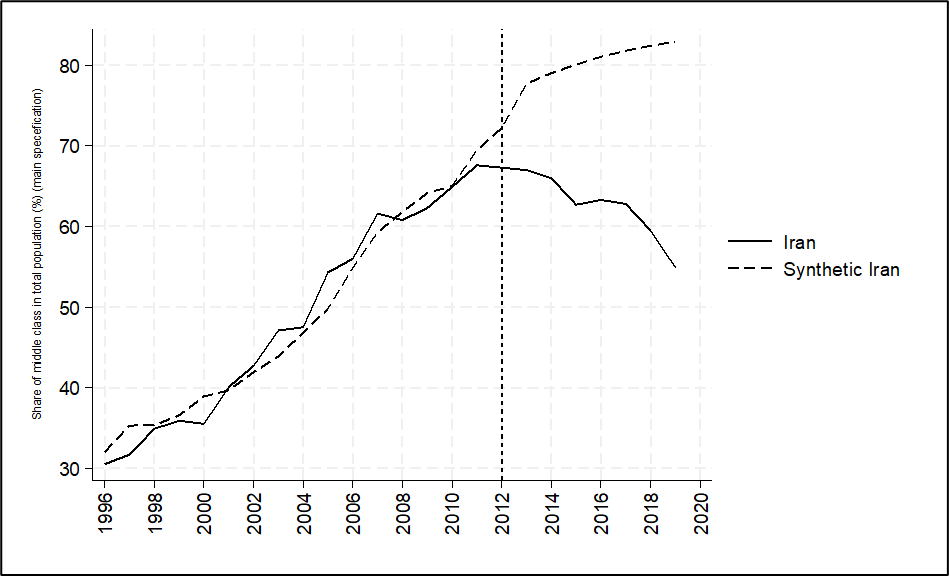
Note: The solid black line shows the share of the middle class in Iran's total population. The dotted line shows the estimated trajectory for the ‘synthetic’ Iran, a weighted average of comparable countries not under sanctions. The vertical line marks the 2012 imposition of severe sanctions. Source: Farzanegan and Habibi (2025).
Our analysis indicates that sanctions caused an average annual decline of 17 percentage points in the size of Iran’s middle class between 2012 and 2019. By 2019, the middle class would have comprised roughly 84% of the population without sanctions, but in reality, it stood at only 56%. To put this in perspective, this represents the loss of economic stability for millions of people. A complementary analysis using the Synthetic Difference-in-Differences (SDID) method (Arkhangelsky et al. 2021, Clarke et al. 2024) yielded a more conservative but still substantial average annual loss of 12 percentage points.
Our quantitative evidence is corroborated by qualitative data from the World Values Survey, which asks people about their own sense of social standing. The share of Iranians who self-identified as belonging to the middle-income group plummeted from 78.7% in 2005 – before international sanctions – to 63.7% in early 2020, during international sanctions. This sharp decline in perception confirms that the economic shocks were felt deeply across society (Figure 4).
Figure 4: To which income category does your household belong in?
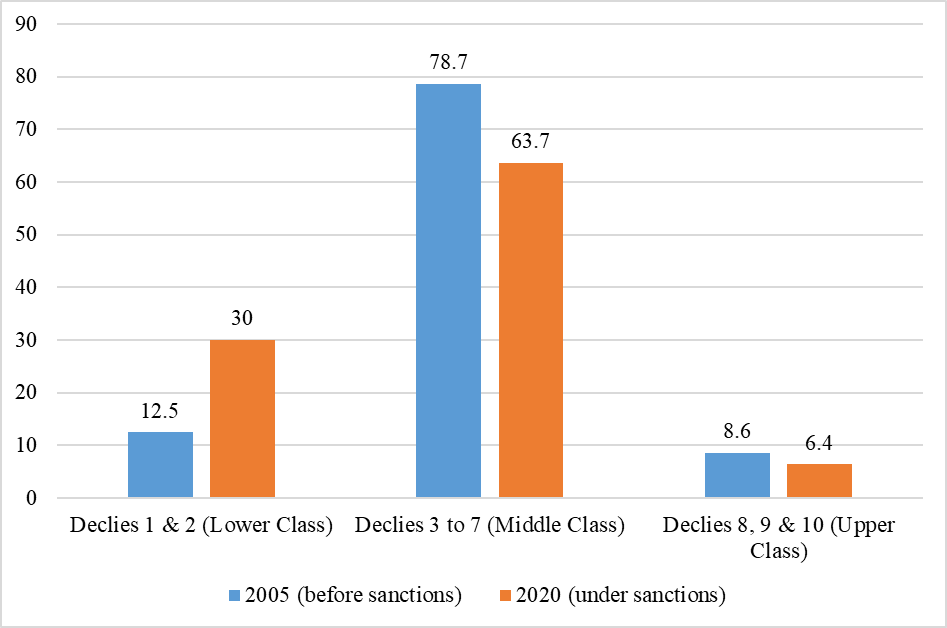
Note: Self-perceptions according to World Values Survey Results for Iran. Source: Farzanegan and Habibi (2025).
How sanctions crippled the middle class: The transmission channels
The economic degradation of Iran’s middle class operated through several powerful channels. Our analysis shows that sanctions directly led to:
- Lower per capita income: By severely restricting oil exports, Iran’s economic lifeblood, and cutting it off from global financial systems, sanctions caused a significant contraction in real GDP per capita. Our counterfactual analysis shows an average annual per capita income loss of around $3000 in Iran due to sanctions between 2012-2019.
- Disrupted trade and investment: Merchandise imports and exports, as well as investment per capita, fell significantly. This crippled businesses that relied on international supply chains and starved the economy of capital needed for growth and job creation.
- Worsening employment quality: As formal businesses contracted, many middle-class workers were pushed into informal and more vulnerable forms of employment, characterised by lower pay and no or weak social protections. We identify a significant increase in both self-employment and vulnerable employment. As a result of sanctions, the proportion of those self-employed was on average 3.4 percentage points larger per year in Iran than its synthetic version between 2012-2019.
It is crucial to clarify that our estimate captures the total effect of the sanctions. This includes both the direct shock of the external restrictions and indirect impact of the Iranian government's own policy responses to them (such as creating front companies or altering domestic spending). The latter are an integral part of the causal chain initiated by the sanctions themselves.
Broader implications for policy and stability
The collapse of a country’s middle class is not only an economic tragedy but also a political risk. Historically, this group has driven reform and balanced elite power (Huntington 1991, Acemoglu and Robinson 2005). Its decline reduces political agency, deepens inequality, and heightens the risk of unrest (Farzanegan and Gutmann 2025). Instead of weakening regimes, sanctions can erode private enterprise and expand state dominance (Eichenberger and Stadelmann 2022).
Our findings show that prolonged broad sanctions inflict long-term social damage, undermining stability and development. Policymakers in countries that sponsor such sanctions must acknowledge these costs. Designing measures that avoid devastating the middle class is essential, though difficult, if the aim is to achieve the objectives of the sanction with minimum pain for ordinary citizens (Sajadi et al. 2025, 2024, Moradi-Lakeh et al. 2025).
References
Abadie, A (2021), “Using synthetic controls: Feasibility, data requirements, and methodological aspects,” Journal of Economic Literature 59: 391–425.
Acemoglu, D, and J A Robinson (2005), Economic Origins of Dictatorship and Democracy, Cambridge University Press.
Agence France-Presse (2022), “Iran teachers protest new pay scales as inflation bites,” VOA News.
Arkhangelsky, D, S Athey, D A Hirshberg, G W Imbens, and S Wager (2021), “Synthetic difference-in-differences,” American Economic Review 111(12): 4088–4118.
Banerjee, A V, and E Duflo (2008), “What is middle class about the middle classes around the world?,” Journal of Economic Perspectives 22(2): 3–28.
Clarke, D, D Pailañir, S Athey, and G Imbens (2024), “On synthetic difference-in-differences and related estimation methods in Stata,” Stata Journal 24: 557–598.
Easterly, W (2001), “The middle class consensus and economic development,” Journal of Economic Growth 6(4): 317–335.
Eichenberger, R, and D Stadelmann (2022), “Sanctions are costly for citizens but beneficial for autocrats: A political-economic perspective,” The Economists’ Voice 19(2): 109–123.
Farzanegan, M R (2009), “Illegal trade in the Iranian economy: Evidence from a structural model,” European Journal of Political Economy 25(4): 489–507.
Farzanegan, M R (2013), “Effects of international financial and energy sanctions on Iran’s informal economy,” The SAIS Review of International Affairs 33(1): 13–36.
Farzanegan, M R, and E Batmanghelidj (2023), “Understanding economic sanctions on Iran: A survey,” The Economists’ Voice 20: 197–226.
Farzanegan, M R, and J Gutmann (2025), “Intensity of international sanctions and internal conflict: The case of Iran,” Unpublished manuscript.
Farzanegan, M R, and N Habibi (2025), “The effect of international sanctions on the size of the middle class in Iran,” European Journal of Political Economy 90: 102749.
Feng, Y (2003), Democracy, Governance, and Economic Performance: Theory and Evidence, MIT Press.
Huntington, S P (1991), The Third Wave: Democratization in the Late Twentieth Century, University of Oklahoma Press.
Iran International (2023), “Teachers’ association raises alarm over low teacher salaries in Iran.”
Kharas, H (2017), “The unprecedented expansion of the global middle class,” Unpublished manuscript.
Kimball, S (2025), “U.S. will collapse Iran’s economy by shutting down its oil industry, Treasury secretary says,” CNBC.
Majidyar, A (2016), “Tycoon’s death penalty points to oil corruption in Iran,” Middle East Institute.
Memar, D (2025), “Unprecedented crisis of bankruptcy of guilds and manufacturing businesses in Iran,” Independent Persian.
Moradi-Lakeh, M, R Majdzadeh, M R Farzanegan, and M Naghavi (2025), “Iran and beyond: Perilous threats to population health,” The Lancet 406(August): 1001–1002.
Obama White House (2012), “Fact sheet: Sanctions related to Iran.”
Sajadi, H S, M R Farzanegan, and R Majdzadeh (2024), “WHO EMRO’s initiative on economic sanctions: Delayed but promising,” The Lancet 404(10463): 1638–1639.
Sajadi, H S, M Moradi-Lakeh, M R Farzanegan, and R Majdzadeh (2025), “Beyond national resilience: Liability for sanctions impact,” The Lancet Global Health.
Swift (2012), “Swift instructed to disconnect sanctioned Iranian banks following EU Council decision.”
US Energy Information Administration (EIA) (2013), “Sanctions reduced Iran’s oil exports and revenues in 2012.”
WDI (2025), “World Development Indicators (WDI),” World Bank.
Zamani, O, M R Farzanegan, J-P Loy, and M Einian (2021), “The impacts of energy sanctions on the black-market premium: Evidence from Iran,” Economics Bulletin 41(2): 432–443.