






Delays in public benefit delivery can harm societies' most vulnerable households, but making management-relevant information more accessible to the bureaucrats implementing these programmes can meaningfully improve delivery speeds.
Editor's note: For a broader synthesis of themes covered in this article, check out our VoxDevLit on Bureaucracy.
Around one in four people globally receives some form of government payment (World Bank 2022). Yet, in many settings, delays in these payments limit their protective value, especially for the liquidity-constrained poor – the very individuals the system aims to protect (Basu et al. 2024). In Ethiopia's Productive Safety Net Programme, 90% of surveyed beneficiaries reported that wages for public works were not paid within the required 15-20-day window, with delays averaging three months (Dejene and Cochrane 2022). The Philippines' large conditional cash transfer programme has experienced delayed and irregular payments, with widespread beneficiary complaints (Acosta et al. 2019). Kenya's Hunger Safety Net Programme has sometimes struggled with payment delays driven by the burden on individual agents tasked with physical cash distribution across remote arid counties (O'Brien et al. 2018).
Even in the US, pandemic-era unemployment insurance systems crashed under the volume of claims, leaving applicants waiting months for benefits that identity verification bottlenecks had frozen (Courtney 2024). The consequences of payment delays for the poorest households can be severe, pushing individuals towards harmful coping strategies such as high-cost payday lending (Dejene and Cochrane 2022).
We study how to reduce payment delays in the world's largest workfare programme: India's Mahatma Gandhi National Rural Employment Guarantee Scheme (MGNREGS), where rural households can complete up to 100 days of paid manual labour per year near their homes. Chronic payment delays were so severe that India's Supreme Court ruled in 2016 that delayed wage payments constituted "a clear constitutional breach committed by the State". Yet the government had already deployed digital systems to track payments at every stage – the question was why they were not reducing delays.
Two explanations dominate the policy debate on payment delays. The first is that local bureaucrats know where the bottlenecks are but allow them to persist because delays generate rents (Vivek et al. 2018, Karippacheril et al. 2024). This points to the need for stronger monitoring by supervisors. The second is that bureaucrats are well-intentioned but overwhelmed (Viswanathan 2019, Dasgupta and Kapur 2020): offices are chronically understaffed, officials hold multiple posts, and they lack time to access and act on data their digital systems already produce. This points towards tools that reduce the cost of getting the right information to the right person at the right time. The two explanations are not just theoretically distinct; they also point to opposite reforms.
In Dodge, Neggers, Pande, and Troyer Moore (2025), we designed a large-scale randomised experiment to directly test these explanations, using an app focused on the world's largest safety net programme, MGNREGS, which covers over 50 million households annually.
PayDash: Making information easier to access
Working with India's Ministry of Rural Development, we developed PayDash, a mobile and web application that does not generate new data, but rather reorganises existing information in a more accessible and actionable format. PayDash relies on timestamps automatically generated in MGNREGS' existing digital management system as village and subdistrict officials complete each administrative step before a worker payment order reaches the bank.
The PayDash design insight was simple: the government website already reported daily-updated counts of delayed attendance registers – lists of workers who have completed bi-weekly labour spells – and the stage at which payment processing was stalled for each register, but accessing this information required navigating many webpages. For example, a typical subdistrict officer overseeing 45 villages with five processing steps would need to navigate hundreds of pages just to get a complete picture of her jurisdiction – and the spreadsheet format was poorly suited to mobile viewing, officials' preferred mode of access. PayDash collapsed the interface into a single home screen showing daily-updated delay counts for a user's jurisdiction and subordinate-specific 'cards' showing which registers were delayed, for how long, and at which step – alongside single-tap functionality to call or WhatsApp the responsible official directly. In addition, PayDash could be accessed offline, which was critical for officials in rural subdistricts with intermittent connectivity.
Figure 1: PayDash app screenshots
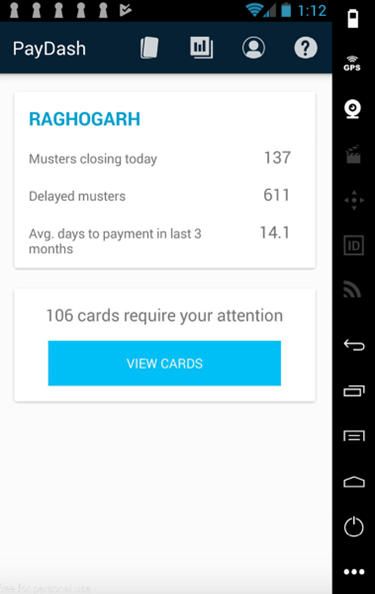
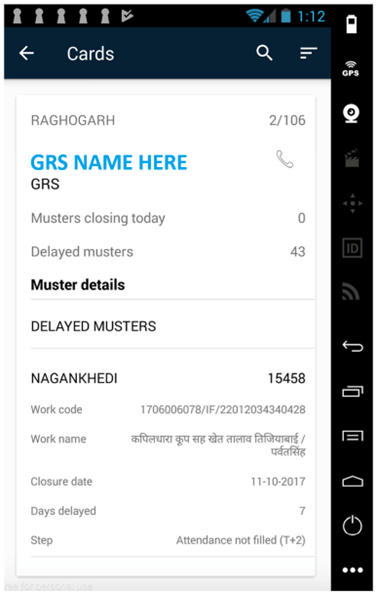
Notes: The figure shows an example subdistrict-level PayDash mobile application home screen (left), providing a daily-updated overview of payment processing within a subdistrict officer's jurisdiction, and a 'card' screen (right) with subordinate-level information on pending delayed documents for which that officer is responsible and an icon that can be clicked to directly contact that officer. See Dodge et al. (2026) for more details.
We randomised 73 districts spanning the states of Madhya Pradesh and Jharkhand – encompassing 561 subdistricts and approximately 25 million rural poor – into four groups:
- Districts where only district supervisors received PayDash;
- Districts where only subdistrict managers received it;
- Districts where both levels received it; and
- Control districts where neither received PayDash.
This four-arm design was key to distinguishing between the two explanations for delay. The intervention ran from early 2017 through August 2018, and our analysis draws on over 17.4 million worker attendance registers, additional MGNREGS administrative data, baseline and endline bureaucrat surveys, app usage data, and records from independently conducted audits of MGNREGS activity.
PayDash led to faster, more reliable wage payment processing
PayDash reduced the share of attendance registers processed 'late' (above the legal eight-day limit) by 9 percentage points (23%), reflecting a general improvement across the distribution of processing times. Correspondingly, average processing time dropped by 1.4 days (16%), and variability in processing time, which additionally diminishes the protective value of MGNREGS wage payments for low-income households, also fell by 12%.
PayDash increased workfare activity, particularly during the lean season
Even though PayDash itself only provided payment-processing information, bureaucrat access to the app also expanded social protection. Work provision rose by 9%, with a 23% increase in active worksites, concentrated in the agricultural lean season – precisely when safety net protection matters most. This increased work activity likely reflects both greater interest in MGNREGS work by rural households – who could now rely on faster, more predictable payments – and officials having more bandwidth to open new worksites.
Results point to strained management capacity, rather than agency concerns
Improvements in payment processing speed, work provision, and worksite activity were statistically indistinguishable across locations where only subdistrict managers, only district supervisors, or both received PayDash. Reducing information acquisition costs at either level was sufficient to improve implementation. This result highlights that information frictions, not rent seeking, appear to have been the binding constraint. Consistent with this, most district supervisors report using PayDash to share information with subordinates rather than to monitor them, and independent audits detect no treatment effects on financial misappropriation.
Reinforcing the idea that managerial bandwidth was a key constraint on information acquisition, processing time improvements from PayDash were magnified in districts where subdistrict managers oversaw larger numbers of village clusters at baseline, i.e. where their bandwidth was most constrained.
Leveraging digital data trails to improve state capacity
A standard argument for digitalising information in safety net programmes emphasises transparency and accountability: more visible data makes it harder for corrupt bureaucrats to extract rents. Our results suggest a different and more immediately solvable problem dominates in the Indian context: busy, overburdened bureaucrats lack the time to access and act on data their own digital administrative systems already produce. The bottleneck is not data generation but data delivery.
The economic case for addressing this bottleneck is compelling: we estimate a benefit-cost ratio for PayDash of more than 165:1 in the first year, and higher in subsequent years when fixed app development costs are not incurred. Since the study concluded, PayDash's features have been integrated into a major central government platform that will cover tens of millions of participants in India's revised workfare programme, the Viksit Bharat Gramin Aajeevika Guarantee (VB-GRAMG).
The challenge PayDash addresses is not unique to India. As the cases from Ethiopia, the Philippines, Kenya, and elsewhere illustrate, rapidly expanding social protection programmes have increased workloads even as digital systems generate ever-richer data trails (Tesliuc et al. 2025). Partial digitalisation reduces some frictions, but frequently leaves management-relevant steps – getting information from government databases to the officials who need to act on it – unaddressed. Tools that close this gap, delivering the right information at the right time in a usable format, offer a cost-effective lever for improving service delivery in precisely the settings where the stakes are highest.
References
Acosta, P, I Endo, A G G Luna, A de Guzman, and Y Okamura (2019), "Making payments more efficient for the Philippines conditional cash transfer program," World Bank.
Basu, P, R R S N, and K Sen (2024), "Payment delay in workfare programmes and household welfare: Theory and some evidence from India," Manchester School, 92(2): 93–121.
Courtney, M (2024), "Unemployment insurance technology pain points across three states," Unpublished manuscript.
Dasgupta, A, and D Kapur (2020), "The political economy of bureaucratic overload: Evidence from rural development officials in India," American Political Science Review, 114(4): 1316–1334.
Dejene, M, and L Cochrane (2022), "Safety nets as a means of tackling chronic food insecurity in rural southern Ethiopia: What is constraining programme contributions?" Canadian Journal of Development Studies, 43(2): 157–175.
Dodge, E, Y Neggers, R Pande, and C M Troyer Moore (2025), "From delay to PayDay: Easing bureaucrat access to implementation information strengthens social protection delivery," NBER Working Paper No. 33756.
Karippacheril, T G, L I Alberro Encinas, A L Cardenas Martinez, C Daly, and S Suri (2024), "Playbook on digital social protection delivery systems: Towards dynamic inclusion and interoperability," World Bank.
O'Brien, C, C Riungu, and M Scott (2018), "Hunger safety net programme: Evaluation of the Kenya Hunger Safety Net Programme Phase 2," Oxford Policy Management.
Supreme Court of India (2016), "Swaraj Abhiyan v. Union of India and Ors."
Tesliuc, E D, C P Rodriguez Alas, and J Rigolini (2025), "State of social protection report 2025: The 2-billion-person challenge," World Bank.
Viswanathan, S (2019), "Improving the delivery of direct benefit transfers in India," Oxford Policy Management.
Vivek, S, R Narayanan, D Chakraborty, R Veeraraghavan, and V Vardhan (2018), "Are technology-enabled cash transfers really direct?" Economic and Political Weekly, 53(30): 58–64.
World Bank (2022), "Next generation G2P payments: Building blocks of a modern G2P architecture."