





When delivered by a single donor, development aid appears to curtail corruption. However, under donor fragmentation, these benefits are significantly diminished.
In recent years, international donors have channelled significant resources towards fragile and conflict-affected states. From 2000 to 2012, official development assistance to these countries exceeded US$450 billion, while outlays rose nearly 10% annually (OECD 2015). Afghanistan and Iraq received $120 billion and $80 billion, respectively, from the US alone (SIGIR 2013, SIGAR 2018). These massive disbursements were made with the expectation that foreign aid would spur development and strengthen governance in recipient countries. Yet, despite this extraordinary assistance, these countries often rank among the most corrupt in the world (Transparency International 2023).
One prevailing challenge in aid delivery that may help explain this paradox is donor fragmentation, wherein multiple donors share overlapping responsibilities within a common geographical area. The OECD has long highlighted these challenges, warning that fragmentation seriously impairs aid effectiveness by straining government administrative capacities, increasing costs, duplicating efforts, and creating uneven aid distribution (OECD 2012).
The limited empirical evidence supports these concerns: cross-country analyses show that fragmentation is associated with weaker bureaucratic quality (Knack and Rahman 2007, Djankov et al. 2008, Kimura et al. 2012); however, such cross-country comparisons only reveal broad correlations. Much less is known about the micro-level institutional consequences of fragmentation – particularly its role in shaping corruption within recipient states.
Understanding aid fragmentation in Afghanistan
In recent research, we take an important first step towards credibly estimating the causal effects of aid fragmentation using granular data from Afghanistan (Child, Wright, and Xiao 2024). Our aid data comes from a rare hardcopy of NATO C3 Agency’s “Afghanistan Country Stability Picture”, which records over 30,000 development projects from 38 different donors (Child 2019, 2023). We link these projects to public opinion and institutional quality measures from the Afghanistan Nationwide Quarterly Assessment Research (ANQAR) surveys, sponsored by ISAF HQ and Resolute Support HQ. Our corruption outcome reflects citizens’ perceptions of whether the government is effectively reducing corruption, views that strongly track with respondents’ own reports of bribery demands. To analyse this data, we estimate a panel model that allows donor fragmentation to moderate the effects of aid on corruption.
Figure 1: Spatial distribution of aid, fragmentation, and corruption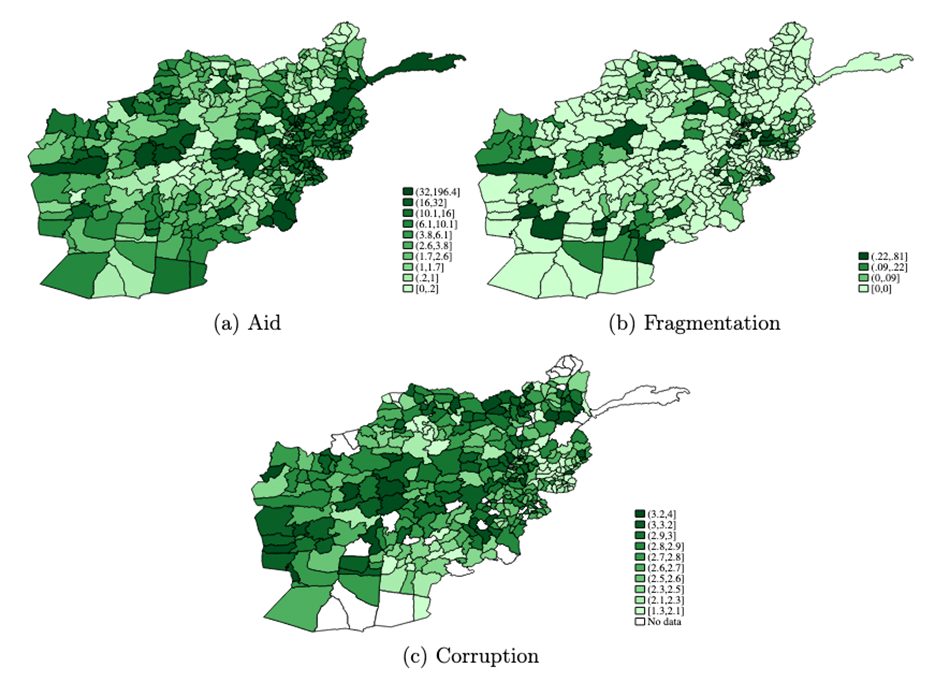
Note: Subfigures map the spatial distribution of district-level averages for aid, fragmentation, and corruption. Figure 1(a) shows the average number of concurrent aid projects per day. Figure 1(b) presents our measure of donor fragmentation, defined as one minus the inverse of the number of active donors within a sector, averaged across sectors. Figure 1(c) displays the corruption index, reflecting public perceptions of government effectiveness in reducing corruption.
We find that development aid has the potential to curb corruption, yet the manner of delivery can undercut this effectiveness. When a single donor provides aid, it significantly reduces corruption. But as the donor landscape becomes fragmented, those beneficial effects vanish. Moving from single donor delivery to the highest levels of fragmentation even reverses the corruption-reducing effects of aid. However, at moderate aid levels, fragmentation can actually reduce corruption, suggesting that the direction of this effect depends on the volume of aid provision.
Construction projects are most susceptible to fragmentation
Notably, the corruption effects are concentrated in projects involving construction and physical goods provision – such as roads, buildings, equipment, and other infrastructure – rather than in non-physical projects like training, vocational programmes, or rehabilitation services in sectors such as education, agriculture, and health. We find that aid itself reduces corruption across both categories, but the harmful effects of donor fragmentation are concentrated in the physical domain. In other words, fragmentation erases the benefits of aid only for infrastructure and material goods projects, which appear especially vulnerable to coordination failures and present greater opportunities for graft.
Our finding that construction projects drive the corruption-enhancing effects of aid fragmentation is consistent with detailed case evidence from Afghanistan. A US government watchdog agency, the Special Inspector General for Afghanistan Reconstruction (SIGAR), has long highlighted corruption in projects of a physical nature (SIGAR 2011). From 2008 to 2019, SIGAR investigated 176 projects for corruption; 137 of which involved infrastructure or material goods, making up nearly 80% of all cases.
Why are construction projects so vulnerable? Two features stand out:
- Profit-driven incentives. Unlike service delivery programmes often implemented by non-profit NGOs, construction projects are typically carried out by private contractors. These firms have strong incentives to cut corners or inflate costs, particularly when oversight is weak or divided.
- Greater scope for hidden corruption. Infrastructure involves complex supply chains, technical specifications, and quality standards that are difficult for non-specialist monitors to assess. When oversight is weak, it becomes easier to substitute inferior materials, manipulate contracts, or overstate costs without detection.
Beyond Afghanistan: Policy implications for aid in conflict-affected states
Though our analysis focuses on Afghanistan, fragmentation challenges extend across sub-Saharan Africa, parts of Asia, and other conflict-affected regions. The mechanism we highlight – particularly the role of assistance via infrastructure development and physical goods allocation – builds on a deeper intuition about the political and economic conditions that create opportunities for misappropriation of public resources. This dynamic could also be present in other settings where high profile infrastructure projects have been captured by corrupt bureaucrats and aligned private actors. In Ghana, for example, one-third of infrastructure projects remain unfinished, absorbing nearly 20% of local government investment (Williams 2017). In Peru, strengthening civil society oversight reduced infrastructure spending by over 15% via curbing corruption and inefficiency (Lagunes 2019). Together, this evidence underscores how fragmented donor oversight can magnify risks already inherent in construction and physical goods projects.
The solution isn't reducing donors or eliminating aid – both aid and donor diversity can bring important benefits. Rather, the challenge is designing coordination mechanisms that preserve these benefits while minimising corruption risks from fragmentation. Our evidence shows that aid can powerfully reduce corruption and strengthen governance, but only when delivered effectively. With global development assistance approaching $200 billion annually (OECD 2023), even modest coordination improvements can yield billions in additional poverty reduction resources.
References
Child, T B (2019), “Conflict and counterinsurgency aid: Drawing sectoral distinctions,” Journal of Development Economics 141.
Child, T B (2023), “Losing hearts & minds: Aid and ideology,” Journal of Conflict Resolution 67(2-3): 457–493.
Child, T B, A L Wright, and Y Xiao (2024), “Aid fragmentation and corruption,” The Review of Economics and Statistics: 1–43.
Djankov, S, J G Montalvo, and M Reynal-Querol (2008), “The curse of aid,” Journal of Economic Growth 13(3): 169–194.
Kimura, H, Y Mori, and Y Sawada (2012), “Aid proliferation and economic growth: A cross-country analysis,” World Development 40(1): 1–10.
Knack, S, and A Rahman (2007), “Donor fragmentation and bureaucratic quality in aid recipients,” Journal of Development Economics 83(1): 176–197.
Lagunes, P (2019), “Guardians of accountability: Corruption and inefficiency in local public infrastructure,” VoxDev.
OECD (2012), “The architecture of development assistance.”
OECD (2015), “States of fragility 2015: Meeting post-2015 ambitions.”
OECD (2023), “Official development assistance (ODA) 2023 final figures.”
Special Inspector General for Afghanistan Reconstruction (2011), “Quarterly report to the United States Congress.”
Special Inspector General for Iraq Reconstruction (SIGIR) (2013), “Final report to the United States Congress.”
Special Inspector General for Afghanistan Reconstruction (SIGAR) (2018), “Quarterly report to the United States Congress.”
Transparency International (2023), “Corruption Perceptions Index 2023.”
Williams, M J (2017), “The political economy of unfinished development projects: Corruption, clientelism, or collective choice?,” American Political Science Review 111(4): 705–723.