







Evidence from Mexico suggests that carefully designed outsourcing regulation can significantly improve wages without reducing employment in developing countries.
Editor’s note: For a broader synthesis of themes covered in this article, check out Issue 2 of our VoxDevLit on Informality.
Workers’ power is declining across the world
The share of national income going to workers has been falling across the globe for decades (Karabarbounis and Neiman 2014). At the same time, economists have observed sizable ‘wage markdowns’, a measure indicating that workers are increasingly being paid less than the value of what they produce (Yeh et al. 2022, Brooks et al. 2021).
A growing body of research points to weakening worker bargaining power as a key driver of these trends (Grossman and Oberfield 2022). One increasingly common strategy that reduces worker leverage is domestic outsourcing—where companies hire staffing firms to manage on-site employees, bypassing formal employer–employee relationships and associated labour obligations.
Outsourcing: A workaround for labour protections
Outsourcing can lower costs for firms, but often at the expense of workers. By outsourcing core workers (those performing a company’s main activities), firms in many countries have been able to avoid payroll taxes, profit-sharing obligations, and social security payments. As a result, workers lose out on benefits and legal protections. This practice has been linked to lower wages, higher inequality, and weaker worker protections (Autor 2003, Dube and Kaplan 2010, Goldschmidt and Schmieder 2017).
Mexico provides a striking case. Following trade liberalisation in the 1990s, domestic outsourcing surged, particularly in manufacturing. By 2019, more than one in five manufacturing workers were formally employed by staffing firms—not the firms where they actually worked.
Can regulation improve outcomes without hurting employment?
In April 2021, the Mexican government implemented a bold labour reform. The new law banned domestic outsourcing of core workers, requiring firms to directly employ these workers and comply fully with tax and labour laws. Importantly, the reform preserved flexibility for hiring specialised services—such as cleaning or catering—via registered subcontractors, and it left room for temporary and contract employment.
In our study (Estefan et al. 2024), we analyse the impact of this reform using rich administrative and survey data. We find that the policy had its intended effects: outsourcing rates collapsed, firms brought formerly outsourced workers onto their own payrolls, wages rose significantly (especially for lower-wage workers), and firms began making mandated social security, benefits, and profit-sharing payments. These gains did not come at the cost of employment or output, which remained stable, or cause a shift in input composition. These effects are exemplified in Figure 1, which shows the raw trends in employment and wages before and after the reform for establishments exposed and unexposed to the reform.
Figure 1: Trends in employment and mean wage at the establishment level
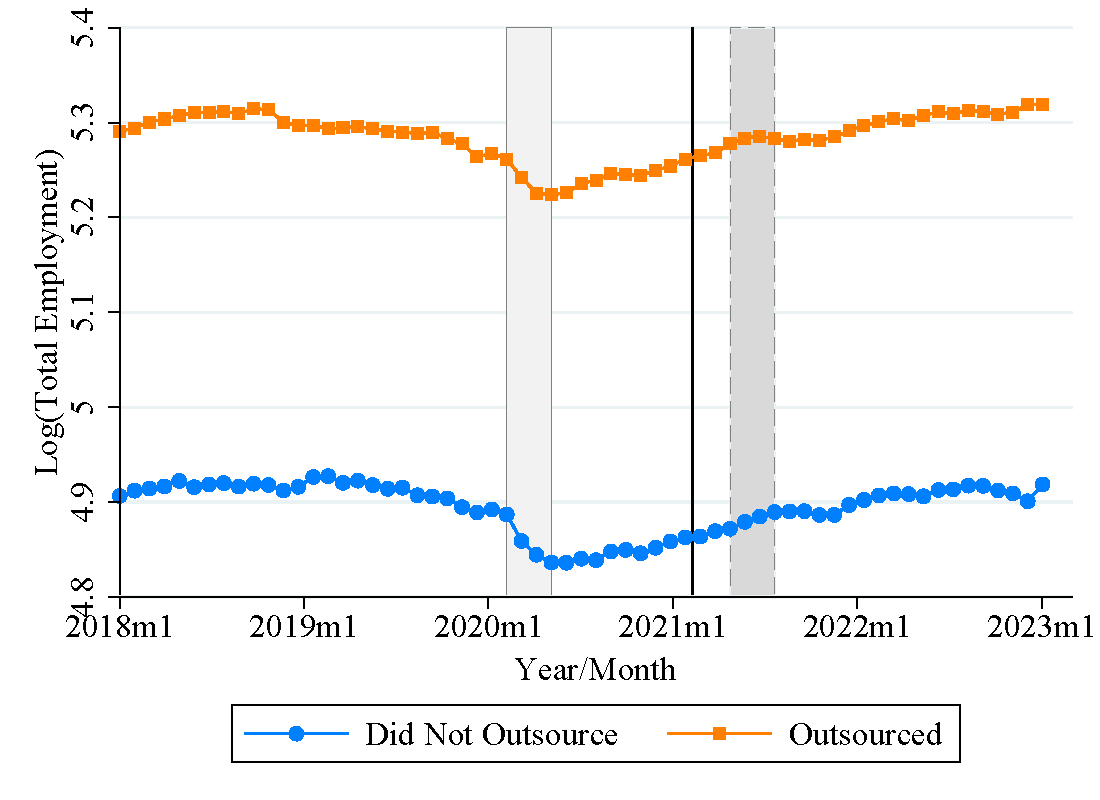
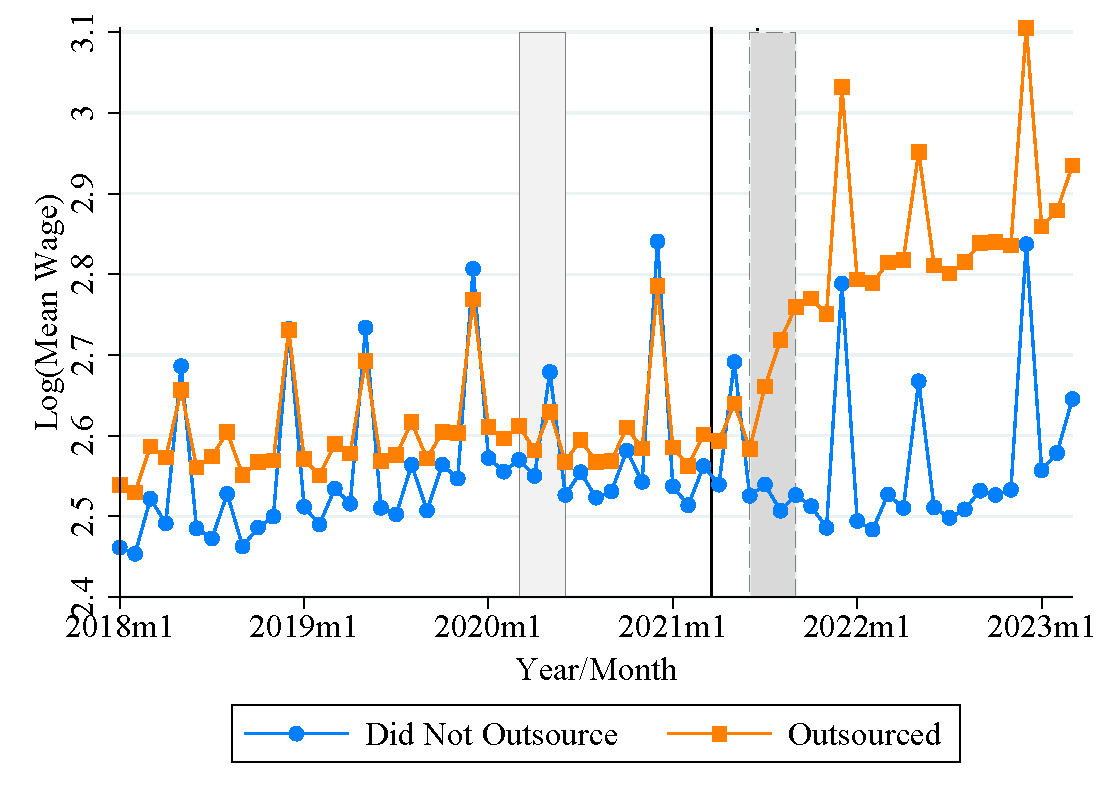
Notes: This figure presents mean employment and wages from 2018 to 2023 in establishments that outsourced at least one worker and establishments that hired all their workers directly in February 2020, the month prior to the onset of COVID-19. The vertical solid line depicts the enactment of the reform, while the vertical dashed line depicts the cutoff date for its enactment. The first grey area outlined with a solid line represents the strictest COVID-19 lockdown implemented by the federal authorities in Mexico. The second grey area outlined with a dashed line represents the grace period for transferring previously outsourced workers to their employing companies as mandated by the reform. Source: Estefan et al. (2024).
A shift in bargaining power—and distribution
The wage increases we observe were largest among workers at the bottom of the distribution. This, together with the fact that neither productivity, output, nor other inputs changed, suggests that the reform not only reduced wage inequality but shifted bargaining power back toward workers. The increase in compensation was especially concentrated in firms that previously held the most monopsony power—those with the highest markdowns, or which paid workers far less than their marginal productivity.
While labour costs rose, our data show no reduction in the use of other inputs or in productivity. This supports the view that prior to the reform, firms were able to suppress wages through market power, rather than reflecting underlying economic constraints.
The trade-offs: Investment and exit risks
The reform did come with costs. We observe a small but significant decline in capital investment, and a slight increase in the probability that firms would exit the market. These negative effects were most pronounced among smaller or lower-revenue firms, suggesting that some businesses had relied on cost savings from outsourcing to stay afloat.
However, the scale of these downsides appears modest when compared to the large gains in wages and formalisation of employment.
Lessons for labour market policy
The Mexican case shows that labour market regulation—when carefully targeted and effectively enforced—can significantly improve worker outcomes without harming employment. It also underscores the importance of clear legal definitions, strong monitoring, and administrative capacity for enforcement.
Yet the experience also highlights the risks of going too far. As other studies have shown, overly rigid labour protections can backfire by pushing firms toward informal hiring or limiting job creation (Autor et al. 2007, Felix and Wong 2024). Striking the right balance is essential.
Still, our evidence shows that modest, well-designed interventions can succeed where earlier, weaker regulations failed. Formal inclusion of workers not only boosts their compensation—it reshapes the distribution of power and profits in the labour market.
References
Autor, D (2003), “Outsourcing at will: The contribution of unjust dismissal doctrine to the growth of employment outsourcing,” Journal of Labor Economics, 21(1): 1–42.
Autor, D, W Kerr and A Kugler (2007), “Does employment protection reduce productivity? Evidence from US states,” The Economic Journal, 117(521): F189–F217.
Brooks, W, K Donovan, S Gonzalez and J Ramos (2021), “Monopsony in the developing world: Evidence from Latin America,” American Economic Review: Insights, 3(4): 495–510.
Dube, A and G Kaplan (2010), “Does outsourcing reduce wages in the low-wage service occupations? Evidence from janitors and guards,” ILR Review, 63(2): 287–306.
Estefan, A, R Gerhard, J Kaboski, I Kondo and W Qian (2024), “Outsourcing policy and worker outcomes: Causal evidence from a Mexican ban,” Unpublished manuscript.
Felix, R and M Wong (2024), “Flexible labor markets and firm dynamics: Evidence from a natural experiment in Brazil,” World Bank.
Goldschmidt, D and J Schmieder (2017), “The rise of domestic outsourcing and the evolution of the German wage structure,” The Quarterly Journal of Economics, 132(3): 1165–1217.
Grossman, G and E Oberfield (2022), “The decline of the labor share and the rise of superstar firms,” Unpublished manuscript.
Karabarbounis, L and B Neiman (2014), “The global decline of the labor share,” The Quarterly Journal of Economics, 129(1): 61–103.
Yeh, C, C Macaluso and B Hershbein (2022), “Monopsony in the US labor market,” Journal of Human Resources, 57(S): S143–S184.