







Using detailed data from a major call centre in Turkey, we find that a permanent shift to fully remote work boosts recruitment and productivity without harming service quality. Not only did this increase the share of female and small-town workers, but productivity rose as home environments cut noise and sped up conversations. Employees who began with in-person training had higher long-term output and lower attrition, underscoring the value of face-to-face onboarding.
Editor’s note: A version of this article first appeared on VoxEU.
The pandemic sparked a lasting shift to remote work, with over one in four workdays in the US taking place from home by 2025—trends that mirror developments across Europe and other advanced economies (Barrero et al. 2021, Aksoy et al. 2022, Zarate et al. 2024, Luca et al. 2025). This transformation has redrawn the geography of jobs, extending roles once confined to city centres to smaller towns and opening doors for those who previously faced barriers to employment—including women, older workers, and residents of remote areas. As remote work becomes a common feature of modern labour markets, understanding how it affects workforce composition and performance is essential for firms and policymakers.
In Aksoy et al. 2025, we study Tempo BPO, a Turkish call centre that permanently shifted all 3,500 agents from fully onsite to fully remote work in March 2020. Using detailed personnel and performance data from 2019 to 2023, we find three main benefits:
- Productivity increased as home settings cut noise and sped up calls.
- Hiring broadened at the same pay, with more graduates, experienced staff, and married women in small towns.
- Agents who had three months of initial in-person training had higher long-term output and lower attrition.
Remote work expands recruitment of married women and small-town residents
One of the most noticeable impacts of remote work at Tempo was a shift in hiring practices. The share of women rose sharply—from around 50% to 76% by early 2023—in a country where women account for only about 35% of the overall labour force (Figure 1, Panel A). The increase was especially pronounced among married women, who often face social constraints working outside the home, reflecting the strong appeal of home-based roles. This effect is particularly significant in regions where Tempo operates, where female labour force participation rates are even lower (often under 20%) than other parts of the country, and married women encounter additional social and logistical hurdles to working outside the home.
At the same time, the firm raised recruitment from smaller towns and rural communities (Figure 1, Panel B). These areas, once excluded due to long commutes and lack of transport links, became part of Tempo’s hiring pool. The company also onboarded a higher proportion of university graduates and professionals with substantial experience—while continuing to pay the national minimum wage irrespective of location. Overall, shifting to fully remote work allowed Tempo to tap into under‑utilised segments of the labour market, enhancing the overall skill level of its workforce without raising labour costs.
Figure 1: Remote work increased the share of married female and small-town workers
A: Share of married agents by gender B: Share of agents from small towns
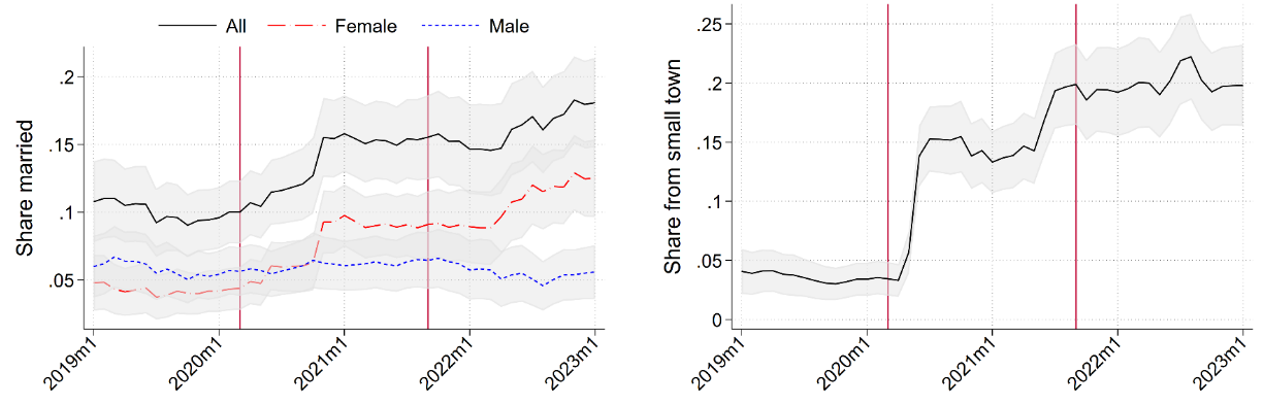
Notes: Figure 1 shows changes in the workforce over time, presenting monthly means, with the shaded area representing 95% confidence intervals around the mean for each month. Vertical red lines indicate March 2020 and September 2021, corresponding to the start and end of the COVID-19 lockdown period in Turkey.
Quieter home environments boosted productivity without compromising service quality
Tempo’s shift to remote work boosted productivity significantly (Figure 2). Agents handled 10% more calls per hour than before the pandemic—an improvement that persisted even after lockdowns ended. These gains did not stem from longer hours or fewer breaks. Instead, it is likely that quieter home environments cut average call durations. Conversations became clearer, agents needed fewer repetitions, and processed queries more swiftly.
Importantly, these efficiency gains came without any drop in service standards. Customer satisfaction ratings and supervisor audit scores remained stable or edged up after the shift to remote work. This aligns with evidence that noise and high-distraction office environments can undermine performance in communication-heavy roles (Bloom et al. 2015, Battiston et al. 2021), an impression that is reinforced by visual inspection of Tempo office settings before the pandemic.
Agents who performed less well in the office saw the biggest gains. Those hampered by distractions and noise in open-plan settings thrived in quieter home workspaces. This pattern suggests that remote work can help close performance gaps by providing an environment where all agents—including those most affected by office stressors—can deliver at their full potential.
Figure 2: Productivity increased after the shift to remote work, with more calls processed per hour
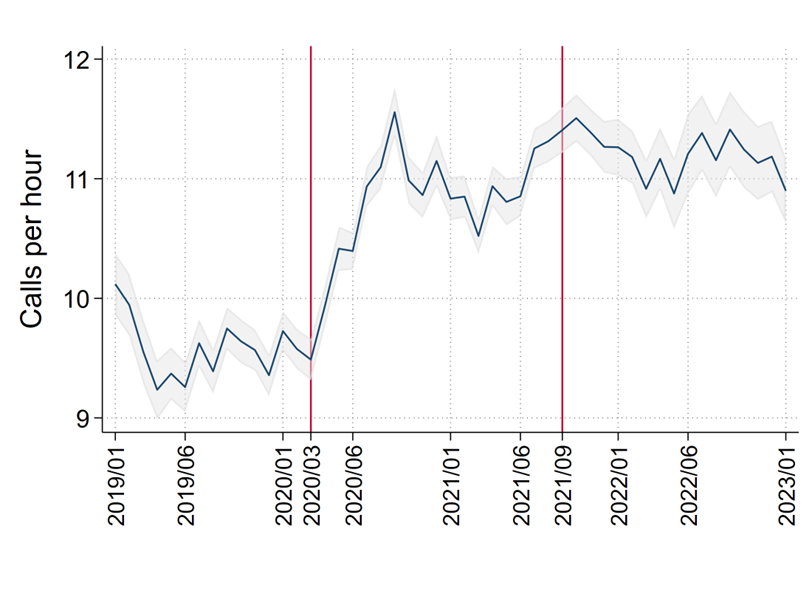
Notes: Figure 2 shows predictions from a regression of calls per hour on monthly fixed effects, omitting February 2020 as the reference month. The OLS regression controls for the mix of calls, repeat calls, and includes agent fixed effects. Standard errors are clustered at the agent level, and 95% confidence intervals are calculated from these clustered errors and shown as shaded bands around the point estimates. Vertical red lines depict March 2020 and September 2021, the start and end of the COVID-19 lockdown period, respectively.
In-person onboarding boosts long-run performance and retention
Despite these promising results, fully remote work does come with some trade-offs. Onboarding—the process through which new employees learn skills, absorb knowledge, and form social bonds—is harder without face‑to‑face interaction. In remote settings, limited informal learning and peer support can slow integration, weaken performance, and raise turnover.
We exploit a natural discontinuity created by the timing of Turkey’s COVID‑19 lockdown. In the weeks before restrictions, Tempo recruited agents for on‑site roles. All new hires applied under identical conditions, but only those who began before the lockdown received in‑person onboarding; the rest began fully remotely. This cutoff lets us apply a regression discontinuity design (RDD) to estimate the causal effect of initial face‑to‑face training on performance and retention. The two groups share similar demographics, application timing and role expectations, differing only in onboarding mode.
Our results show that remote starters began handling calls sooner and initially outperformed their on‑site peers. However, their productivity plateaued after a few months. By month six, the on‑site group had caught up and then surpassed the remote cohort. Attrition also differed: remote starters were significantly more likely to leave within the first several months. These findings underscore the value of early face‑to‑face induction, even when seasoned employees operate in a fully remote mode.
Remote work: Implications for firms and policymakers
Our results show that fully remote work can benefit employers by broadening the talent pool—especially in regions facing geographic or social barriers—boosting efficiency without sacrificing service quality. In addition, there are gains to effective onboarding that keeps new employees connected, supported, and productive over time.
From a policy perspective, remote work can boost the labour participation of women, older workers, and those living outside major urban centres. In regions with restrictive social norms or heavy family duties, women often face barriers to working outside the home. Home-based roles allow these women to participate in the labour force while balancing family responsibilities. Higher female participation in these areas can raise household incomes, boost spending in local businesses and improve child well‑being through better access to health and education. Remote work also expands the overall labour force, promoting business growth and greater tax revenue. Realising this potential requires reliable broadband, affordable internet access, and training programmes that equip workers to succeed in remote roles.
References
Aksoy, C G, N Bloom, S J Davis, V Marino, and C Özgüzel (2025), “Remote work, employee mix, and performance,” Unpublished manuscript.
Aksoy, C G, J M Barrero, N Bloom, S J Davis, M Dolls, and P Zarate (2022), “Working from home around the world,” Unpublished manuscript.
Barrero, J M, N Bloom, and S J Davis (2021), “Why working from home will stick,” Unpublished manuscript.
Battiston, D, J Blanes i Vidal, and T Kirchmaier (2021), “Face-to-face communication in organisations,” Review of Economic Studies, 88(2): 574–609.
Bloom, N, J Liang, J Roberts, and Z J Ying (2015), “Does working from home work?” Quarterly Journal of Economics, 130(1): 165–218.
Bloom, N, R Han, and J Liang (2024), “Hybrid working improves retention without hurting productivity,” Nature, 630: 920–925.
Luca, D, C Özgüzel, and Z Wei (2025), “The new geography of remote jobs in Europe,” Regional Studies, 59(1).
Zarate, P, M Dolls, S J Davis, N Bloom, J M Barrero, and C G Aksoy (2024), “Why does working from home vary across countries and people?,” Unpublished manuscript.