



An experiment in Egypt tested for employment discrimination by sex and marital status, and found no sizeable discrimination against married women.
Editor’s note: For a broader overview of the drivers of women’s employment globally, see our VoxDevLit on Female Labor Force Participation.
As of 2024, 69% of men were employed globally, compared to only 46% of women (ILO 2024). The Middle East and North Africa (MENA) region has the lowest female labour force participation rate in the world (Verick 2018); the gender gap in employment in Egypt is particularly acute, with only 15% of women employed as of 2023, relative to 69% of men (Krafft et al. 2024). Around the world, when women marry and begin childbearing, their employment rates drop substantially (Angelov et al. 2016, Kuziemko et al. 2018, Kleven et al. 2019). For instance, in Egypt, nearly half of women working in the private sector exit employment around marriage (Assaad et al. 2022). This pattern begs the question: why do so few married women work in Egypt?
Studying discrimination against women in Egypt
One potential explanation for married women’s low employment rates is employer discrimination, for which there is some evidence globally (Arceo-Gomez and Campos-Vazquez 2014, Zhang et al. 2021, Bedi et al. 2022). In recent research, I conducted a correspondence study in Egypt to examine employment discrimination against women, with a focus on married women (Krafft 2025). This research involved submitting fictitious job applications that randomly varied applicants’ sex and marital status, assessing discrimination based on whether employers expressed an interest in interviewing them.
The evidence on discrimination against women in developing countries is limited
My findings apply to jobs that were publicly posted online and cannot be generalised to all vacancies in Egypt. These jobs are a selected segment of the labour market, overrepresenting jobs that require educated workers as well as certain sectors such as ICT. Firms that posted positions online were presumably larger, less likely to hire through social networks, and have more professional human resources (HR) practices. Since hiring through social networks is common, particularly for men in Egypt (El-Mallakh 2020, Osman et al. 2022), encouraging firm growth and HR professionalisation may help prevent discrimination, as suggested in Banerjee et al. (2018).
Other research on Egypt shows that 51% of businesses, on average, across various industries discriminate against women (Osman et al. 2025). However, based on my calculations, only 14% of these employees are at firms that prefer hiring men, as discrimination declines with firm size. Discrimination also varied substantially across industries (Osman et al. 2025).
Similar research on Turkey (Balkan and Cilasun 2018, 2019) and Tunisia (Alaref et al. 2020) did not find discrimination against women. In fact, in Tunisia, there was discrimination in favour of women overall and in specific fields, such as marketing, while men were preferred in other fields, such as IT (Alaref et al. 2020). Discrimination may thus contribute to gendered occupational segregation, limiting the occupations women can access. Globally, other studies find similar results in terms of the absence of employment discrimination against women (Lippens et al. 2023).
There is less research on discrimination against married women, most of which centres on developed countries; among these studies, three out of ten found evidence of negative discrimination against married women.[1] The findings of our experiment in Egypt contrast with the few studies on developing countries, which demonstrate that married women and mothers are discriminated against (Arceo-Gomez and Campos-Vazquez 2014, 2019, Bedi et al. 2018, Maurer-Fazio and Wang 2018, Bedi et al. 2022). For example, an experiment in India found that mothers experienced 20 percentage point (57%) fewer callbacks (Bedi et al. 2022).
Women, especially married ones, were more likely to be asked for more information
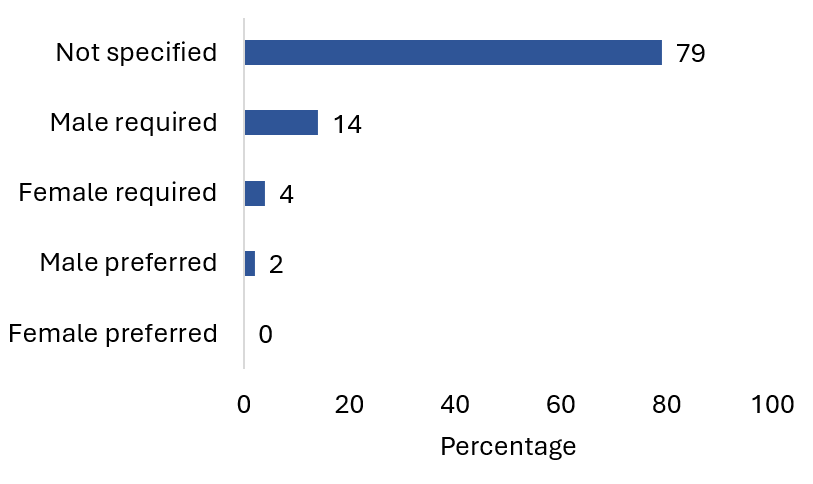
Some of the job postings we applied to listed specific gender requirements, as is common globally (Kuhn and Shen 2019); Figure 1 illustrates this. While most postings (79%) did not specify the gender, those that did more often required men (14%) than women (4%). A further 2% preferred men while none strictly preferred women.
Figure 1: Gender requirements of job postings (percentage)
Source: Author’s calculation based on job posting data. Observation is a posting.
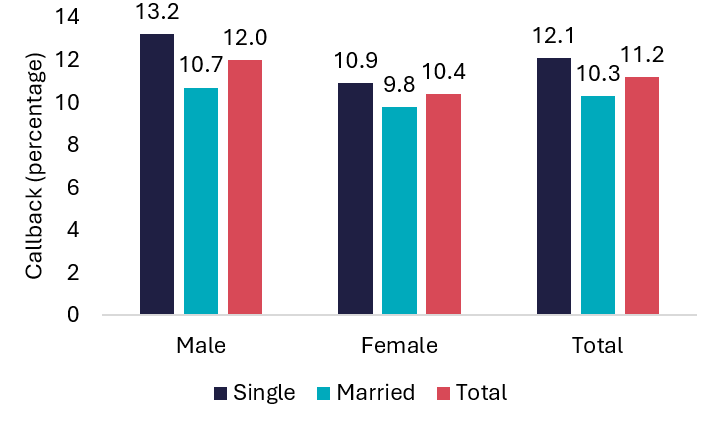
Around 11.2% of all applications generated a callback signalling potential interest in hiring. There were only small differences in callbacks by gender and marital status (Figure 2). The highest rate of callbacks was for single men (13.2%), followed by single women (10.9%). Married men received callbacks at a rate of 10.7%, compared to 9.8% of married women. These differences were not statistically significant.
Figure 2: Callback rates (percentage), by gender and marital status
Source: Author’s calculation based on resume data and callback data.
We further tested for discrimination in the types of employment women can access. Additional analyses tested for discrimination across different occupations, industries, work experience, age, and skill requirements. There was not significant discrimination in any specific segment of the labour market, except for jobs requiring customer service skills, where women were, in fact, favoured.
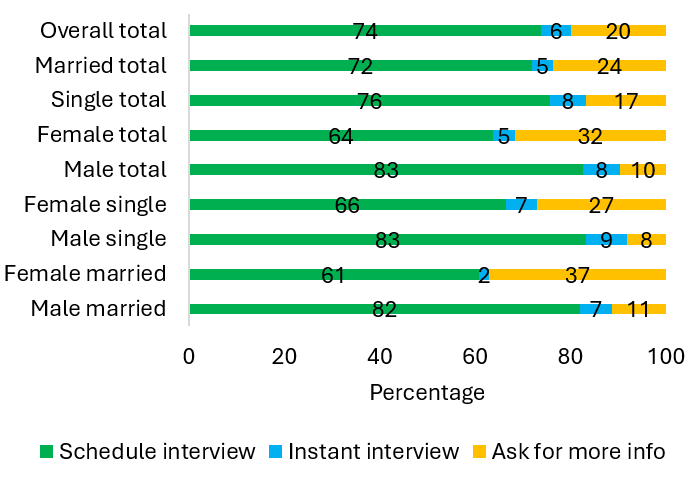
We subsequently tested for differences that could signal discrimination in the hiring phase. Figure 3 shows types of callbacks, which may be suggestive of subsequent hiring. Overall, 74% of callbacks were to schedule an interview, 6% were an instant interview, and 20% asked for more information. Single women (27%) and married women (37%) were much more likely to be asked for more information than men (8% single men, 11% married men). Differences by sex in being asked for more information were statistically significant.
Figure 3: Detailed callback outcomes (percentage) for individuals who received a callback, by gender and marital status
Source: Author’s calculation based on resume and callback data.
This disparity in the type of callback may be a negative signal for women’s subsequent hiring. Requesting additional information from women—such as whether they have access to safe transport (Buchmann et al. 2024) or childcare (Bedi et al. 2022)—can be considered paternalistic discrimination if used as a precondition for employment.
Improving low female labour force participation: Policy implications
My findings suggests that supply-side forces, rather than demand-side, explain women’s low employment rates in Egypt. That women tend to exit employment in advance of marriage in Egypt and other MENA countries (Selwaness and Krafft 2021, Assaad et al. 2022) also corroborates the supply-side explanation.
Discriminatory gender norms both within society and women’s households limit female labour supply (El-Feki et al. 2017). These norms substantially constrain the type of work women can accept in Egypt and throughout MENA (Gauri et al. 2019, Aloud et al. 2020, Caria et al. 2025). Male breadwinner (and female homemaker) norms also feed into women’s disproportionate care responsibilities, further limiting their labour supply (Atallah and Hesham 2024, Krafft and Li 2024).
Efforts to increase women’s employment in such highly-constrained contexts can potentially work, for example, through providing remote and flexible jobs (Ho et al. 2024, Jalota and Ho 2024). Interventions that work in other contexts, such as providing childcare (Halim et al. 2023), will not necessarily work in settings with low female employment (Krafft and Lassassi 2024, Krafft and Li 2024, Caria et al. 2025). Interventions to change norms (Dhar et al. 2022) or perceptions of norms (Aloud et al. 2020, Bursztyn et al. 2020) may also be needed to increase female employment.
Acknowledgments
This research was supported by a grant from the International Labour Organisation (ILO) to the Economic Research Forum for the “Understanding the Low Participation of Women in the Egyptian Labour Market” project. This is an adaptation of the ERF/ILO policy brief “Caroline Krafft, Why Do So Few Married Women Work in Egypt?, Cairo: International Labour Organization, 2023” and the ERF/ILO working paper “Caroline Krafft, Do employers discriminate against married women? Evidence from a field experiment in Egypt, Cairo: International Labour Organization, 2023,” subsequently published as “Krafft, Caroline. 2025. Do Employers Discriminate Against Married Women? Evidence from A Field Experiment in Egypt. Journal of Development Economics 174: 103452.” Responsibility for the views and opinions expressed rests solely with the author.
The author greatly appreciates the excellent work of the research team at J-PAL MENA, which implemented the study. Salma Rizk and Mona Amer provided research leadership and management, and Ibrahim Adham, Ahmed Shabaan, Menna Shamoun, and Aliyaa Assem undertook careful data collection. May Gadalla and Luca Fedi provided thoughtful comments on the analyses.
References
Alaref, J., Towfighian, S. N., Paez, G. N., and Audah, M., 2020, “Tunisia labor market field experiment paper,” World Bank.
Aloud, M., Al-Rashood, S., Ganguli, I., and Zafar, B., 2020, “Information and social norms: Experimental evidence on the labor market aspirations of Saudi women,” Unpublished manuscript.
Angelov, N., Johansson, P., and Lindahl, E., 2016, “Parenthood and the gender gap in pay,” Journal of Labor Economics, 34(3): 545–579.
Arceo-Gomez, E. O., and Campos-Vazquez, R. M., 2014, “Race and marriage in the labor market: A discrimination correspondence study in a developing country,” American Economic Review, 104(5): 376–380.
Arceo-Gomez, E. O., and Campos-Vazquez, R. M., 2019, “Double discrimination: Is discrimination in job ads accompanied by discrimination in callbacks?,” Journal of Economics, Race, and Policy, 2(4): 257–268.
Assaad, R., Krafft, C., and Selwaness, I., 2022, “The impact of marriage on women’s employment in the Middle East and North Africa,” Feminist Economics, 28(2): 247–279.
Atallah, M., and Hesham, M., 2024, “Unpaid care work in Egypt: Gender gaps in time use,” Economic Research Forum.
Balkan, B., and Cilasun, S. M., 2018, “Does gender discrimination contribute to low labor force participation of women in Turkey?,” Economic Research Forum.
Balkan, B., and Cilasun, S. M., 2019, “Gender discrimination among college graduates – Evidence from a developing country,” Economic Research Forum.
Banerjee, R., Reitz, J. G., and Oreopoulos, P., 2018, “Do large employers treat racial minorities more fairly? A new analysis of Canadian field experiment data,” Canadian Public Policy, 44(1): 1–12.
Bedi, A., Majilla, T., and Rieger, M., 2022, “Does signaling childcare support on job applications reduce the motherhood penalty?,” Review of Economics of the Household, 20(2): 373–387.
Bedi, A., Majllla, T., and Rieger, M., 2018, “Gender norms and the motherhood penalty: Experimental evidence from India,” Unpublished manuscript.
Buchmann, N., Meyer, C., and Sullivan, C. D., 2024, “Paternalistic gender discrimination: Evidence from labour markets in Bangladesh,” VoxDev.
Bursztyn, L., Gonzalez, A. L., and Yanagizawa-Drott, D., 2020, “Misperceived social norms: Female labor force participation in Saudi Arabia,” American Economic Review, 110(11): 3522–3548.
Caria, S., Crepon, B., Krafft, C., and Nagy, A. R., 2025, “The barriers to female employment: Experimental evidence from Egypt,” Unpublished manuscript.
Dhar, D., Jain, T., and Jayachandran, S., 2022, “Reshaping adolescents’ gender attitudes: Evidence from a school-based experiment in India,” American Economic Review, 112(3): 899–927.
El-Feki, S., Heilman, B., and Barker, G., eds., 2017, "Understanding masculinities: Results from the International Men and Gender Equality Survey (IMAGES)", UN Women.
El-Mallakh, N., 2020, “Internet job search, employment, and wage growth: Evidence from Egypt,” World Bank.
Gauri, V., Rahman, T., and Sen, I., 2019, “Measuring social norms about female labor force participation in Jordan,” World Bank.
Halim, D., Perova, E., and Reynolds, S., 2023, “Childcare and mothers’ labor market outcomes in lower- and middle-income countries,” World Bank Research Observer, 38(1): 73–114.
Ho, L., Jalota, S., and Karandikar, A., 2024, “Bringing work home: Flexible arrangements as gateway jobs for women in West Bengal,” Unpublished manuscript.
ILO, 2024, "World employment and social outlook: Trends 2024".
Jalota, S., and Ho, L., 2024, “What works for her? How jobs from home and local offices affect female labor force participation in urban India,” Unpublished manuscript.
Kleven, H., Landais, C., and Søgaard, J. E., 2019, “Children and gender inequality: Evidence from Denmark,” American Economic Journal: Applied Economics, 11(4): 181–209.
Krafft, C., 2025, “Do employers discriminate against married women? Evidence from a field experiment in Egypt,” Journal of Development Economics, 174: 103452.
Krafft, C., Assaad, R., and McKillip, Z., 2024, “The evolution of labor supply in Egypt through 2023,” Economic Research Forum.
Krafft, C., and Lassassi, M., 2024, “Public preschool and maternal employment in Algeria: Evidence from a natural experiment,” World Bank Economic Review, 38(1): 74–94.
Krafft, C., and Li, R., 2024, “The impact of early childhood care and education on maternal time use in Egypt,” Economic Research Forum.
Kuhn, P., and Shen, K., 2019, “Gender-targeted job adverts: Patterns, impacts, and mechanisms,” VoxDev.
Kuziemko, I., Pan, J., Shen, J., and Washington, E., 2018, “The mommy effect: Do women anticipate the employment effects of motherhood?,” Unpublished manuscript.
Lippens, L., Vermeiren, S., and Baert, S., 2023, “The state of hiring discrimination: A meta-analysis of (almost) all recent correspondence experiments,” European Economic Review, 151: 104315.
Maurer-Fazio, M., and Wang, S., 2018, “Does marital status affect how firms interpret job applicants’ un/employment histories?,” International Journal of Manpower, 39(4): 567–580.
Osman, A., Speer, J. D., and Weaver, A., 2022, “Connections, referrals, and hiring outcomes: Evidence from an Egyptian establishment survey,” Journal of Economic Behavior & Organization, 204: 342–355.
Osman, A., Speer, J., and Weaver, A., 2025, “Discrimination against women in hiring,” Economic Development and Cultural Change, 73(2): 781–809.
Selwaness, I., and Krafft, C., 2021, “The dynamics of family formation and women’s work: What facilitates and hinders female employment in MENA?,” Population Research and Policy Review, 40(3): 533–587.
Verick, S., 2018, “Female labor force participation and development,” Unpublished manuscript.
Zhang, J., Jin, S., Li, T., and Wang, H., 2021, “Gender discrimination in China: Experimental evidence from the job market for college graduates,” Journal of Comparative Economics, 49(3): 819–835.