







In settings where reliable data on poverty is difficult to come by, non-traditional data sources such as mobile phone metadata has the potential to fill data gaps. New research on a cash transfer programme in Togo reveals that mobile phone data enabled accurate targeting but was less effective for impact evaluation.
One of the most important trends in measuring and tracking poverty in low- and middle-income countries is the use of non-traditional data sources–such as mobile phone metadata (Soto et al. 2011, Blumenstock et al. 2015, Dube et al. 2025), satellite imagery (Jean et al. 2016, Yeh et al. 2020, Hanson and Khandelwal 2018), and financial services records (Lopez 2020, D’Andrea et al. 2025)–to complement surveys and other more traditional sources of information about living conditions. Particularly in settings where administrative data on poverty is low-quality, out-of-date, or prohibitively expensive to collect, non-traditional data can provide insights into on-the-ground conditions at a much lower cost than traditional survey-based data collection.
Two main policy use cases for poverty statistics derived from mobile phone metadata have been posited: (1) targeting resources for aid programmes to households and communities who are most in need, and (2) impact evaluation–tracking the poverty impacts of interventions. Over the past few years, our research team has explored how mobile phone metadata can help with these two activities in Togo.
The increasing use of mobile phone metadata in research
Mobile phone metadata refers to the administrative records generated by mobile network operators when calls, text messages, and other mobile transactions are placed on their networks. Mobile phone metadata typically contains information about the timing and locations of calls and texts; it never contains information on the content of calls or text messages. Figure 1 shows the typical information recorded in mobile phone metadata. Anonymised mobile phone metadata has been used in research to track mobility after natural disasters (Lu et al. 2012), study social network structures (Blumenstock et al. 2025), and rapidly detect emergencies (Gundogdu et al. 2016). Particularly as mobile phone penetration continues to rise in low-income settings (currently at 44% in Sub-Saharan Africa, for example) (GSMA 2024), mobile phone metadata is an increasingly useful tool for social science research and development policymaking.
Figure 1: Information typically contained in mobile phone metadata

Using mobile phone data for poverty targeting and impact evaluation in Togo
Our research team partnered with the government of Togo and NGO GiveDirectly to study whether mobile phone data could be used for poverty targeting and impact evaluation. Our work began in the context of the COVID-19 pandemic, when the government of Togo launched the Novissi programme, which provided small (US$13-15/month) mobile money transfers to poor households to offset the economic impacts of lockdowns and curfews. At the time, the government of Togo did not have a social registry to indicate which households were poorest, and the most recent census was conducted in 2011. We developed a targeting approach for Novissi using information derived from mobile phone metadata–like the number of calls subscribers place, the number of unique cell towers they visit, and how much mobile data they use–combined with survey data and processed with machine learning algorithms to estimate the poverty of each mobile subscriber in Togo. These estimates were used to target Novissi cash transfers to the poorest mobile phone users in rural parts of the country. We later extended this approach to evaluate the impacts of these cash transfers on poverty and vulnerability.
Targeting resources with mobile phone data using machine learning
In our first research paper (Aiken et al. 2022), we focused on the question of targeting: how accurately could mobile phone data identify the poorest households in Togo? We used a representative survey of around 6,000 households in Togo, in which we obtained a ‘ground truth’ measure of consumption expenditures, allowing us to compare the households selected using phone data to those that were ‘truly poor’, based on consumption expenditures. We also tested other approaches to targeting the poorest households, including geographic targeting (providing aid to all households living in the poorest areas), occupation-based targeting (providing aid to households working in informal occupations–the government of Togo’s original eligibility criteria for the Novissi programme), and traditional survey-based approaches such as proxy means testing.
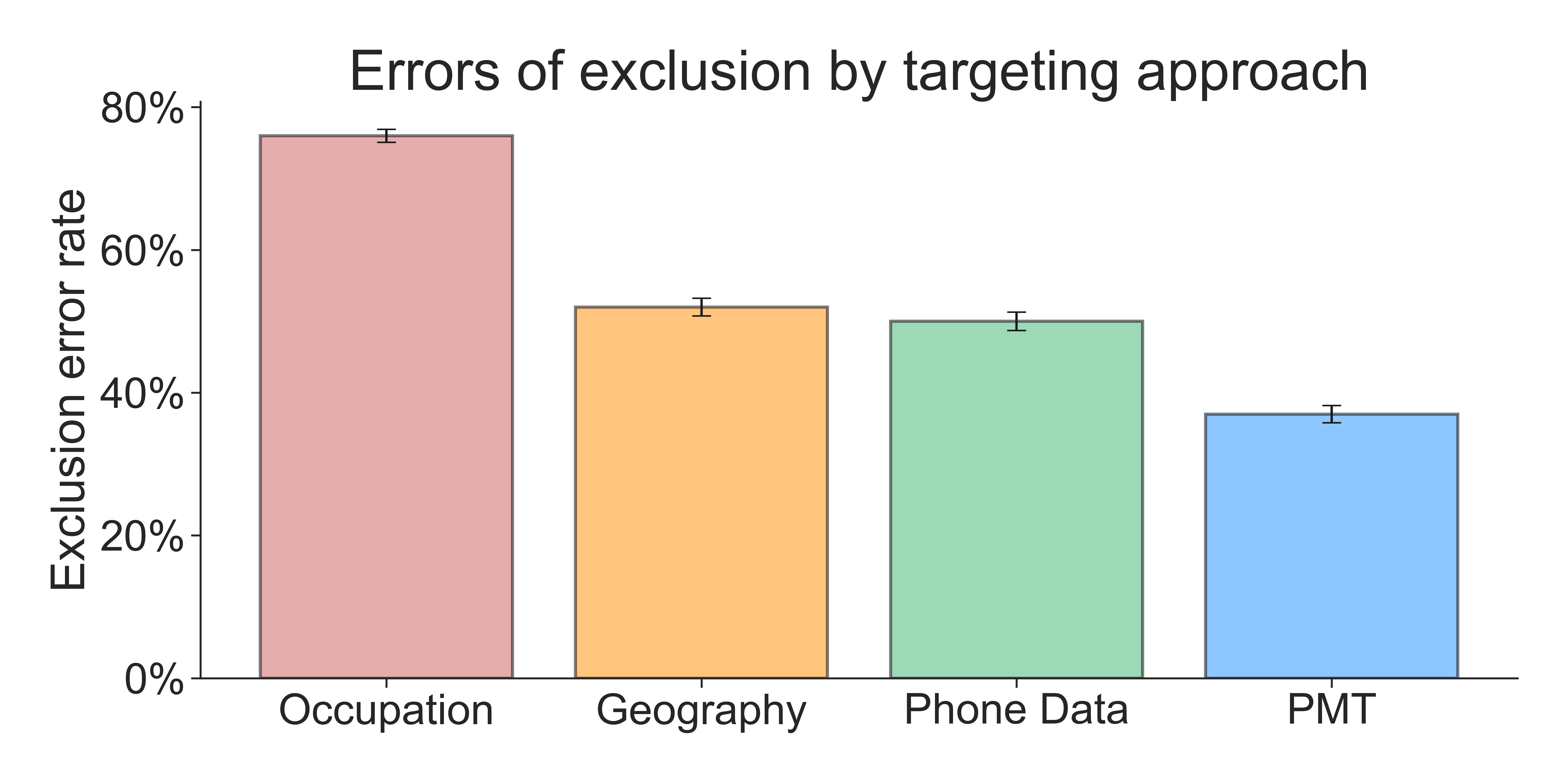
We found that the targeting approach based on mobile phone metadata was the most accurate approach feasible during the pandemic (i.e. requiring neither exhaustive survey data collection nor a social registry), outperforming both geographic and occupation-based targeting. Mobile phone data, however, was not as accurate as relying on traditional survey-based poverty scorecards such as proxy-means tests. Figure 2 contains more details on the accuracy of each of the targeting methods we assessed. Since our work on the Novissi programme, similar techniques for targeting based on mobile phone data have been adopted in other settings, including a pandemic cash transfer programme in the Democratic Republic of the Congo (Mukherjee et al. 2023), as well as GiveDirectly programmes in Malawi (GiveDirectly 2022) and Bangladesh (Aiken et al. 2025a).
Figure 2: Accuracy of approaches to targeting Novissi cash transfers in Togo
Evaluating the impact of cash transfers using mobile phone data
Once the Novissi cash transfers were delivered, we were eager to test whether the same poverty estimation techniques we had used for targeting could also be used for impact evaluation. If feasible, remote impact evaluation based on non-traditional data could enable monitoring and evaluation of policies at a much lower cost than traditional data collection–and could be implemented in settings (such as conflicts and natural disasters) where survey-based data collection is infeasible.
To benchmark the effectiveness of mobile phone data for impact evaluation, we conducted a randomised staggered roll-out of the Novissi programme: a randomly selected ‘treatment group’ of households received monthly Novissi transfers from November until April 2021, whereas the remaining ‘control’ households received the same total value in a lump sum in June 2021. In May 2021, we conducted a phone survey of 10,000 households across the treatment and control groups. By comparing treatment and control outcomes in our survey, we found that the cash transfers had modest but statistically significant impacts on food security, mental health, and perceived socioeconomic status (Aiken et al. 2025b).
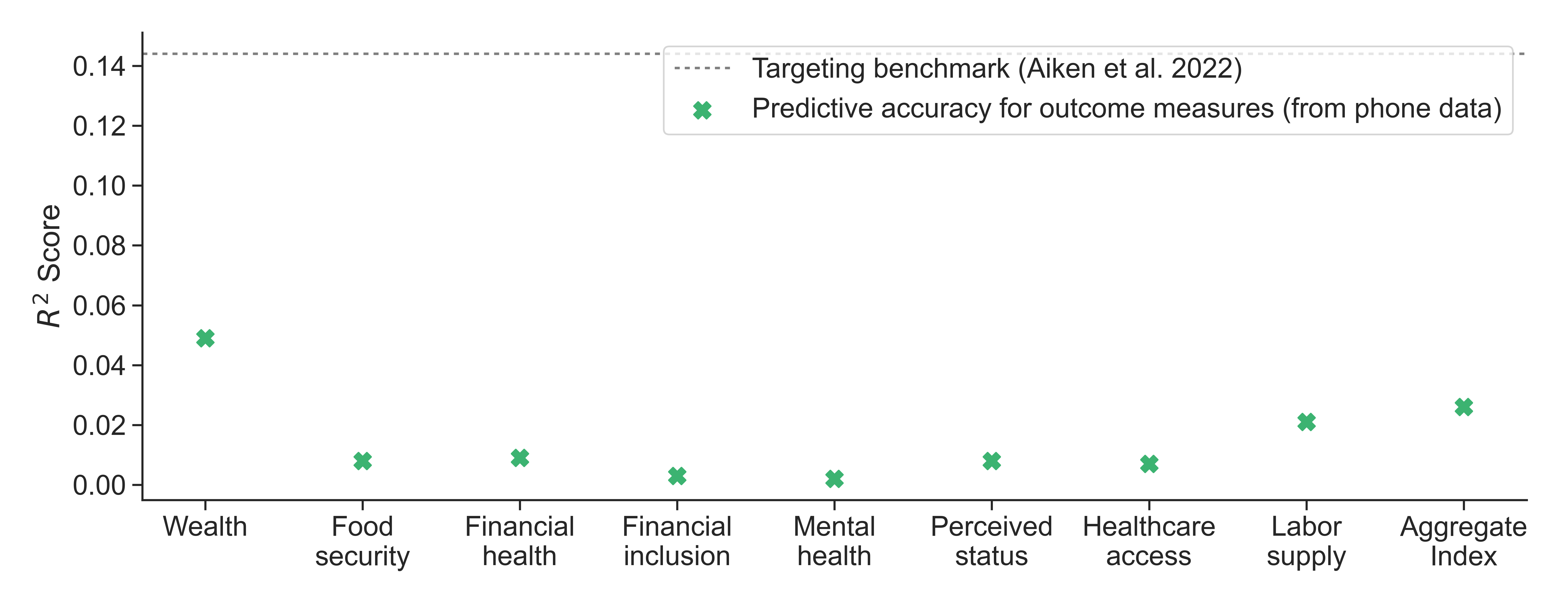
We also found that mobile phone use was significantly impacted by cash transfers: households in the treatment group used their phones on more days, placed more calls, and had more unique contacts than control group households. Estimates of poverty and wellbeing derived from mobile phone data, however, were not statistically significantly impacted by the programme (Figure 3). One key challenge was that the measures of poverty and wellbeing that were statistically significantly impacted by the cash transfers–such as food security and mental health–were much more difficult to estimate from mobile phone metadata than the consumption expenditures-based measure of poverty used in the targeting project (Figure 4). As a result, the phone-based estimates of food security, mental health, and other impact evaluation outcomes are substantially less accurate than the phone-based estimates of consumption expenditures, leading to imprecise estimates of programme impacts.
Figure 3: Impacts of Novissi cash transfers measured with surveys vs. measured with phone data
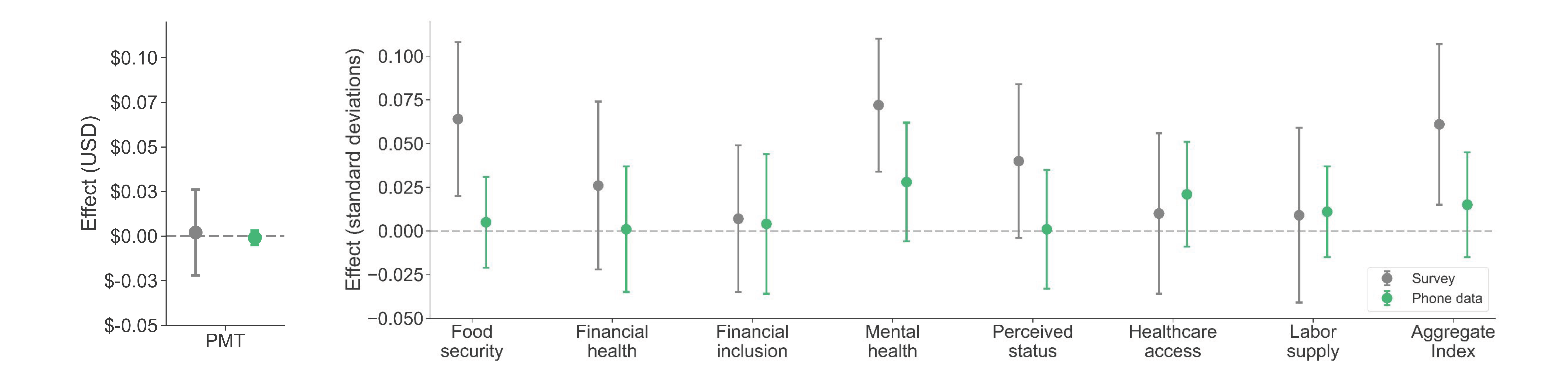
Figure 4: Accuracy for predicting endline survey outcomes from phone data, in comparison to the accuracy for poverty prediction from our paper on targeting
Opportunities and challenges for phone-based targeting and impact evaluation going forward
Our research shows that, in the context of rural Togo and the Novissi programme, impact evaluation using mobile data was substantially more challenging than poverty targeting with mobile phone data. There are several specific challenges to impact evaluation with mobile phone data that would benefit from further research. First, in the context of our work on the Novissi programme, the survey-measured impacts of cash were relatively modest. Interventions that have larger impacts, like large cash transfers or graduation programmes, may be easier to observe in mobile phone metadata and other non-traditional data sources. For example, Huang et al. (2021) showed that the impacts of a large GiveDirectly cash transfer programme in Kenya could be recovered using satellite imagery. Second, in comparison to the targeting setting, evaluating impacts with mobile phone metadata may require not just detecting levels of poverty, but also detecting changes in poverty over time. This can be more challenging in the machine learning setting (Yeh et al. 2020), and potentially even more so if changes do not affect long-term poverty, but instead manifest in more experiential or wellbeing-based indicators that capture short-term or transient poverty-related stress. Future research could dig into time series methods specifically designed for measuring poverty dynamics from non-traditional data.
References
Aiken, E, A Ashraf, J Blumenstock, R Guiteras, and A M Mobarak (2025a), “Scalable targeting of social protection: When do algorithms out-perform surveys and community knowledge?” Unpublished manuscript.
Aiken, E, S Bellue, J E Blumenstock, D Karlan, and C Udry (2025b), “Estimating impact with surveys versus digital traces: Evidence from randomized cash transfers in Togo,” Journal of Development Economics, 175: 103477.
Aiken, E, S Bellue, D Karlan, C Udry, and J E Blumenstock (2022), “Machine learning and phone data can improve targeting of humanitarian aid,” Nature, 603(7903): 864–870.
Blumenstock, J, G Cadamuro, and R On (2015), “Predicting poverty and wealth from mobile phone metadata,” Science, 350(6264): 1073–1076.
Blumenstock, J E, G Chi, and X Tan (2025), “Migration and the value of social networks,” Review of Economic Studies, 92(1): 97–128.
D’Andrea, A, P Hitayezu, K Kpodar, N Limodio, and A Presbitero (2025), “Expanding mobile internet fueled a financial transition in Rwanda,” VoxDev.
Dube, O, J E Blumenstock, and M Callen (2025), “What mobile data can tell us about religion in conflict zones,” VoxDev.
GiveDirectly (2022), “Canva partnership tackling extreme poverty in Malawi one year on.”
GSMA (2024), "The mobile economy: Sub-Saharan Africa."
Gundogdu, D, O D Incel, A A Salah, and B Lepri (2016), “Countrywide arrhythmia: Emergency event detection using mobile phone data,” EPJ Data Science, 5: 1–19.
Jean, N, M Burke, M Xie, W M Alampay Davis, D B Lobell, and S Ermon (2016), “Combining satellite imagery and machine learning to predict poverty,” Science, 353(6301): 790–794.
Hanson, G and A Khandelwal (2018), “Satellite imagery: The future of tracking urban markets,” VoxDev.
Huang, L Y, S M Hsiang, and M Gonzalez-Navarro (2021), “Using satellite imagery and deep learning to evaluate the impact of anti-poverty programs,” Unpublished manuscript.
Lopez, J (2020), “Experimenting with poverty: The SISBEN and data analytics projects in Colombia,” Unpublished manuscript.
Lu, X, L Bengtsson, and P Holme (2012), “Predictability of population displacement after the 2010 Haiti earthquake,” Proceedings of the National Academy of Sciences, 109(29): 11576–11581.
Mukherjee, A N, L X Bermeo, Y Okamura, J V Muhindo, and P G Bance (2023), “Digital-first approach to emergency cash transfers: Step-kin in the Democratic Republic of Congo,” World Bank.
Soto, V, V Frias-Martinez, J Virseda, and E Frias-Martinez (2011), “Prediction of socioeconomic levels using cell phone records,” in User Modeling, Adaptation and Personalization: 19th International Conference, UMAP 2011.
Yeh, C, A Perez, A Driscoll, G Azzari, Z Tang, D Lobell, et al. (2020), “Using publicly available satellite imagery and deep learning to understand economic well-being in Africa,” Nature Communications, 11(1): 2583.