







An experiment in Nairobi's informal settlements found that parents usually made child-nutrition decisions cooperatively, and that fathers were at least as willing as mothers to allocate resources to their children's meals – challenging the case for universally targeting mothers in cash transfer programmes.
Editor's note: The authors have made slides available here.
As cash transfers become a standard part of social protection, one question keeps coming back: if the goal is to improve children’s welfare, who in the household should receive the money? Early evidence suggested that resources controlled by women often translate into more spending on children (Thomas 1990, Duflo 2003, Armand et al. 2020), but more recent work urges caution: household decision-making is not a black box we can safely ignore, and programme design matters (Doepke and Tertilt 2019, Crosta et al. 2025).
The stakes are high. As of 2024, 150.2 million children under five globally are stunted and 42.8 million are wasted (UNICEF et al. 2025). In poor urban areas, where cash is tight and food prices are volatile, policymakers need to know not only whether parents care about nutrition, but how mothers and fathers make decisions together.
In our research, we study 424 married couples in Nairobi’s informal settlements (Cherchye, Chiappori, De Rock, Ringdal, and Vermeulen 2025). Each couple faced a simple but revealing set of choices. First, each parent separately chose how to divide an experimental budget between cash for themselves and subsidised nutritious meals for one of their children. Then the couple made the same choices jointly. Because budgets and relative prices changed across 11 decision problems, the experiment lets us go beyond a single observed choice and study how preferences and bargaining interact.
In informal settlements, even households that devote a large share of income to food can still struggle to provide nutrient-rich diets for children, so the way resources are allocated within the household may matter as much as the overall budget.
Do parents cooperate or compete over children’s welfare?
A key question is whether joint household choices look cooperative or non-cooperative. In a non-cooperative household, each parent has an incentive to free ride on the other’s concern for the child. That would tend to push joint spending on the child below what either parent would choose alone. In a cooperative household, by contrast, the joint choice should typically lie between the two individual choices: bargaining changes the final allocation, but parents still internalise each other’s preferences.
That comparison delivers a clear answer. In 88.8% of decision problems, the couple’s joint allocation to the child was between the mother’s and the father’s individual allocations. In only 4.6% of cases did the joint choice fall below both individual choices. Formal testing reveals the same story: the data fits a cooperative bargaining model much better than a non-cooperative one.
This finding complicates a common policy instinct: many programmes are implicitly designed around the idea that mothers and fathers have sharply conflicting objectives and that better child outcomes require shifting resources towards mothers. Our results suggest that, at least in this setting, that picture is too stark. Fathers and mothers do not always agree, but they usually behave as if they are solving a joint problem rather than sabotaging one another.
Figure 1: In almost nine out of ten cases, joint choices lay between the parents’ individual choices
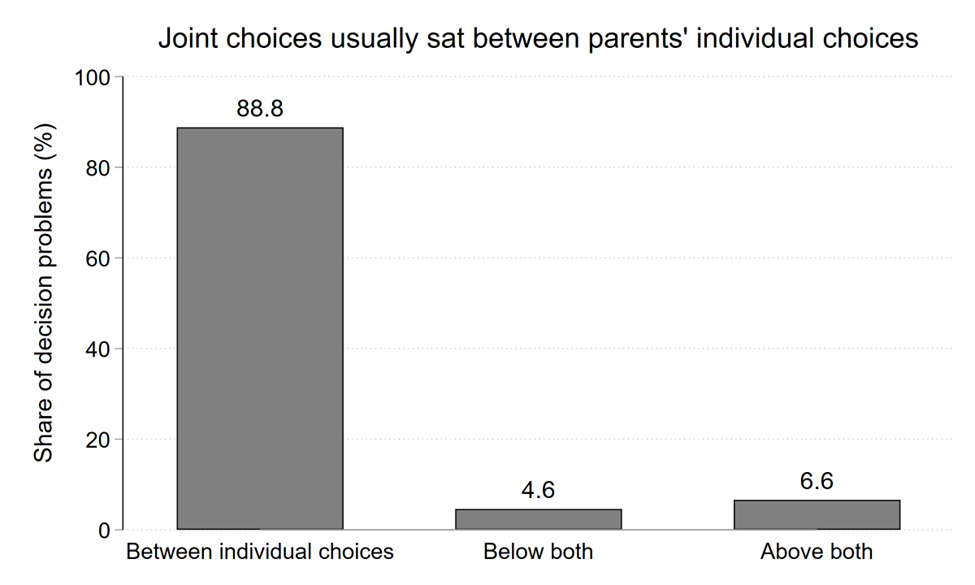
Notes: ‘Below both’ corresponds to the non-cooperative prediction. Source: authors’ calculations from Cherchye et al. (2025), Table 1.
Who spends more on children?
Our second result is even more striking. When deciding alone, fathers devoted a larger share of the experimental budget to the child’s meals than mothers did: 37% versus 32% on average. The joint decision, at 35%, sat between the two. This does not mean fathers are universally more child-oriented than mothers, but it does mean that giving money directly to mothers does not work well in every context.
The structural analysis also suggests that women had, if anything, a somewhat stronger bargaining position on average. In joint decisions, women ended up with a slightly larger share of private spending than men. Put differently, our results do not fit a simple story in which mothers are more altruistic but have little say, while fathers are selfish and dominant. Preferences and bargaining both matter, and in our sample both are more balanced than standard narratives often assume.
Figure 2: Average allocations in individual and joint decisions
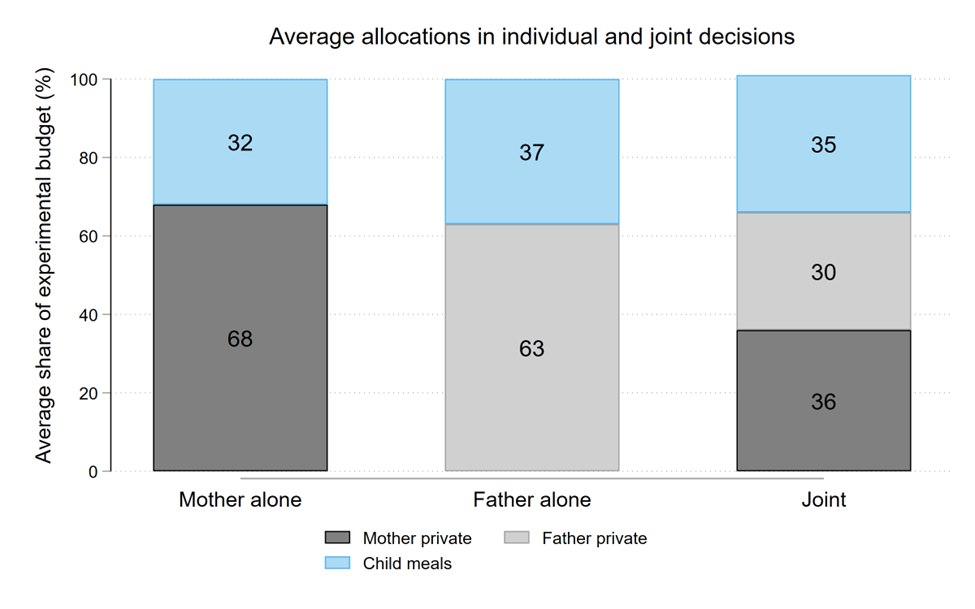
Notes: In the individual decisions, allocations were only made between the decision-maker and the child. Source: Authors’ calculations from Cherchye et al. (2025), Table 4.
Policy implications: Rethinking who receives transfers
One implication is caution about universal rules. Targeting mothers can still be justified for many reasons, including fairness, protection, autonomy, and in some cases children’s welfare. The point is narrower but important: the identity of the transfer recipient is not a universal proxy for child-oriented preferences. A programme that works through women in one setting may not do so for the same reason in another.
Another implication is to focus on effective control, not just nominal targeting. A payment made in a woman’s name may have different effects depending on whether she can actually access, store, and spend the money. Gender targeting, transfer frequency, and child-focused framing can all matter, and their effects need not come from pure preference differences alone (Crosta et al. 2025). Our results reinforce that view.
The third implication is that interventions may work better when they build on cooperation rather than assume conflict. If couples normally bargain efficiently, then joint planning tools, clear labelling of funds for child nutrition, or complementary information about diet quality may sometimes outperform policies that treat the household as a battleground. In other contexts, of course, strengthening women’s voice may still be essential. The point is that design should be driven by evidence on household behaviour, not by stereotypes.
Finally, variation matters. Our averages hide wide variation across households. Some couples allocated almost nothing to the child in the experiment, while others allocated nearly everything. That is a warning against one-size-fits-all programme design. Nutrition policy for poor urban households may need a mix of instruments: cash, information, targeted supplementation, and close attention to which households are most likely to underinvest in children.
The need for context
There are also reasons to be careful in generalising. Our study concerns poor monogamous couples in Nairobi and a specific choice between private cash and subsidised meals for one child. Real households make many other decisions at the same time, and mothers may sometimes spend less on this particular meal option because they are thinking about other household needs. Thus, our findings should not be read as proof that recipient identity never matters, or that mothers and fathers always have identical priorities.
But they do make one point very clearly. If policymakers want to improve children’s nutrition, they should start by understanding how decisions are actually made inside households. In our sample, parents mostly acted cooperatively, and fathers were not less willing than mothers to spend on their children. That should make us more careful about treating ‘transfer to mothers’ as a universal law of policy design. Sometimes it will help. Sometimes it will help for reasons other than different preferences. And sometimes the biggest gains will come not from choosing one parent over the other, but from designing programmes that work with the way families already make decisions together.
References
Armand, A, O Attanasio, P Carneiro, and V Lechene (2020), "The effect of gender-targeted conditional cash transfers on household expenditures: Evidence from a randomized experiment", The Economic Journal 130(631): 1875–97.
Cherchye, L, P-A Chiappori, B De Rock, C Ringdal, and F Vermeulen (2025), "Feed the children", The Economic Journal, ueaf099.
Crosta, T, D Karlan, F Ong, J Rüschenpöhler, and C R Udry (2025), "Unconditional cash transfers: A Bayesian meta-analysis of randomized evaluations in low and middle income countries", Unpublished manuscript.
Doepke, M, and M Tertilt (2019), "Does female empowerment promote economic development?" Journal of Economic Growth 24: 309–343.
Duflo, E (2003), "Grandmothers and granddaughters: Old age pensions and intrahousehold allocation in South Africa", The World Bank Economic Review 17(1): 1–25.
Thomas, D (1990), "Intra-household resource allocation: An inferential approach", Journal of Human Resources 25(4): 635–64.
UNICEF, WHO, and World Bank (2025), "Levels and trends in child malnutrition: Key findings of the 2025 edition of the Joint Child Malnutrition Estimates."