





Experimental evidence from rural Malawi shows that women's reputation concerns within households can lead to underinvestment in new technologies and persistence with bad ones. Engaging both spouses and/or equipping women to effectively communicate the proven benefits of new technologies could help promote their adoption.
In low-income countries, women's economic autonomy is often constrained by limited access to income-generating opportunities and formal financial services. This makes many women dependent on discretionary transfers from their husbands to meet household needs and make investments. While economic policies have traditionally focused on increasing women's bargaining power through external factors such as education and income, our research reveals a crucial internal household dynamic that significantly affects women's economic decisions: reputation management.
Women’s reputation matters in household finance
In Kenya, Dupas (2009) found that providing a voucher to both spouses, rather than only wives, could increase investment in a novel preventive health product. In Zambia, Ashraf et al. (2010) observed that women are more likely to use a water treatment product when they have to pay for it, as opposed to receiving it for free.
Our research in rural Malawi explains these findings using the concept of ‘market expertise reputation’ (Buchmann et al. 2025). We show that husbands condition financial transfers on their perception of their wives' competence as consumers, especially their ability to judge the value of new products. This creates strong incentives for women to protect their reputation, even at the cost of household efficiency. When wives avoid new technologies or continue using suboptimal products to maintain their image as competent decision-makers, information interventions that involve both spouses—such as those in Dupas (2009)—can eliminate this reputation barrier and increase adoption of beneficial technologies.
How women’s reputation concerns create inefficiencies
The key intuition for the reputation dynamics we study is as follows: if a husband provides his wife an allowance only when he believes she is a savvy investor, the wife faces a dilemma: trying a new product risks exposing her as a non-expert spender if the purchase fails. This creates two distinct inefficiencies:
- Under-investment in new products: In domains where they have no expertise, wives avoid unfamiliar goods—even those with high potential returns—to minimise the risk of making visible mistakes.
- Over-use of ‘lemons’: If the wife mistakenly purchases a substandard product, she may choose to use it regardless in an attempt to ‘hide’ the error from her husband and protect her reputation. This provides a rationale for behaviour that is empirically equivalent to the sunk cost fallacy—the tendency to follow through with an endeavour after having invested time, effort, or money into it.
Do husbands condition transfers on wives' perceived competence?
We conducted three complementary experiments with over 2,600 married couples in rural Malawi to test this theory. In our first experiment, 1,093 husbands participated in a modified dictator game in which they decided how much money to allocate to their wives. The money shared with the wife was multiplied by a factor of 1.5, incentivising husbands to transfer to their wives. For a randomly selected half of the spouses, we first made the wife's purchase history salient by asking detailed questions about her recent marketplace decisions.
The results were striking: husbands whose wives had a reputation for low market expertise reduced their transfers by 13% when reminded of this history (Figure 1). For wives with strong reputations, there was no negative effect, confirming that perceived competence directly influences financial support.
Figure 1: Effect of reputation salience on amount (%) transferred from husbands to wives
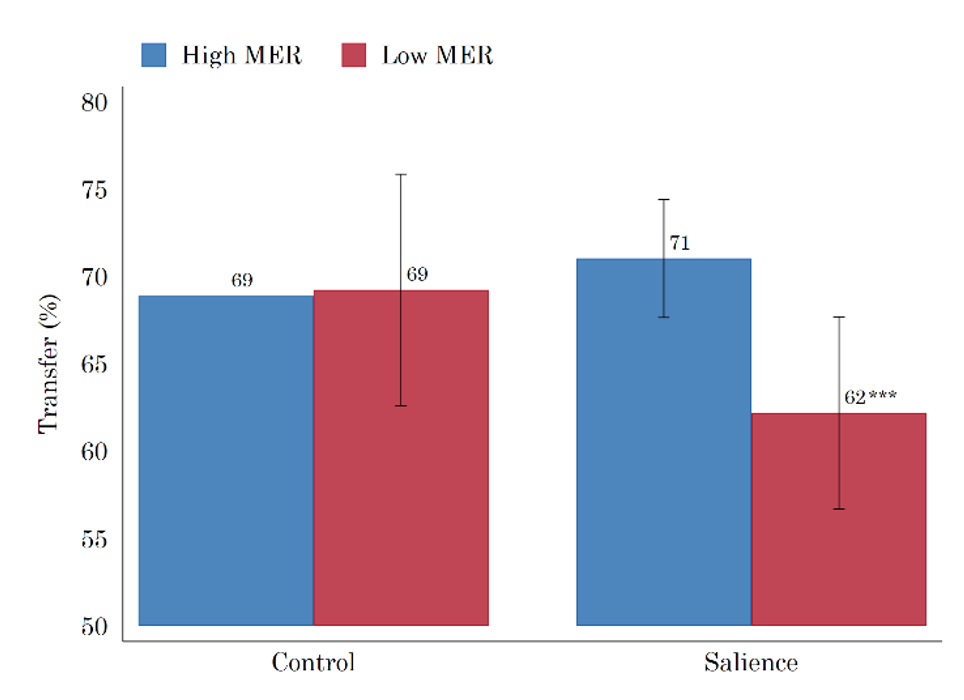
Notes: The graph shows modified means from regressions. “High and low MER” indicate whether the husband considers his wife to have high or low “Market Expertise Reputation”. p <0.10*, p <0.05**, p <0.01***
Do women strategically manage their reputation in the household?
In our second experiment, wives completed a quiz assessing their ability to identify high- and low-quality goods on local markets. They could choose to share their score with their husband (‘play’) in exchange for a bonus payment, and could pay a price to hide wrong answers before sharing (‘correct errors’). We randomly varied the hiding price to be either low, intermediate, or high.
Women who perceived themselves as non-experts were significantly less likely to participate when hiding mistakes was costly (Figure 2). When hiding was affordable, they participated but paid substantial amounts (up to 36% of daily income) to correct their scores and conceal errors from their husbands.
Figure 2: Effect of hiding price on sharing the score with the husband (%) and correct errors (number correct)
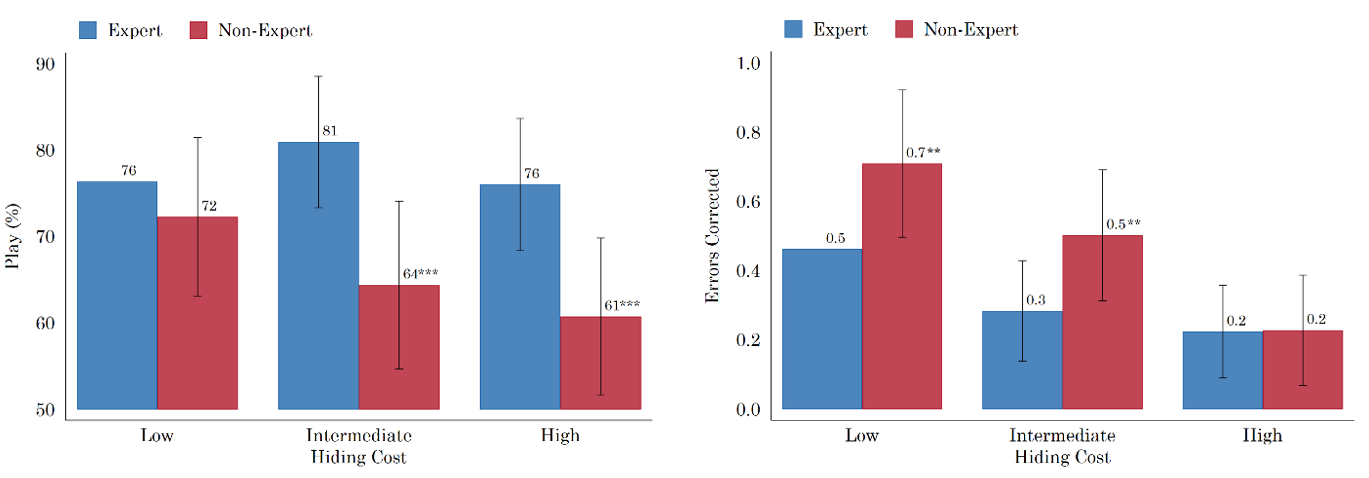
Notes: The graph shows modified means from regressions. ‘Expert’ and ‘Non-Expert’ indicate whether the wife believes to have a high or low score on the quiz. p <0.10*, p <0.05**, p <0.01***
Do reputation concerns affect real-world purchases?
Our third experiment offered women an unfamiliar but high-return product in a real market setting. Some women randomly received the product with a sticker indicating that it was donated (i.e. not purchased with the husband’s money) or its effectiveness had been verified by experts (certain payoff).
Without these stickers, women who considered themselves non-experts were 25% less likely to accept the product than self-perceived experts (Figure 3). With either sticker, this gap disappeared completely, suggesting that the ability to deflect responsibility for the decision or have external validation removed the reputational barrier.
Figure 3: Effect of stickers on willingness to pay for the unfamiliar good (MWK)
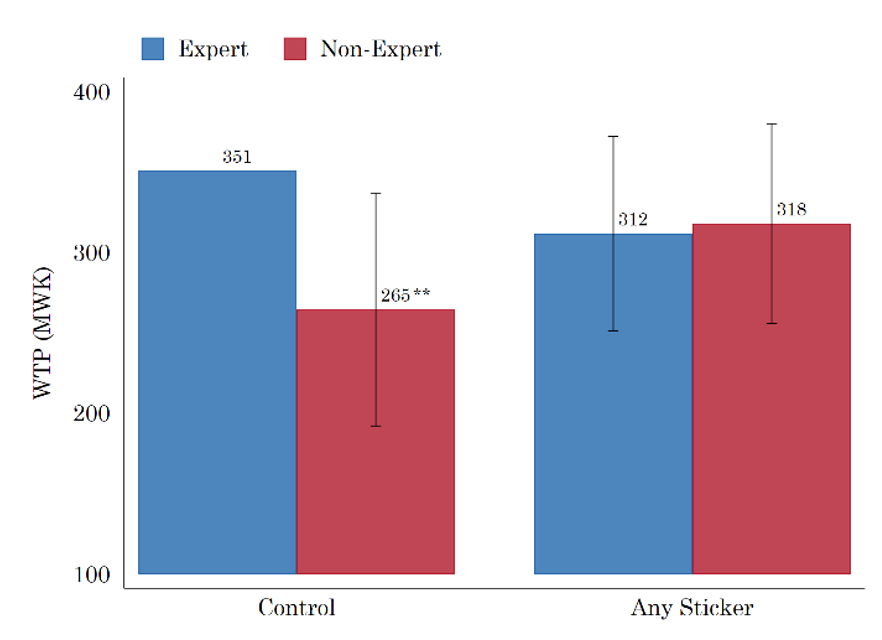
Notes: The graph shows modified means from regressions. ‘Expert’ and ‘Non-Expert’ indicate whether the wife believes her husband to consider her an expert or non-expert. p <0.10*, p <0.05**, p <0.01***
Taking reputation concerns into account when designing policy
These findings have significant implications for policy and programme design. Campaigns promoting new technologies or goods could potentially be more successful and pose less reputation risk to women by engaging both spouses and/or equipping women with credible means to communicate the benefits of the products to their spouses.
Finally, although our research focuses on wives’ reputation concerns, there is no reason the mechanism would not operate symmetric in contexts where spousal roles are reversed. When both spouses earn equal income, reputation may still matter for the share of the budget that one has control over. For example, a spouse who purchased a bench press that was only used twice in the last year may face resistance when suggesting buying a treadmill. Our framework could also apply to parents and teenage children, or international migrants and those receiving their remittances. However, we see the dynamics we model as particularly consequential for poor households in low-income countries, where the subordinate position and financial dependence of one spouse relative to the other remain common and exacerbate the issue.
References
Ashraf, N, J Berry, and J M Shapiro (2010), “Can higher prices stimulate product use? Evidence from a field experiment in Zambia”, American Economic Review, 100(5): 2383–2413.
Buchmann, N, P Dupas, and R Ziparo (2025), “The good wife? Reputation dynamics and financial decision-making inside the household”, American Economic Review, 115(2): 525–570.
Dupas, P (2009), “What matters (and what does not) in households’ decision to invest in malaria prevention?”, American Economic Review, 99(2): 224–230.