


China’s bureaucratic promotion system unintentionally incentivises local leaders to restrict trade and underinvest in cross-jurisdictional infrastructure with provincial peers, fragmenting the world’s largest domestic markets and undermining long-term growth.
Editor's note: The author has made slides available here.
Geopolitical tensions fragment international trade (Fajgelbaum et al. 2020, Caldara and Iacoviello 2022, Kleinman et al. 2024), but can analogous political forces fragment markets within a single country? Despite decades of reform, China's domestic market remains surprisingly disintegrated, with local protectionism generating substantial welfare losses (Barwick et al. 2021).
In recent work (Jiang 2025), I show that China's bureaucratic promotion system, often credited with driving economic growth, is itself a major source of this fragmentation. When local leaders compete for career advancement, they strategically restrict trade that benefits their political rivals.
The promotion trap: When helping your neighbour hurts your career
China evaluates city party secretaries – the top political leaders at the city level – through yardstick competition, comparing their economic performance against provincial peers (Shleifer 1985, Besley and Case 1995). When a city builds a motorway or subsidises manufacturers, the resulting trade creates spillovers for neighbouring cities. Under relative evaluation, boosting a rival's economy worsens one's own promotion chances. Politicians respond by redirecting resources towards real estate, generating rapid, locally confined GDP gains, while underinvesting in connective infrastructure and tradable manufacturing.
Measuring competition through leaders’ ages
Age is one of the strongest predictors of promotion in China (Wang et al. 2020). Leaders face mandatory retirement, and those whose age is far from the provincial average face less competitive pressure. I measure competition using the absolute age gap between a city’s party secretary and her provincial peers. Small gaps mean fierce rivalry; large gaps mean the leader has effectively exited the race. Because this variation is largely driven by leadership turnover in other cities, it is plausibly exogenous to local economic conditions.
More competition, less trade
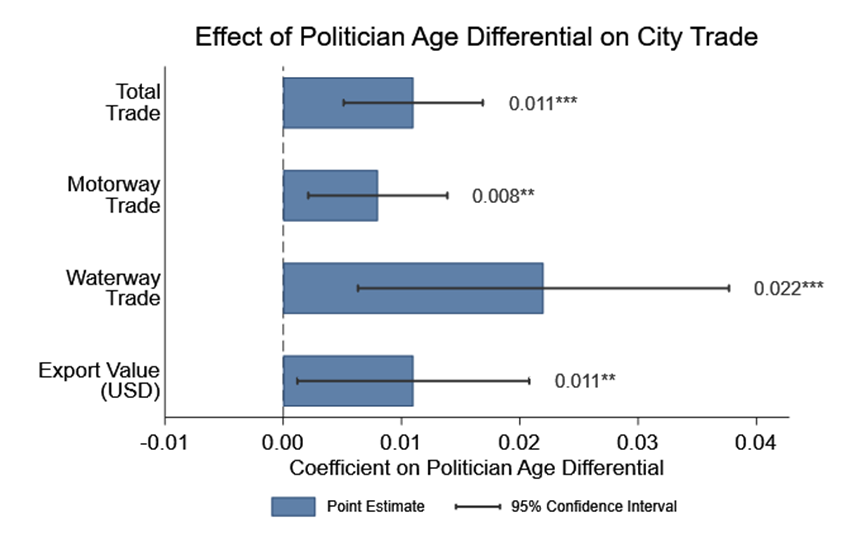
Combining trade data for 283 cities with biographical records of their top leaders – city party secretaries – over 1996–2018, I find that intensified yardstick competition significantly reduces inter-city trade. Effects vary strikingly by transport mode: waterway trade, where leaders exercise the most regulatory control, is most affected, followed by motorway trade. Exports also fall, suggesting that domestic fragmentation inadvertently undermines international competitiveness.
Figure 1: Effect of reduced competition on trade, by transport mode
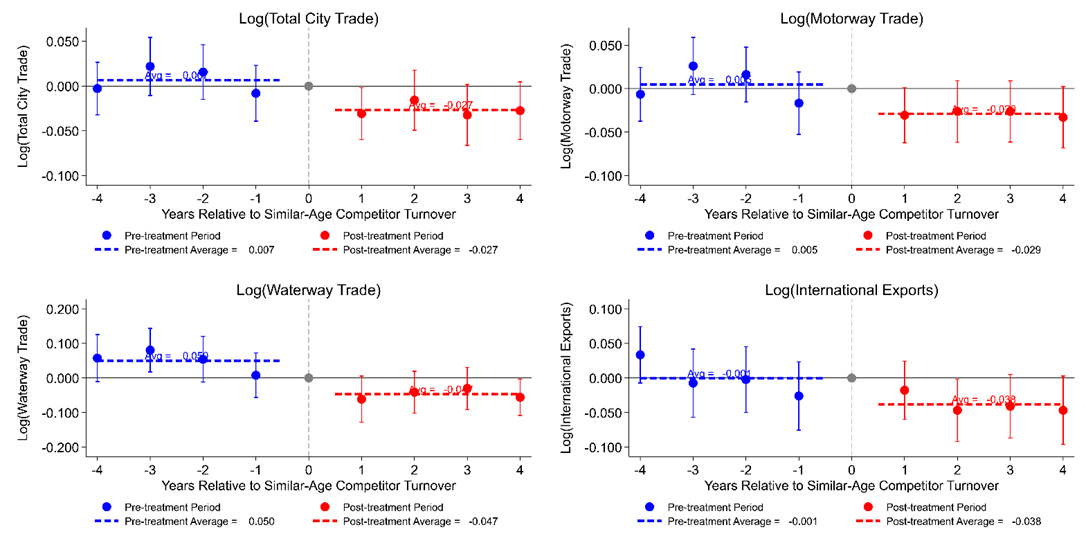
Critically, repeating the analysis for city mayors, who do not face the same within-province tournament, yields zero effects. An event study tracking the arrival of a similar-age competitor confirms causality: trade declines only after the new rival arrives, with no pre-trends.
Figure 2: Event study – trade falls after the arrival of a similar-age competitor
Three policy levers that fragment markets
I identify three policy tools through which competing leaders fragment markets:
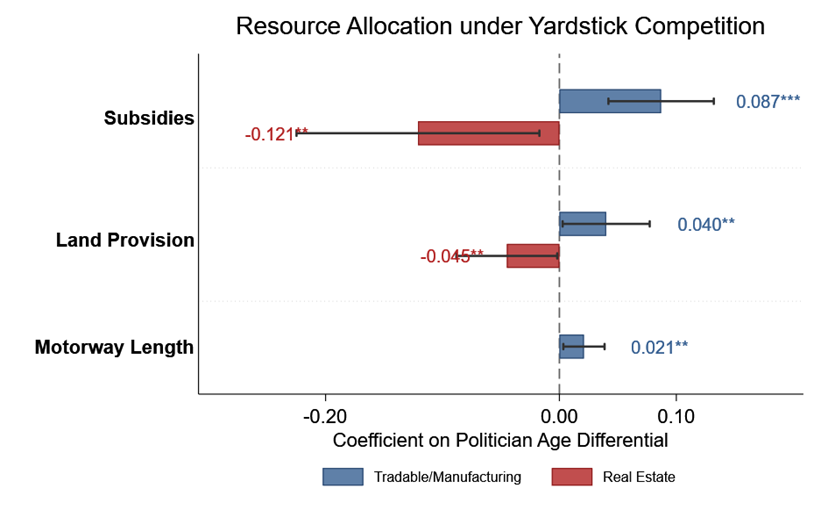
- They underinvest in trade infrastructure. Cities under intense competition build fewer motorway links, and this underinvestment concentrates precisely at jurisdictional borders – the locations where new roads would most benefit neighbouring rivals. Interior roads, whose benefits stay local, are largely unaffected.
- Government subsidies shift away from tradable manufacturing and towards real estate. Tradable firms generate supply-chain linkages that spill across city boundaries; real estate delivers rapid, visible GDP growth that stays within the leader's jurisdiction. When competition intensifies, leaders tilt subsidies towards the latter.
- Land allocation follows the same logic: competitive leaders release less industrial land and more residential land, constraining the physical capacity of tradable sectors while fuelling a local property boom.
Figure 3: Three channels – infrastructure, subsidies, and land allocation
Supply chains disrupted, long-run growth undermined
These distortions ripple through firm networks. Using machine learning to identify business linkages between firms, I show that intensified competition in one city reduces input access, revenue, and productivity not only for local firms but also for connected suppliers and partners in other cities. Downstream firms that rely on intermediate inputs from multiple jurisdictions are hit hardest. This also explains why international exports decline even though politicians have no incentive to restrict them: when domestic supply chains fragment, exporting firms lose access to competitively priced inputs, undermining their global competitiveness as an unintended consequence.
These costs accumulate over time. While tournament incentives motivate effort and boost short-term GDP (Li and Zhou 2005), the trade barriers they generate become entrenched. Cities exposed to more intense competition show approximately 1.9% lower annual GDP growth over two decades, revealing that the protectionist strategies that help individual leaders win promotion collectively undermine the long-term prosperity of the regions they govern.
Implications beyond China
These findings reveal a fundamental tension in decentralised governance that extends well beyond China. Whenever local leaders are evaluated relative to their peers, they have incentives not only to improve their own performance but also to undermine their neighbours. This logic applies to any setting where subnational governments compete under relative evaluation, from federal systems with fiscal competition to development programmes that allocate aid based on comparative performance.
Reforms should consider incorporating inter-jurisdictional outcomes into evaluation criteria or centralising decisions over connective infrastructure. More broadly, policymakers designing decentralised institutions must recognise that incentivising local effort and fostering market integration can be fundamentally at odds.
References
Barwick, P J, S Cao, and S Li (2021), “Local protectionism, market structure, and social welfare: China’s automobile market,” American Economic Journal: Economic Policy, 13(4): 112–151.
Besley, T, and A Case (1995), “Incumbent behavior: Vote-seeking, tax-setting, and yardstick competition,” American Economic Review, 85(1): 25–45.
Caldara, D, and M Iacoviello (2022), “Measuring geopolitical risk,” American Economic Review, 112(4): 1194–1225.
Fajgelbaum, P, P Goldberg, P Kennedy, and A Khandelwal (2020), “The return to protectionism,” Quarterly Journal of Economics, 135(1): 1–55.
Jiang, J (2025), “Politically induced internal trade barriers in China,” Unpublished manuscript.
Kleinman, B, E Liu, and S Redding (2024), “International friends and enemies,” American Economic Journal: Macroeconomics, 16(4): 350–385.
Li, H, and L-A Zhou (2005), “Political turnover and economic performance: The incentive role of personnel control in China,” Journal of Public Economics, 89(9–10): 1743–1762.
Shleifer, A (1985), “A theory of yardstick competition,” RAND Journal of Economics, 16: 319–327.
Wang, Z, Q Zhang, and L-A Zhou (2020), “Career incentives of city leaders and urban spatial expansion in China,” Review of Economics and Statistics, 102(5): 897–911.