



Greenfield investment plays a critical role in Africa’s integration into global value chains, with inward investment in manufacturing boosting forward participation, while outward African investment in services enhances overall participation.
Editor’s note: For a broader synthesis of themes covered in this article, check out our VoxDevLit on Foreign Direct Investment.
Global value chains (GVCs) have become linchpins of modern trade, offering pathways for countries to specialise, innovate, enhance productivity, and foster economic growth and development (Macchiavello and Grossi 2023), in addition to generating positive spillover effects on local firms (Amendolagine et al. 2017, Winkler 2018). For African economies, deeper integration into these chains holds immense potential for structural transformation. But what are the key drivers that facilitate this integration? Our recent research (Shingal and Agarwal 2025) delves into the role of greenfield investment – a type of foreign direct investment (FDI) that involves establishing new operations – in shaping Africa’s participation in GVCs.
While existing research has often examined the FDI-GVC nexus using aggregate cross-country (Fernandes et al. 2022) or firm-level data (Hoekman and Sanfilippo 2023), we take a bilateral approach, focusing on both inward and outward African greenfield investment between 2003 and 2022. By employing a gravity-type framework and leveraging detailed data on greenfield investment from fDi Markets, coupled with GVC participation measures calculated using the EORA data (Lenzen et al. 2012), we uncover nuanced patterns that shed light on how investment flows are shaping Africa's role in global production networks.
Greenfield investment and Africa’s pathways into global value chains
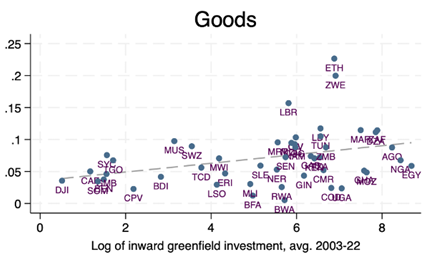
One of our key findings highlights the positive association between inward greenfield investment in manufacturing sectors and the forward participation of African host countries in GVCs (see Figure 1). Forward participation represents a country supplying intermediate goods and services to other countries for further processing and eventual export. In our results, this effect is largely driven by extra-African investment directed towards North Africa or the Arab Maghreb Union members. This suggests that investments originating from outside the continent are playing a crucial role in building North Africa's capacity to feed into global manufacturing value chains.
Our research uncovers another significant pattern: greenfield investment by African investors outside the continent is also positively linked to overall GVC participation. This finding is particularly driven by sub-Saharan African investment in services sectors, especially digitally delivered services, and mostly by South Africa. This hints at a growing sophistication and interconnectedness within the African continent, where outward investment in services is enabling both the investing and recipient countries to engage more actively in global value chains.
Figure 1: Inward extra-African investment in manufacturing sector drives forward participation of host countries
Source: Shingal and Agarwal (2025).
These results are robust to accounting for endogeneity in the two-way relationship between investment and GVC participation – a common challenge in such analyses. We also find consistency when using alternative investment data from the OECD, UNCTAD, and USAID, lending further credence to our conclusions.
In terms of mechanisms, we show that better contract enforcement, high quality infrastructure and institutions, and conducive FDI promotion policies tend to strengthen the association between investment and GVC participation in African countries.
Policy implications: Harnessing FDI for economic integration
Our findings carry important policy implications. They underscore that FDI, particularly greenfield investment that establishes new productive capacities, has significant ‘second order’ effects on productivity, growth, and structural transformation by fostering deeper GVC linkages.
Africa has experienced significant FDI growth since the 1990s, with inward stock surpassing US$1 trillion in 2022 led by South Africa, Egypt, Nigeria, Morocco, and Mozambique (Agarwal et al. 2024). However, its overall share in global FDI remains low at around 3% (UNCTAD 2018). Thus, empirical evidence on the positive link between FDI and value-chain integration across Africa is likely to incentivise policy action towards dismantling investment barriers within the continent, including via the African Continental Free Trade Area (AfCFTA), to attract quality greenfield investment from both within and outside Africa.
Facilitating such investment flows, in both manufacturing and services, can serve as a powerful catalyst for Africa's further integration into the global economy and unlock its potential for sustainable development. The Protocol on Investment AfCFTA can be leveraged to help countries improve the national investment climate and coordinate across members states to increase the ease of doing business, enhance transparency and improve the regulatory environment in Africa (Mbengue et al. 2024). By understanding these dynamics, African nations can strategically leverage greenfield investment to climb up the value chain, diversify their economies, and ultimately foster inclusive and sustainable growth.
References
Agarwal, P, Y Ayele, R McGarrell, V Murinde, R Ng’eno, and D W te Velde (2024), “Exploring data on foreign direct investment to support implementation of the AfCFTA Protocol on Investment,” ODI Global.
Amendolagine, V, A F Presbitero, R Rabellotti, M Sanfilippo, and A Seric (2017), “FDI, global value chains, and local sourcing in developing countries,” IMF Working Paper Series.
Fernandes, A M, H L Kee, and D Winkler (2022), “Determinants of global value chain participation: Cross-country evidence,” The World Bank Economic Review 36(2): 329–360.
Hoekman, B, and M Sanfilippo (2023), “Trade and value chain participation: Domestic firms and FDI spillovers in Africa,” The World Economy 46(11): 3367–3391.
Lenzen, M, K Kanemoto, D Moran, and A Geschke (2012), “Mapping the structure of the world economy,” Environmental Science & Technology 46(15): 8374–8381.
Macchiavello, R, and J C Grossi (2023), “Global value chains and development,” VoxDev.
Mbengue, M M, R Ng’eno, P Okala, and D W te Velde (2024), “Investment facilitation under the AfCFTA Protocol on Investment,” ODI Global.
Shingal, A, and P Agarwal (2025), “Greenfield investment and value-chain integration: Evidence from Africa,” STEG Working Paper.
UNCTAD (2018), “World investment report: Investment and new industrial policies.”
Winkler, D (2018), “Potential and actual FDI spillovers in global value chains: The role of foreign investor characteristics, absorptive capacity and transmission channels,” Journal of Banking and Financial Economics 2(10): 5–44.