





Indonesia’s non-tariff import measures – particularly inspections, import approvals, and port restrictions – significantly weakened exporters’ ability to adjust to China’s yuan depreciation by constraining their access to cheaper intermediate inputs. By contrast, tariffs did not meaningfully affect export resilience, highlighting that regulatory barriers, not import prices alone, were the main obstacle to adjustment.
Editor’s note: For a broader synthesis of themes covered in this article, check out Issue 2 of our VoxDevLit on International Trade.
Recent geopolitical tensions and shifting trade patterns have renewed concerns about how well exporters can cope with global shocks. Exchange rate movements, supply disruptions, and sudden changes in foreign competition can all undermine exporters that are unable to adapt quickly. Existing work and policy discussions have largely focused on how trading partners’ trade policies, such as tariffs and non-tariff measures, affect a country’s exports. (Goldberg and Pavcnik 2016, Fontagné et al. 2015, WTO 2021).
In contrast, our research on Indonesian exporters during a major geopolitical shock – China's 2014–2018 currency depreciation – reveals that Indonesia's own import regulations, particularly non-tariff measures (NTMs) on inputs, significantly affected exporters’ ability to respond to the shock (Calì et al. 2026).
Trade and competition in a turbulent world
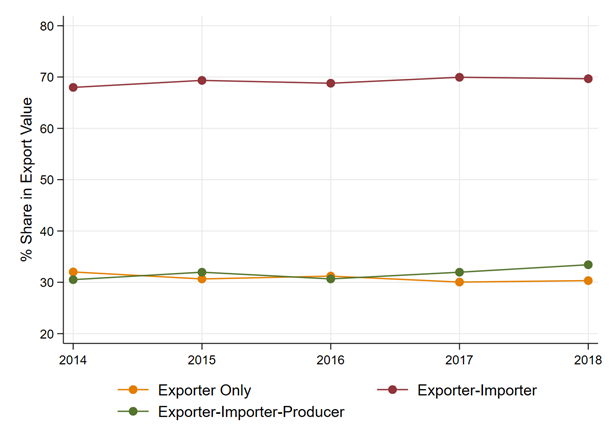
Indonesian exporters are no strangers to global competition. With more than US$180 billion in annual exports, Indonesia is deeply integrated into global markets and faces strong competition from Chinese firms in key destinations such as Japan, where China accounts for over 20% of total imports. At the same time, Indonesian exporters rely heavily on imported intermediate inputs: firms that both import and export account for around 70% of export value in our data (Figure 1).
Since access to foreign inputs is crucial for export performance (Amiti and Konings 2007, Halpern et al. 2015), domestic import regulations may critically shape how firms adjust when competitive pressure from China increases. That is particularly the case for NTMs, which increase the fixed cost per shipment, thereby reducing exporters’ ability to switch inputs towards alternative sources when they become cheaper. That is not the case for ad-valorem import tariffs, which raise the import costs only in proportion to their value.
What are non-tariff measures, and why do they matter?
NTMs – such as import approvals, mandatory standards, inspections, and port-of-entry restrictions – can affect access to these inputs. When designed well, these measures protect consumers, ensure product safety, and/or safeguard the environment. However, when they lack transparency or impose excessive compliance costs, they can become barriers, especially for firms that depend on imported inputs to compete globally.
Figure 1: Indonesian exports are dominated by GVC firms
A real-world stress test: The yuan depreciation
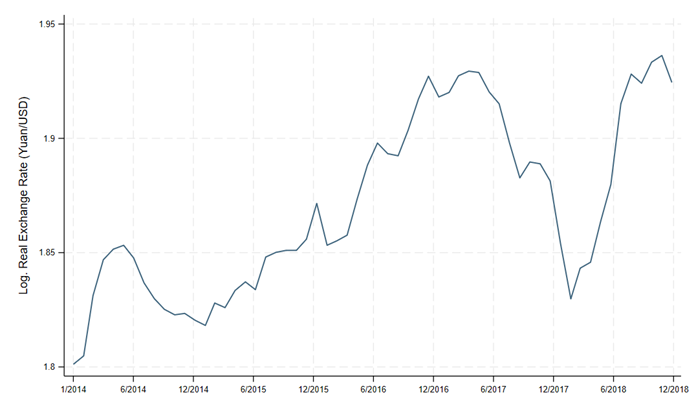
Between 2014 and 2018, the Chinese yuan depreciated against the US dollar by approximately 12% (Figure 2), making Chinese goods cheaper in third markets such as Japan. Indonesian exporters suddenly faced tougher competition – but also had a chance to buy cheaper inputs from China. The catch? Only firms not bogged down by NTMs could seize that opportunity. Firms grappling with regulatory costs imposed by NTMs had a harder time switching to cheaper inputs from China.
Figure 2: The Chinese yuan depreciated vis-a-vis the US dollar for most of 2014–18
NTMs hurt exporters’ ability to adapt
The impact was stark: a firm whose inputs were at the 75th percentile of NTM exposure saw its exports fall by 5.2 percentage points more than a firm at the 25th percentile after a 10% yuan devaluation. This happened because NTMs prevented adaptation. Firms with high NTM exposure imported from fewer countries and were 9.9 percentage points less likely to increase imports from China when Chinese inputs became cheaper. This lower ability to switch to cheaper sources of inputs appears to be the key mechanism behind the NTM effects on export response.
By contrast, tariffs showed no statistically significant effect on resilience: while they raise the cost of the imported inputs, they do not prevent firms from switching to cheaper suppliers.
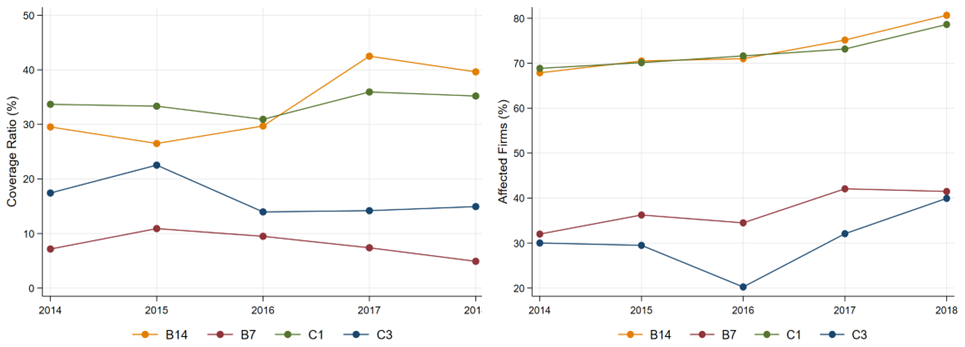
Not all NTMs hurt equally. We identified four particularly damaging measures, which we argue are largely protectionist – restricting trade without serving a clear public policy objective under WTO principles: pre-shipment inspections, import approvals, mandatory Indonesian standards certification, and port-of-entry restrictions. These measures cover a substantial share of imports (Figure 3a) and affect a large proportion of firms (Figure 3b). For instance, by 2018, import approvals and pre-shipment inspections each applied to over 35% of import value (coverage ratio) and affected at least 75% of exporter-producers (frequency ratio), while mandatory Indonesian standards certification and port restrictions, though less pervasive, still covered about 5% and 15%, respectively, of imports and touched more than one-third of firms.
Figure 3: A large share of products and firms are exposed to the four NTMs analysed
(a) Coverage ratio (by NTM) (b) Percent of affected firms (by NTM)
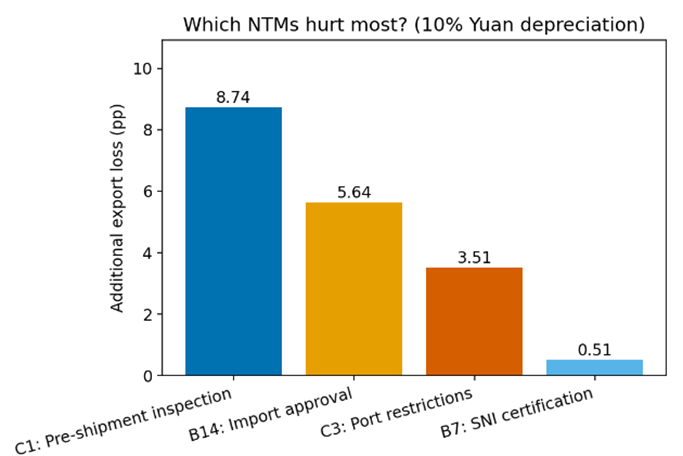
Impact also varies across measures (Figure 4). Pre-shipment inspections, which require shipments to be inspected at the port of departure from the exporting country before leaving for Indonesia, stand out as the most damaging: firms at the 90th percentile of exposure to this measure see their exports drop by 8.7 percentage points more than those at the median. Import approvals, typically issued by the Ministry of Trade before certain products can be shipped, are also highly restrictive, associated with a 5.6 percentage point larger export loss. Port-of-entry restrictions, which force firms to route imports through designated ports, lead to a 3.5 percentage point additional decline. Meanwhile, mandatory Indonesian standards certification – while widespread – has a more modest effect, with a 0.5 percentage point export loss for highly exposed firms. These figures, all calculated for the same 10% yuan depreciation shock, highlight that not all NTMs are equally costly. This differentiation is crucial for policymakers aiming to prioritise reforms that will most effectively boost exporters’ resilience.
Figure 4: NTMs affect export resilience to different degrees
Policy takeaways for trade
- Review NTMs critically and selectively. Not all NTMs serve a clear public interest. Policymakers should focus on those that genuinely protect consumers or the environment, and reconsider those that simply add red tape.
- Streamline import procedures. Faster, more predictable processes help firms respond quickly to changing global conditions.
- Support exporters in global value chains. Firms that rely on imported inputs are especially vulnerable to rigid rules. Targeted reforms could boost their resilience.
As global shocks – from currency swings to pandemics to trade wars – become more common, countries need to ensure their own policies are not making things worse.
For Indonesia, reforming the four NTMs we identify could significantly boost exporter resilience without compromising legitimate safety goals. For other developing countries, the lesson is clear: your own trade rules may matter more than your competitors' exchange rates.
References
Amiti, M, and J Konings (2007), “Trade liberalization, intermediate inputs, and productivity: Evidence from Indonesia,” American Economic Review, 97(5): 1611–1638.
Atkin, D, A Khandelwal, L Boudreau, R Dix-Carneiro, I Manelici, P Medina, B McCaig, A Morjaria, L Pascali, H Pellegrina, B Rijkers, and M Startz (2025), “International trade,” VoxDevLit, 4(2).
Calì, M, S Caicedo Graciano, D Ghose, A F Montfaucon, and M Ruta (2026), “Trade policy and exporters’ resilience: Evidence from Indonesia,” Journal of Development Economics, 179: 103561.
Fontagné, L, G Orefice, R Piermartini, and N Rocha (2015), “Product standards and margins of trade: Firm-level evidence,” Journal of International Economics, 97(1): 29–44.
Goldberg, P, and N Pavcnik (2016), “The effects of trade policy,” in Handbook of Commercial Policy, vol. 1, K Bagwell and R W Staiger (eds.), North-Holland: 161–206.
Halpern, L, M Koren, and A Szeidl (2015), “Imported inputs and productivity,” American Economic Review, 105(12): 3660–3703.
WTO (2021), "World trade report 2021: Economic resilience and trade."