





Bilateral trade agreements create opportunities beyond signatories. The US-Vietnam trade agreement led to large, persistent increases in formal manufacturing employment in Vietnam through the entry and expansion of multinationals from East Asia.
Editor’s note: For a broader synthesis of themes covered in this article, check out our VoxDevLits on Foreign Direct Investment and International Trade.
Low-income countries have dramatically expanded their exports over the past three decades (Hanson 2012, 2021), yet the long-run employment consequences of this growth remain poorly understood. While export expansion is often expected to generate jobs through firm entry and growth, extensive evidence shows that domestic firms in low-income countries rarely deliver sustained employment gains (Hsieh and Klenow 2014, McMillan and Zeufack 2022). At the same time, manufacturing export growth has increasingly taken place within global value chains dominated by multinational enterprises (MNEs) and their affiliates (Johnson and Noguera 2017). As a result, understanding how MNEs respond to new export opportunities is central to assessing whether export-led growth translates into sustained job creation.
Understanding new export opportunities and employment in Vietnam
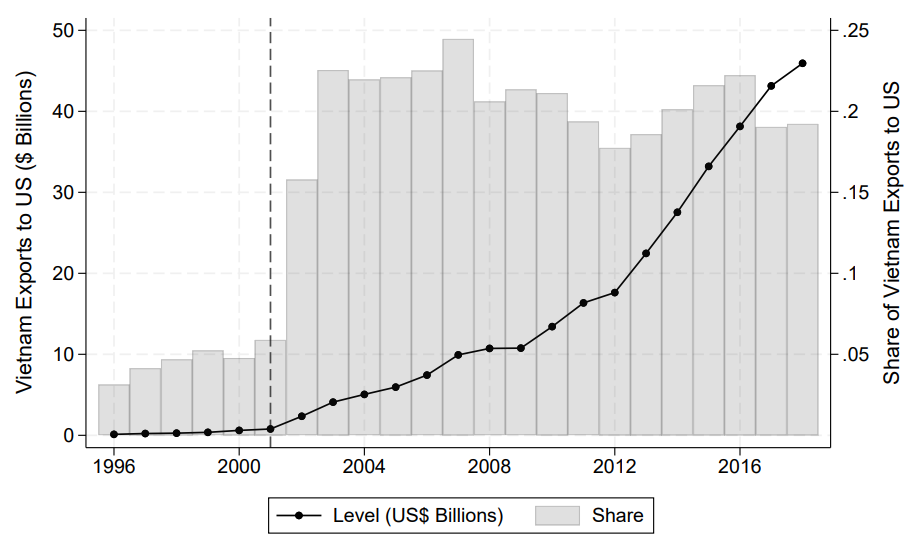
In McCaig, Pavcnik, and Wong (2025), we investigate the long-run employment effects of the 2001 US-Vietnam Bilateral Trade Agreement (BTA) in Vietnam. The BTA sharply and immediately reduced US tariffs on Vietnamese exports – from 31.9% to 2.9% on average for manufacturing – triggering a rapid expansion of Vietnamese exports to the US (Figure 1). The tariff cuts shifted Vietnam between pre-existing US tariff schedules, leaving no scope for industry-specific negotiation and making industry-level exposure plausibly exogenous (McCaig 2011).
Figure 1: Vietnamese manufacturing exports to the US, 1996–2018
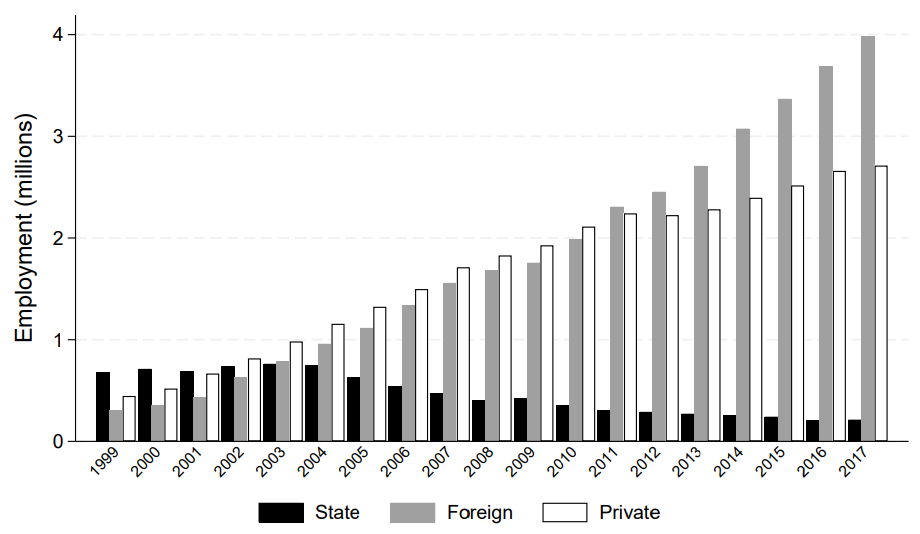
We combine this trade policy change with all formal manufacturing firm data from 1999 to 2017 to estimate the effects of this one-time reduction in US tariffs on Vietnamese employment for 16 years after the agreement. Over this period, formal manufacturing employment expanded dramatically, particularly in foreign firms (Figure 2).
Figure 2: Vietnamese manufacturing employment by ownership, 1999–2017
Large increases in export growth and long-run employment
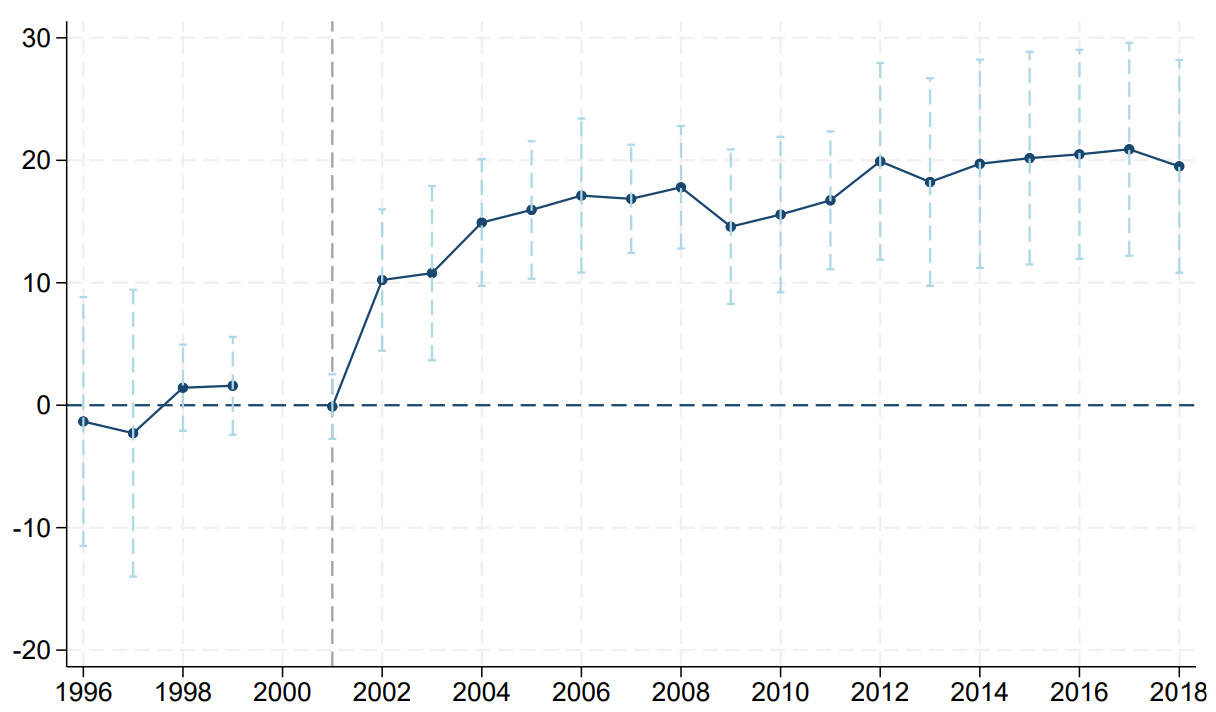
We first show that US tariff cuts under the BTA led to a large and immediate increase in Vietnamese exports to the US (Figure 3). Industries receiving larger tariff reductions experienced rapid export growth in the years following 2001, with effects that accumulated over time and remained strong through 2017, despite a temporary dip during the 2008 financial crisis. An industry exposed to the average tariff cut exported roughly five log points more to the US in the long run than an unexposed industry.
Figure 3: Effects of BTA tariff reductions on Vietnam’s exports to the US, 1996–2018
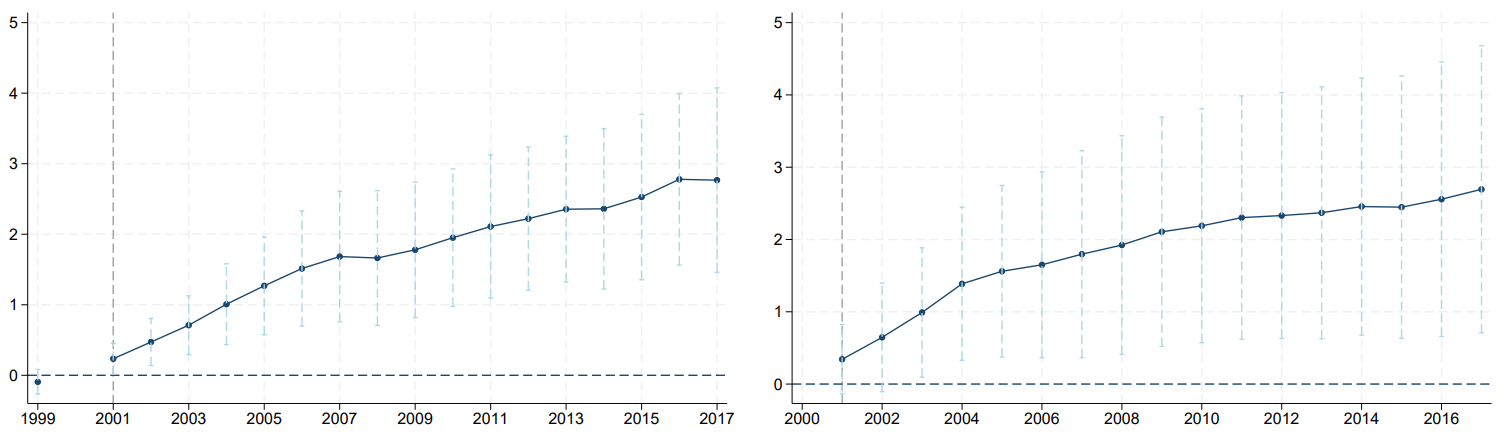
These export opportunities are associated with large employment expansion in the formal manufacturing sector (Figure 4). Vietnamese industries subject to the average tariff reduction doubled their employment relative to an unexposed industry. These gains accumulated rapidly in the short run and continued to increase up to 16 years after the BTA, highlighting the importance of a long-run perspective when evaluating the labour market effects of trade policy.
Figure 4: Effects of BTA tariff reductions on industry employment and number of firms
Long-run employment gains are concentrated in foreign affiliates and entrants
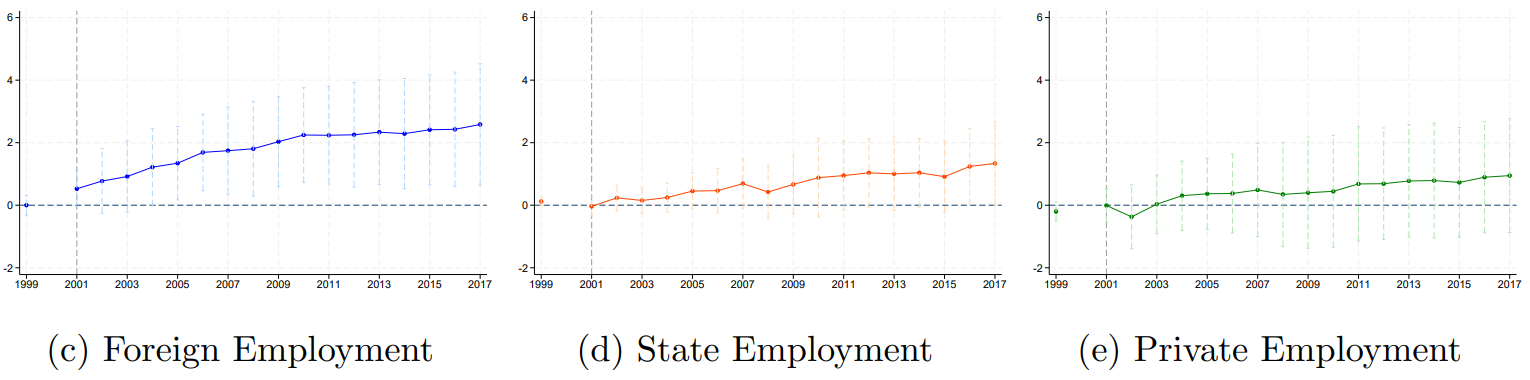
Which firms are driving these large employment responses? Foreign affiliates respond most strongly, with employment in these firms rising sharply over 8–10 years and continuing to grow gradually thereafter (Figure 5). State and private domestic firms also expand employment, but the effects are smaller, consistent with the greater trade frictions they face and the generally limited employment growth of domestic firms in low-income countries.
Figure 5: Effects of BTA tariff reductions on industry employment by ownership
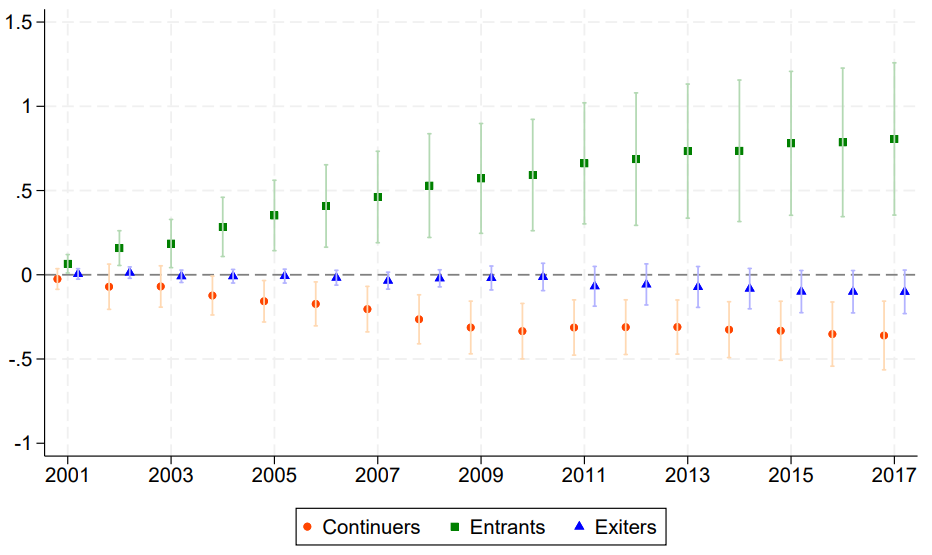
Which types of foreign firms created these new jobs? The US tariff cuts shifted employment within industries towards foreign entrants (Figure 6). These were new firms creating new jobs in formal manufacturing, not foreign takeovers of existing plants. Tariff reductions contributed to this shift through encouraging entry of foreign multinationals to Vietnam, and post-entry employment expansion over time.
Figure 6: Effects of BTA tariff reductions on the employment share of foreign continuers, entrants, and exiters
Beyond bilateralism: Entry of affiliates from East Asia and exports to non-US destinations
Our results also show that employment gains are closely tied to exporting. US tariff cuts primarily increased employment in exporting foreign entrants, with little effect on non-exporters. These patterns are consistent with theories emphasising the role of variable trade costs in driving foreign firm location and expansion decisions. While fixed costs of establishing new facilities and local production costs matter, the BTA’s reduction in trade costs made Vietnam a more attractive production base and encouraged foreign affiliates to enter and expand.
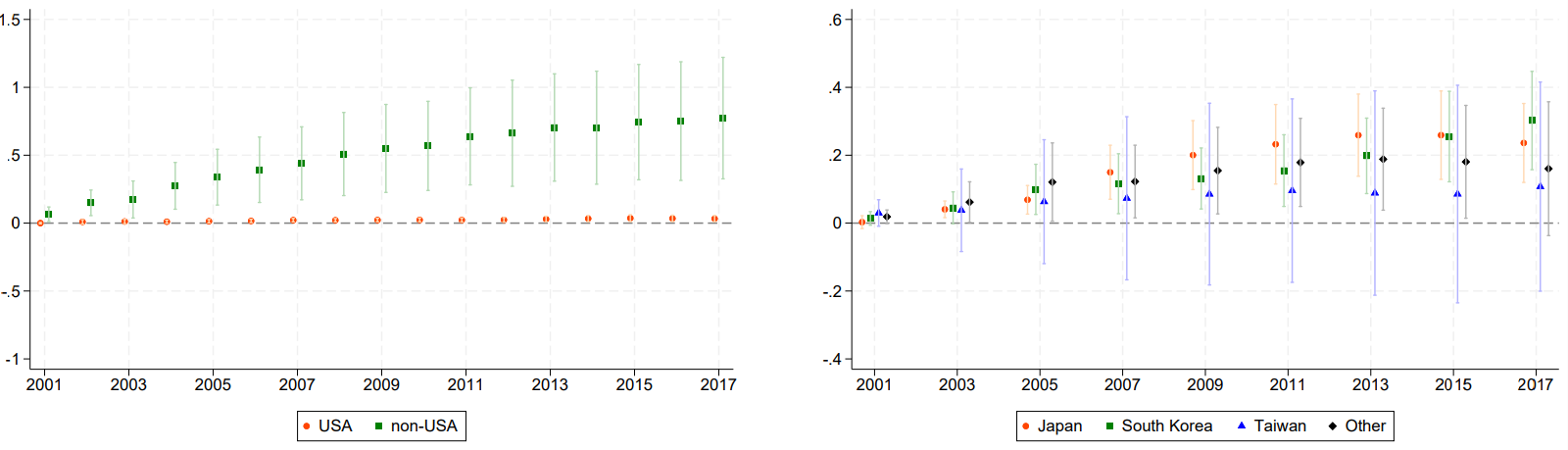
Even though the US was the target market of the tariff cuts, the bulk of the job growth came from non-US foreign entrants to Vietnam from Japan, South Korea, and Taiwan, reflecting existing East Asian regional supply chains (Figure 7, left panel). US-owned entrants play a negligible role (Figure 7, right panel). By 2017, these three East Asian countries accounted for the vast majority of FDI in Vietnam. Focusing only on US multinationals would therefore miss the main labour market response, highlighting how bilateral trade agreements can generate employment spillovers through global value chains beyond the signing partners.
Figure 7: Effects of BTA tariff reductions on foreign entrants by source country
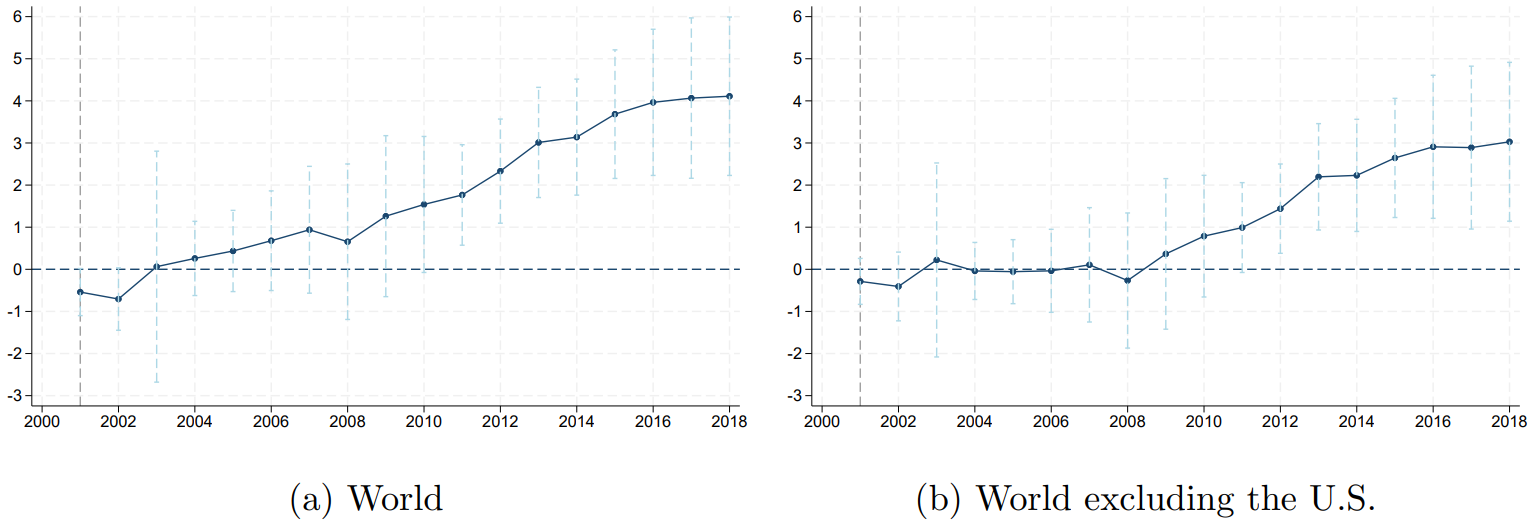
US tariff cuts initially boosted Vietnamese exports to the US, but over time the same industries also expanded exports to other countries, highlighting the longer-term effects of trade policy and the potential of bilateral policy changes to reshape trade flows far beyond the signing partners. The effects emerged slowly: exports in industries facing the average tariff cut were up 161% a decade after the BTA. Exports to non-US markets followed a similar pattern, remaining flat until 2008 and then rising steadily, reaching 105% growth by 2017 (Figures 8). By lowering export costs, the BTA made Vietnam more attractive for foreign firms that exported to multiple countries. The results are also consistent with scale spillovers: as Vietnam became more integrated into global value chains, expanding exports to other markets likely supported continued employment growth in foreign entrants, even after US export growth slowed.
Figure 8: Effects of BTA tariff reductions on Vietnamese exports to the world
Implications for trade policy: bilateral trade policies can generate third-country spillovers
Recent shifts in global trade policy, including the US-China trade war, have brought Vietnam into the international spotlight, with many viewing it as a major beneficiary. Our results help explain why Vietnam was well positioned to benefit. The BTA set the stage for Vietnam’s rise as a major exporter and a hub for export-oriented foreign investment, long before the recent US-China trade tensions. By sharply reducing US tariffs, the BTA opened the world’s largest export market to Vietnam and triggered substantial entry of foreign affiliates.
The experience of Vietnam highlights that bilateral trade agreements can generate spillovers beyond their signatories – they can integrate countries into global production networks and reshape labour markets. Tariff reductions under the 2001 US-Vietnam BTA triggered sustained entry and expansion of export-oriented foreign affiliates, creating formal manufacturing jobs over 16 years, about half of which came from post-entry growth that short-run analyses would miss. Domestic firms contributed little to employment growth, with most new affiliates coming from East Asia rather than the US, reflecting the importance of geographic proximity to pre-existing regional supply chains. Together, these findings imply that trade policy and FDI can interact over long horizons to create sustained employment opportunities through cross-border production linkages and global value chains. The flip side is equally important: withdrawing from trade relationships or raising barriers can have similarly widespread adverse effects, given how deeply interconnected firms and production networks are across borders.
References
Hanson, G H (2012), “The rise of middle kingdoms: Emerging economies in global trade,” Journal of Economic Perspectives, 26(2): 41–64.
Hanson, G H (2021), “Who will fill China’s shoes? The global evolution of labor-intensive manufacturing,” Unpublished manuscript.
Hsieh, C-T, and B A Olken (2014), “The missing ‘missing middle’,” Journal of Economic Perspectives, 28(3): 89–108.
Hsieh, C-T, and P J Klenow (2014), “The life cycle of plants in India and Mexico,” Quarterly Journal of Economics, 129(3): 1035–1084.
Johnson, R C, and G Noguera (2017), “A portrait of trade in value-added over four decades,” Review of Economics and Statistics, 99(5): 896–911.
McCaig, B (2011), “Exporting out of poverty: Provincial poverty in Vietnam and US market access,” Journal of International Economics, 85(1): 102–113.
McCaig, B, N Pavcnik, and W F Wong (2025), “Foreign and domestic firms: Long-run employment effects of export opportunities,” Review of Economics and Statistics.
McMillan, M, and A Zeufack (2022), “Labor productivity growth and industrialization in Africa,” Journal of Economic Perspectives, 36(1): 3–32.