




Tariff cuts in India reduced firms’ reliance on political connections, lowering politically driven misallocation and addressing a common source of inefficiency.
In many countries, politicians use their discretionary power to favour firms they are connected to–granting them easier access to inputs, fewer regulatory hurdles, or other forms of preferential treatment. When such firms are favoured regardless of performance, resources fail to flow to the most efficient producers, hurting overall productivity (Restuccia and Rogerson 2008, Hsieh and Klenow 2009).
These political distortions are particularly common in many low- and middle-income countries, where weak institutions, corruption, and uneven enforcement of regulations enable politically connected firms to receive preferential treatment (Banerjee and Duflo 2005). At the same time, these countries are increasingly integrated into global markets. However, while international trade is typically expected to enhance efficiency and generate welfare gains, its impact in politically distorted environments is far less clear (Goldberg and Pavcnik 2016, Atkin and Khandelwal 2020, Atkin and Donaldson 2022). In such settings, the gains from trade depend on whether trade may reinforce or weaken the political forces that misallocate resources in the first place (Bhagwati and Ramaswami 1963). Shedding light on this ambiguity is central to understanding the implications of trade in politically distorted environments, particularly as many low- and middle-income countries continue to maintain relatively high import tariffs (UNCTAD 2025).
Studying trade liberalisation and political distortions in India
In Jävervall and Khoban (2025), we empirically study how international trade impacts the distortionary effects of political connections in the context of India, a lower-middle-income country where political favouritism plays an important role in firms’ exposure to distortions. Specifically, by leveraging India’s large-scale trade liberalisation in the 1990s, we provide new evidence on how tariffs can directly affect the value of political connections.
Politicians distort resources in favour of politically connected firms
To study this, we combine detailed firm-level, electoral, and tariff data from 1987 to 2007. Using this data, we first measure firms’ connections to local politicians and estimate the value these connections provide. We define connections using a surname-based measure that captures social proximity between firm directors and politicians. Our focus is on state-level politicians, known as Members of the Legislative Assembly (MLAs), who often play an important role in helping firms in their constituency access inputs and services.
To estimate the value of political connections for firms, we take advantage of political turnover following elections. By comparing changes in outcomes for firms connected to the winning politician to firms that were not, before and after elections, we can estimate the overall effect of political connections. Our approach allows us to capture the distortionary impact of political connections without neglecting essential sources of distortions that are difficult to observe, such as corruption and crony capitalism.
We find that firms connected to the politicians who win an election experience, on average, a 10–20% increase in sales and expenditures (Figure 1). These gains reflect greater input use, such as capital, labour, and materials, rather than improved productivity, suggesting that politicians indeed distort resource allocation by favouring connected firms.
Figure 1: Effect of political connections on sales

Notes: Figure 1 plots the dynamic effects of political connections. The dependent variable is the natural logarithm of firm sales. ‘−1’ is normalised to be the year before a firm is defined as politically connected.
Tariff reductions substantially reduce the distortionary effect of political connections
We then ask whether increased trade exposure can affect the distortionary effect of political connections. To estimate this, we combine variation in firms’ political connection status with differences in tariff reductions across industries during India’s trade liberalisation in the 1990s. The trade liberalisation, which was a response to a balance-of-payment crisis, drastically cut import tariffs from an average of 80% in 1990 to 40% by 1996. Importantly, because the reform was externally imposed, rapidly implemented, and largely unexpected, it provides a good setting for studying the causal impact of trade on the value of political connections.
We find that tariff reductions substantially eroded the advantage enjoyed by politically connected firms. Crucially, this effect is almost entirely driven by the reductions of tariffs on input goods (i.e. input tariffs), which improve firms’ access to foreign inputs. In contrast, falling tariffs on final goods (i.e. output tariffs), which increase foreign competition, had a much smaller and less robust effect.
Specifically, our estimates show that the reductions in input tariffs during India’s trade liberalisation in the 1990s decreased sales for politically connected firms by 15% annually relative to firms without political connections. Our results suggest that the trade reform reduced the value of political connections by diminishing the difference between firms with and without political connections.
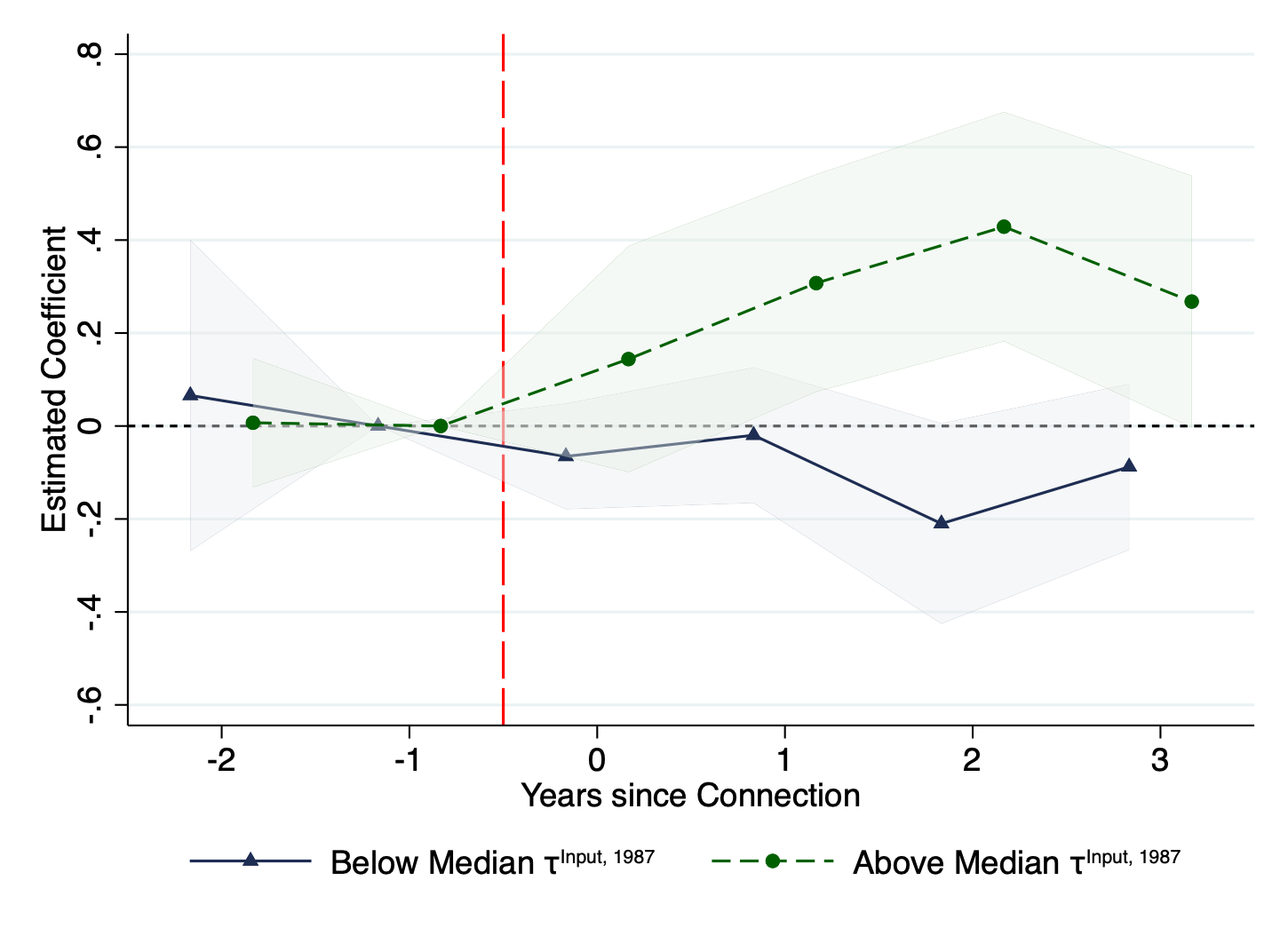
Figure 2 illustrates this pattern. From 1987 to 1996, firms in industries with high initial input tariffs benefited substantially from political connections, while there was no significant effect for firms in industries with low initial tariffs (Panel A). Following the trade liberalisation (1997–2007), when all tariffs were relatively low, neither group appeared to be affected by political connections (Panel B). Taken together, Figure 2 illustrates how the returns to political connections declined as tariffs were reduced.
Figure 2: Effect of political connections on sales by period and initial trade protection
Panel A: 1987—1996
Panel B: 1997—2007

Notes: Figure 2 plots the dynamic effects of political connections separately for 1987—1996 and 1997—2007, where the dependent variable is the natural logarithm of firm sales. The samples are split into firms in industries with input tariffs below the median input tariff level and firms in industries with input tariffs above the median input tariff level in 1987. ‘−1’ is normalised to be the year before a firm is defined as politically connected.
We find similar results when estimating the effect of tariff reductions on the returns to political connections in terms of total expenses and the use of capital, labour, and material. These findings imply that increased access to material inputs through cheaper imports also affects firms’ usage of capital and labour, suggesting that capital and labour were previously held back by material constraints.
Better access to inputs provides an outside option to political connections
Our findings suggest that greater access to imported input goods can substitute for political favouritism, directly reducing the distortions caused by political connections. To unpack this mechanism, we examine firms’ trade patterns. Although politically connected firms used more inputs before the trade liberalisation, we find that they imported less, suggesting that the main effects are not driven by politicians helping connected firms import. Instead, our findings imply that when tariffs are high, local politicians have more leeway to intervene in favour of connected firms in the domestic market, for instance, by influencing the allocation of constrained resources toward such firms. Better access to inputs through importing provides an outside option to political connections, which reduces firms’ dependence on these connections.
Does trade openness amplify or reduce the harm caused by political distortions?
Political distortions are widespread in many low- and middle-income countries, posing a serious challenge to development. Our findings show that by giving firms increased access to global markets for inputs, trade liberalisation can reduce the influence of political connections on resource allocation, thereby limiting their distortionary effects.
While our results suggest that trade policy can play an important role in addressing a common source of productivity loss, they also highlight a potential incentive for politicians and firms benefiting from cronyism to oppose globalisation.
References
Atkin, D and D Donaldson (2022), “The role of trade in economic development,” in Handbook of International Economics, 5: 1–59.
Atkin, D and A K Khandelwal (2020), “How distortions alter the impacts of international trade in developing countries,” Annual Review of Economics, 12: 213–238.
Banerjee, A V and E Duflo (2005), “Growth theory through the lens of development economics,” in Handbook of Economic Growth, 1A: 473–552.
Bhagwati, J and V K Ramaswami (1963), “Domestic distortions, tariffs and the theory of optimum subsidy,” Journal of Political Economy, 71(1): 44–50.
Goldberg, P and N Pavcnik (2016), “The effects of trade policy,” in Handbook of Commercial Policy, 1A: 161–206.
Hsieh, C-T and P J Klenow (2009), “Misallocation and manufacturing TFP in China and India,” Quarterly Journal of Economics, 124(4): 1403–1448.
Jävervall, S and R Khoban (2025), “The impact of trade liberalization in the presence of political distortions,” American Economic Journal: Applied Economics, 17(3): 1–41.
Restuccia, D and R Rogerson (2008), “Policy distortions and aggregate productivity with heterogeneous establishments,” Review of Economic Dynamics, 11(4): 707–720.
UNCTAD (2025), "Key statistics and trends in trade policy 2024."