



When trade disruptions threaten access to food, importers face a hard choice between openness and insurance.
The authors have made slides available to accompany this research here.
Food security has re-emerged as a global policy priority, enshrined in the United Nations’ Sustainable Development Goals. International trade provides critical access to food when countries cannot grow enough efficiently at home. Yet, against specialisation based on comparative advantage, agricultural production persists in low-productivity countries (Restuccia et al. 2008) and many food-importing economies protect their domestic agricultural sectors (Anderson et al. 2011). If importing food is cheaper, why do so many countries keep producing and protecting it at home?
While trade can provide cheaper access to food, it also makes countries vulnerable to trade disruptions, such as those triggered by geopolitical conflicts, export bans, climate shocks, or shipping breakdowns. Historically, severe food crises and even famines resulted from collapses in trade and distribution (Sen 1981, O Grada 2007). In our new research (Adamopoulos and Leibovici 2025), we show that the risk of trade disruptions fundamentally shapes how countries organise production and set policy. We find that exposure to trade risk leads food-importing countries to retreat from global markets, expand domestic agriculture, and adopt protective policies as insurance against import disruptions. However, productivity enhancing reforms can substitute for protection by mitigating exposure to import disruptions.
Food importers are more food insecure
We document that reliance on imported staples is strongly linked to higher food insecurity, especially among poorer countries. Using historical data from the Food and Agricultural Organization (FAO) for 1961–2023, we find that food trade disruptions are infrequent but recurring events. Large annual import drops of at least 20% occur in roughly 10% of country-years. The cross-country FAO data reveals that net importers of cereals experience more than twice the rate of moderate to severe food insecurity as net exporters (35% versus 15%). Moreover, among importers, the problem is most acute for lower-income countries that rely heavily on imported food for consumption.
The vulnerability arising from a reliance on foreign suppliers is vividly illustrated when war disrupts food imports. We exploit the Ukraine-Russia war as a natural experiment that abruptly cut off cereal and vegetable oil supply from the Black sea region, on which many African economies relied. We examine this shock through the lens of Ethiopia, a country that imports large shares of its wheat and sunflower oil from Ukraine and Russia. Districts in Ethiopia that were more exposed to pre-war imports from Ukraine and Russia experienced larger declines in their food security following the conflict. Households in these areas were significantly more likely to report that they “ate only a few kinds of foods,” a direct measure of food insecurity.
Trade risk shapes sourcing incentives
To interpret these patterns, we develop a global model of production and trade featuring international trade risk and food as a basic necessity in consumption. In our framework there is uncertainty about whether trade routes will remain open and households value reliability as much as cost. This creates a risk–return trade-off: sourcing from cheaper but risky foreign suppliers yields efficiency gains but exposes countries to possible import shortfalls, which is detrimental when consumption cannot fall below subsistence levels. As a result, risk can induce retreat from global markets and a change in the composition of trade: food-importing countries tend to “reshore” production by expanding domestic agriculture or “friend-shore” by trading more with more reliable partners.
We estimate the model to match current patterns of production and trade across 70 countries. We then ask: what would be the effect on food security, global production, and welfare if a rare but severe trade disruption, suddenly limited access to imported food?
The cost of resilience
Figure 1 summarises the average effects of introducing trade risk in our model. Risk dramatically reduces international integration. All countries trade less, but the effect is largest for food importers, who face the steepest welfare losses. Food-importing countries reduce their aggregate import shares by around 9 percentage points and increase agricultural employment by 6.6 percentage points. These adjustments raise resilience but at a cost: food prices surge, consumption falls, and overall welfare declines by nearly 9% on average. For food exporters, by contrast, welfare losses are minimal (around 1%).
Figure 1 Average effects of trade risk
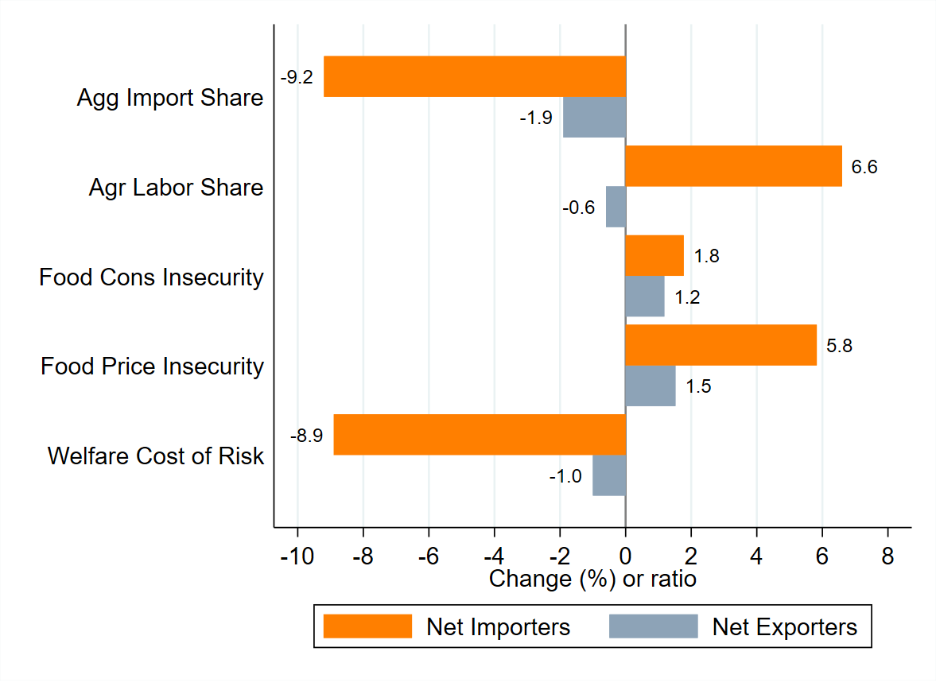
Note: “Food Cons Insecurity” and “Food Price Insecurity” measure the food consumption shortfall and food price increase, as ratios between open trade and autarky. All other variables measure the percentage change between the risk and no risk economies.
Trade risk also interacts with structural change. In our framework, the precautionary expansion of agriculture is strongest in poorer countries, where food accounts for a large share of consumption and the welfare cost of import shortages is steep. Figure 2 illustrates that, conditional on trade exposure, the predicted rise in agricultural labour shares is larger the larger the share of food in their consumption baskets.
Figure 2 Shift to domestic agricultural production by importers
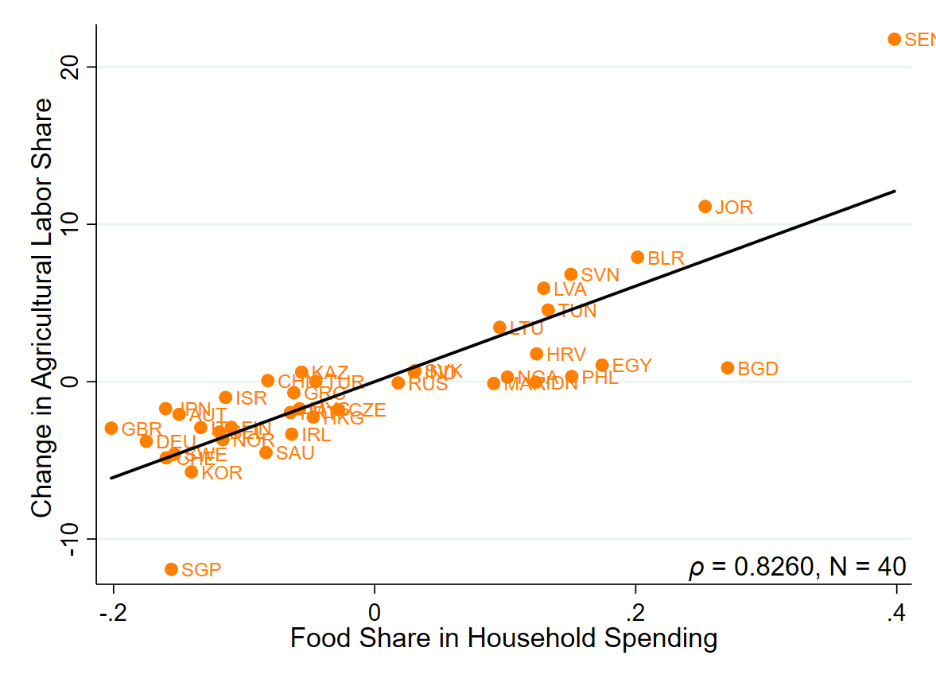
Note: The horizontal axis shows the share of food in household consumption, while the vertical axis shows the increase in the agricultural employment share when trade risk is introduced. Both variables are adjusted for the trade position of each country.
These costs of resilience imply a re-evaluation of the traditional gains from globalisation. The welfare consequences of trade risk are visualised in Figure 3, which shows that infrequent but severe trade disruption events can erase some of the traditional gains from openness for net food importers. The reason is that trade risk limits reliable access to essential goods and countries themselves engage less in trade as a result.
Figure 3 Loss of the gains from trade due to risk
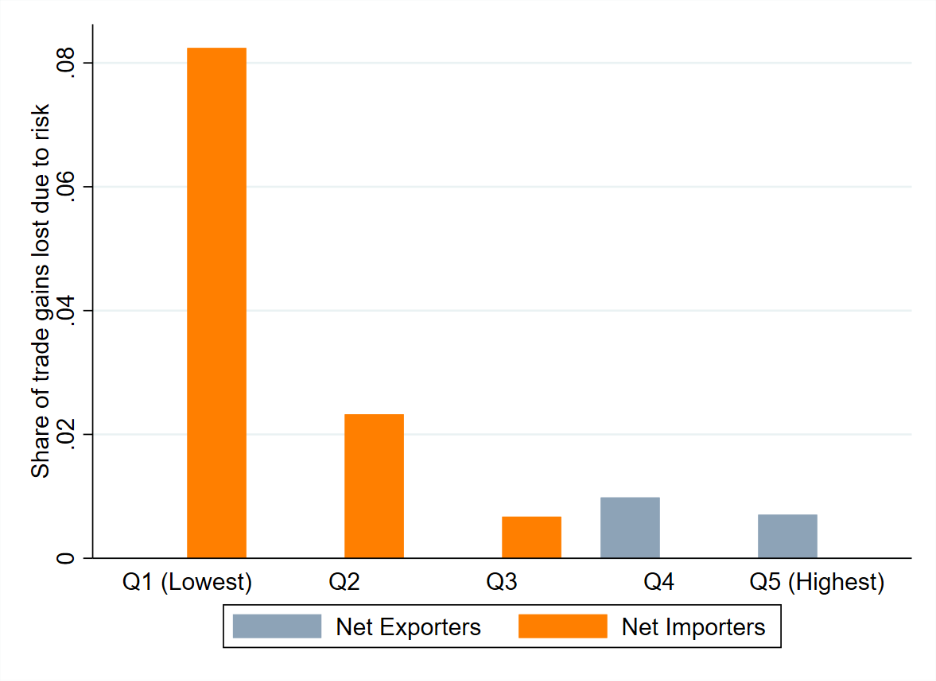
Note: Countries are grouped into five quintiles based on their food-import dependence. The chart reports the average share of gains from trade that is lost when risk is introduced. Import-dependent countries in the lowest quintiles experience the largest losses, while exporters lose relatively little.
Can protection make sense?
Protective agricultural policies are prevalent across many countries, but particularly pronounced among food importing countries. Using World Bank data on the nominal rate of assistance – a measure of how protected a country’s agriculture is through subsidies and border policies, we document that on average food importers protect agriculture at a rate of 45%, against 4% of exporters. From a comparative advantage perspective, this is counterintuitive, since low-productivity countries would usually specialise and import food rather than protect domestic production.
In our framework, agricultural protection can be rationalised as a tool to insure countries against the risk of trade disruptions that cut off foreign supply. In this context, production subsidies or import tariffs can reduce exposure to import risk. This insurance-based economic rationale, what we call a resilience protection motive, is distinct from market power, geo-strategic, political or lobbying motives. Figure 4 shows that the introduction of trade risk raises optimal import tariffs and production subsidies, above their no-risk levels, much more for importers than for exporters, mirroring real world patterns.
Figure 4 Effect of risk on optimal policies
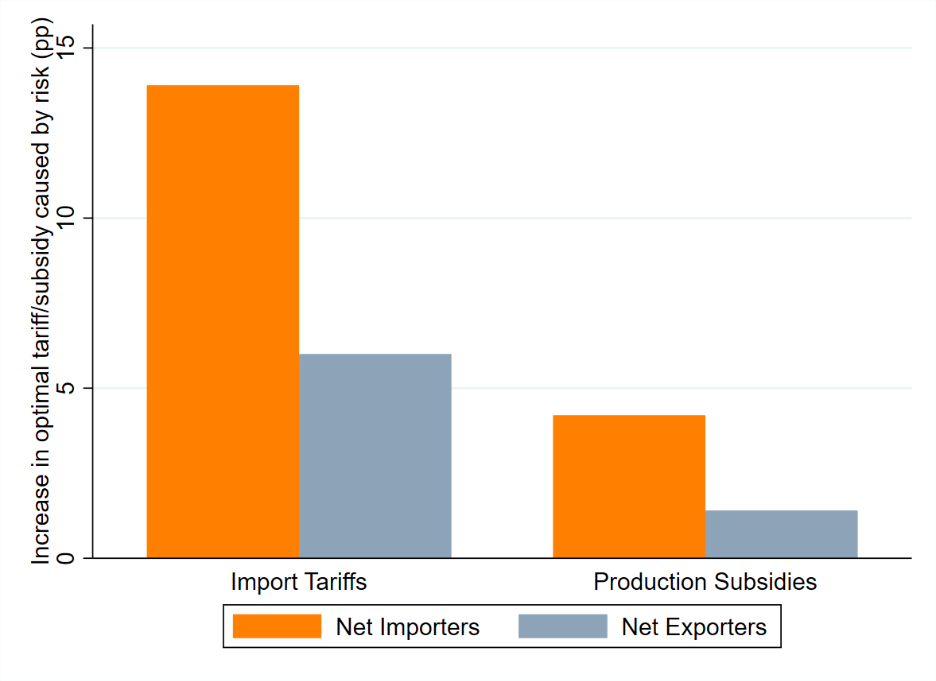
Note: Bars display the difference between optimal policies in the risk and no-risk scenarios. Results are averaged separately for food importers and exporters. “Import tariffs” refer to optimal ad valorem tariffs on agricultural imports; “production subsidies” refer to optimal percentage subsidies to domestic agricultural producers.
However, protection is not the only answer. Our analysis highlights that productivity growth can substitute for protection. Improving domestic agricultural productivity, through better technologies or input use, naturally reduces exposure to trade, and the incentive to impose protective policies, allowing countries to achieve resilience through efficiency rather than insulation. This substitution is particularly important for developing countries early in their structural transformation process, where food still accounts for a large share of household spending. For these economies, trade risk can slow structural change by keeping labour trapped in low-productivity agriculture. Productivity-enhancing reforms can break that link, supporting both resilience and growth.
Policy lessons on balancing efficiency and resilience
The recent wave of trade tensions and supply chain disruptions – spanning from grain exports to semiconductors – has shown that efficiency and resilience often pull in opposite directions. Our findings suggest that policies supporting domestic production of essential goods, though seemingly protectionist, can serve a legitimate insurance function.
That said, investing in agricultural productivity is an alternative path to resilience. By improving yields and lowering domestic production costs, governments can reduce vulnerability to trade shocks without sacrificing openness.
Authors’ note: The views expressed herein are those of the individual authors and do not necessarily reflect official positions of the Federal Reserve Bank of St. Louis, the Federal Reserve System, or the Board of Governors.
References
Adamopoulos, T and F Leibovici (2025), “Trade Risk and Food Security.” Federal Reserve Bank of St. Louis, Research Division.
Anderson, K, S Nelgen and E Valenzuela (2011), "Estimates of Distortions to Agricultural Incentives 1955-2011 [Data set]." World Bank, Development Data Group.
O Grada, C (2007), “Making famine history.” Journal of Economic Literature, 45(1):5–38.
Restuccia, D, D Yang and X Zhu (2008), “Agriculture and aggregate productivity: A quantitative cross-country analysis.” Journal of monetary economics, 55(2): 234-250.
Sen, A (1981), Poverty and Famines: An Essay on Entitlement and Deprivation. Oxford University Press, Oxford.