





The most remote villages in Northern Tanzania pay 40–55% more for fertiliser than villages with better market access. Halving travel costs leads to a nearly fourfold increase in fertiliser adoption.
Editor’s note: For a broader synthesis of themes covered in this article, check out Issue 2 of our VoxDevLit on Agricultural Technology in Africa.
It is widely believed that poor access to markets—mainly due to high transportation costs and poor infrastructure—reduces incentives to invest in agriculture by lowering potential gains from selling output (World Bank 2007, 2017). International donors and policymakers have therefore increasingly focused on integrating smallholder farmers into value chains through output market linkages. On the other hand, poor market access is equally problematic on the input side, as it increases the cost of acquiring modern agricultural technologies such as chemical fertiliser; yet, there is little research to quantify its effect.
Mapping out the supply chain for fertiliser in Northern Tanzania
In Aggarwal et al. (2024), we rigorously document input market access for farmers in 1,180 villages, essentially the universe of villages in two regions—Kilimanjaro and Manyara—of Northern Tanzania. We map the entire supply chain for fertiliser in these regions using:
- Surveys with a random sample of 2,845 farmers in 246 randomly selected villages.
- Surveys with 532 agro-input retailers, effectively spanning the universe of input retail locations.
- Surveys with transportation operators that measure road quality, travel times, and travel costs.
- Driving times and distances from Google Maps API.
The data we collect enables us to examine how farmers make fertiliser adoption decisions based on travel costs and the locations of agro-input retailers.
Substantial fertiliser price differences between remote and non-remote villages
Farmers in remote villages may incur higher costs when purchasing fertiliser. They may have to pay higher transportation costs to reach input sellers. Additionally, local retailers in remote areas may charge higher prices for inputs. We calculate a travel cost-inclusive fertiliser price for every village-input seller pair in our study region, using bilateral travel costs between origin and destination points, combined with fertiliser prices at each input seller. For each village, we then identify the minimum travel cost-inclusive fertiliser price among all available sellers.
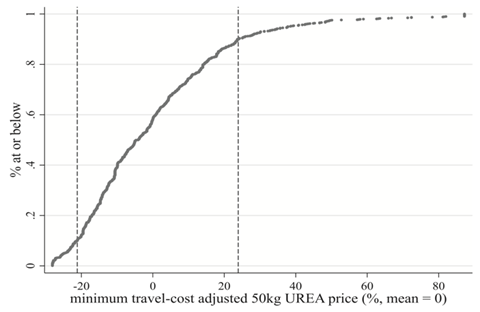
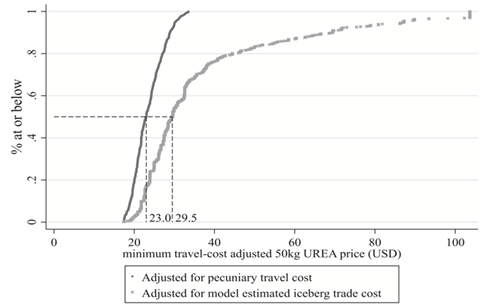
First, we document that the travel cost-inclusive price of fertiliser varies substantially across villages as shown in Panel A of Figure 1. The 90-10 difference for the best travel cost-inclusive price for fertiliser is about 45% of the mean. Using the average travel cost-inclusive price of a 50 kg bag of fertiliser (i.e. US$24.38), this translates to a nearly $11 difference. Second, we demonstrate that pecuniary travel costs account for only a small portion of the overall trade costs faced by farmers, as demonstrated in Panel B of Figure 1.
Figure 1: CDF of travel-cost inclusive prices across villages
Panel A: Pecuniary costs only Panel B: Pecuniary vs. overall trade cost
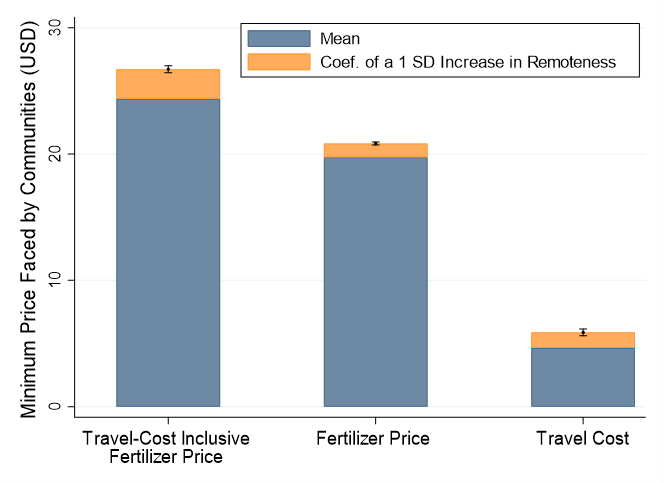
In the Kilimanjaro and Manyara regions, the population-weighted average distance to the regional hubs is 303 km. We interpret our results based on whether a village is one standard deviation (i.e. 32 km) closer to or farther from the regional hubs than the average distance. Figure 2 illustrates the impact of a one standard deviation increase (i.e. 32 km farther than the average) in remoteness on the fertiliser price, inclusive of travel costs. While the average travel cost-inclusive price of a 50 kg bag of urea fertiliser is $24.38, villages that are one standard deviation more remote pay $2.34 more. We decompose the price into two components: the retail price (excluding travel costs) and the travel cost. We find that the fertiliser price increases by 5.6%, while the travel cost increases much more sharply—by 27%—for each standard deviation increase in remoteness. Importantly, these costs only include pecuniary costs, where overall trade costs are addressed later with a spatial model of input adoption.
Figure 2: Travel cost and fertiliser prices by remoteness
Fertiliser adoption decreases significantly with remoteness
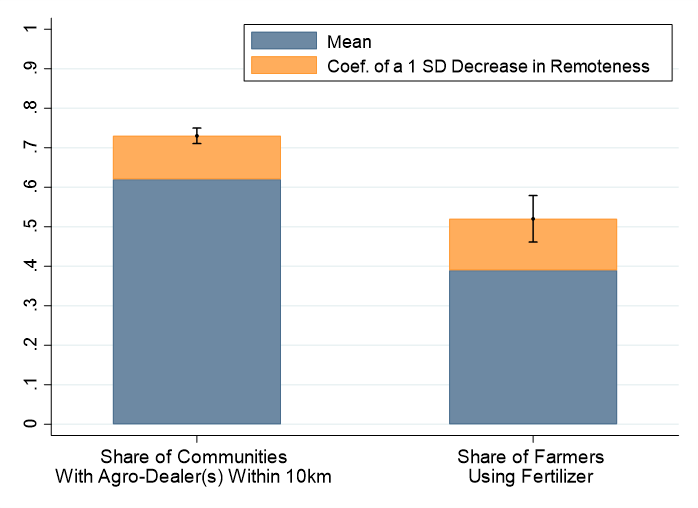
Our results so far demonstrate clear evidence of higher retail price and travel costs incurred by villages in remote areas to reach an agro-input retailer. These results lead us to expect lower input usage in more remote areas. First, we establish that remote villages are less likely to have an agro-dealer nearby. Figure 3 shows that the share of communities with agro-dealer(s) within 10 km increases by 11 percentage points for each standard deviation decrease in remoteness on a base of 62%. Consequently, we find that, even after accounting for differences in farmer and soil characteristics, the fertiliser adoption rate increases by 13 percentage points for each standard deviation decrease in remoteness on a base of 39%.
Figure 3: Access to input retailers and fertiliser adoption in remote areas
How would fertiliser adoption change if travel costs were lower?
Using a spatial model of fertiliser and retailer pricing, we found that the total costs of obtaining fertiliser extend well beyond pecuniary costs. These trade costs—which also account for time, effort, and other non-monetary barriers—are estimated to be about four times higher than direct travel expenses. For instance, even when farmers buy from the closest input shop, the total cost is approximately 72% higher due to these additional trade barriers.
We run policy simulations in the spatial model of fertiliser adoption by reducing farmers’ travel costs to agro-input sellers by 50%, which is similar to the expected reduction in travel time if roads were upgraded (Casaburi et al. 2013). Such a cost reduction can also be motivated by speeds on trunk roads in Kilimanjaro being approximately 50% lower than US speeds.
This counterfactual policy leads to a nearly fourfold increase in fertiliser adoption. Additionally, the adoption gradient between remote and non-remote areas narrowed by 63%.
We also leverage our extensive transport surveys to assess counterfactuals in which transport improvements are targeted toward main and rural roads separately. While both increase adoption, only improvements to main roads reduce the remoteness adoption gradient by enhancing market access. Surprisingly, upgrading only rural roads has a smaller effect on both adoption and the remoteness adoption gradient, failing to disproportionately increase market access in rural areas. This is because few retailers are located in remote areas, so farmers typically rely on main roads to access a broader set of input sellers.
We also study hypothetical entry counterfactuals and find that entry conditions are worse in more remote markets but improve disproportionately after the 50% reduction in trade costs. Finally, reducing distribution transport costs from wholesalers has a modest impact on adoption, while disproportionately improving adoption in rural areas exclusively via improved market access.
Policy implications for agricultural technology adoption in Africa
The results of our counterfactual simulations, along with the presence of similar patterns in other countries, naturally raise the question of policy implications. Many African countries have experimented with input subsidies, which have significantly increased adoption by directly lowering the delivered price of fertiliser—even when transport costs remain unchanged. However, most farmers fail to graduate out of the subsidy, perhaps in part because market access issues remain unresolved, making inputs unprofitable at prevailing market prices. Our findings suggest that policies—such as investments in infrastructure—that lastingly affect input and output prices faced by farmers can generate sustained effects. Initiatives to organise farmers into cooperative groups that allow them to defray the total costs of transportation over a large number of buyers may also be helpful.
References
Aggarwal, S, B Giera, D Jeong, J Robinson, and A Spearot (2024), “Market access, trade costs, and technology adoption: Evidence from northern Tanzania”, Review of Economics and Statistics, 106(6): 1511–1528.
Casaburi, L, R Glennerster, and T Suri (2013), “Rural roads and intermediated trade: Regression discontinuity evidence from Sierra Leone”, Unpublished manuscript.
World Bank (2007), "World Development Report 2008: Agriculture for Development."
World Bank (2017), "Enabling the Business of Agriculture 2017."