
View Chapter:
Downloads:
Chapter 2
Introduction - Climate Adaptation
Developing countries face the joint challenges of reducing poverty and adapting to a changing climate, while in some cases also needing to reduce their greenhouse gas emissions. From 1990 to 2024, the global extreme-poverty rate (as measured by the $2.14 per day benchmark) fell steadily, but progress has since slowed, with the COVID-19 pandemic reversing gains, and poverty rates in low-income countries only returning to pre-pandemic levels (World Bank 2024, Lønborg 2026). Currently, 60% of the world’s population lives in a place where a hotter year causes lower GDP growth, and by 2100, this will reach 75% (Acevedo et al. 2020). Therefore, even if the ambitious global target of limiting warming to two or below degrees is reached, there will be a substantial need to allocate resources towards adaptation, and balance the need to increase resilience to climate change with the need for economic growth.
Developing countries are most vulnerable to climate change for a range of reasons. These include a greater impact of temperature on output (Acevedo et al. 2020, Burke et al. 2015), long coastlines which increase vulnerability to certain extreme events (Balboni 2025), and lower incomes, which can impact resilience and the ability to undertake adaptive investments. Indeed, higher incomes are found to moderate the impacts of weather shocks on several economic outcomes, from the mortality effects of heat (Carleton et al. 2022), the impacts of flooding on economic activity (Gandhi et al. 2025), to the relationship between temperature shocks and conflict (Burke et al. 2015). This raises the concern that climate change may itself undermine future adaptation by depressing growth (Ferguson et al. 2025). Furthermore, on average, mean temperatures are higher in developing countries, implying that further warming may increase this vulnerability. Finally, developing countries have lower access to social safety nets, further increasing households’ vulnerability in the face of climate shocks (Hanna and Oliva 2016).
Figure 1: Impact of one degree Celsius hotter temperature on GDP per capita (Acevedo et al. 2020)
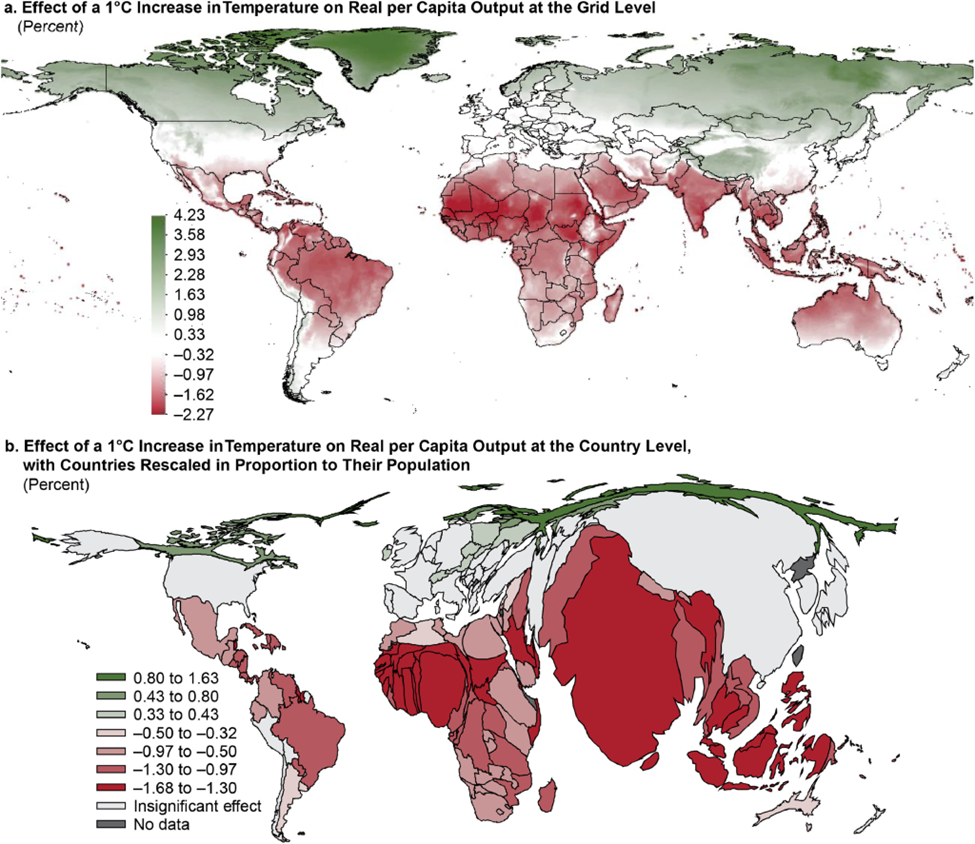
Note: Panel (a) depicts the effect of a 1°C increase in temperature on real per capita output at the 0.5-by-0.5 degree grid-cell level, Panel (b) depicts the effect of a 1°C increase in temperature on real per capita output at the country level, with countries rescaled in proportion to their population. Source: Acevedo et al. (2020).
This review summarises the literature on climate adaptation in developing countries, focusing on three aspects in particular. The first is the literature on quantifying vulnerabilities to weather and climate, which focuses on the cost of weather and climate shocks on important economic outcomes. The second is the literature on measuring adaptation by individual actions as well as government policies. The third summarises the recent literature on spatial linkages and general equilibrium approaches to climate change adaptation.
Figure 2: Projected climate change (IPCC 2021)
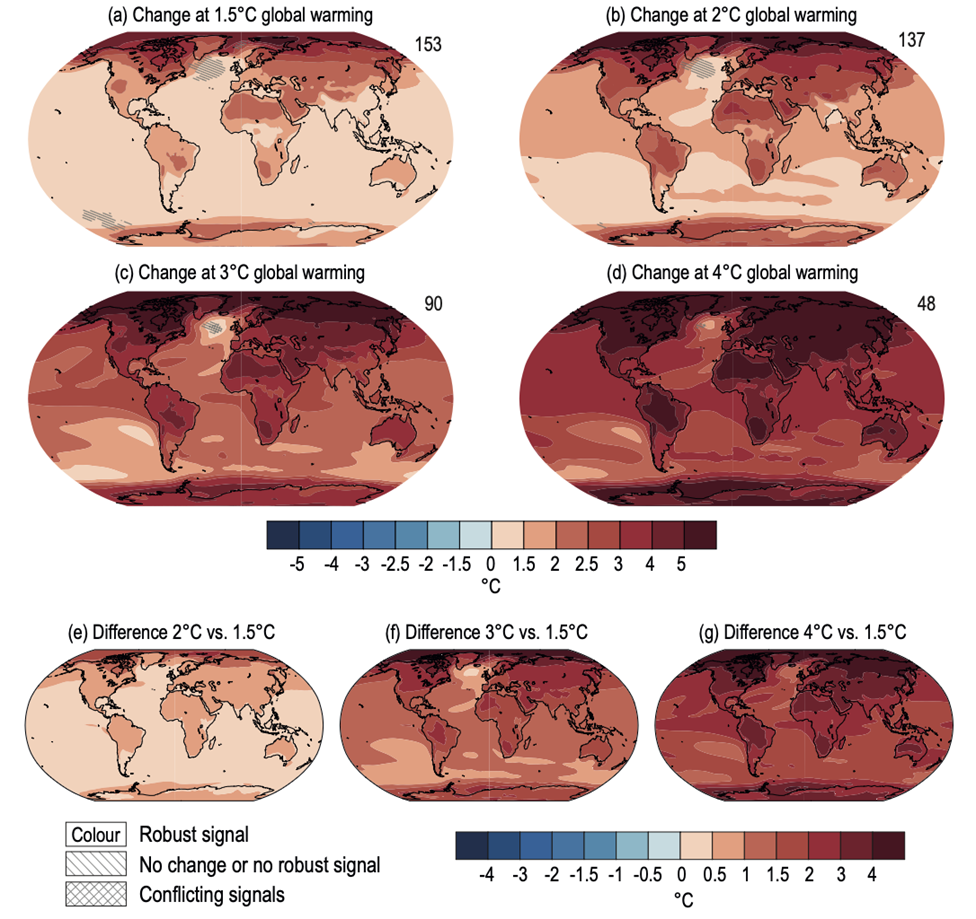
Note: Multi-model mean projections of changes in annual average near-surface temperature (°C) at 1.5°C, 2°C, 3°C, and 4°C of global warming relative to 1850–1900, based on CMIP6 Tier-1 SSP simulations. Diagonal lines indicate no robust change; crossed lines indicate conflicting signals. Source: IPCC AR6 (2021).
Figure 2 (Continued): Projected climate change (IPCC 2021)
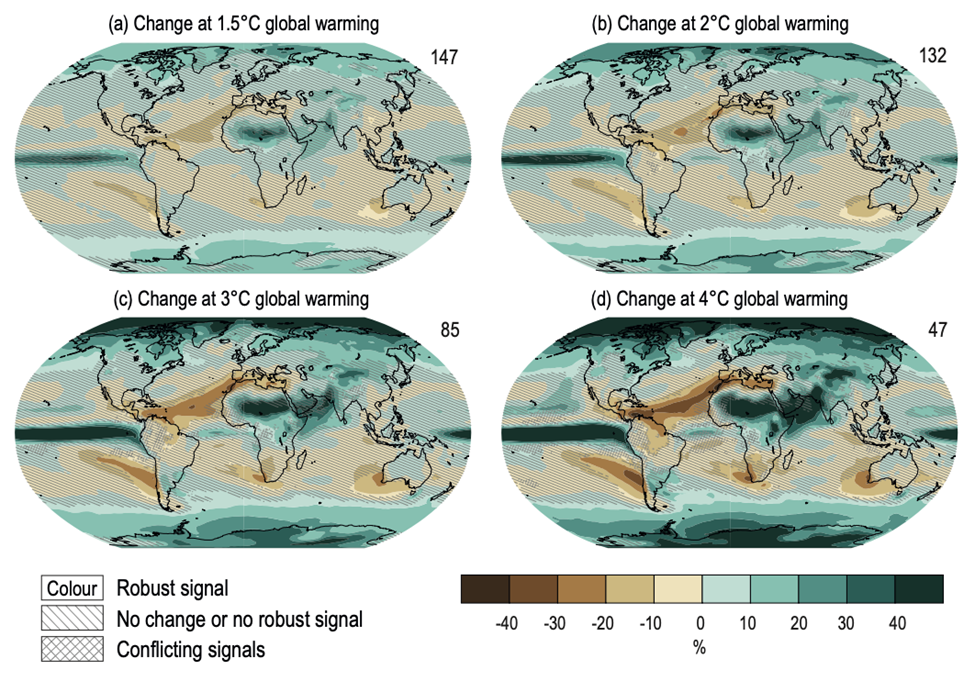
Note: Multi-model mean projections of changes in annual average precipitation (%) at 1.5°C, 2°C, 3°C, and 4°C of global warming relative to 1850–1900, based on CMIP6 Tier-1 SSP simulations. Diagonal lines indicate no robust change; crossed lines indicate conflicting signals. Source: IPCC AR6 (2021).
For full reference list see the end of the conclusion chapter.
Contact VoxDev
If you have questions, feedback, or would like more information about this article, please feel free to reach out to the VoxDev team. We’re here to help with any inquiries and to provide further insights on our research and content.
Supporter Logos