


View Chapter:
Downloads:
Chapter 4
The impacts of electricity supply
While expanding access to electricity is an important first step in the process, as is clear in Figure 1, there are a number of dimensions of electricity infrastructure beyond access. Even when considering access, an important caveat with administrative data on access is that it is often considered a binary variable: was a particular area electrified or not? However, there is a substantive difference between having readily available, scalable power and merely being connected to the grid with very restricted supply. A growing body of research, summarised in Meeks and Pokhrel (2024), highlights the importance of considering these other dimensions in energy access research. As discussed in the previous section, the quality and reliability of electricity (i.e. the frequency and duration of outages, voltage stability, etc.) can play an important role in the extent to which electricity access benefits are realised. Power quality and reliability, however, are not purely technical results of the quality of electricity infrastructure. They result from a complex, interdependent system that depends on the financial health of utilities, supply side factors, and demand side behaviours.
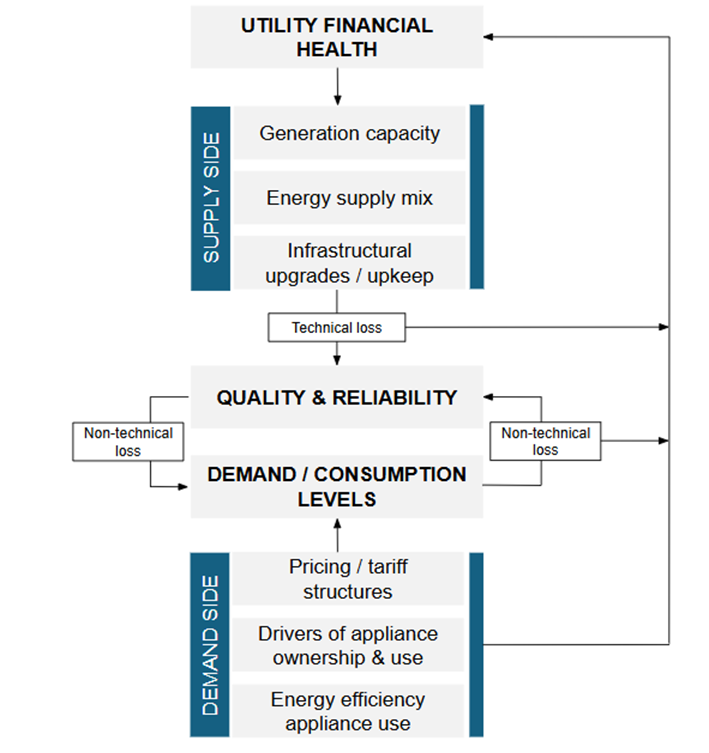
Figure 2 illustrates the interdependent cycles that exist between electricity supply and demand. Central to this process is a loop between power quality/reliability and the levels of electricity consumption. Electricity quality and reliability can directly influence consumer behaviour as households, firms, and institutions adjust their consumption levels, investment in appliances, and willingness to pay based on their experiences with power quality and reliability. In turn, these consumption patterns and choices affect grid stability and revenue recovery for utilities, which ultimately affects the investments the utility can make in infrastructural upgrades and maintenance. Utilities that serve customers who do not pay their bills or steal electricity at high rates are unable to recover costs, which can lead to underinvestment in maintenance and upgrades, worsening electricity quality issues and further diminishing customers' willingness to pay for electricity. This can create a cycle described in detail in Burgess et al. (2020).
In the remainder of this section, we separately discuss the supply and demand side factors that feed into this inner loop. We first discuss supply side challenges starting with electricity quality and reliability and how these variables impact firm and household outcomes. We then turn to the financial health of utilities, focusing on how challenges related to recovering revenue influence and are influenced by consumer behaviour. And finally, we discuss generation, and how the choice of where and how to generate electricity can have direct effects on populations, as well as contribute to the relationship depicted in Figure 2.
From there, we shift to discussing how demand side factors feed into this inner loop. Specifically, we consider how electricity prices, use of energy efficient appliances, and other broader drivers of appliance ownership and use (i.e. temperature and wealth) can influence consumption levels and grid stability.
Figure 2: Interconnected cycles of utility financial health, supply & demand, and electricity reliability
Electricity supply: The impacts of unreliable and low-quality electricity
Hundreds of millions of grid-connected households face regular outages in LMICs (Day 2020). Electricity reliability is a persistent issue that has far-reaching impacts on households, firms, and public service institutions like health facilities. Outages have both micro-level effects as well as macro-level effects. On the latter, Chen et al. (2023) find that a 1% improvement in reliability, as measured by the System Average Interruption Duration Index (SAIDI), increases global economic growth by 2%, with even larger effects in LMIC settings. Additionally, Fried and Lagakos (2023) estimate that the long-run general-equilibrium effect of eliminating power outages on output per worker amounts to 15% across a range of countries facing reliability challenges.
Impacts of outages on firm productivity
Given that firms rely on electricity as an input in their production process, quantifying the impacts of unreliable power on productivity has been a central focus of this literature. At the firm level, unreliable power can lead to lower firm productivity (Fisher-Vanden et al. 2015, Allcott et al. 2016, Xiao et al. 2022, Fried and Lagakos 2023) and higher unemployment at the national level (Mensah 2024, Bhorat and Kohler 2024). With an analysis using firm-level data across 14 countries in Sub-Saharan Africa, Cole et al. (2018) find that outages decrease firms’ sales and that the effect is larger for firms that do not own a generator. Conversely, an ability to charge higher tariffs and improve revenue allows some Indian utilities to supply more reliable electricity, leading to an improvement in firm level worker hours and output (Mahadevan 2024b). Further, national level outages have also been associated (though not causally) with reductions in working hours and wages in South Africa at the individual-level (Bhorat and Kohler 2024).
Firms have several ways to cope with outages (Fisher-Vanden et al. 2015). If they face capital constraints or other limitations, electricity shortages can directly reduce productivity. When there is a stoppage in electricity service delivery, firm production may halt until power is restored. Some firms invest in self-generation (e.g. diesel generators) or shift to non-electricity-dependent practices. Others outsource production or adopt energy-efficient technologies.
Indeed, self-generation is a common path for firms seeking to mitigate the effects of outages. Alby et al. (2013) develop a model of investment in self-generation, which is discussed in an applied setting in Steinbuks and Foster (2010). Self-generation is generally considered more expensive, and thus a second-best option to relying on electricity from the grid (Bhattacharya and Patel 2008, Steinbuks and Foster 2010, Alby et al. 2013, Abeberese 2017). Allcott et al. (2016) find that even when firms do invest in generators in India, they may function as a stop-gap; however, in the long-run, productivity is lower as a result of the outages. Fisher-Vanden et al. (2015) do not find evidence of self-generation in China, but instead that firms substitute away from some uses of electricity and that they also outsource some stages of production. Guo et al. (2023) find that firms limit investment in R&D activities and shift to less energy-intensive production processes in the face of outages, which is an effect also seen in response to high electricity prices (Abeberese 2017).
There is little evidence that firms invest in energy-efficient technologies purely in response to outages. However, such shifts may occur if utilities impose electricity limits or quotas (Fisher-Vanden et al. 2015).
The strategy a firm chooses to cope with outages, and the resulting impacts on their productivity, varies with a number of factors. Several papers note that smaller firms are more affected by outages and have less ability to cope (Alby et al. 2013, Allcott et al. 2016, Guo et al. 2023) as well as non-export-oriented firms (Cole et al. 2018, Guo et al. 2023). Fried and Lagakos (2023) quantify the long-run, general equilibrium effects of outages - regardless of which coping mechanisms the firms employ - and find that long-run productivity is impacted far more than individual micro studies had estimated.
Impacts of outages and low-quality power on household outcomes
Hundreds of millions of households are connected to electric grids that provide unreliable and low quality power (Day 2020). Reflecting how crucial this problem is, recent research addresses the impacts of outages and power quality on outcomes at the household and individual levels. Indeed, unreliable electricity service – characterised by frequent outages – affects households in many ways. Evidence indicates that households located in areas with more frequent blackouts have lower demand for connection to the electric grid overall (Bajo-Buenestado 2021).
Poor power quality, which consists of voltage spikes (i.e. surges) and sags (i.e. drops), is studied even less frequently than reliability. This is likely because poor power quality can be more challenging to accurately capture than outages. Survey questions can be designed to ask about the results of power quality issues (Jacome et al. 2019); however, more accurately measuring power quality requires directly monitoring the power source. In contrast, outages can be proximately measured using remotely sensed data in some cases (Mahadevan 2024a, Burlig and Preonas 2024, Min and Golden 2014). This presents an additional challenge when attempting to understand the impacts of variations in power quality.
Descriptive papers provide a framework for incorporating power quality measurements into causal studies. Jacome et al. (2019) use a combination of survey data, interviews, and detailed monitoring data to describe some of the consequences of poor power quality for households in Tanzania. While not causal, this study provides rich detail on both the experiences of households as they cope with damaged appliances and dim lights, but also on some of the more technical details whereby households further from the transformer experience more voltage fluctuations than those close by. Miles et al. (2023) use monitoring data to characterise the power quality landscape at health facilities in DRC, finding large amounts of variation by power source. The implications of having poor power quality in health facilities, while not yet casually studied, are particularly severe.
Studying the impacts of unreliable and poor-quality power suffers from many of the same endogeneity challenges as studying the initial placement of electricity infrastructure given that it is often impractical or even impossible to randomly improve reliability and quality. As a result, experimental studies on quality and reliability are rare. To date, there is limited evidence on households response to improvements in power quality. Some evidence shows households increase electricity consumption, which is at least partly due to an increase in appliances in response to quality improvements.
Meeks et al. (2023) study the effects of improvements in the distribution system (via the installation of smart meters) on electricity service quality through a randomised experiment in the Kyrgyz Republic. The smart meters help utilities to more quickly identify power quality issues. Households randomly assigned to have smart meters installed experienced significantly fewer voltage fluctuations per day post-installation. They also had increased electricity bills and more electric appliances following the meter upgrade, indicating poor power quality was suppressing demand.
Berkouwer et al. (2024) use power quality data from customers in Ghana to document persistent undervoltage issues and study how consumers respond: a quarter of survey respondents reported investments in devices to protect appliances from voltage fluctuations. Using quasi-random variation in grid investments, they found transformer replacements improved voltage quality, but had no other significant impacts on households or firms (Berkouwer et al. 2024). The null results could be due to the study’s relatively short-run time frame or because the intervention did not improve power quality sufficiently enough to affect outcomes.
Relatedly, there is a growing body of literature focused on household willingness to pay for reducing outages. This evidence suggests that there is demand for improved reliability in multiple settings (Alberini et al. 2022b, Deutschmann et al. 2021, Hashemi 2021, Meles et al. 2021, Khanna and Rowe 2024, Bigerna et al. 2024).
Impacts of outages on communities
There is a small and relatively new literature on community impacts of outages in low- and middle-income countries. These primarily investigate environmental and public health outcomes. Budlender (2024) study rolling blackouts in South Africa and find that areas spared from loadshedding have lower mortality rates, especially among older populations. Relatedly, results from India document the effects of outages on increases in air pollution, which is likely due to common use of diesel generators as a backup electricity supply when there is a grid outage (Lin and Kassem 2025).
Evidence gaps and future directions for research
The opportunities for future research on the impacts of power quality and reliability as well as the impacts of infrastructure interventions on improving power quality and reliability are numerous given that this is a relatively nascent area of focus in the literature.
In addition to an overall increase in research on these topics, there are some particular areas of focus that we believe are major gaps in the existing literature. First, the majority of the existing work is in urban settings, usually at the industrial/firm level. While this is logical given the disproportionately higher levels of electricity access in urban relative to rural areas in LMICs, Jacome et al. (2019) highlight that spatial variation matters and that while not well documented, anecdotally, power quality issues may be worse in rural areas. This is particularly important in the context of studies focused on understanding the impacts of expanding access to electricity if that electricity service quality is insufficient. As is the case with studies on expanding electricity access, there is little to no evidence of the long-term impacts of improving power quality and reliability. It might take time for firms and households to notice and react to these improvements, so it is possible that in studies like Berkouwer et al. (2024) where there are no clear impacts of the voltage improvements, households simply did not have time to shift their behaviour. Further, although Chaurey and Le (2022) show that electricity infrastructure maintenance and upgrades play an important role in achieving sustained impacts on local economic activity, little evidence exists on how to ensure regular maintenance and improvements occur, particularly in rural settings.
Additional relationships are crucial to understand, beyond the most frequently studied labour and employment outcomes. Budlender (2024) highlights the implications for health, and it is reasonable to expect that power quality and reliability have other important impacts, such as education and household welfare. The implications of poor power quality and reliability are quite severe at health facilities, where consistent power is critical to performing life-saving services. Yet electricity and power quality at health facilities are rarely studied causally (IRENA 2023). There is room for additional causal evidence on the impacts of changes in electricity quality and reliability on households, as well as in other settings where electricity is a key input, such as health facilities.
Beyond studying the impacts of outages, it is important to consider some of the factors that exacerbate them. The majority of electricity generation, transmission, and distribution infrastructure across the globe is state-owned. In LMICs this figure is particularly high, with approximately 80% of utilities publicly owned (World Bank 2024, 2025b). The ownership status of electricity utilities can sometimes lead to political appropriation, worsening the financial losses to the utilities. For instance, Min and Golden (2014) document how electricity supply in India follows electoral cycles, with power losses increasing before elections as politicians turn a blind eye to potentially illegal consumption to secure votes. Baskaran et al. (2015) show how politicians may be redirecting electricity supply in areas with special elections to potentially sway election outcomes. An important area of research for the future is identifying political incentives that lead to perverse supply outcomes, and reckoning with ways to re-align political and institutional incentives in a way that is consistent with broader economic welfare.
Electricity supply: Utility financial health
The unreliable and poor quality electricity service discussed above can result from electricity distribution companies' inability to recover the full cost of delivering electricity services. Low cost recovery is due to highly subsidised prices, non-payment of bills and electricity theft (Burgess et al. 2020). This is particularly problematic in low- and middle-income countries.Although only 37% of utilities globally are able to recoup operating costs, this number is even lower in LMICs (World Bank 2025b, Burgess et al. 2020).
When electric utilities are operating consistently at a loss, they must identify strategies to minimise costs and increase revenue recovery. They may deprioritise investments in upgrading or even maintaining existing infrastructure or struggle to pay for generation costs. These types of cuts can exacerbate the quality and reliability problems described above and can further incentivise bill nonpayment and electricity theft, perpetuating the cycles illustrated in Figure 2 (World Bank 2024, Burgess et al. 2020, Carranza and Meeks 2021).
In the sub-sections that follow, we discuss the evidence on these three contributors to low cost recovery – highly subsidised prices, non-payment of bills and electricity, and theft – and efforts to improve utility financial health.
Changes in electricity subsidies
Subsidised prices are common in many developing countries. Some subsidies – such as lifeline tariff rates – are intended to assist the poorest households and ensure that they have access to some basic quantity of electricity. However, in some locations, electricity prices are highly subsidised even for those customers that are not among the poorest. At a minimum, subsidies create a gap between the cost of supplying electricity and the official tariff rate charged per kWh, reducing cost recovery. Subsidised electricity prices can also have further unintended and complicated effects, such as leading to underinvestment in infrastructure, via a subsidy trap (McRae 2015).
With concerns regarding potential negative effects from electricity subsidies in mind, some utilities have instituted tariff reforms. Research has covered some prior electricity pricing reforms, such as shifts from a fixed rate to volumetric charges (McRae 2024) or from a linear tariff to an increasing block price (McRae and Meeks 2016) or more drastic changes within a “wild” increasing block rate structure (Alberini et al. 2022a).
The extent to which changes in tariffs – and therefore subsidies for electricity – will improve utilities’ cost recovery will depend not only on whether they affect the quantity of electricity consumed but also if they affect bill payment and theft. Limited research exists on the causal effects of tariff changes in LMICs. Residential consumption does appear to respond to price changes: tariff increases led to a decrease in consumption (at least initially) (Hassen et al. 2022, McRae 2024, McRae and Meeks 2016, Alberini et al. 2022a) – and tariff reductions increased consumption (Alberini et al. 2022a).
Tariff structures (and associated changes in tariff design) do not always work as intended. For example, in many settings poorer households may share an electricity meter with other poor households as a cost cutting measure. But because their consumption is measured together, they might not quality to benefit from tariff structures, such as a lifeline tariff, that are meant to keep costs lower for households with low levels of consumption (Klug et al. 2022). Additionally, households may not understand how tariff changes affect their household given their own household’s historical consumption, leading them to respond to tariff changes inappropriately given their historical consumption (McRae and Meeks 2016).
Although changing the electricity tariff or reducing subsidies may affect utility cost recovery, it is an extremely politically charged issue. In contexts in which electricity utilities are commonly state-owned and managed, political capture may occur. State-run utilities, already with negative loss-making reputations (Chatterjee 2018), can be exploited to provide selective services for electoral gains. Mahadevan (2024) provides evidence of political manipulation, showing how Indian politicians illicitly subsidise their voters with misreported bills, causing large losses to the electricity utilities. Misreported bills can go long undetected because of the many intermediaries involved in reporting consumption: meter readers, billing officers, chief engineers of billing centres. Recent reports in the news from India suggest that broad opposition to functions provided by smart meters may be related to protecting the political capture of utilities (The Times of India 2024, The Hindu 2024, The Indian Express 2024, News Click 2023). Nevertheless in parts of the world where electricity consumption and measurement are less politically charged, technological advances may enable increases in cost recovery.
Increasing bill payment
Utilities are investing in and installing new technologies, such as advanced metering, in an effort to increase bill payment – which is the proportion of electricity that is billed to customers that actually is paid by consumers. For example, prepaid meters require consumers to pay in advance for the future electricity consumed. This overcomes the challenge of collecting overdue payments from consumers and from expensive manual disconnections of indebted customers.
Prepaid meters force households to shift their payment behaviours such that they now make the payment prior to consumption of the services. This may lead them to be more conscientious about how they consume electricity. A randomised experiment implemented by Jack and Smith (2020) in Cape Town, South Africa found that households who were switched to a prepaid meter reduced their electricity use by 14% (Jack and Smith 2020). While these reductions in consumption might seem like they would not benefit the utility’s financial health, Jack and Smith (2020) find that the improvements in rates and timeliness of bill payment and the reductions in costs utilities incurred collecting those payments are enough to make up for the lower bill amounts.
Correlational evidence - through research by Aliu (2020) and Beyene et al. (2022) in Nigeria and Ethiopia, respectively – supports the finding by Jack and Smith (2020). Both papers report finding that households who have prepaid meters consume less electricity than those who have post-paid meters.
More recently, some utilities have invested in smart meters, which introduce new options for utilities to affect consumer behaviour. The effects of smart meters will depend on the features present and enabled on those meters – as noted earlier, the political will to use certain features may be low. Smart meters allow more accurate measurement of consumption and can alert the utility of voltage fluctuations and outages as well as any efforts to tamper with the devices. To assist with enforcing bill payment, smart meters permit utilities to remotely disconnect non-paying consumers, which avoids the costly process of sending out a team of utility employees to manually disconnect non-payers (and then again reconnect after payment). They also enable utilities to introduce alternative tariff structures, such as time of day pricing or other forms of dynamic pricing.
Similar to pre-paid meters, policymakers are interested to understand how these advanced meters affect consumption. Meeks et al. (2023) and Mahadevan et al. (2025) find increases in billed consumption after the installation of smart meters in the Kyrgyz Republic and Nepal, respectively. It is notable that smart meters have, at least in some settings, the opposite effect on consumption as prepaid meters.
Decreasing electricity theft
While technological improvements in metering may assist with bill payment, they are unlikely – by themselves – to stop unbilled electricity consumption (i.e. theft). Even with advanced metering technologies consumers may still be able to bypass the meter and hook directly to the low-voltage distribution lines (Fowlie et al. 2018). Such illegal connections are common in many low- and lower-middle-income countries and are a large part of the reason why electric power transmission and distribution loss are several times higher in those countries than they are in high income countries (Meeks and Pokhrel 2024).
In Pakistan, Ahmad et al. (2024) use a quasi-experimental design to study the impact of replacing bare distribution wires with theft-resistant cables that make it much more difficult to tap into the distribution network to steal power. They find a reduction in losses resulting from lower rates of consumption that goes unbilled. They also find that as fewer people are able to illegally consume electricity, which can affect the quality and reliability of the power for the rest of the consumers. Paying consumers reported fewer instances of load shedding. This again represents an example of how an infrastructural intervention not directly targeting quality/reliability, can affect these dimensions because of the interdependencies and fine balances that exist in an electricity delivery system.
It is also worth noting that any utility intervention that improves utility finances by reducing or eliminating non-technical losses – by increasing bill payment or decreasing consumption that is unbilled due to theft – also changes the effective price that consumers (at least the ones that were not previously paying the full cost per kWh of electricity consumed) pay for their electricity services. In the context of Pakistan, Ahmad et al. (2024) provide evidence that the theft-resistant cables likely most affected the poorest households who shifted from informal to formal connections, but still consumed less than the cutoff for the bottom (lifeline tariff) pricing tier.
Evidence gaps and future directions for research
There is ample opportunity for additional research on the impacts of interventions aimed at improving utility cost recovery. Depending on what is being introduced, these types of interventions may be easier to randomise than other electricity infrastructure improvements. This creates possibilities for experimental studies. Many of these interventions are related to upgrading meters or introducing other infrastructural upgrades that could, in theory, be rolled out in a coordinated way in collaboration with researchers. There are several recent examples of such successful collaborations – implementing both experimental and quasi-experimental research - between researchers and utilities (e.g. Jack and Smith 2020, Meeks et al. 2023, Mahadevan et al. 2025).
When undertaking randomised experiments or leveraging the staggered rollout of an infrastructure improvement to study an intervention (e.g. Ahmad et al. 2024, Mahadevan et al. 2025), it is crucial to consider the power system and infrastructure as a whole. The power system must constantly be balanced and any shifts to this balance can negatively affect power quality and reliability, which, as highlighted in Figure 2, can in turn have a range of other impacts on consumers.
Electricity supply: Generation and transmission
Direct impacts of electricity generation source and location
Electricity generation in and of itself can have direct local effects, through the construction and operation of the power plant. Understanding the regulatory and institutional environment of the electricity sector and how they impact supply starts with generation. In India, for instance, Ryan (2021) shows that government-connected firms manipulate power procurement by under-indexing bids for coal prices, anticipating renegotiation will cover cost shocks. This distorts competition, leading to inefficient power project allocation and higher costs downstream. However, there remains very little work around the regulatory and institutional setup behind generation and transmission contracts in developing countries.
There is research on externalities from power plants, particularly those that depend on fossil fuels for generation. Research specific to developing countries documents the health effects of fossil fuel-based electricity generation on health outcomes. In India coal-fired power plants generate substantial air pollution (Cropper et al. 2021) and increased exposure to coal power plants has been associated with poorer respiratory outcomes (Gupta and Spears 2017). Adhvaryu and co-authors show how changes in generation fuel mix – which were induced by an electricity pricing policy – affected health outcomes in Colombia. They found increased thermal electricity generation is associated with greater local pollution levels and this increased cardiovascular related ER visits (Adhvaryu et al. 2023).
Placement and construction of generators can affect local populations, even with other non-fossil fuel-based generation sources. For example, although hydropower is considered to be a source of “clean” electricity, the vast quantity of land necessary for dam construction and water storage often results in the displacement of nearby populations and destruction of the local environment. To the extent that power plants are more often constructed in locations inhabited by poor and marginalised populations, such direct effects of electricity generation are then also linked with environmental justice concerns.
Increasing the renewable generation supplying the electricity grid
Renewable energy sources could replace or offset coal-fired power plants (or other thermal generators) in the generation process to reduce both particulate air pollution and greenhouse gas emissions. Taxing electricity generated via fossil fuels or subsidising renewable energy sources are policy tools available to increase the electricity supplied by renewables to the electric grid. In low and middle-income countries, additional impediments, such as limitations of the grid or weak contractual enforcement, may prevent or slow investments in renewables. Alleviating these impediments may be necessary to increase the proportion of generation from renewable sources, as illustrated in the following paragraphs.
Gonzales et al. (2023) study grid expansion, which facilitated market integration – the trade of electricity between renewable-intensive regions (area where renewables are generated) and the demand centre locations – in Chile. This integration is key to increasing renewables on the grid – and thereby reducing greenhouse gas emissions from electricity generation - as renewable power plants are often located in sites that are not close to load centers. They find that integration not only changed electricity production and wholesale prices, but also renewable investments.
Ryan (2022) documents another challenge, “hold-up” or foregone investment in renewable energy due to contractual risk, which can slow efforts to decarbonise electricity generation. In the case of India, hold-up – specifically the foregone investment due to the risky state governments implementing solar procurement auctions - impedes the procurement of solar plants and results in lower investment. The paper documents that the counterparty risk can be mitigated when the solar procurement auctions are intermediated by the central government.
For full reference list see the end of the conclusion chapter.
Contact VoxDev
If you have questions, feedback, or would like more information about this article, please feel free to reach out to the VoxDev team. We’re here to help with any inquiries and to provide further insights on our research and content.