



View Chapter:
Downloads:
Chapter 3
The impacts of expanding access to electricity
Figure 1 provides a summary of different kinds of interventions relevant to electricity infrastructure, details on the dimensions of electrification they target, and the units/institutions that are usually the focus of subsequent studies. We include both supply-side interventions that are more directly focused on the expansion and upgrading of infrastructure, as well as demand-side interventions, which have the ability to affect the way that electricity infrastructure operates due to the need for constant balance between electricity supply and demand.
Figure 1: Electricity infrastructure interventions and their impacts
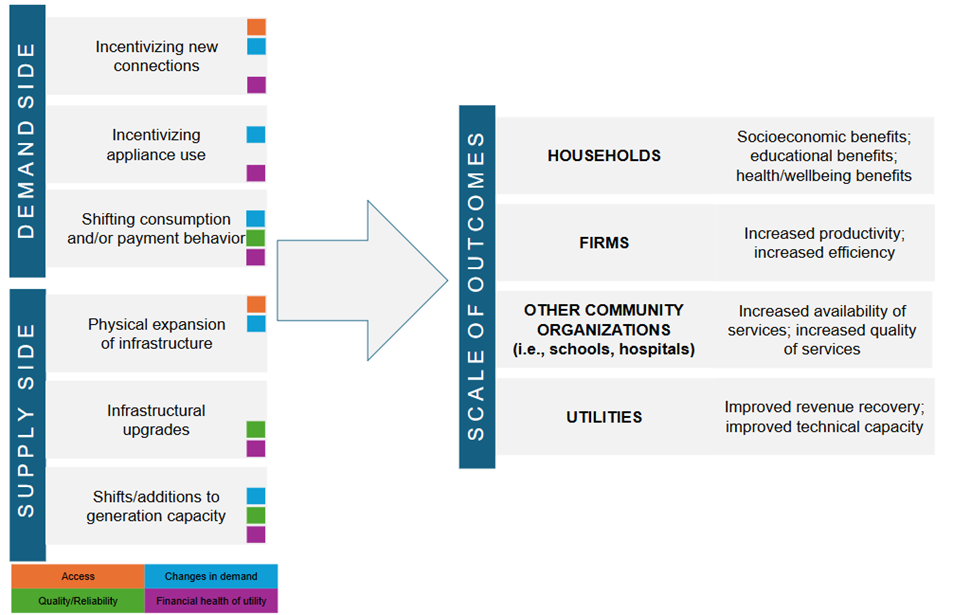
Historically, the majority of the electrification literature has focused on the impacts of expanding physical infrastructure with a focus on how new access (i.e. new connections) can unlock a range of socioeconomic benefits for households and firms. As is clear from Figure 1, this is only one of many potential types of electricity-related interventions, and access to electricity is only one of the dimensions of electrification that are important and should be studied. More recently, interventions that targeted the deeply intertwined dimensions (see Burgess et al. 2020) of electricity reliability and quality, demand for electricity, and the financial health of utilities have become an area of focus in the literature. However, there are still significant knowledge gaps on these topics. In the remainder of this section, we focus on the causal impacts of electrification, with a focus on the impacts of access to electricity connections (by way of infrastructure construction and expansion). In subsequent sections, we focus on studies that are more explicitly focused on non-access dimensions of electricity (i.e. quality and reliability).
How are the impacts of electrification studied?
The presumption that large-scale electrification programmes will bring forth widespread socioeconomic benefits is not a new concept (Dow 1937, Erdman 1930). There is a large body of research that finds strong, positive correlations between electrification and GDP per capita (particularly as countries begin to grow their economies) that supports this idea at a larger scale (Stern et al. 2019), but efforts to rigorously identify causal relationships have occurred primarily over the last two decades.
Untangling the mechanisms underlying the relationship between electricity access and development, and in turn identifying causal effects of electricity access, is an empirical challenge for researchers, largely due to the endogeneity of investment in, and placement of, infrastructure. The selection of where to extend electricity infrastructure is not a random process. It can be targeted towards areas already undergoing economic growth, those that are politically in favour, or areas that are simply closest or least expensive to extend to (Jimenez 1995, Canning 1998, Min and Golden 2014). Given the level of funding and coordination needed to expand infrastructure like electricity grids, randomisation of this process is rarely practical meaning that researchers have primarily needed to rely on econometric techniques that attempt to overcome the endogeneity challenges to isolate the effect of electrification.
There is now a growing body of research that attempts to tackle these challenges and study the impacts of electrification at a micro-scale. In general, the findings are either positive or null. When they are null, the conclusion is not generally that electrification does not affect development, but rather that the story is more complicated than a particular study might capture. When studied at the village or regional level, electrification has been found to increase housing values and human development index scores (Lipscomb et al. 2013) as well as employment outcomes (Fetter and Usmani 2024), though other studies at this scale find no impacts on socioeconomic outcomes in the short-run (Burlig and Preonas 2024). At the household level, many mechanisms and outcomes have been studied, and there have been increases in labour force participation (especially for women) (Dinkelman 2011, Grogan and Sadanand 2013), better school attendance and outcomes for children (Khandker et al. 2013, Akpandjar and Kitchens 2017), higher income/expenditure/consumption (Van de Walle et al. 2017, Chakravorty et al. 2016, Khandker et al. 2014), and reduced exposure to indoor air pollution and in turn improved respiratory health (Barron and Torero 2017). However, more recent papers have increasingly found smaller impacts or even no impacts from electrification, highlighting a now central question in the literature on the impacts of electrification – why are impacts not always detected (Lee et al. 2020a, Masselus et al. 2024)?
In the following paragraphs, we discuss how the impacts of electrification have been studied as a way to help reconcile some of the inconsistencies across the existing literature. Dinkelman (2011) is one of the earliest, most widely known papers aiming to identify the causal effects of electrification. The paper studies the construction of electricity infrastructure in South Africa, a process that occurred rapidly at the end of apartheid. Dinkelman argues that the land gradient within a community can function as an instrumental variable for electricity grid roll-out because building electricity is more expensive on steeper terrain. A primary finding is a large increase in female employment within the first five years after a community is electrified (Dinkelman 2011).
Following Dinkelman’s seminal paper, least-cost-based instruments mostly based on topographical features became very popular in the electrification literature. Grogan and Sadanand (2013) use an instrument based on population density and mean slope gradient and find that electrification leads to an increase in female employment in Nicaragua. Lipscomb et al. (2013) use a different version of a least-cost instrument, forecasting hydropower dam placement and grid expansion in Brazil. They find that community-level human development indices and housing values increase in the long run after electrification. Van de Walle et al. (2017) and Chakravorty et al. (2016) instrument based on distance to the closest power generation source and grid, respectively. In contrast to earlier papers, van de Walle et al. (2017) find no significant increase in female labour supply (or other employment outcomes) in India. Chakravorty et al. (2016) find that household expenditures and income increase post-electrification. Kassem (2024) uses an IV based on the location of colonial infrastructure in Indonesia and finds that electrification increases competition and industrial development.
Although the findings of these papers are mostly positive, as highlighted in Lee et al. (2020b), instruments that rely on theoretically exogenous cost considerations might be problematic. It is plausible that the cost of grid expansion is not correlated with the outcomes being studied, however, it is difficult to rule out that the instruments are uncorrelated with other infrastructure development. For example, if land gradient is closely related to the cost of expanding electricity infrastructure, it is likely also related to the cost of expanding road infrastructure. If roads were being built at a similar time as the grid was being expanded, then papers using this specific kind of instrument would not be fully isolating the effect of just electrification. While this potential violation of the exclusion restriction is often addressed in individual papers (Dinkelman 2011), it remains difficult to be fully confident that no other complimentary investments are being made in the newly electrified villages, which in turn means it is difficult to conclude the results in these cost-based studies are not overestimates. In fact, complimentary infrastructure investments, which will be discussed later in this review, have been a major focus of recent literature (Selod et al. 2024, Mensah et al. 2024).
Other empirical strategies have been used to attempt to identify causal effects of electrification, but notably less often than instrumental variable approaches. For example, Burlig and Preonas (2024) study village-level electrification in India using a regression discontinuity design that exploits the cutoff in eligibility for a rural electrification programme based on a minimum number of residents in the village. Burlig and Preonas (2024) find a meaningful increase in electrification from the programme, but little impact on economic outcomes. Following a similar strategy, Fetter and Usmani (2024) find an increase in total employment and non-agricultural employment specifically in villages that were also impacted by a commodity boom during a similar time period. Khandker et al. (2013) use a household-level fixed effects method to study educational outcomes in Vietnam, finding an increase in the number of years girls remain in school in electrified households.
As with instrumental variable approaches, other empirical methods present distinct advantages and limitations. While regression discontinuity designs, as used by Burlig and Preonas (2024) and Fetter and Usmani (2024), rely on assumptions that are generally more transparent and easier to validate than those required for IV estimation, they provide estimates of a local average treatment effect (LATE) that may not generalise beyond the population near the policy cutoff. This presents a key limitation if the characteristics of units close to the threshold differ systematically from the broader population. Similarly, panel data approaches with fixed effects, such as the one used by Khandker et al. (2013), control for time-invariant unobserved heterogeneity, but they rely on the assumption that time-varying confounders are adequately addressed. Moreover, more recent econometric developments in difference-in-differences (DiD) estimation have highlighted potential biases when treatment timing varies across units. Given that these newer robustness tests were not yet standard in 2013, their absence represents a methodological limitation of Khandker et al.'s approach. While no single identification strategy is without its limitations, each provides a complementary perspective on the impacts of electrification. As econometric methodologies continue to evolve, newer studies will be able to refine causal estimates and offer a more comprehensive understanding of the relationship between electricity access and development.
As previously mentioned, experimental studies are challenging because of the difficulty of convincing government officials (or other high-level stakeholders) to randomly place electricity infrastructure. Randomising infrastructure placement is also not necessarily even feasible (and certainly not cost effective) from an engineering standpoint because of the way transmission and distribution networks need to be interconnected. Because of this, there are very few experimental studies on the impacts of electrification, and the ones that do exist randomise treatments related to individual household-level grid connections rather than larger-scale infrastructure roll-outs. Barron and Torero employ a randomised encouragement design in El Salvador and find both higher electrification rates as well as lower concentrations of fine particulate matter among treatment households. Lee et al. (2020a) offer randomised clusters of households different subsidy levels for the initial connection fee. They find persistently low levels of electricity consumption and no other notable impacts from connecting.
Key findings on the impacts of expanding electricity access and evidence gaps
Individual papers on the impacts of electrification have been summarised in a handful of recent review articles including Jimenez (2017), Moore et al. (2020), Bayer et al. (2020), Lee et al. (2020b), and Chakravorty and Pelli (2022). In general, these papers seek to highlight the heterogeneity in findings in the impacts of electrification literature and provide some plausible explanations for the different results across studies. They note the diversity of contexts, interventions, and methods as primary reasons. The differences can be categorised as those that are outside the control of the researcher but can help to explain why results are so heterogeneous, and those that the researcher might have more control over that can be used as suggestions for adjusting the ways we go about future research on the impacts of electrification.
Factors including contextual details like the starting income of households, the existence of complementary interventions, and the quality of the power (and other details related to the intervention), are not necessarily manipulable within the context of an existing project but could be explaining differences in impacts (Chakravorty and Pelli 2022, Lee et al. 2020). Burlig and Preonas (2024), for example, find differential effects of “full electrification” across small versus large villages. Lee et al. (2020) and Peters and Sievert (2016) argue that households below a certain income level may lack the financial resources to benefit from electrification fully. In particular, the upfront costs of purchasing appliances and the ongoing expenses of electricity use may be prohibitive, limiting the potential gains from electrification in particularly rural, low-income settings. This could help to explain some of the null results in studies, especially those in lower-resource areas.
Recent papers have more explicitly studied the impacts of complementary interventions. Selod et al. (2024) find that neither electricity infrastructure nor road construction independently impacts local wealth, but that when the two roll out contemporaneously, there is a positive impact on growth and industrial output. Similarly, Mensah and Traore (2024) find that when electricity, roads, and high-speed internet cables are brought to a particular area, foreign direct investment grows more than when internet comes without the other two. These papers suggest a logical, yet vastly understudied component of electricity infrastructure expansion. Understandably, the methodological challenges become even more complex when trying to account for the rollout of multiple types of major infrastructural interventions. Both of these papers rely on staggered difference-in-differences estimation, which has received considerable attention and refinement in the econometrics literature in recent years (Callaway and Sant’Anna 2021, Sun and Abraham 2021, Roth et al. 2023).
While one can not necessarily modify the details of a study area and the intervention, impacts may be more likely to be detected if research is conducted under certain conditions and in particular if the study is focused on an area with the ability to take advantage of the electricity infrastructure either because of a high enough level of baseline income, the existence of complementary infrastructure or other investments in the same area, or a combination of both. For example, Peters and Sievert (2016) suggest that positive findings from Latin America and other regions may not be generalised to sub-Saharan Africa where baseline levels of wealth are lower. They also highlight that complementary interventions can increase the size of impacts, pointing to the lack of impacts detected in Burlig and Preonas (2024) of the village-level of electrification in India but the significant increase in employment in villages electrified and also affected by the commodity boom as studied by Fetter and Usmani (2024).
On the other hand, there are certain methodological choices that researchers have more control over that can also affect the results of these studies. The first choice relates to empirical strategy which has been discussed above. Lee et al. (2020b) and Bayer et al. (2020) in particular emphasise the importance of increasing the number of experimental studies on electrification as a way to identify the effect of electrification more precisely. While randomising the placement of infrastructure in the form of new transmission and/or distribution networks will remain challenging, recent experiments have focused on randomising other supply-side interventions focused on impacts including improving power quality and shifting the consumption and payment behaviour of consumers using infrastructural upgrades like pre-paid and smart meters (Jack and Smith 2020, Meeks et al. 2023, Burgess et al. 2022). However, these studies focus on existing electricity customers, which means that the focus is not on the impacts of expanding access to electricity in the binary sense. Experimental evidence related to expanding electricity access remains limited.
Lee et al. (2020b) and Bayer et al. (2020) make a strong case for the importance of experiments, while also noting the ongoing challenges related to actually designing an electricity-infrastructure-based experiment. They highlight that experiments usually involve researcher-designed survey instruments which allow for a more detailed exploration of mechanisms and impact pathways, but they also acknowledge the benefits of working with administrative data (usually the data sources used in non-experimental studies) which generally allow larger sample sizes and more generalisable results. There have been promising innovations in methodologies using secondary data in recent years, particularly related to using spatial data and machine learning (e.g. Ratledge et al. 2022) that could allow for new ways to leverage administrative datasets. Although these methods are relatively new and not yet widely used, they represent an exciting new set of tools available to isolate the effects of electrification.
In addition to attempts to explain the heterogeneity in findings, these review papers also highlight major gaps in the existing research on the impacts of electrification in LMICs. One such gap is studies assessing impacts across a longer time scale. Chakravorty and Pelli (2022) contrast the LMIC literature which generally assesses impacts after 3-5 years (at most) to a study by Lewis and Severnini (2020) who find significant benefits from rural electrification in the US after 40-70 years. While the US case is significantly different than most LMIC settings due to the growth trajectory and baseline wealth, factors which we have previously discussed might be crucial for seeing impacts from electrification (Lee et al. 2020b), the contrast with a study using a 40-70 year time scale is apparent. Masselus et al. (2024) is a recent paper that uses a 10-year follow-up in Rwanda, however, they still find no significant impacts from electrification. This could be for reasons discussed above, i.e. insufficient baseline levels of income or complementary interventions.
Another gap is the lack of studies on demand-side interventions (Moore et al. 2020). The few that do exist (e.g. Lee et al. 2020b) tend to focus on reducing the cost of connections and less on interventions designed to shift end uses (e.g. cooking) to electricity (from other fuels) or changing consumer preferences, etc. There are exceptions including the recent papers on infrastructural improvements like smart meters and anti-theft technologies (i.e. aerial bundled cables), which are supply-side interventions that are also aiming to change demand behaviour (Burgess et al. 2022, Meeks et al. 2023, Ahmad et al. 2024).
Beyond evidence on the impacts of electricity access, it is important to understand factors and constraints preventing access in some locations. Income and credit constraints are the constraints alleviated via interventions providing subsidies, such as through the experimental design of Lee et al. (2020b). Additional factors can determine to which locations the grid is extended - or not. Political pressures can play a role, as discussed earlier. Other factors, such as weak or nonexistent property rights and land titles may impede utility infrastructure expansion to some regions or neighbourhoods, as there may be concerns that provision of public services, such as electricity and water, may strengthen people’s property rights claims (Meeks 2018).
Lastly, there continues to be a dearth of evidence on the impacts of electrification on public services, including at schools and health facilities (Jeuland et al. 2021). Koima (2024) is a recent exception to this in the domain of schooling, but to date, the field still lacks causal evidence on the impacts of expanding electricity access at health facilities.
For full reference list see the end of the conclusion chapter.
Contact VoxDev
If you have questions, feedback, or would like more information about this article, please feel free to reach out to the VoxDev team. We’re here to help with any inquiries and to provide further insights on our research and content.