




View Chapter:
Downloads:
Chapter 5
Causes of Political Polarisation
Political polarisation arises from societal foundations, strategic actions by political elites, psychological and emotional processes, and the contemporary media environment. While recent research emphasises the role of digital technology and social media, polarisation fundamentally rests on deep economic inequalities, demographic cleavages, and institutional frameworks that shape political competition. Political elites strategically exploit these underlying societal divides, often leveraging emotional appeals to intensify partisan identities. Moreover, the internet and social media amplify these divisions, creating self-reinforcing cycles of information segregation and misinformation. Understanding these multiple, reinforcing drivers provides a foundation for effective interventions aimed at reducing polarisation.
We therefore categorise the drivers of polarisation into four broad, mutually reinforcing categories: (i) societal foundations; (ii) institutional and elite-driven strategies; (iii) psychological and emotional factors; and (iv) the information environment, especially the role of the internet and social media.
Structural and Societal Foundations
Polarisation often originates from fundamental social and economic cleavages within a society. High levels of economic inequality can create conditions for polarisation by heightening perceptions of zero-sum competition and redistributive conflicts (Esteban and Ray 2011, Stewart et al. 2020). These risks are especially salient in developing countries, where inequalities often overlap with ethnic or regional cleavages. For instance, Huber and Suryanarayan (2016) show that ethnic inequality – not just ethnic diversity – is a key predictor of politicised ethnic identities and polarised party systems in less developed countries. When economic disparities align with social divisions, political preferences become more entrenched and emotionally charged.
Cross-national evidence further highlights the link between inequality and polarisation. Using tax and survey data from 21 countries, Gethin et al. (2021) document how income, education, and wealth structure support for different parties. They find that class-based voting cleavages are especially pronounced in settings where inequality is high, redistributive conflict is more salient, and political identities are more closely tied to socioeconomic status.
Demographic sorting also contributes to polarisation, especially when urban-rural, ethnic, or religious divisions coincide with partisan identities (Posner 2004, Baldassarri and Gelman 2008, Brown and Enos 2021). Even in the absence of ideological extremism, these deep-rooted social divisions can lead groups to view political competition as existential, exacerbating affective polarisation.
Institutions and Elites
While social structures create the conditions for polarisation, political institutions and elite strategies shape how those divides are activated and amplified. Electoral systems characterised by winner-takes-all rules or single-member districts tend to support polarisation by incentivising candidates to differentiate themselves from their opponents (McCarty et al. 2016). Where institutional checks are weak, these incentives may escalate, producing a political environment in which confrontation and conflict are rewarded over consensus and collaboration.
The relationship between elites and mass polarisation is mutually reinforcing, making it difficult to distinguish clear causal pathways. Elite polarisation can intensify voter polarisation – especially through identity-driven messaging, emotional appeals, and antagonistic rhetoric – while polarised electorates also incentivise elites to adopt sharper and more extreme positions. For example, Gentzkow et al. (2019) show a striking increase in partisan language in US Congressional speeches since the 1990s, underscoring how rhetorical strategies – not just policy disagreements – can deepen divides. Similarly, Rathje et al. (2021) show that elite social media posts expressing out-group animosity are especially likely to go viral, reinforcing both affective polarisation and elite incentives to stoke division. Experimental and observational studies confirm that exposure to uncivil rhetoric can heighten animosity among voters (Iyengar et al. 2019, Skytte 2021).
Populist and anti-establishment candidates, in particular, thrive in polarised environments. They often exploit voter distrust, amplify perceived threats from out-groups, and portray themselves as the sole voice of the majority against the elite (Guriev and Papaioannou 2022, Haggard 2021). They are especially adept at exploiting emotions to solidify existing cleavages or mobilise new grievances (Brader 2006, Widmann 2021, Galasso et al. 2024).
At the same time, their rise is itself a consequence of polarisation: fragmented societies provide fertile ground for populists to mobilise grievance-based support (Davis et al. 2025, Campante et al. 2017). In addition, polarisation may deepen even further after populist leaders take power. Their electoral victories can legitimise extreme positions, reshape political discourse, and intensify partisan divisions. For example, Bischof and Wagner (2019) find that voters become more polarised after the election of extreme candidates, suggesting that elite influence extends beyond campaigns into governing behaviour and political norms.
The Internet and Social Media
The rise of the internet and social media is widely viewed as one of the major forces shaping political polarisation around the globe (Larreguy and Raffler 2025). As shown in Figure 2, internet penetration has increased sharply across all world regions over the past two decades, mirroring global trends in rising political polarisation previously shown in Figure 1.
Figure 2: Internet Penetration is Rising Across the World
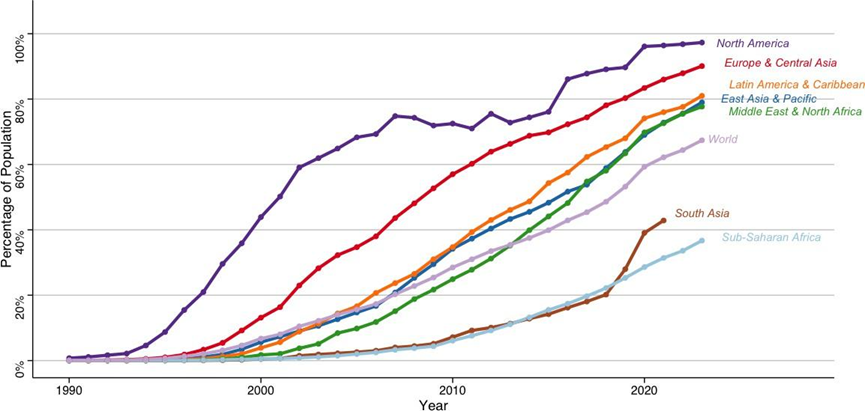
Source: Percentage of population using the internet by region from the International Telecommunication Union (via World Development Indicators) (Larreguy and Raffler 2025).
Several studies provide descriptive cross-sectional or quasi-experimental evidence linking internet access to increased polarisation. Mobile internet infrastructure has enabled the spread of social media and transformed information environments. In Europe, Guriev et al. (2021) find that mobile internet access increases support for extreme left- and right-wing parties. In the US, Melnikov (2024) shows that mobile coverage is associated with ideological polarisation, driven by increased exposure to misinformation. Similarly, Lelkes et al. (2017) find that internet access contributes to affective polarisation.
Recent work by Manacorda et al. (2022) further highlights the role of mobile internet in shifting political preferences. Using the staggered rollout of mobile broadband across Italy, they show that internet access increases support for communitarian and anti-establishment parties. This shift is not driven by direct exposure to political content, but rather by increased consumption of emotionally charged, non-political content that indirectly heightens affective responses to political issues. These findings suggest that mobile internet reshapes political preferences through indirect pathways rooted in affect and identity, not just elite messaging or political news exposure.
Experimental evidence on the direct effects of social media remains mixed. In relatively moderate settings, several studies suggest that social media contributes to polarisation. Deactivation experiments on Facebook (Allcott et al. 2020) and exposure experiments (Levy 2021) both find that social media use increases political polarisation. Enikolopov et al. (2024) show that social media’s high level of homophily compared to offline interactions amplifies polarisation.
However, more recent studies in highly polarised contexts find weaker or null effects. Facebook and WhatsApp deactivation during the 2020 US and 2022 Brazilian elections (Allcott et al. 2024, Ventura et al. 2023), as well as Facebook algorithm manipulation (Guess et al. 2023a, Nyhan et al. 2023), show that exposure to ideologically aligned content may not increase polarisation as much as previously thought. In fact, Boxell et al. (2017) document that polarisation has increased most among demographic groups least likely to use the internet. These findings highlight the conditional nature of digital polarisation effects, which may be strongest in earlier stages of adoption or lower-polarisation contexts.
Despite the mixed evidence on direct effects, substantial work documents how digital platforms shape information environments in ways that indirectly facilitate polarisation. First, internet and social media use is characterised by ideological segregation. Studies show that users are disproportionately exposed to like-minded content across platforms such as Facebook, Twitter, Reddit, and Gab (Guess et al. 2023b, González-Bailón et al. 2023, Halberstam and Knight 2016, Cinelli et al. 2021). Online ideological segregation often exceeds that of offline media (Gentzkow and Shapiro 2011), driven by user preferences for ideologically proximate content (Mosleh et al. 2021, Hobolt and Tilley 2024).
Second, selective consumption and supply reinforce this segregation. Individuals prefer ideologically aligned news sources, both because they find them more credible (Gentzkow and Shapiro 2006, Braghieri et al. 2024) and because partisan cues simplify information processing (Chopra et al. 2024, Peterson and Kagalwala 2021). Media outlets cater to these preferences, further entrenching slanted coverage (Mullainathan and Shleifer 2005, Gentzkow and Shapiro 2010). This gives rise to a self-reinforcing cycle of ideological homogeneity in both content consumption and production.
Third, as discussed in the previous section, social media platforms amplify emotionally charged and often misleading content (Melnikov 2024, Vosoughi et al. 2018). Negative and partisan posts are more likely to be shared and engaged with (Brady et al. 2017, Levy 2021, Guess et al. 2023b). This facilitates the spread of misinformation – particularly when platforms reward engagement over accuracy.
These mechanisms contribute to the formation of echo chambers and filter bubbles, where users are exposed primarily to ideologically consistent information. This reinforces prior beliefs, distorts perceptions of the political out-group, and limits cross-partisan engagement (Sunstein 2017, Levy and Razin 2019).
Overall, the evidence suggests that the internet and social media platforms contribute to polarisation through both direct and indirect channels. While the magnitude of these effects varies by context and study design, the mechanisms – segregated exposure, selective consumption, and algorithmic amplification – create environments that reward partisanship, undermine trust in neutral sources, and reduce opportunities for constructive cross-cutting engagement.
Psychological and Emotional Drivers
Political polarisation is not only a product of institutions or information environments – it is also sustained by powerful psychological and emotional mechanisms. Voters are not merely passive recipients of elite cues: they interpret political messages through cognitive and affective filters that reinforce existing beliefs and identities.
Emotions such as anger, fear, and moral outrage are especially potent drivers of polarisation. Political messages that evoke strong emotions capture attention, reshape attitudes, and increase political engagement (Brady et al. 2017, Vosoughi et al. 2018). Emotionally charged messages are especially salient, shaping how citizens interpret information and respond to political events. These messages are more likely to provoke visceral reactions that deepen affective divides and reduce openness to alternative views (Iyengar et al. 2019, Ruggeri et al. 2021, Mason 2018). These dynamics contribute not only to ideological entrenchment but also to affective polarisation: citizens growing animosity towards political opponents (Ahler and Sood 2018, Lees and Cikara 2019, Moore-Berg et al. 2020, Ruggeri et al. 2021). Moreover, psychologically, individuals disproportionately weight like-minded signals (Chandrasekhar et al. 2020, Enke and Zimmermann 2017) and engage in confirmation bias when confronted with counter-attitudinal information (Rabin and Schrag 1999).
Psychological predispositions towards in-groups, confirmation bias, and affective sorting are also amplified by features of the digital media environment (see Section 4.4). Digital platforms algorithmically reinforce ideological divisions, while social incentives online further amplify emotional and polarising content. As a result, even citizens with moderate views may become more entrenched over time – not because of changing beliefs, but because their emotional reactions are shaped by how political content is framed, delivered, and socially endorsed.
For full reference list see the end of the conclusion chapter.
Contact VoxDev
If you have questions, feedback, or would like more information about this article, please feel free to reach out to the VoxDev team. We’re here to help with any inquiries and to provide further insights on our research and content.