




Although sex ratios at birth remain relatively balanced in sub-Saharan Africa, this does not necessarily imply a lack of son preference. Analysis of over 100 Demographic and Health Surveys across 34 countries reveal that having a firstborn daughter—as opposed to a son—significantly shapes the trajectory of a woman’s life, influencing her marriage prospects, fertility decisions, and economic security.
In many parts of Asia, a strong preference for sons has resulted in millions of ‘missing girls’, i.e. girls who were never born (Sen 1990, Jayachandran 2015, Baland et al. 2024). In contrast, sub-Saharan Africa presents a different picture. Birth sex ratios remain relatively balanced (Anderson and Ray 2017), suggesting that these families may not have a preference for sons—or do they?
Our research (Genicot and Hernandez-de-Benito 2025) suggests that, while sub-Saharan Africa does not show evidence of sex-selective abortion, this does not mean that son preference is entirely absent. Instead, it operates more subtly, emerging through women’s marital and reproductive trajectories after their first child is born.
Using data from over 100 Demographic and Health Surveys (DHS) across 34 countries, we find that the gender of a woman’s first child has profound implications for her future. A firstborn daughter—rather than a son—affects a woman’s likelihood of marriage, her exposure to divorce or polygamy, fertility outcomes, and even economic well-being. These effects are not marginal; they accumulate over time and across millions of women, with consequences for gender inequality and household welfare across the continent.
A firstborn girl changes the course of a woman’s life
In our analysis, we find that the gender of a woman’s first child has profound and lasting consequences. These effects are illustrated in Figure 1, which summarizes the key impacts on marriage, polygamy, and fertility.
Specifically:
- Women whose first child is a daughter are more likely to eventually marry if the child was born outside of marriage, but they are less likely to marry the child’s father.
- They face a higher risk of divorce and are more likely to end up in polygamous unions.
- They tend to have more children overall.
Figure 1: How firstborn daughters influence marital outcomes in sub-Saharan Africa
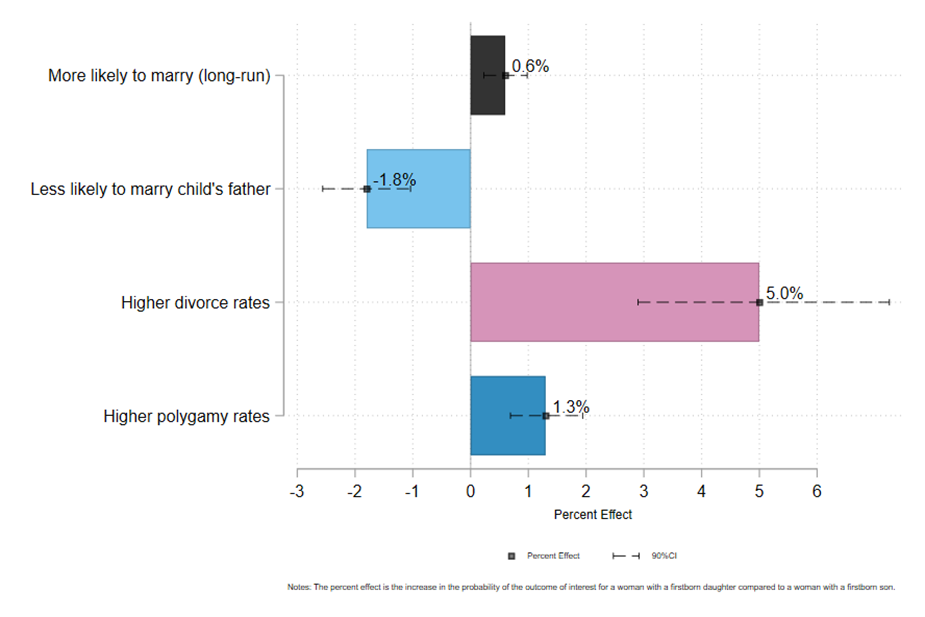
These patterns suggest that the gender of the firstborn set women on distinct marital and reproductive paths. Strikingly, these patterns do not vary significantly by women’s education or urban/rural residence. Instead, as discussed in the next section, the impact of a first child’s gender appears to reflect deeply rooted gender and kinship norms that value sons differently across cultural contexts.
The role of kinship systems: Why lineage matters
To understand the mechanisms, we examine the differences between societies who traditionally practice patrilineal versus matrilineal kinship. In patrilineal cultures—where inheritance and family lineage are passed down the male bloodline—sons are seen as essential for family continuity. In these systems, the absence of a husband or son often leaves women economically vulnerable, amplifying the incentive for son preference.
In contrast, matrilineal systems place intrinsic value on daughters. Women in these societies retain stronger claims to land, children, and family assets, even in the event of divorce. If son preference is socially rooted, we shall expect its impact to vary by lineage norms.
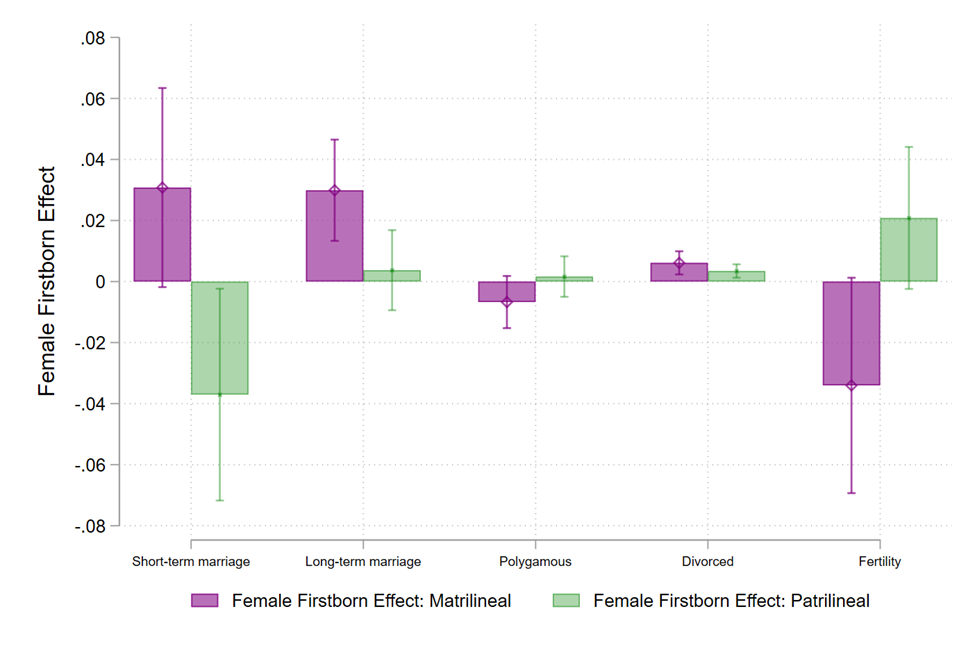
We exploit geographic discontinuities between matrilineal and patrilineal communities to compare women living in adjacent areas with different kinship traditions. The contrasts are striking: in patrilineal areas, a firstborn daughter reduces short-term marriage prospects and leads to higher fertility. While in matrilineal areas, a firstborn daughter actually increases marriage rates, reduces the likelihood of being in a polygamous union and lowers total fertility. Interestingly, we don´t find relevant kinship heterogeneity on divorce outcomes.
These results highlight how the same child—a daughter—can be valued or devalued depending on the surrounding social structure, with patrilineal norms often carrying significant socioeconomic consequences.
Figure 2: Female firstborn effect on family structure by kinship system
Women bear the cost of patrilineal norms
Family structure also matters for economic outcomes. In sub-Saharan Africa, we see that women with a firstborn daughter are more likely to live in poorer households and face higher rates of intimate partner violence. In areas with high HIV prevalence, these women are also more likely to contract the virus, possibly due to increased marital instability or diminished ability to negotiate safe sex.
We also find that these women are more likely to justify wife-beating, reflecting internalised norms that reinforce male dominance in the household. Even their husbands are more likely to justify violence, compared to fathers of firstborn sons.
Rethinking son preference: It’s not just about birth
While son preference in Africa may not manifest through selective abortion, it still profoundly shapes women’s lives—affecting marriage prospects, fertility decisions, and economic security. These findings call for a broader view of gender inequality, one that accounts for how norms influence outcomes long after a child is born.
Policy implications for gender equity in sub-Saharan Africa
Policies that recognise and respond to deeply embedded norms are key to advancing gender equity. These may include:
- Strengthening economic rights for women, including access to property and credit.
- Reforming inheritance laws and recognising customary marriages to protect women post-divorce.
- Targeting patrilineal norms through legal and community-based interventions that elevate women’s status.
- Expanding sexual health and protection programs, especially for unmarried mothers and women in polygamous unions.
References
Anderson, S and D Ray (2015), “Missing unmarried women”, Journal of the European Economic Association, 17(5): 1585–1616.
Anderson, S and D Ray (2019), “Missing women: Age and disease”, Review of Economic Studies, 77: 1262–1300.
Baland, J-M, G Cassan, and F Woitrin (2024), “Stopping rule as sex-selective abortions and instrumental births: A unified framework and world evidence”, Unpublished manuscript.
Genicot, G and M Hernandez-de-Benito (2025), “Firstborn daughters and family structure in Sub-Saharan Africa”, Unpublished manuscript.
Jayachandran, S (2015), “The roots of gender inequality in developing countries”, Annual Review of Economics, 7(1): 63–88.
Sen, A (1990), “More than 100 million women are missing”, The New York Review of Books, 37(20).
Sen, A (1992), “Missing women”, BMJ: British Medical Journal, 304(6827): 587.