



Agricultural modernisation in Brazil has driven economic growth but also intensified land inequality and redistributive conflict. As capital-intensive farming expands, it displaces rural communities and fuels organised land occupations—highlighting the need for policies that balance productivity with social equity.
In the last 30 years, economic structures in large developing countries have undergone dramatic transformation. Agricultural modernisation, driven by market-oriented reforms and technological innovation, has expanded capital-intensive farming at an unprecedented scale. This process has brought productivity gains and contributed to economic growth, while also creating profound social tension and conflict over land (McGuirk and Nunn 2024).
Our research (Falcone and Rosenberg 2025) shows that agricultural modernisation can increase redistributive conflict. Focusing on Brazil—a paradigmatic case of agribusiness expansion—we find that the surge in capital-intensive agriculture since the mid-1990s has led to a rise in land occupations by subsistence farmers, rural workers, and indigenous communities.
Crucially, the escalation of land invasions is not due to landless peasants seeking to appropriate increasingly valuable land. Rather, it reflects the dispossession of rural populations and erosion of their access to land, driven by the expansion of large farms and international agribusiness.
The two faces of agricultural modernisation
Modernisation of agriculture is a critical driver of development. The transition from subsistence to commercial farming generates surpluses, raises incomes, and fosters structural transformation. These changes, in turn, can reduce conflict by increasing the opportunity cost of violence (Collier and Hoeffler 2004, Chassang and Padro´ i Miquel 2009). However, modernisation can also increase redistributive conflict. By extending large-scale commercial farming into forests, pastures, and marginal lands, by substituting capital for labour and consolidating small farms, it can dispossess traditional communities and displace rural workers. For these communities, land occupations become the most viable economic and political strategy.
While economists have long examined conflict as a barrier to growth (North 1981, Besley 1995), the impact of modernisation on conflict has received less attention, particularly in contemporary developing economies. Yet during the past three decades, developing countries experienced a 30% increase in cultivated land, 70% rise in labour productivity, and 24% decline in agricultural employment.[1] Understanding this dynamics is essential to devise the appropriate tools to foster inclusive economic growth and reduce conflict.
The Brazilian case: Soy expansion and land occupations
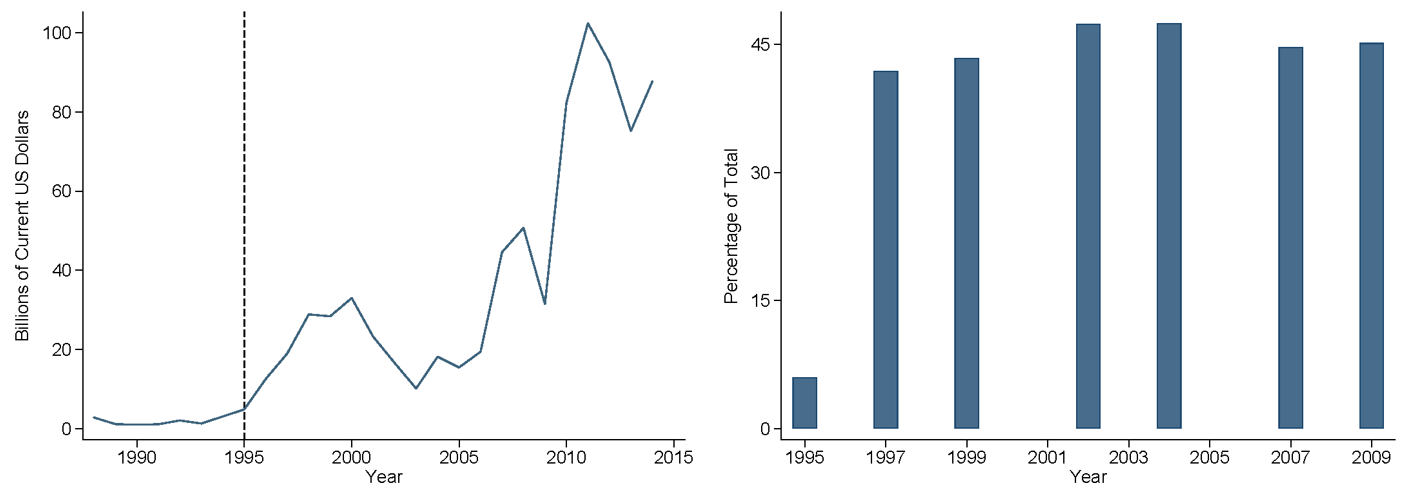
Our new approaches this question by studying Brazil’s soy boom. Between 1990 and 2010, the share of global farmland devoted to soy increased by more than 80%, while prices remained high (IBGE 2006). Brazil emerged as a global leader, doubling soy production in just a decade, attracting foreign capital in the agro-industrial sector and increasing soy export five times between 1995 and 2010 (Figure 1). Two key forces drove this transformation.
First, market-oriented reforms in 1995–1996 opened Brazil’s agricultural sector to foreign investment. These included eliminating restrictions on foreign capital, exempting it from taxation, and removing a 13% value-added tax on primary sector exports. Second, the invention of a genetically engineered (GE) soy seed in 1996 reduced labour requirements and production costs (Bustos et al. 2016, Moorthy 2025). Together, these institutional and technological changes encouraged large-scale soybean cultivation.
Figure 1: FDI, soy area, and exports in Brazil
A. FDI net inflow in Brazil B. FDI in soy processing capacity
C. Brazilian soy and other crops areas D. Brazilian soy exports
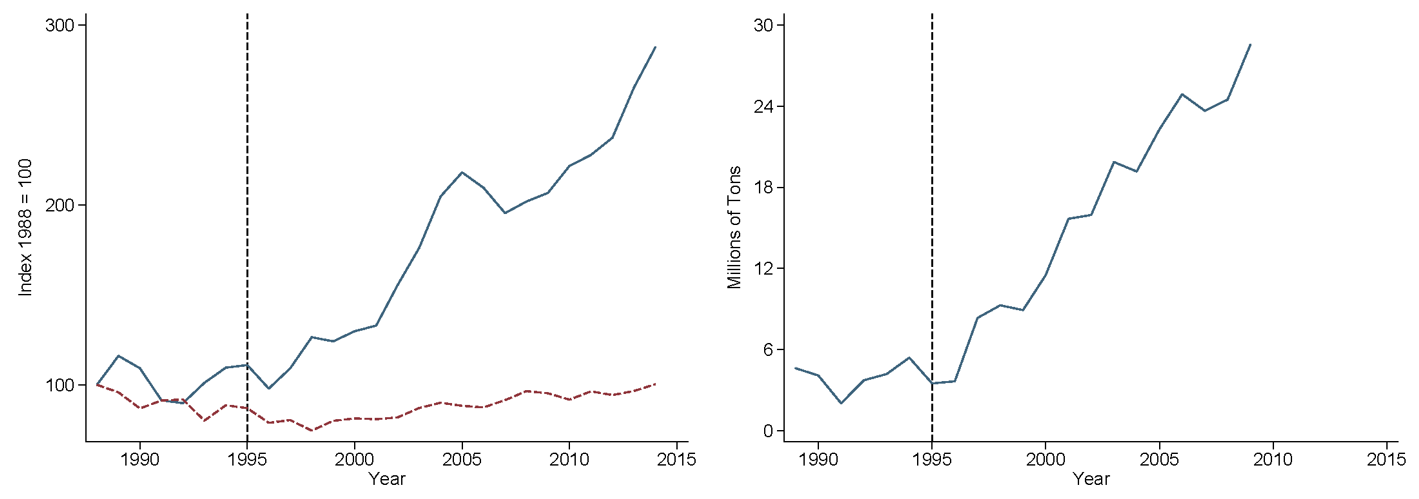
Notes: Panel A: FDI net inflow in billions of current US dollars. Panel B: soy processing capacity by largest four foreign firms as share of total from 1995 to 2009 for available years. Panel C: trend in area cultivated with soy (continuous blue) and all other crops (dashed red) from 1988 to 2014 normalised to 100 in 1988. Panel D: exports of raw soy and soy crushed grains in millions of tons. Sources: areas: PAM; exports: UN Comtrade; FDI: World Development Indicators; capacity: Wesz Jr. (2011).
This boom coincided with a surge in land conflict. Between 1988 and 2014, more than 1.3 million families participated in over 9,000 land occupations. The annual number of occupations quadrupled after 1996. The social cost of this phenomenon is reflected in the approximately 1700 land dispute-related deaths in the same period (Dataluta 2018).
Figure 2: Land occupations, 1988–2014
A. B.
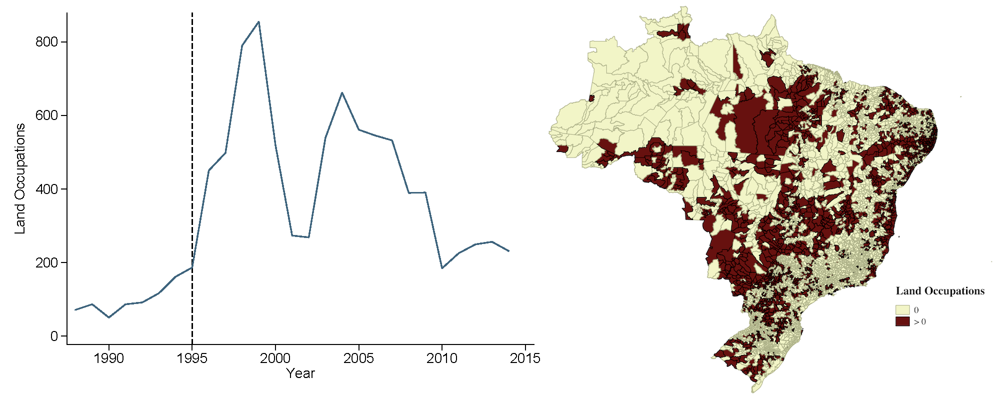
Notes: Panel A: number of land occupations from 1988 to 2014. Panel B: municipalities with at least one land occupation from 1988 to 2014. Source: Dataluta.
Why conflict increased: Land inequality, dispossession, and displacement
To establish causality, we exploit variation in municipalities’ potential gains from soy investments, determined by soil and climatic characteristics (Bustos et al. 2016), in a difference-in-differences framework. Our results show a one-standard-deviation increase in soy potential gains led to a 54% rise in land occupations after 1996. The magnitude of the effect is roughly equally due to market reforms and the GE soy innovation.
Why did modernisation fuel conflict? One hypothesis is rapacity: rising land values make land more attractive to occupy. But we find no evidence for this mechanism. Instead, our findings point to increased land inequality through dispossession and displacement. As large, capital-intensive farms expanded, they encroached on land used informally by subsistence farmers and indigenous communities. Moreover, market forces led to the consolidation of the more labour-intensive small famers, leading to a decline in employment opportunities.
We document the expansion of soy farms into pastures, forests, and unregistered lands—areas that traditionally provide livelihoods for marginalised groups (Eidt and Udry 2019). Indigenous communities were particularly affected: soy expansion into their territories drove land occupations by indigenous groups who sought to reclaim ancestral lands, providing compelling evidence of the dispossession channel.
Figure 3: Timing of effect on land occupations (A–B) and soy area (C–D)
A. Full sample B. Central-South (95% of soy area)
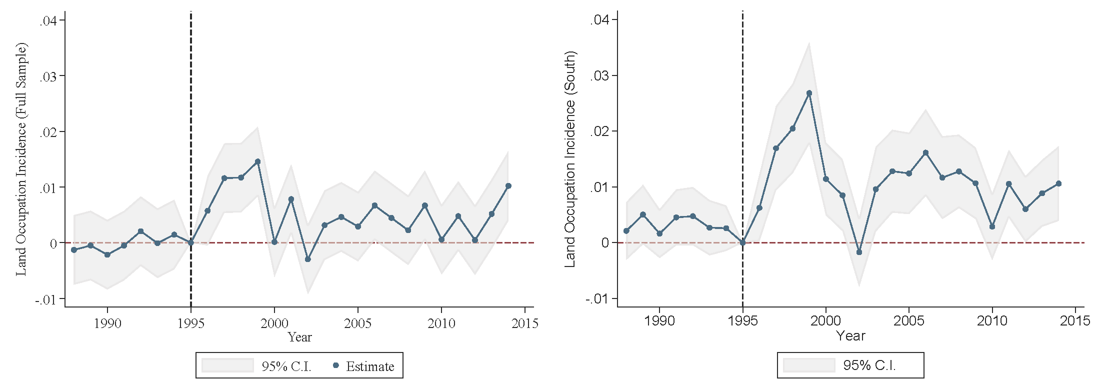
C. Full sample D. Central-South (95% of soy area)
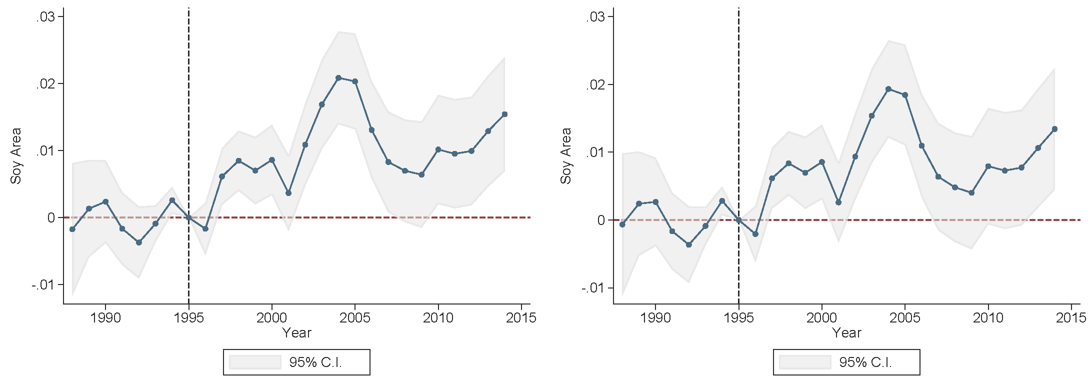
Notes: Panel A: shows the main effect where the dependent variable is equal to 1 if number of land occupations is higher than 0. Panel B: shows the main effect for the Central-South (the area that includes the South, the South-East, and the Central-West regions and which accounted for 95% of soy area in the country in 1996); dependent variable is equal to 1 if number of land occupations is higher than 0. Panel C: estimates the main effect where the dependent variable is the soy area as municipal share. Panel D: estimates the main effect for the Central-South; dependent variable is the soy area as municipal share. Source: land occupations: Dataluta; soy area: PAM.
Political incentives and organised resistance
Redistributive conflict in Brazil is a political issue that reflects unequal land distribution since the colonial period. Landless movements such as the Movimento dos Trabalhadores Rurais Sem Terra (MST) have long used occupations to pressure the government to enforce constitutional provisions on the ‘social function’ of land. These provisions allow expropriation of underutilised estates for redistribution.
We find that agricultural modernisation increased organised land occupations—as opposed to spontaneous ones—particularly in municipalities with large estates (latifundia) and stronger left-wing political preferences. These movements often targeted symbolic locations—large soy farms owned by foreign companies—to draw attention to their struggle. Political considerations thus amplified economic grievances.
Broader implications: Modernisation, inequality, and conflict
Brazil’s experience illustrates how market forces and technological change exacerbate inequality and provoke redistributive struggles in rural setting. Our findings resonate with the historical development of modern economies during the nineteenth century when land enclosure through consolidation and privatisation led the way to the development of the first modern agricultural sector while increasing inequality with high potential for social conflict (Heldring et al. 2022). Today, this pattern is not unique to Brazil. Across sub-Saharan Africa and Southeast Asia, international agribusiness is expanding rapidly, often displacing local communities (Deininger and Byerlee 2012, De Janvry et al. 2001, Dhingra and Tenreyro 2021).
These dynamics highlight the relevance of structural transformations in shaping conflicts and the need for redistributive policies and social insurance to reduce their cost and promote inclusive economic growth. Without safeguards, modernisation risks deepening rural inequality and destabilising fragile political systems. Policymakers face a critical challenge: how to balance productivity gains with social equity. As global agribusiness continues to reshape rural economies, these choices will determine whether modernisation fosters shared prosperity—or fuels redistributive conflict.
References
Besley, T (1995), “Property rights and investment incentives: Theory and evidence from Ghana,” Journal of Political Economy, 103: 903–937.
Bustos, P, B Caprettini, and J Ponticelli (2016), “Agricultural productivity and structural transformation: Evidence from Brazil,” American Economic Review, 106: 1320–1365.
Chassang, S and G Padró i Miquel (2009), “Economic shocks and civil war,” Quarterly Journal of Political Science, 4: 211–228.
Collier, P and A Hoeffler (2004), “Greed and grievance in civil war,” Oxford Economic Papers, 56: 563–595.
Dataluta (2018), "DATALUTA – Banco de dados da luta pela terra."
De Janvry, A, G Gordillo, E Sadoulet, and J-P Platteau (2001), "Access to land, rural poverty, and public action," Oxford University Press.
Deininger, K and D Byerlee (2012), “The rise of large farms in land abundant countries: Do they have a future?” World Development, 40: 701–714.
Dhingra, S and S Tenreyro (2021), “The rise of agribusinesses and its distributional consequences,” Unpublished manuscript.
Eidt, J and C Udry (2019), "Sistemas agrícolas tradicionais no Brasil," Embrapa.
Falcone, S and M Rosenberg (2025), “Agricultural modernization and redistributive conflict,” Journal of Development Economics, 103529.
Heldring, L, J A Robinson, and S Vollmer (2022), “The economic effects of the English Parliamentary enclosures,” Unpublished manuscript.
IBGE (2006), "Censo agropecuário 2006," Instituto Brasileiro de Geografia e Estatística.
McGuirk, E F and N Nunn (2024), “Development mismatch? Evidence from agricultural projects in pastoral Africa,” Unpublished manuscript.
Moorthy, V S (2025), “Agricultural technological change, female earnings and fertility: Evidence from Brazil,” The Economic Journal, 135(665): 285–320.
North, D C (1981), "Structure and change in economic history," Norton.
Wesz Jr., V J (2011), "Dinâmicas e estratégias das agroindústrias de soja no Brasil," Editoria.