




Can one student’s experience influence the educational decisions of those that follow? Evidence from admissions to elite schools in Peru shows how policies that make success stories visible can have multiplier effects.
Education systems in developing countries are marked by high and persistent inequalities rooted in family background – both in the number of years children can spend in school and in their access to higher-quality educational institutions. These disparities undermine fairness – as educational opportunities depend heavily on circumstances of birth – and reduce efficiency – since many individuals are unable to fully develop their potential.
Part of the gap in access to higher-quality schools is due to costs and geographic constraints. Another part stems from disparities in human capital accumulation, linked to differences in educational investment. However, this is not the whole story: several studies have documented that even among high-achieving students, there is a socio-economic gap in applications to elite schools – even in contexts with low direct costs and no geographic restrictions (Machado et al. 2024, Ajayi 2022, Estrada 2017). One potential reason behind this gap in demand is a lack of information. For many young people from low-income households, it is not easy to know what educational opportunities exist or judge whether those opportunities are truly meant for them.
Imagine a student with good grades, discipline, and motivation – but no one in their school or neighbourhood has ever attended a prestigious, high-quality secondary school or university. This may cause them to doubt whether such opportunities are meant for them. Now consider a different scenario: the previous year, a classmate from the same school managed to gain admission to one of these schools. Could that experience change how younger students perceive their own potential?
In a recent study (Estrada, Gignoux, and Hatrick 2025), we examined exactly this question: Can one student’s experience influence the educational decisions of those that follow?
High-quality schools for high-achieving students in Peru
We study the COAR system (Colegios de Alto Rendimiento) in Peru – a recent nationwide network of free public boarding schools that serve the final three years of secondary education. COAR schools are designed to offer high-quality education to high-achieving students from low-income backgrounds.
Compared to regular public schools, the COAR curriculum includes additional academic and personal development components, and students have the opportunity to earn the International Baccalaureate Diploma Programme certification. The system was launched in 2015 with 14 schools and 1,600 new students; by 2017, it had expanded to 25 schools and 2,700 new students. Importantly, COAR entailed no direct monetary cost to students or their families. This, combined with the recent launch of the programme, made it possible to isolate the effects of information on demand – controlling for factors such as financial constraints and prior exposure.
Despite being designed to broaden access, students from poorer households apply to COAR at lower rates – even when they meet the eligibility criteria. For instance, 64% of eligible students whose parents have tertiary education applied during our period of analysis, compared to just 51% of those whose parents have lower levels of education.
Studying educational opportunity in Peru
To identify the causal effect of a COAR admission, we use a regression discontinuity design based on COAR’s centralised admissions system. In this system, applicants are ranked according to their performance on various assessments and region of origin, creating discontinuities in admission offers at the level of each of Peru’s 24 departments.
Intuitively, we compare schools where the top-ranked applicant was just admitted by a narrow margin with schools where that applicant narrowly missed admission. This comparison allows us to identify the causal effect of having a student admitted to COAR on the younger cohort of students, while isolating it from other differences between schools or students. Additionally, we take advantage of COAR’s recent launching to focus on the first admission (or rejection) in each school, capturing the effect of a new admission without the confounding influence of previous admits.
For the analysis, we use data from the COAR admissions process, national student enrolment system (SIAGIE), and national student achievement assessment (ECE). Our sample includes all public-school students enrolled in the second year of secondary education between 2014 and 2018, as COAR coverage begins in the third year of secondary school.
Figure 1 shows how the number of students from a given school admitted to COAR varies according to the admission score of the school’s top-ranked applicant. This number jumps from 0 to 1 at the admission threshold. We provide evidence supporting the validity of our identification strategy, using standard tests to confirm the absence of manipulation in admission scores and systematic differences between the groups around the threshold.
Figure 1: Number of admitted students by admission score
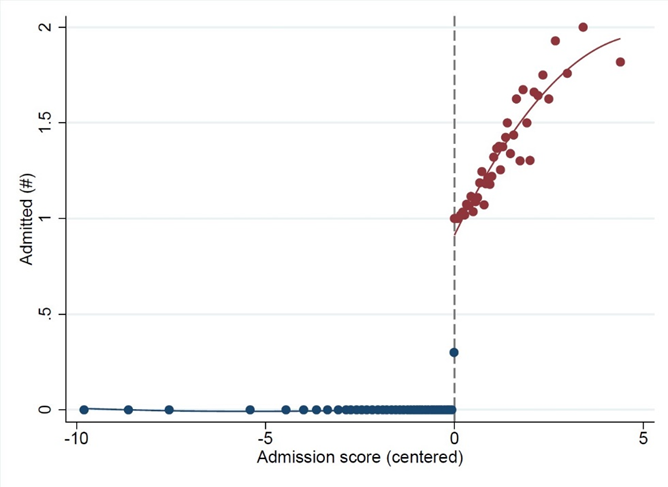
Note: The figure shows the number of students admitted to COAR in year t as a function of the admission score of the school’s best applicant in the admission process in year t-1. The vertical lines separate schools with non-admitted (left side) and admitted (right side) applicants in year t-1. The continuous lines represent the second-degree polynomials that best fit the underlying data on each side of the cutoff. The sample consists of schools with at least one applicant who reached the second round of the COAR admission process for the first time during the 2015–2018 period. Source: COAR administrative data 2015–2018.
Role models matter for educational opportunity
We find that the admission of a student to COAR generates positive spillovers in their school:
- Applications increase by 0.52 students the following year – a 17% rise relative to the control group (Panel A, Figure 2).
- Admissions increase by 0.17, a 43% increase over the control group mean (Panel B, Figure 2).
- Most importantly, the increase in applications was concentrated among students from lower socio-economic backgrounds.
Our results further suggest that this rise in applications stems from younger students learning from their former classmate’s COAR experience and seeing that these schools could be a good fit for someone like them. The presence of a successful role model – a former schoolmate who gained admission to a highly selective school – can help less advantaged students envision themselves following a similar path.
Figure 2: COAR applications and admissions by admission score
(a) Applicants (b) Admitted
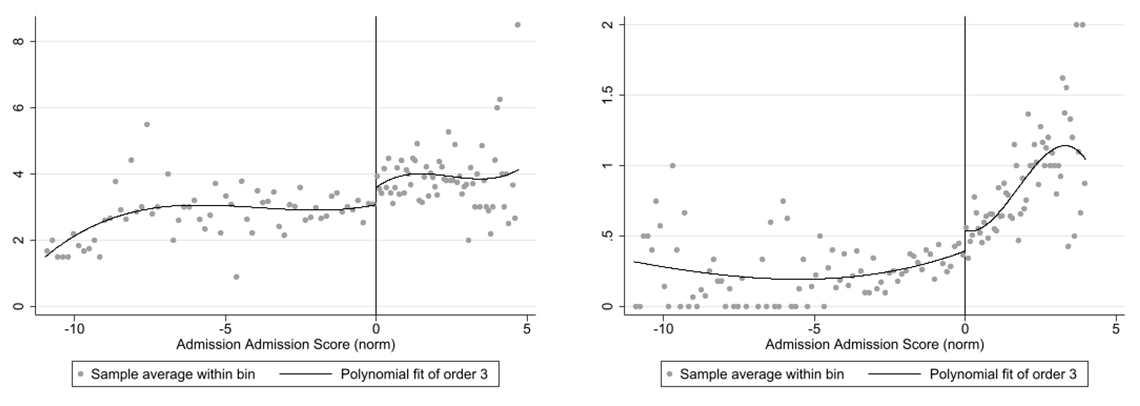
Notes: The figure shows the conditional means of school-level applications to COAR in year t as a function of the admission score of the best applicant from the school in year t-1. Observations are grouped into bins based on Calonico et al. (2015). The vertical lines indicate the admission cutoff in year t-1. The continuous lines represent the third-degree polynomials that best fit the underlying data on each side of the cutoff. The sample consists of schools with at least one applicant who reached the second round of the COAR admission process for the first time during the 2015–2018 period. Source: COAR administrative data 2015–2019.
Spillovers are stronger when:
- The older schoolmate is assigned to a geographically closer COAR.
- The schoolmate comes from a smaller school (where visibility is likely higher).
- The older schoolmate had higher academic performance, enhancing the credibility of the role model.
Importantly, the context and design of our research make it more likely – compared to previous research – that our results reflect learning about the benefits and educational experience of COAR itself, rather than a combination of that and learning about the admissions process.
In the comparison group, students who narrowly missed the admission threshold had participated fully in the application process and performed similarly to those who were marginally accepted. Unlike the admitted students, however, they remained in their original schools, which may have made it easier for them to share information about the admissions process with younger classmates. Along the same lines, we find no evidence that having a classmate admitted to COAR affects the younger students’ performance on the COAR entrance exam.
Still, not all barriers disappear. The increase in admissions among lower socio-economic status students is smaller than the increase in applications. This is because academic performance gaps persist, even within the select group eligible for COAR. Moreover, application increases are concentrated among those living closer to a COAR school, suggesting that indirect costs – such as transportation – remain a significant barrier.
Implications for education policy
Our research offers a clear lesson: improving access to educational opportunities is not just about financial resources, though those are certainly important – it’s also about role models, information, and confidence. In contexts of high inequality, policies that make success stories visible – and show that they are within reach – can have multiplier effects. However, our results also call attention to the fact that, even among relatively high-achieving students, differences in performance on admission assessments by socio-economic status can persist, with potentially relevant consequences for access to high-quality institutions.
References
Ajayi, KF (2022), “School choice and educational mobility: Lessons from secondary school applications in Ghana,” Journal of Human Resources 59(4): 1207–1243.
Calonico, S, M Cattaneo, and R Titiunik (2015), “Optimal data-driven regression discontinuity plots,” Journal of the American Statistical Association 110(512): 1753–1769.
Estrada, R (2017), “The effect of the increasing demand for elite schools on stratification,” CAF–Development Bank of Latin America and the Caribbean.
Estrada, R, J Gignoux, and A Hatrick (2025), “Learning about opportunity: Spillovers of elite school admissions in Peru,” The Economic Journal: ueaf034.
Machado, C, G Reyes, and E Riehl (2025), “The direct and spillover effects of large-scale affirmative action at an elite Brazilian university,” Journal of Labor Economics 43(2): 391–431.