

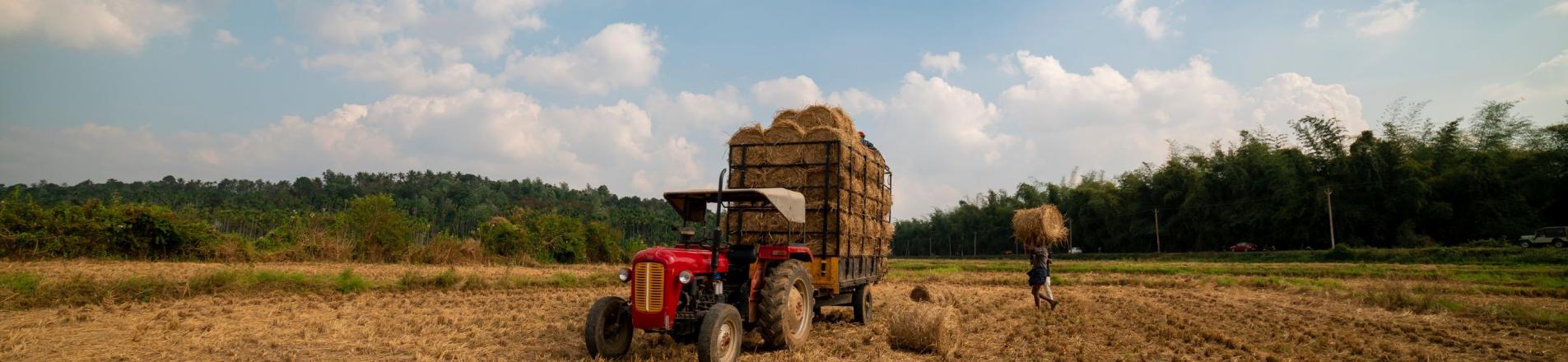




Internal migration of agricultural workers in India leads to a downsizing of farms near cities and an expansion in remote areas, prompting a spatial reorganisation of agriculture whereby remote, non-migrant households adopt more technology and expand production.
Editor’s note: A version of this article first appeared on Ideas for India.
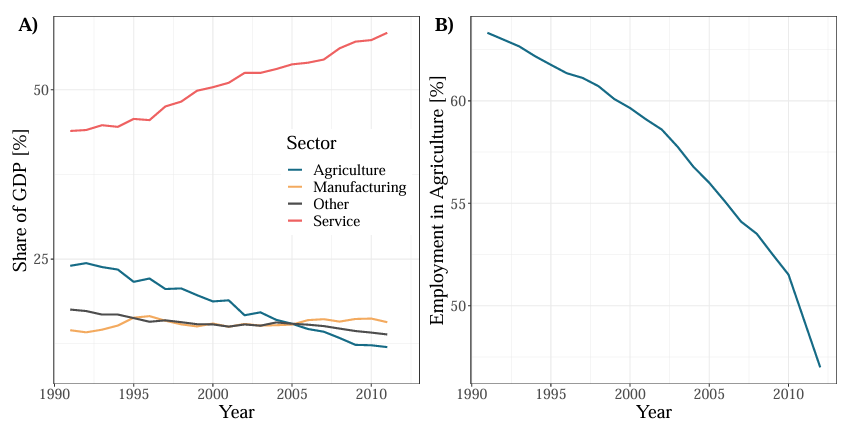
The migration of workers from farms to cities is a hallmark of economic development. For instance, India’s 1991 economic liberalisation led to a 30% drop in the share of the workforce employed in agriculture alongside a rapid expansion of urban service jobs (Figure 1). While development economists have extensively studied migrants and their urban destinations, less is known about how their departure transforms the rural economies they leave behind.
Figure 1: Economic growth and reallocation of labour (1991-2012)
Mainstream models in development economics assume that rural areas have surplus labour, allowing some workers to exit farming without affecting agricultural output (Lewis 1954). Yet empirical research shows that emigration does reduce output (Rozelle et al. 1999, Mendola 2008). Sustaining food supplies as workers exit agriculture thus requires some form of agricultural transformation. Although aggregate analyses suggest that this occurs through labour-capital substitution (Manuelli and Seshadri 2014, Hornbeck and Naidu 2014, Alvarez-Cuadrado and Poschke 2011), micro-level mechanisms remain unclear: do left-behind families of migrants directly substitute capital for labour? Or is the process indirect—where land and crop prices readjust following emigration, leading other non-migrant households to reorganise production and fill the output gaps?
In our new research (Madhok, Noack, Mobarak, and Deschenes 2025), we analyse detailed household-level panel data to paint a richer picture of the direct and indirect pathways through which rural economies respond to migration.
Studying migration and agriculture in India
We use the 2005 and 2012 rounds of the India Human Development Survey (IHDS), which contains information on medium-term migration as well as agricultural inputs, employment, and profits for 42,000 households. We focus on migration of working-age men, as they constitute the majority of India’s migrant workforce.
Three stylised facts from the data guide our research design:
- Migration typically involves individual household members rather than entire families.
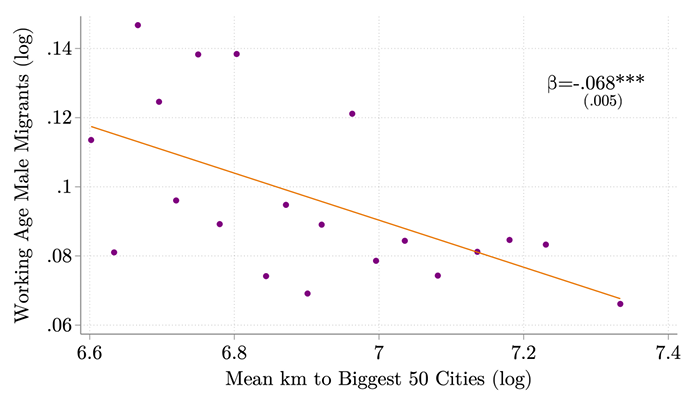
- Migration declines with remoteness (Figure 2), suggesting that migration costs increase with distance.
- Labour constraints increase with farm size, suggesting that the impact of worker exit will be more salient for large farms.
Figure 2: Migration and distance to nearest large cities
Quantifying the impact of migration on agriculture is complicated by the fact that agricultural outcomes could also incentivise migration. We therefore ‘instrument’ for migration using the combination of destination income shocks with household-level exposure to these shocks. Since destination income shocks incentivise migration, but are uncorrelated with agricultural outcomes at the origin, these shocks can be used to isolate the ‘pull’ stream of migration that is plausibly exogeneous to origin ‘push’ factors such as poverty. Exposure to destination income changes is measured by: (i) inverse distance to potential destinations, and (ii) the household’s migration potential, proxied by the number of working-age males at home during the baseline period. Interacting these allow us to compare households with similar migration potential but different exposure to income shocks, or vice versa.
Direct effects of migration: Downsizing, not mechanisation
Contrary to conventional wisdom, we find no evidence that migrant-sending households replace labour with capital. Instead, they scale down farming operations (Figure 3, orange). A one standard deviation reduction in the number of farm workers causes households to reduce agricultural expenses, machinery, and farm size, resulting in lower profits.
Figure 3: The direct effect of migration on agricultural development
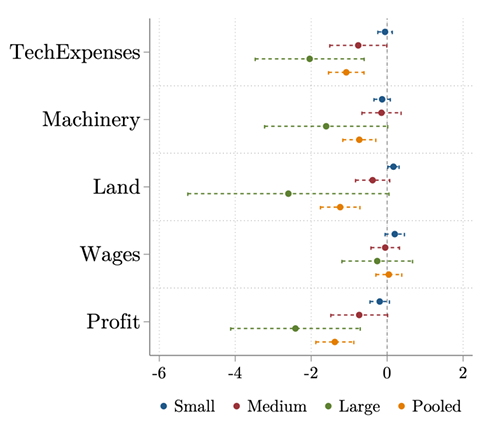
We find that downsizing is driven by large farms (Figure 3, green), consistent with our stylised fact that these farms are more labour constrained. Small farms—characterised by surplus labour—show little response, as the departure of underutilised workers has little effect on production.
At first glance, these findings raise concerns about domestic food supply amidst India’s rapid urbanisation. Yet, the net impact of migration on agriculture also depends on market adjustments to worker movement and how other non-migrating farming households, in turn, adapt their production in response to changing land and crop prices.
Indirect effects of migration: Crop and land markets reallocate production
If the declining food supply in Figure 3 raises crop prices, then other households unaffected by labour loss may respond to higher output prices by scaling up farming. This indirect ‘crop market channel’ is likely strongest in remote areas, where non-migrant households live (Figure 2). Likewise, if shrinking farms of migrant households depress land prices, other village neighbours may expand cultivation through an indirect ‘land market channel’.
Building on this economic intuition, we expand our empirical framework to quantify how migration affects agricultural production through these market channels. We assume land markets operate within villages: as migrant households reduce cultivation following male emigration, local land prices fall, enabling non-migrant neighbours to expand production. For crop markets, we define zones within a state suitable for growing particular crops and measure crop market adjustments through aggregate emigration from these crop-suitable regions. Intuitively, if urban shocks trigger mass emigration from a rice-suitable region, lowering rice output and raising rice prices, then non-migrant households elsewhere in the state will expand rice production if they also live in a rice-suitable region.
We find that agricultural profits increase for non-migrant households through crop market adjustments, partially offsetting the agricultural losses accruing to migrant households. We show that the key mechanism is high crop prices, which prompt households unaffected by migration to spend more on agrochemicals, seeds, and equipment rentals, ultimately leading to higher production.
On the land market side, we find that other farmers in the village who are less exposed to the migration shock expand their farms in response to land market adjustments, counteracting the downsizing of farms among migrant-sending households. We use land transaction data from IHDS to demonstrate that the mechanism is through lower land prices, which enables ‘left-behind’ households in the village to expand cultivation.
The spatial reorganisation of agriculture in India
Our findings embed an important spatial dimension: the negative direct effect of migration on agriculture dominates for households near cities, where migration costs are low. The positive market-driven effects dominate for households further away, where migration costs are high. Therefore, although remote households are less likely to migrate, they still contribute to India’s structural transformation by producing more food. This leads to a spatial reorganisation of agriculture from migrant-sending areas toward remote areas.
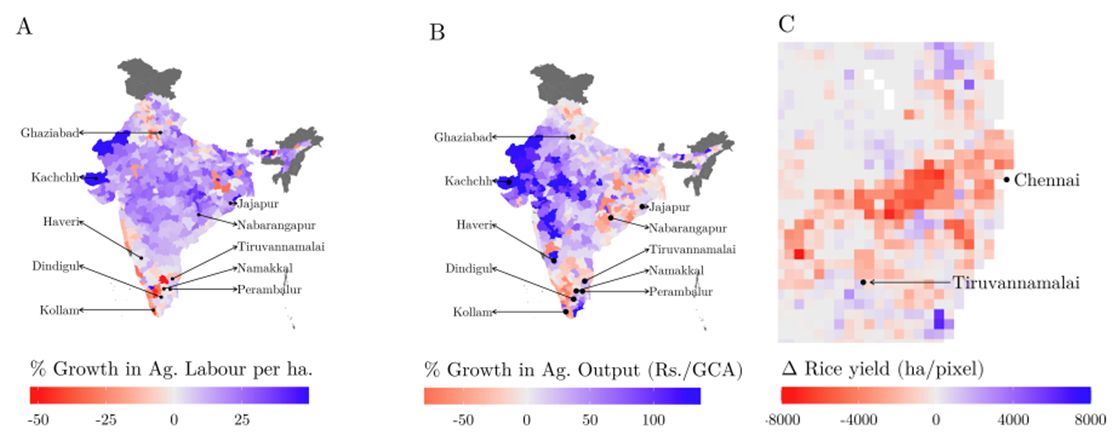
We validate this spatial pattern using census and satellite data on income growth, agricultural labour, and crop output (Figure 4). At the district level, agricultural labour declines near high-growth cities (red), while crop output rises in remote districts (blue), mirroring our estimates of spatial reallocation through crop markets. High-resolution satellite data reveals a similar pattern even within a city: yields decline in peri-urban zones with high labour outflows (red) and rise in the outer fringes (blue), consistent with spatial reallocation through local land markets.
Figure 4: Economic growth, labour exit, and agricultural growth (2001-2011)
Policy implications: Migration and agriculture
We conclude with an accounting exercise to determine how much of the aggregate migration-induced agricultural losses are mitigated by crop and land market adjustments. We simulate aggregate crop value in the absence of migration, with migration but no market adjustments, with migration and land market but no crop market adjustments, and so on. Market adjustments mitigate 80% of aggregate agricultural losses due to emigration.
Our findings add policy relevant value to our understanding of structural transformation. While labour reallocation drives agricultural modernisation, it does not operate through capital substitution alone, but instead through market-mediated spatial reorganisation. Remote, non-migrant households adopt more technology and expand production, enabling them to benefit from a transformation they do not directly partake in. This suggests that structural change can redistribute gains toward the rural poor who stay behind.
References
Alvarez-Cuadrado, F, and M Poschke (2011), “Structural change out of agriculture: Labor push versus labor pull,” American Economic Journal: Macroeconomics 3(3): 127–158.
Hornbeck, R, and S Naidu (2014), “When the levee breaks: Black migration and economic development in the American South,” American Economic Review 104(3): 963–990.
Lewis, WA (1954), “Economic development with unlimited supplies of labour.”
Madhok, R, F Noack, AM Mobarak, and O Deschenes (2025), “Internal migration and the spatial reorganization of agriculture,” NBER Working Paper.
Manuelli, RE, and A Seshadri (2014), “Frictionless technology diffusion: The case of tractors,” American Economic Review 104(4): 1368–1391.
Mendola, M (2008), “Migration and technological change in rural households: Complements or substitutes?” Journal of Development Economics 85(1–2): 150–175.
Rozelle, S, JE Taylor, and A DeBrauw (1999), “Migration, remittances, and agricultural productivity in China,” American Economic Review 89(2): 287–291.