




International tensions and external wars are on the rise, with major economic implications. To study these, economists should bridge the divide between two fields: (i) research on conflict – the use of military weapons, and (ii) geoeconomics, which focuses on ‘economic weapons’.
Editor's note: This article is part of series covering CEPR's Reducing Conflict and Improving Performance in the Economy (ReCIPE) programme. Eoin McGuirk and Christoph Trebesch are the ReCIPE Theme Leaders on Geoeconomics.
In recent decades, research on conflict and wars has predominantly focused on civil rather than international conflict events. This is unsurprising, as civil wars have been far more prevalent than external wars since the end of World War II (Fearon and Laitin 2003, Collier and Hoeffler 2004, Blattman and Miguel 2010).
However, we are now witnessing the return of international warfare. Figure 1 shows that the number of fatalities from international conflicts now far exceeds the fatalities from domestic conflicts. This shift coincides with changing international power dynamics, with the rise of new powers in Asia, and the relative decline in US influence.
Taken together, these trends in the international system raise important questions for economists:
- What do rising geopolitical tensions imply for economic behaviour?
- What are the economic costs of war and international power rivalry?
- How is conflict shaped by international power dynamics, in particular economic power?
- Does the use of ’economic weapons’, such as sanctions increase or decrease the probability of military conflict?
In our recent pathfinding paper (McGuirk and Trebesch 2025), we focus on two areas within political economy that are well equipped to tackle these questions. First, the quickly growing field of geoeconomics, defined by Mohr and Trebesch (2025) as “the field of study that examines the links between geopolitics and economics,” or, more broadly, the economics of international political power rivalry (Clayton et al. 2024, 2025, Thoenig 2025). Second, the more established field of the economics of conflict and security (Rohner 2024, Rohner and Thoenig 2021).
Thus far, these two research fields have remained largely separated – our paper proposes pathways to bridge this gap. A central message of our work is that scholars should study armed and non-armed interventions together, as these strategies are increasingly deployed side by side. Autocratic leaders, in particular, are prone to combine traditional tools of economic coercion such as embargoes or import bans, with more aggressive interventions, including sabotage, cyber-attacks, or outright military conflict against a foreign state.
Figure 1: Battle deaths from domestic vs. international conflict
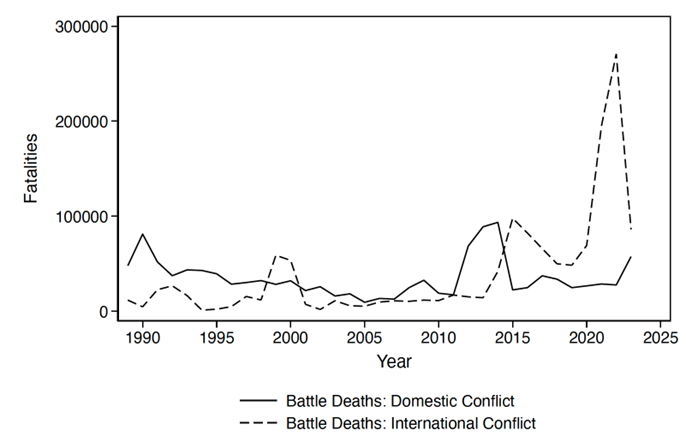
Notes: Domestic conflicts include nonstate and localised intra-state battles. International conflict events are defined as either inter-state wars or internationalised civil conflict battles. The latter are internal armed conflicts where a foreign state is involved, either through military intervention or support to one of the parties. One-sided conflict (violence against civilians) is omitted. Source: UCDP (Sundberg and Melander 2013).
Why does war occur?
International armed conflict is extraordinarily costly, both in terms of direct human fatalities and the destruction of physical and human capital. Federle et al. (2024a) estimates that war on a country’s territory leads to an average decline in output of 20% and a 10-percentage-point increase in inflation, and that there are large international spillovers of wars and geopolitical risks (Caldara and Iacoviello 2022).
The large costs and negative spillovers of international war yield two observations. The first is that war should not occur: there must exist some allocation of resources before a conflict that is preferable to all parties than the allocation that exists after a conflict. Why war persists despite this observation is the subject of a rich theoretical body of research (Fearon 1995, Powell 2006, Jackson and Morelli 2007, Baliga and Sjöström 2024). Economic incentives indeed matter – war is more likely when the value of appropriable rents (the ‘spoils’) increases and when the (opportunity) costs of conducting a war decreases – but they cannot explain the absence of an up-front transfer between parties that avoids all the destruction in the first place.
For this reason, war is best understood as a bargaining failure, which guides three common explanations for why it happens:
- Information problems, where parties face uncertainty about their adversary’s strengths or preferences.
- Commitment problems, where one party cannot credibly commit never to renege on a peace agreement.
- Political agency problems, where political leaders stand to gain more from war than the rest of society.
Efforts to provide mediation, security guarantees, and political accountability can solve these problems.
This brings us to the second observation, which is that external actors – e.g. third-party states, regional blocs, multilateral institutions, or neighbourhood hegemons – ought to have strong incentives to prevent or end conflicts wherever the threat arises. Theory suggests that this can be achieved by addressing the roots of bargaining failures as well as the economic incentives that determine bargaining range.
Understanding the relationship between trade and war
A fundamental question at the intersection of geoeconomics and conflict is on the relationship between trade and war. Montesquieu famously wrote, “wherever the ways of man are gentle, there is commerce; and wherever there is commerce, there the ways of men are gentle.” This reflects a central promise of globalisation: growing economic integration raises the opportunity costs of war and will therefore bring peace.
An important counterargument to this view is that economic integration can also heighten inter-state rivalries by fuelling concern over strategic vulnerabilities and intensifying competition over the gains from trade and access to critical resources (Hirschman 1945, Waltz 1979, Findlay and O’Rourke 2007). Bridging these ‘liberal’ and ‘realist’ perspectives, Martin et al. (2008) show that while bilateral economic integration reduces the likelihood of conflict between states, global integration can have a countervailing effect, as it allows states to more easily re-orient trade elsewhere. In more recent work, Thoenig (2024) and Mayer et al. (2024) highlight a security dilemma arising from these findings: when a state aims to reduce strategically vulnerabilities by decoupling from a potential adversary, it has the effect of increasing the risk of conflict, resulting in lower overall welfare.
Geoeconomic tools for peace
Advocates for the pacifying effect of globalisation have long argued that ‘economic weapons’ inflict large welfare losses to target countries and can therefore be used as an alternative to military weapons (Blackwell and Harris 2016). In recent years, the proliferation of granular data along with the rise of causal inference methods has allowed these claims to be evaluated with more rigour. A burgeoning literature has studied the effects of sanctions, embargoes, export controls, strategic tariffs, and investment screening.
Economic sanctions, for example, are widely believed to deter new conflicts by increasing the expected costs of war as well as undermine ongoing war efforts by hampering military production. Using granular data, recent research on sanctions against Russia shows that the broader economy suffered major losses in terms of imports, TFP, and output, despite successful avoidance efforts and exceptions for well-connected firms (Nigmatulina 2023, Egorov et al. 2024).
Another potentially promising tool are trade agreements and other economic and non-economic treaties, which could allow leaders to credibly signal trust in potential adversaries, facilitating a move to the ‘good’ equilibrium of trade and peace (Martin et al. 2008, Broner et al. 2025).
In addition, foreign aid is often thought to reduce conflict by increasing the opportunity costs of participating in violence (Crost et al. 2016). In the context of counterinsurgency efforts, development aid delivered in secure environments can also be effective in winning local support (Berman et al. 2011, Dell and Querubin 2017). However, consistent with theory, aid that instead raises the value of appropriable rents can have the opposite effect (Nunn and Qian 2014, McGuirk and Nunn 2024).
Thus far, however, the proliferation of geoeconomic tools has not coincided with widespread peace and stability. On the contrary, the risk of war is rising, and global military spending is booming. Current trends suggest that geoeconomics and globalisation may be less stabilising than is often assumed.
Future directions for research on conflict and geoeconomics
Against this backdrop, we highlight four main open questions and directions for future research:
- We propose a broader view on the geoeconomic toolkit used by states. Traditionally, research on economic statecraft and geoeconomics focused on purely economic ‘carrots and sticks’ (Baldwin 1995). We see the need to also consider more aggressive, non-armed tools that are increasingly used in tandem with classic economic tools. These include covert operations, cyber-attacks and sabotage, as well as quasi-armed inventions in the form of military aid or sponsoring insurgencies and terrorism (Figure 2).
Figure 2: A broader geoeconomic toolkit – Economic and noneconomic weapons
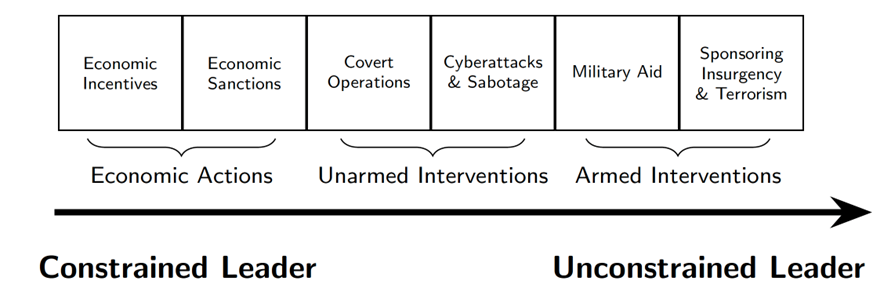
Leaders are likely to face different constraints in how these tools are deployed. For example, rogue leaders are likely to choose the least costly option across the full toolkit to achieve a geopolitical aim, while more constrained leaders in open democracies are more likely to be bound by international law. By studying the full range of actions, new research can shed light on these constraints and on the strategic rationale of different tools. Are some tools complements, or substitutes? Which tools are most likely to be combined? And which ones are most effective at a given cost of deploying them?
- Do geoeconomic tools increase or decrease the risk of conflict? Due to the proliferation of geoeconomic policies, more research is needed to address this question. Does the use of geoeconomic weapons lower geopolitical risk and instability, or exacerbate them?
- We propose more research on explicit peace-making tools of diplomacy. These include interventions that directly address the roots of bargaining failures that lead to war. For example, informational problems can be addressed by mediation efforts that also generate incentives to disclose private information. Commitment problems can be addressed by security guarantees and armed peacekeeping interventions (Hultman et al. 2014). Political pro-war bias can be addressed by internalising the costs of war for pivotal political decision-makers (McGuirk et al. 2023). Beyond the sources of bargaining failures, other interventions can directly address conflict incentives through, for example, transparency and traceability initiatives, such as those in natural resource sectors that are designed to lower the value of conflict-related oil and minerals (Berman et al. 2017).
- The domestic political economy of geoeconomics and war. Leaders are generally concerned with maintaining domestic political power, and many will execute foreign policy with these considerations in mind. For this reason, there is much scope for research on the connection between domestic political economy and the use of geoeconomic tools versus military actions. What are the domestic political consequences of deploying economic weapons in foreign countries, and how does this differ from deploying more aggressive tools? And how popular are individual tools such as sanctions or strategic tariffs or embargoes?
More generally, we see much potential in leveraging novel, granular data to better identify empirical relationships in this area. Applying modern econometric rigour to the kind of big-picture, policy-relevant questions at the heart of geoeconomics and conflict is a challenging but valuable opportunity for future work.
References
Baldwin, D A (1985), "Economic statecraft", Princeton University Press.
Baliga, S and T Sjöström (2024), “Causes of war,” in O Dube, M Morelli and D Ray (eds.), “Handbook of the economics of conflict.”
Barro, R J (2006), “Rare disasters and asset markets in the twentieth century,” Quarterly Journal of Economics 121(3): 823–866.
Berman, N, M Couttenier, D Rohner and M Thoenig (2017), “This mine is mine! How minerals fuel conflicts in Africa,” American Economic Review 107(6): 1564–1610.
Berman, E, J N Shapiro and J H Felter (2011), “Can hearts and minds be bought? The economics of counterinsurgency in Iraq,” Journal of Political Economy 119(4): 766–819.
Blackwill, R D and J M Harris (2016), "War by other means: Geoeconomics and statecraft", Harvard University Press.
Blattman, C and E Miguel (2010), “Civil war,” Journal of Economic Literature 48(1): 3–57.
Broner, F, A Martin, J Meyer and C Trebesch (2025), “Hegemonic globalization,” Kiel Institute for the World Economy.
Caldara, D and M Iacoviello (2022), “Measuring geopolitical risk,” American Economic Review 112(4): 1194–1225.
Clayton, C, A Coppola, M Maggiori and J Schreger (2025), “Geoeconomic pressure,” NBER Working Paper.
Collier, P and A Hoeffler (2004), “Greed and grievance in civil war,” Oxford Economic Papers 56(4): 563–595.
Couttenier, M, N Monnet and L Piemontese (2024), “The economic costs of conflict: A production network approach.”
Crost, B, J H Felter and P B Johnston (2016), “Conditional cash transfers, civil conflict and insurgent influence: Experimental evidence from the Philippines,” Journal of Development Economics 118: 171–182.
Dell, M and P Querubin (2017), “Nation building through foreign intervention: Evidence from discontinuities in military strategies,” Quarterly Journal of Economics 133(2): 701–764.
Egorov, K, V Korovkin, A Makarin and D Nigmatulina (2024), “Trade sanctions,” mimeo.
Fearon, J D (1995), “Rationalist explanations for war,” International Organization 49(3): 379–414.
Fearon, J D and D D Laitin (2003), “Ethnicity, insurgency, and civil war,” American Political Science Review 97(1): 75–90.
Federle, J, A Meier, G J Müller and V Sehn (2024), “Proximity to war: The stock market response to the Russian invasion of Ukraine,” Journal of Money, Credit and Banking, forthcoming.
Federle, J, A Meier, G J Müller, W Mutschler and M Schularick (2024), “The price of war,” Kiel Institute for the World Economy.
Findlay, R and K O’Rourke (2007), "Power and plenty: Trade, war, and the world economy in the second millennium", Princeton University Press.
Hirschman, A O (1945), "National power and the structure of foreign trade", University of California Press.
Hultman, L, J Kathman and M Shannon (2014), “Beyond keeping peace: United Nations effectiveness in the midst of fighting,” American Political Science Review 108(4): 737–753.
Jackson, M O and M Morelli (2007), “Political bias and war,” American Economic Review 97(4): 1353–1373.
Martin, P, T Mayer and M Thoenig (2008), “Make trade not war?,” Review of Economic Studies 75(3): 865–900.
Mayer, T, I Mejean and M Thoenig (2024), “The fragmentation paradox: How de-risking trade undermines global safety,” mimeo.
McGuirk, E F, N Hilger and N Miller (2023), “No kin in the game: Moral hazard and war in the US Congress,” Journal of Political Economy 131(9): 2370–2401.
McGuirk, E F and N Nunn (2024), “Development mismatch? Evidence from agricultural projects in pastoral Africa,” NBER Working Paper.
McGuirk, E and C Trebesch (2025), “Geoeconomics and conflict: A review and open questions,” Economic Policy, eiaf005.
Montesquieu (1748), "The spirit of law".
Nigmatulina, D (2023), “Sanctions and misallocation: How sanctioned firms won and Russians lost.”
Nunn, N and N Qian (2014), “US food aid and civil conflict,” American Economic Review 104(6): 1630–1666.
Powell, R (2006), “War as a commitment problem,” International Organization 60(1): 169–203.
Rohner, D (2024a), “Mediation, military, and money: The promises and pitfalls of outside interventions to end armed conflicts,” Journal of Economic Literature 62(1): 155–195.
Rohner, D and M Thoenig (2021), “The elusive peace dividend of development policy: From war traps to macro complementarities,” Annual Review of Economics 13: 445–468.
Rohner, D, M Thoenig and F Zilibotti (2013), “War signals: A theory of trade, trust, and conflict,” Review of Economic Studies 80(3): 1114–1147.
Sundberg, R and E Melander (2013), “Introducing the UCDP georeferenced event dataset,” Journal of Peace Research 50(4): 523–532.
Thoenig, M (2024), “Trade policy in the shadow of war: A quantitative toolkit for geoeconomics.”
Waltz, K N (1979), "Theory of international politics", Addison-Wesley Publishing Company.