





Digital connectivity boosts export participation in developed countries by lowering trade costs for a wide range of firms, but in developing regions it disproportionately benefits only the most productive exporters, forcing smaller firms out of global markets. Without complementary policies to build digital skills and infrastructure, expanding connectivity risks deepening global trade inequalities.
A critical question in the current policy debate is whether all countries equally benefit from digitalisation. Recent research confirms the gains of digitalisation for both countries and firms (Hjort and Tian 2025, Tian 2025), but there is less evidence on whether these gains are equally distributed. As broadband infrastructure continues to expand globally, understanding its potential to boost economic performance while inadvertently marginalising less productive economic units is crucial.
Technological change is not necessarily an inclusive process (Acemoglu 2002, Violante 2018), often excluding the poorest segments of the population (Akerman et al. 2015). In this way, digital technologies are both inherently inclusive and exclusive: they are general-purpose technologies with broad economic benefits, yet also function as network goods whose marginal benefits grow with the number of adopters. Consequently, without inclusive policies to bridge the digital divide, digital infrastructure rollout may intensify existing socio-economic inequalities between and within countries.
Digital technologies can profoundly affect export participation by reducing information frictions and trade costs (D’Andrea and Limodio 2023). Indeed, exporters often lead in adopting technological innovations to maintain their competitiveness internationally. However, exporters may not benefit equally from trade cost reductions and technological upgrading, limiting the gains of enhanced digital connectivity (Melitz 2003, Bustos 2011). For instance, India and Botswana illustrate a dual digital market scenario. Despite only having 40% internet penetration in 2020, India’s ICT exports accounted for almost half of its total services exports (World Bank 2025). By contrast, Botswana reached over 80% Internet penetration in 2023, but ICT services and high-tech goods made up just 4.7% and 1% of exports, respectively. The ability of exporters to leverage digital connectivity, therefore, varies significantly across countries, with less developed regions such as sub-Saharan Africa (SSA) displaying the lowest level of digital readiness (NRI 2024).
Our research (Imbruno, Cariolle, and de Melo 2025) investigates how digital connectivity impacts firm participation in export markets using bilateral data on the deployment of telecom submarine cables (SMCs) – a critical infrastructure for global internet connectivity – along with firm bilateral export market participation using the World Bank Exporter’s Dynamic Database. Spanning 48 countries from 1997 to 2014, we highlight diverging trade patterns: improved bilateral digital connectivity via SMCs significantly boosts export participation by firms in developed countries but reduces the number of exporting firms in developing countries, especially those in the Middle East and North Africa (MENA), and SSA regions.
Submarine cables as digital connectors
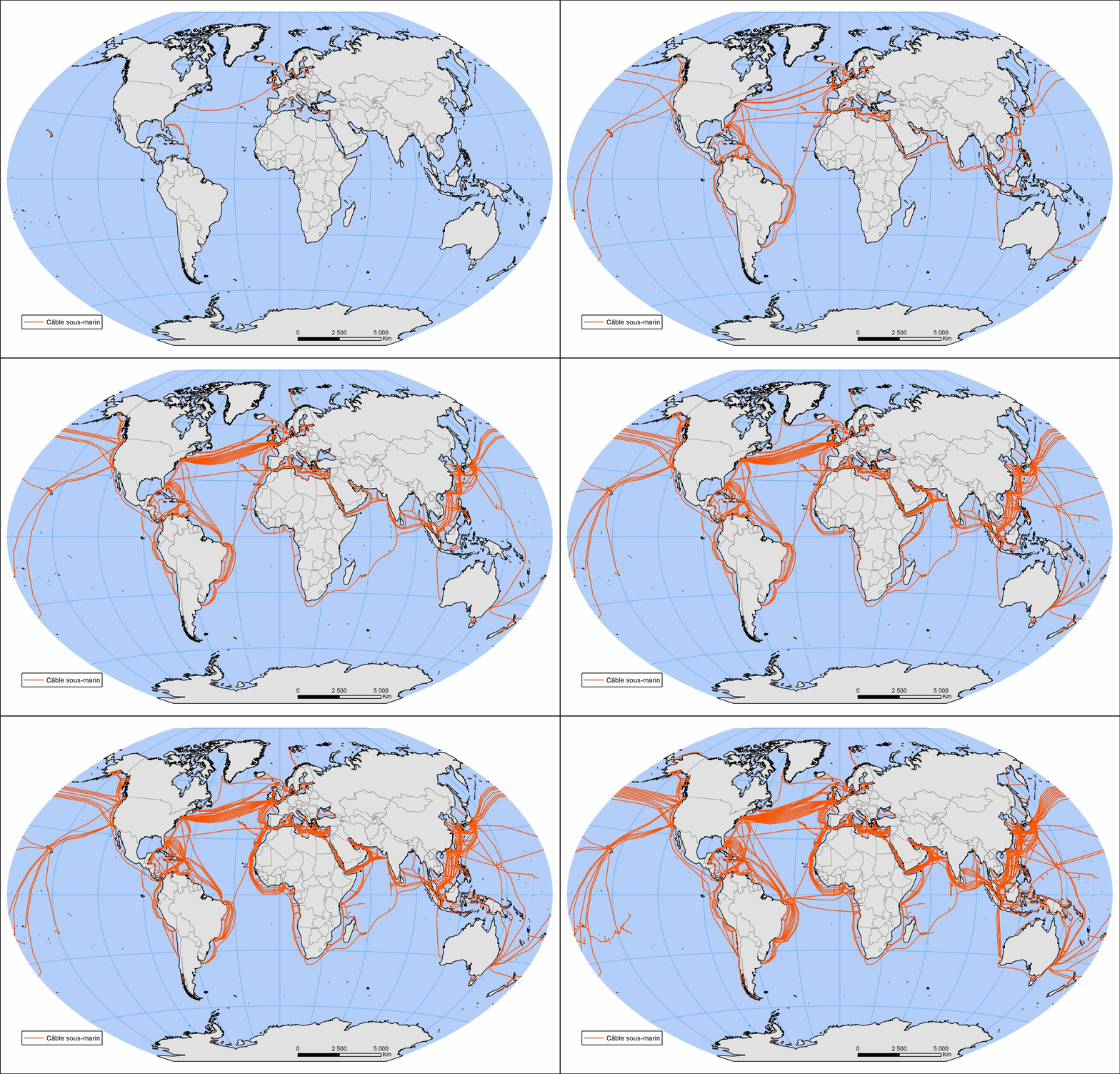
The backbone of global digital connectivity relies heavily on SMCs which transmit over 99% of international data traffic. These fibre-optic cables connect continents and countries, significantly reducing latency and increasing bandwidth, thereby enhancing the speed and efficiency of cross-border digital communications. SMCs are critical for international trade as they sharply reduce bilateral communication and transaction costs. Improved digital connectivity via these cables enhances firms’ abilities to identify trading partners, communicate, and manage transactions effectively. Consequently, bilateral digital connections via SMCs facilitate greater international integration by enabling firms to overcome traditional trade barriers related to distance and information asymmetry. Over the past two decades, the deployment of SMCs has dramatically expanded, directly linking nearly all coastal countries to global digital networks (Figure 1).
However, the adoption and effectiveness of digital connectivity vary significantly across countries and regions due to differences in digital literacy, infrastructure readiness, and firm capabilities. Understanding how these differences translate into export performance is crucial for addressing global digital divides.
Figure 1: SMC network expansion across time and space (1995-2020)
Why digital connectivity affects exporters differently
Our research builds upon influential theoretical frameworks (Melitz 2003, Bustos 2011) that highlight how firm productivity differences influence exports and responses to technological change. In Melitz (2003), only the most productive firms can bear the additional trade costs associated with exporting. Bustos (2011) shows how trade liberalisation prompts technological upgrading primarily among high-productivity exporters, leaving lower-productivity firms disadvantaged. In our version of the model, which incorporates two different plausible parameter assumptions for the North and South, the arrival of a bilateral SMC – lowering search and communication costs – results in an increase in the number of exporting firms in the North, while leading to a reduction in the South.
So, why does digital connectivity create winners and losers among exporters? In the model, when digital infrastructure improves, high-productivity firms gain disproportionately by adopting digital technologies that enhance their competitive edge, thereby crowding out lower-productivity firms. This reallocation is particularly pronounced in developing economies, where digital skills and absorptive capacities – such as R&D investment and organisational structures necessary to capitalise on digital gains — are typically limited. Consequently, many exporters in poorer countries exit international markets after connectivity improves as they cannot effectively compete against more digitally equipped foreign rivals. Conversely, in developed countries, where digital infrastructure and skills are already widespread, even moderately productive firms can effectively leverage digital connectivity to enhance their international competitiveness. This allows more firms to enter and remain in export markets.
The differing effects of bilateral digital connectivity
Our analysis uses a unique bilateral panel dataset covering 48 coastal countries from 1997 to 2014, exploiting the staggered bilateral deployment of SMC infrastructure. Controlling for omitted factors with bilateral, country-year, and destination-year fixed effects, we document significant heterogeneity across regions in how improved digital connectivity via SMCs affects firm export participation.
In developed countries, enhanced bilateral digital connectivity via SMCs is associated with a substantial increase in the number of firms entering export markets. This finding is consistent with the theory that improved digital infrastructure lowers communication and transaction costs sufficiently for many moderately productive firms to export profitably.
In stark contrast, the evidence from developing regions reveals a significant decline in the number of exporting firms following improvements in bilateral digital connectivity. This negative effect is especially pronounced in SSA and MENA, and less so for Latin America and South Asia. Our results show that in MENA and SSA, only firms with already high productivity and established digital capabilities can leverage improved connectivity to strengthen their competitive advantage. As a result, many lower-productivity firms are driven out of export markets.
Our analysis also highlights significant reallocation effects. In developed countries, better digital connectivity lowers trade costs and enables small- and medium-sized firms to enter export markets. These firms are better positioned to take advantage of digital tools thanks to existing infrastructure and skill levels. In developing countries, however, the same improvements in connectivity tend to push smaller, less digitally equipped firms out of global markets. Limited digital absorptive capacity – as captured by weaker infrastructure, lower digital literacy, and fewer skilled workers – means that only the most productive firms are able to adapt and benefit, reinforcing existing inequalities in access to global trade.
Sector-level analysis further emphasises heterogeneous effects. Specifically, the negative impacts on exporters in developing regions are most severe in digitally intensive sectors, such as ICT-related industries, where the ability to use advanced digital tools is critical for international competitiveness. Additionally, our results indicate that the negative SMC impact is exacerbated in low-income countries that have lower digital absorptive capacity, reflected by less infrastructure capacity, penetration of digital technologies, or population skills.
Distance also matters. When two countries are close, laying a new cable often leads to big jumps in the number of exporters: lower digital frictions go hand in hand with shorter shipping times and lower logistics costs. But in developing countries, the story is different for far‑away markets. There, the usual costs of distance – longer sea voyages, higher freight costs – still loom large, so better connectivity alone does not push out small exporters as quickly. In other words, the physical barriers to trade at long distances cushion some firms from the pressure of digital competition, softening the negative effects of improved connectivity on distant developing markets.
Policy implications: Digital infrastructure and economic growth
Expanding digital infrastructure alone is insufficient to ensure inclusive export growth. In high-income countries, digitalisation facilitates broader participation among diverse firms. In low-income regions, only the most productive firms benefit substantially, potentially marginalising smaller, less-prepared exporters.
To achieve the inclusive benefits from digital connectivity, governments must complement infrastructure development with targeted strategies. These include:
- Investing in digital education and training to equip SMEs with essential skills
- Providing financial incentives to support digital technology adoption among smaller firms
- Encouraging regional cooperation to simplify digital trade regulations
- Ensuring rural and peripheral areas have adequate digital access
Such comprehensive approaches would help bridge the digital divide, enabling a broader range of firms to participate and thrive in international trade.
References
Acemoglu, D (2002), “Technical change, inequality and the labor market,” Journal of Economic Literature 40(1): 7–72.
Akerman, A, I Gaarder, and M Mogstad (2015), “The skill complementarity of broadband internet,” Quarterly Journal of Economics 130(4): 1781–1824.
Bustos, P (2011), “Trade liberalization, exports, and technology upgrading: Evidence on the impact of MERCOSUR on Argentinian firms,” American Economic Review 101(1): 304–340.
D’Andrea, A, and N Limodio (2023), “High-speed internet, financial technology, and banking,” Management Science 70(2): 773–798.
Hjort, J, and L Tian (2021), “The economic impact of internet connectivity in developing countries,” Annual Review of Economics 17.
Imbruno, M, J Cariolle, and J De Melo (2025), “Digital connectivity and firm participation in foreign markets: An exporter-based bilateral analysis,” Journal of Development Economics 103551.
Melitz, MJ (2003), “The impact of trade on intra‐industry reallocations and aggregate industry productivity,” Econometrica 71(6): 1695–1725.
Tian, L (2025), “How does internet connectivity impact developing economies?” VoxDev.
Violante, GL (2018), “Skill-biased technical change,” in The New Palgrave Dictionary of Economics, Palgrave Macmillan.
World Bank (2025), World Development Indicators.
Network Readiness Index (2024), “Network readiness index.”