



Many poor, ethnically divided societies are caught in an ‘ethnic growth trap’, where conflict, low public investment, and political economy dynamics reinforce each other, hindering development. Historical examples reveal that inter-ethnic economic cooperation and innovative financial mechanisms can realign incentives, reduce conflict, and promote sustained prosperity.
Editor's note: This article is part of series covering CEPR's Reducing Conflict and Improving Performance in the Economy (ReCIPE) programme. Saumitra Jha is the ReCIPE Theme Leader on Ethnic Diversity and Nation-Building. The author has prepared slides to accompany this research, which can be downloaded here.
As of the end of 2024, 123.2 million people worldwide were forcedly displaced by conflict (UNHCR n.d.). Richer countries encounter increasingly polarised debates on immigration and openness, while poorer countries contend with managing both pre-existing and emerging ethnic differences.
I argue that poorer societies often confront an ‘ethnic growth trap’ (Jha 2025a): many poor ethnically divided societies likely remain poor precisely because they struggle to overcome the political challenges of conflict and underinvestment that are accentuated by their ethnic divisions.
In Jha (2025a), I discuss the existing cross-country evidence on the links between ethnic polarisation, conflict, and lack of public investment and development, and how the mutual negative feedback between these likely engender an ethnic growth trap. I then identify important directions for how developing societies can break out of such ethnic growth traps and instead leverage the potential gains of ethnic diversity.
Here, I emphasise two in particular: the study of business incubators that can leverage inter-ethnic economic complementarities, and the use of financial approaches that can empower individuals across ethnic lines, improve diversification, and align incentives towards peace and development.
Studying the ethnic growth trap
The last 50 years have seen dramatic advances in technology, knowledge, and economic development around the world, with average global GDP per capita rising 4.4 times between 1950 and 2016. Yet a troublingly large set of countries have witnessed, not just a decade, but rather half-centuries of lost economic growth (Figure 1). It is no coincidence that many of the countries that have failed to grow have undergone severe conflict in this period as well, often along ethnic lines (Figure 2). Since the Second World War, two out of five independent countries have experienced at least one civil war that took at least 1,000 lives (Fearon and Laitin 2014).
Figure 1: GDP per capita in 1950 versus 2026
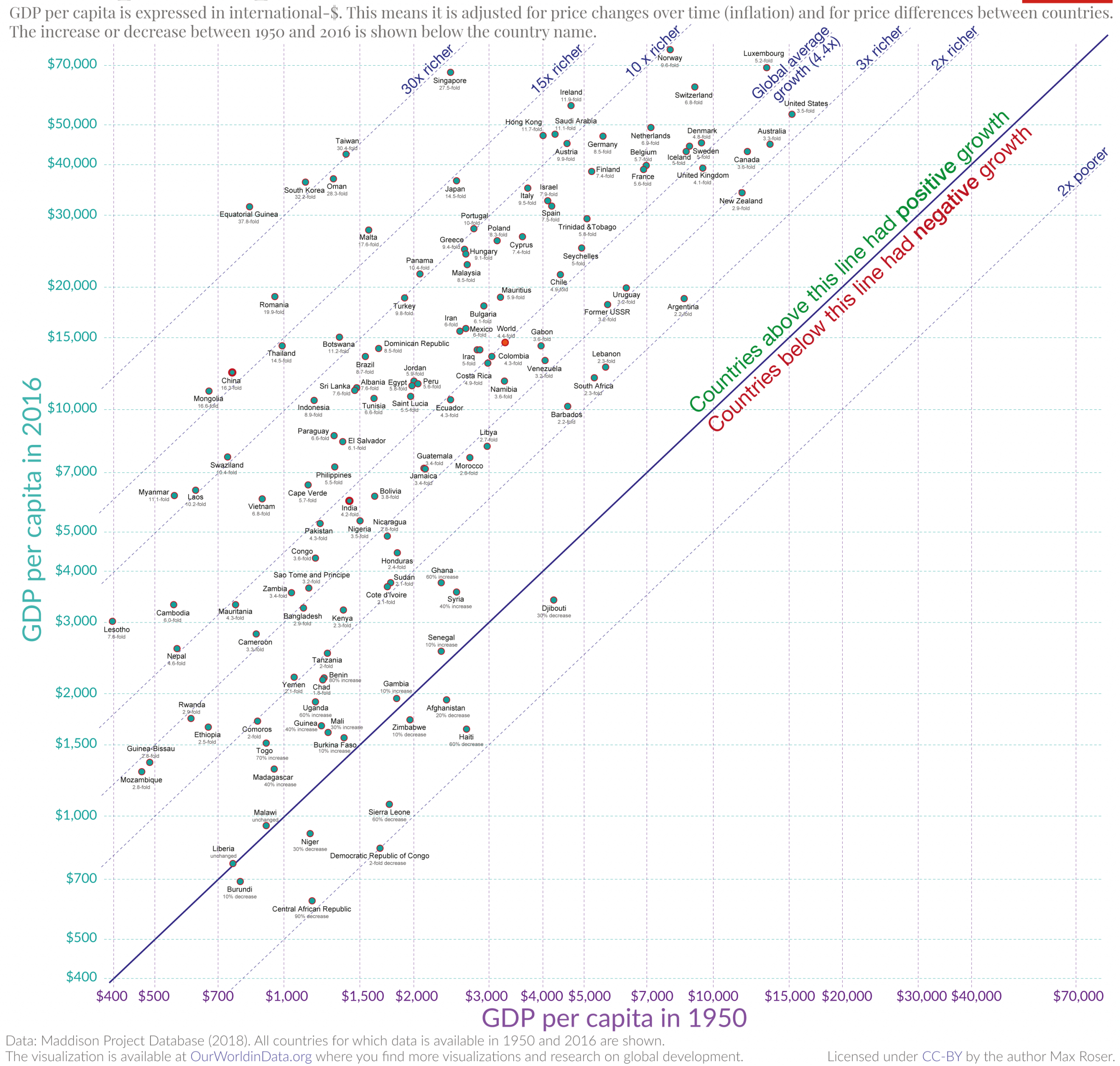
Source: Roser (2019) based on the Maddison Project Database.
Could these lost half-centuries of economic development be due in part to an ethnic growth trap, i.e. do feedback loops exist in societies with ethnic divisions that reduce the returns on different types of investment such that these societies become more likely to remain poor and divided?
Figure 2: Major battles and other conflicts, 1945-2020
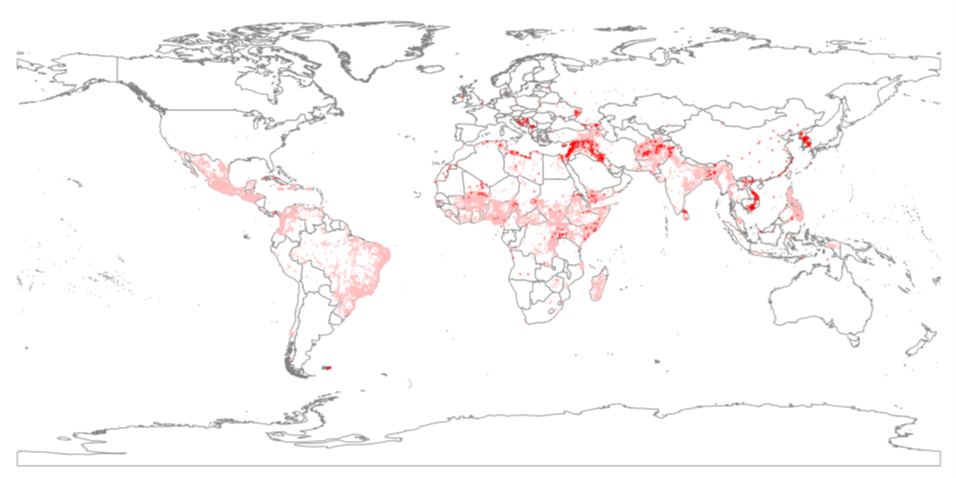
Notes: In dark red: contains major land battles with a definite location from Jha (2024). This combines Kitamura (2021), Jaques (2007), Dincecco et al. (2021) for India; 1815-1945: Brecke (1999), Fenske and Kala (2017) for Africa; 2018-2020: all battles in the Armed Conflict Location and Event Data (ACLED) project (in pink).
As with the important ongoing debate among proponents and opponents of foreign aid with regard to the presence or absence of poverty traps (Moyo 2009, Banerjee and Duflo 2011, Banerjee et al. 2019, Crosta et al. 2025), this question is crucial for determining which types of policies are likely to be helpful – rather than ineffectual or even harmful – in supporting development. For instance, if ethnically diverse communities are poor because they are subject to the threat of violent expropriation whenever their members do invest or reap windfall gains, then an external agency providing expanded credit or capital may actually increase the incentives for violent expropriation.
While it may be tempting to conclude that development policymakers should simply refrain from intervention – as is argued in Moyo (2009) – what is needed instead is a deeper understanding of the mutual feedback loops through which ethnically divided societies remain trapped in poverty. Recognising these intertwined political and economic dynamics will allow us to design more nuanced, resilient, and context-specific policy solutions.
Figure 3: The ethnic growth trap: Mutual feedback
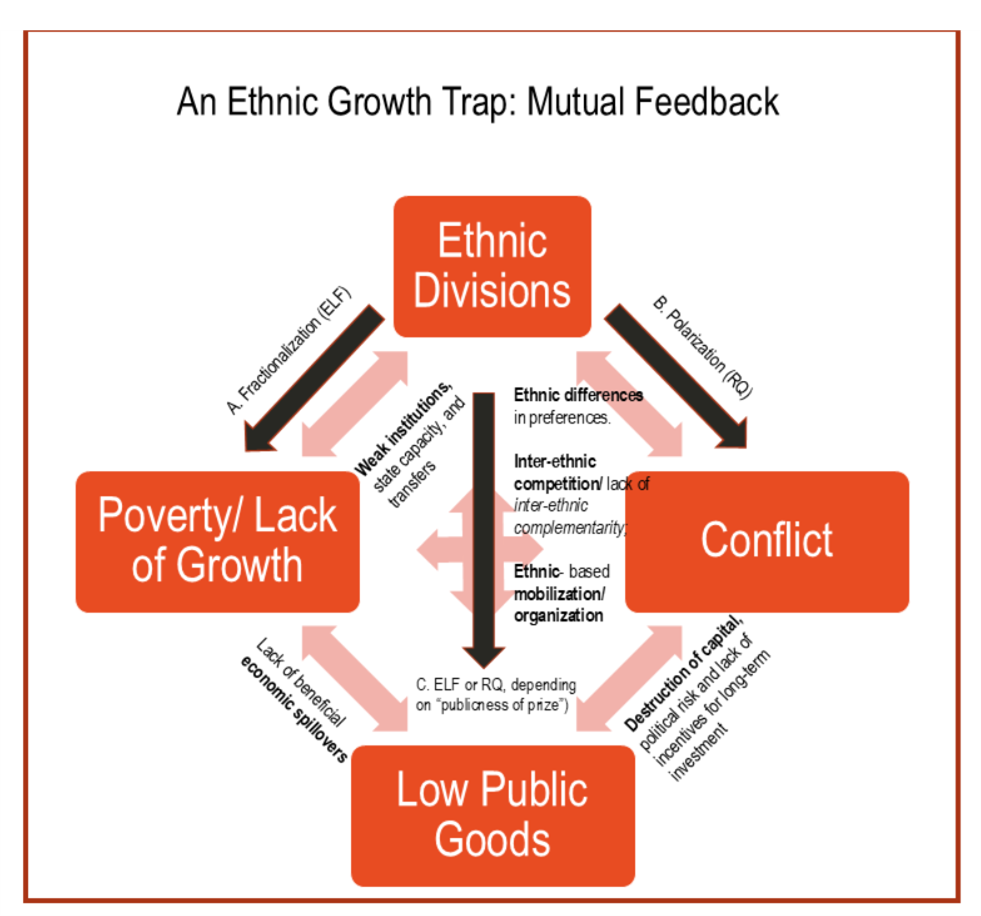
Source: Jha (2025a).
Figure 3 summarises the main channels linking ethnic divisions, conflict, and low public goods provision, illustrating potential mutual feedback that could engender an ethnic growth trap. Around the world, and particularly in sub-Saharan Africa, societies divided along ethnic lines are more prone to violent civil conflict (Montalvo and Reynal-Querol 2005, Blattman and Miguel 2010).[1] Ethnically-divided societies also provide fewer public goods to their citizens, and tend to be poorer and grow more slowly (Alesina and La Ferrara 2005).
Crucially, all three of these channels demonstrate mutual feedback. Societies in conflict are more likely to develop institutions and incentives for perpetuating such conflict and maintaining the salience of ethnicity rather than enhancing growth (Brass 2003, Esteban and Ray 2008, Jha 2013). As a focal example, societies with pre-existing ethnic divisions may face increased potential for conflict and thus reduce investment in public goods and other productive dimensions that might pull societies out of poverty and ameliorate ethnic strife. One key challenge of governance unique to ethnically divided societies is that of ‘ethnic cronyism’: members of vulnerable ethnic groups, particularly ‘middlemen’ minorities, often have incentives to buy protection from those in power, undermining democratic accountability (Jha 2018). For example, in sub-Saharan Africa, South Asian minority members have been implicated in apex corruption scandals involving high-level leaders. Such scandals not only erode voter turnout and support for democracy but can also normalise corruption by shaping societal norms of acceptable behaviour (Rivera et al. 2025).
Disarming the ethnic growth trap: Two examples
Countering ethnic cronyism and harnessing inter-ethnic complementarity: Ismailis in East Africa
One group with a strong South Asian provenance – the Ismaili community of East Africa – illustrates an alternative approach. For more than 160 years, members of this vulnerable trading-oriented minority have avoided apex corruption. Instead, they have played leading roles in founding philanthropic institutions, including establishing the first hospitals, clinics, and schools in Zanzibar. This community has also established inter-ethnic business incubators to match and support Ismailis and non-Ismailis in complementary economic roles (Penrad 2000). These early forms of ‘corporate social responsibility’ shared the gains from expanded trade credibly with local populations without undermining the local governance. The Ismaili case illustrates how ethnically diverse societies can foster investment in public goods as part of a cohesive approach to reducing inter-group conflict and enhancing development. Such approaches have proven successful in other settings as well (Jha 2013, 2018, 2023, 2025). However much more research, particularly experimental evaluation, is necessary in this area.
Harnessing financial innovations to mitigate caste and clan conflict: The Samurai in Meiji Japan
Creating inter-ethnic businesses at scale, using financial innovations to create joint ownership, has also proven successful at helping countries break through the ethnic growth trap at the national level. An important example of this is that of the first non-European state or off-shoot to industrialise: Meiji Japan. In the 1870s, Japan was largely able to overcome political and caste fractionalisation, breaking out of the ethnic growth trap within a single generation, despite strong caste and regional identities, and existing mobilisation capacity among the militarised samurai clans.
Like many other ethnically divided settings, the Meiji reformers had to deal with two margins of potential civil conflict:
- The local, decentralised, incentives of samurai to reassert their cultural identity and privileges through violence.
- Given that the samurai had strongly militarised clan organisational structures, these clans might seek to break away or threaten control of the state.
Jha et al. (2025a) describes how reformers addressed these challenges by replacing the rice stipends traditionally owed to each samurai with government bonds and the opportunity to co-invest in banks. These inter-ethnic banks spread across castle towns of Japan.
Figure 4: Samurai castle towns and the spread of banks in Meiji Japan
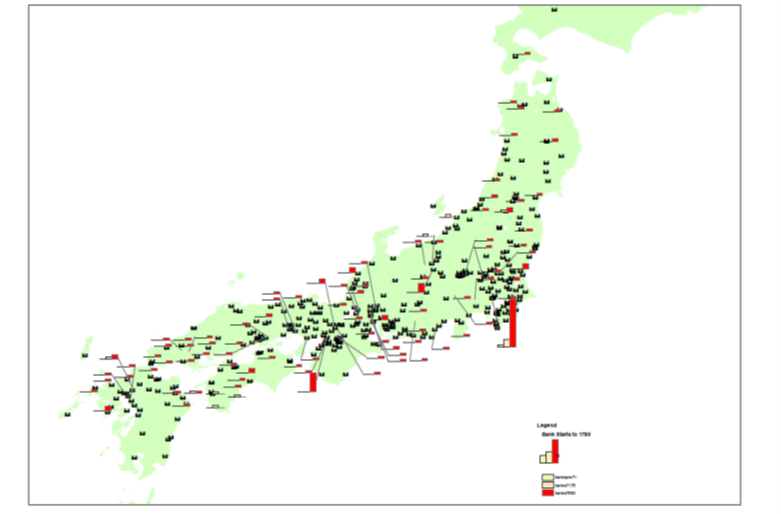
Source: Jha et al. (2025a), Jha (2025a).
Giving individual samurai the chance to co-invest with commoners in local banks lending to local merchants provided them opportunities to gain from local peace, aligning the incentives of individual samurai with local development. Simultaneously, in 1877, a special bank was created exclusively for investment by the former samurai clan leaders (daimyo) and nobles. With a capitalisation comparable to all other national banks combined, the bank became the largest of its kind (Schalow 1987). In its early years, the bank was used to mobilise capital for two specific purposes, both of which aligned the incentives of its potentially secessionist shareholders with national integration instead: to provide loans to the Meiji government to finance the suppression of samurai revolts, and invest in the Japanese railway network. This aligned shareholder incentives for a unified, peaceful Japan (Jha et al. 2025a).
Inspired by this, recent research providing individuals from diverse ethnic and social backgrounds randomised opportunities to invest in the common good through stock markets has similarly proven effective – enhancing financial literacy and confidence, and building support for economic integration, climate action, and peace (Jha and Shayo, 2019, 2025, Jha et al. 2025b, Jha 2025b, Hanlon et al. 2025).
Policy implications: Mitigating polarisation and conflict
Understanding the root causes of diversity in different environments can be crucial for understanding the scope of conditions under which certain policies will be successful in different contexts and developing new policy ideas. Above all, this research underscores that, although ethnic divisions and political economy challenges can make the process of strengthening development and peace difficult – and less amenable to magic bullets or one-size-fit-all solutions – such obstacles have been overcome in the past, and can be once again.
References
Alesina, A, and E La Ferrara (2005), “Ethnic diversity and economic performance,” Journal of Economic Literature 43(3): 762–800.
Banerjee, A V, and E Duflo (2011), “Poor economics: A radical rethinking of the way to fight global poverty,” Public Affairs.
Banerjee, A V, E Breza, E Duflo, and C Kinnan (2019), “Can microfinance unlock a poverty trap for some entrepreneurs?,” NBER Working Paper.
Blattman, C, and E Miguel (2010), “Civil war,” Journal of Economic Literature 48(1): 3–57.
Brass, P R (2003), “The production of Hindu-Muslim violence in contemporary India,” University of Washington Press.
Brecke, P (1999), “Violent conflicts 1400 A.D. to the present in different regions of the world.”
Crosta, T, D Karlan, F Ong, J Rüschenpöhler, and CR Udry (2025), “Unconditional cash transfers: A Bayesian meta-analysis of randomized evaluations in low and middle income countries,” NBER Working Paper.
Dincecco, M, J Fenske, A Menon, and S Mukherjee (2021), “Pre-colonial warfare and long-run development in India,” Economic Journal 132(643): 981–1010.
Esteban, J, and D Ray (2008), “On the salience of ethnic conflict,” American Economic Review 98(5): 2185–2202.
Fearon, J D, and D D Laitin (2014), “Does contemporary armed conflict have deep historical roots?.”
Fenske, J, and N Kala (2017), “1807: Economic shocks, conflict and the slave trade,” Journal of Development Economics 126: 66–76.
Hanlon, M, S Jha, N Shroff, N Kala, and C Weiss (2025), “Seeing green: The effects of financial exposure on climate beliefs, preferences and behaviors,” Stanford Working Paper.
Jaques, T (2007), “Dictionary of battles and sieges: F–O,” Greenwood Publishing Group.
Jha, S (2013), “Trade, institutions and ethnic tolerance: Evidence from South Asia,” American Political Science Review 107(4): 806–832.
Jha, S (2018), “Trading for peace,” Economic Policy 33(95): 485–526.
Jha, S (2024), “Civil and ethnic conflict in historical political economy,” in J Jenkins and J Rubin (eds.), "The Oxford handbook of historical political economy," Oxford University Press.
Jha, S (2025a), “Breaking through the ethnic growth trap,” Economic Policy, eiaf008.
Jha, S (2025b), “Resisting populism through financial market exposure,” Stanford GSB Working Paper.
Jha, S, and M Shayo (2019), “Valuing peace: The effects of financial market exposure on votes and political attitudes,” Econometrica 87(5): 1561–1588.
Jha, S, and M Shayo (2025), “Trading stocks builds financial confidence and compresses the gender gap,” Economic Journal 135(665): 235–263.
Jha, S, K Mitchener, and M Takashima (2025a), “Swords into bank shares: Finance, conflict and political reform in Meiji Japan.”
Jha, S, M Shayo, and C M Weiss (2025b), “Financial market exposure increases generalized trust,” Journal of Public Economics 242: 105303.
Kitamura, S (2021), “World historical battles database.”
Montalvo, J G, and M Reynal-Querol (2005), “Ethnic polarization, potential conflict and civil wars,” American Economic Review 95(3): 796–816.
Moyo, D (2009), “Dead aid: Why aid makes things worse and how is another way for Africa,” Farrar, Straus and Giroux.
Penrad, J-C (2000), “The Ismaili presence in East Africa: A note on its commercial history and community organization,” in D Lombard and J Aubin (eds.), "Asian merchants and businessmen in the Indian Ocean and the China Sea," Oxford University Press 17: 223–238.
Rivera, E, E Seira, and S Jha (2025), “Apex corruption erodes democratic values,” Stanford GSB Working Paper.
Roser, M (2019), “Which countries achieved economic growth? And why does it matter?,” Our World in Data.
Schalow, T (1987), “Transforming railroads into steamships: Banking with the Matsukata family at the 15th bank,” Hitotsubashi Journal of Commerce and Management 22(1): 55–67.
United Nations High Commissioner for Refugees (UNHCR) (n.d.).