




Inclusive institutions are key to sustaining peace – shaping incentives, deterring violence, and preventing cycles of fragility.
Editor's note: This article is part of series covering CEPR's Reducing Conflict and Improving Performance in the Economy (ReCIPE) programme. Laura Mayoral and Hannes Mueller are the ReCIPE Theme Leaders on Institutions, Democracy, and Peace.
Recent years have witnessed two troubling global trends: the erosion of democratic institutions and a resurgence of armed conflict (Luhrmann et al. 2022, V-Dem Institute 2023). These developments raise pressing questions for policymakers in development and foreign policy. A growing body of work, summarised in Mayoral and Mueller (2025), highlights that institutions are not passive background conditions; rather, they are active determinants of peace and violence, shaping incentives and constraints faced by political actors, economic agents, and citizens alike.
But the pathways from institutions to peace are complex and causality does not always run in one direction. Understanding these pathways is not only important when thinking about strengthening institutions directly, but also for seemingly unrelated policy areas which interact with institutions and may work to strengthen or contradict them.
Channels from institutions to peace
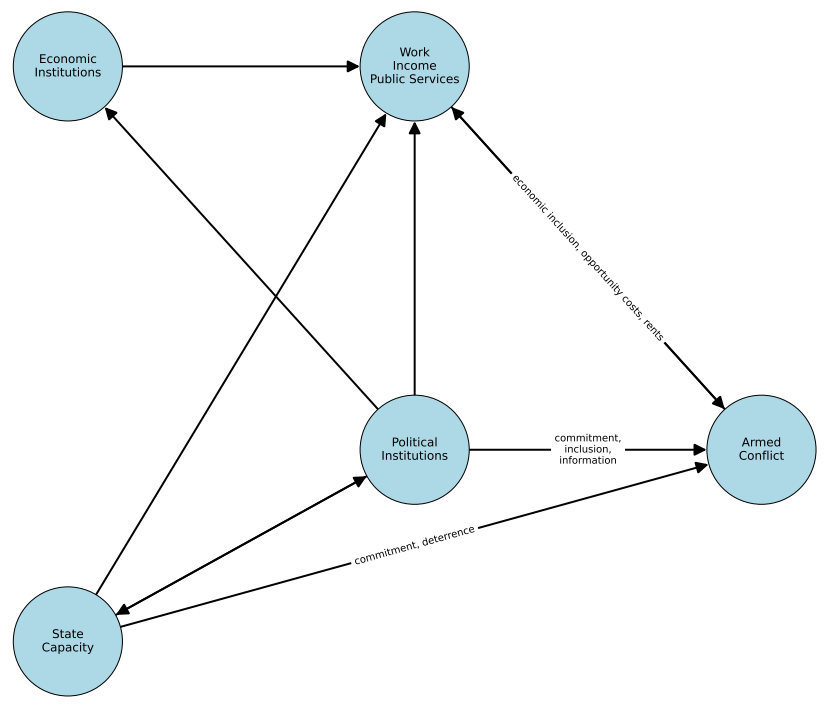
The various pathways from institutions to peace are captured in Figure 1, which outlines the main causal mechanisms identified in theoretical and empirical research. Political institutions influence conflict risk through their effects on inclusion, credible commitment, and the availability of information. Economic institutions shape the distribution of rents and opportunity costs of violence. State capacity reinforces deterrence and ensures the provision of public goods that reduce the appeal of rebellion. At the same time, conflict feeds back into institutions, eroding their effectiveness and creating self-reinforcing cycles of fragility.
Figure 1: Conceptual diagram of the causal mechanisms linking institutions and armed conflict
Source: Mayoral and Mueller (2025).
Theoretical foundations: Institutions and conflict
Two broad theoretical traditions underpin this literature. The first, rooted in contest theory, portrays violence as a struggle for rents under conditions of insecure property rights (Tullock 1980, Grossman 1991, Skaperdas 1996). The second focuses on bargaining failures, following Fearon (1995), where conflict arises when actors cannot credibly commit to agreements, when private information is strategically concealed, or when disputes concern indivisible issues. This has recently received an important upgrade in Blattman (2023), which emphasises that armed conflict is the outcome of a negotiation failure. Both frameworks place institutional design at the centre of efforts to prevent conflict.
Political institutions are particularly prominent. Democracies are, on average, less prone to civil conflict than autocracies, largely because political inclusion raises the costs of repression and makes space for peacefully negotiated solutions (Acemoglu and Robinson 2001, Collier and Rohner 2008, Lacroix 2023, Laurent-Lucchetti et al. 2024). Institutionalised checks and balances further reduce the risks of exclusion and elite capture. Evidence shows that inclusive mechanisms such as power-sharing or decentralisation have especially strong conflict-preventing effects (Burgess et al. 2015, Hodler and Raschky 2014, Mueller and Rohner 2018, Mueller and Rauh 2024). Yet, the relationship is not automatic: electoral competition without genuine accountability may heighten rather than mitigate tensions.
State capacity provides a second pillar. Following Tilly (1990) and Besley and Persson (2011), strong states deter insurgency by enforcing law, raising revenues, and delivering services. Where institutions are weak, rebellion and elite predation become more attractive. Importantly, capacity building without inclusion may be counterproductive: authoritarian rulers can leverage administrative strength for repression, deepening grievances rather than reducing them (Heldring 2021, Acemoglu et al. 2011).
Economic institutions complete the picture. Secure property rights, functioning markets, and inclusive credit systems raise the returns to productive activity, increasing the opportunity costs of violence (Blattman and Annan 2016, Fetzer 2020). Conversely, the presence of resource rents in weak institutional settings often fuels violent contestation, a dynamic central to the evidence on the ‘resource curse’ (Ross 2012, Berman et al. 2017). Property rights are particularly critical here. Where property rights are contested violence becomes more likely. But who holds these rights also matters. Distributional effects are crucial: entrenched inequality and elite capture create grievances and undermine trust, making violence more likely (Falcone and Rosenberg 2025, Guarnieri 2025).
Policy implications for institutions in conflict settings
Three broad lessons emerge for policymakers:
- Institutions directly and indirectly influence incentives for peace, shaping inclusion, commitment, and credible enforcement.
- Complementarities matter: political inclusion strengthens the effectiveness of state capacity, while robust fiscal systems are only sustainable if they serve the provision of public goods.
- Because conflict undermines institutions, prevention requires sustained investment before violence erupts, as institutional erosion accelerates once fragility sets in.
A key debate concerns feasibility. Institutions evolve through long historical processes, raising doubts about the scope for deliberate reform. Yet empirical evidence indicates that targeted institutional innovations can make a difference.
Power-sharing agreements, independent audit bodies, and transparency initiatives in resource sectors have all been linked to reductions in violence (Berman et al. 2017, Jha 2013, Mueller and Rauh 2024). Development programmes that cushion economic shocks, such as India’s NREGA workfare scheme, have reduced recruitment opportunities for armed groups by raising opportunity costs (Fetzer 2020).
Looking forward, several priorities stand out for research and policy. These include identifying which forms of power-sharing and decentralisation work best in ethnically diverse societies, building fiscal and legal capacity in fragile states without triggering elite resistance, designing economic institutions that encourage inclusive growth while limiting capture, and leveraging new empirical tools – from causal inference to natural language processing – to better measure institutional change. Translating such insights into practice remains one of the most urgent challenges for development and foreign policy.
The stakes are considerable. Rising conflict and democratic backsliding threaten decades of progress in governance and development. Investing in institutions is among the most promising strategies for prevention. Political inclusion, credible commitments, and robust capacity are not abstract ideals but practical tools for peace. Policies that strengthen institutional foundations can help societies escape fragility traps and secure a more stable future.
References
Acemoglu, D, and JA Robinson (2001), “A theory of political transitions,” American Economic Review 91(4): 938–963.
Acemoglu, D, D Ticchi, and A Vindigni (2011), “Emergence and persistence of inefficient states,” Journal of the European Economic Association 9(2): 177–208.
Berman, N, M Couttenier, and D Rohner (2017), “This mine is mine: How minerals fuel conflicts in Africa,” American Economic Review 107(6): 1564–1610.
Besley, T, and T Persson (2011), “Pillars of prosperity: The political economics of development clusters,” Review of Economic Studies 78(1): 289–321.
Blattman, C (2023), “Why we fight: The roots of war and the paths to peace,” Penguin Books.
Blattman, C, and J Annan (2016), “Can employment reduce lawlessness and rebellion? A field experiment with high-risk men in a fragile state,” American Political Science Review 110(1): 1–17.
Burgess, R, R Jedwab, E Miguel, A Morjaria, and G Padró i Miquel (2015), “The value of democracy: Evidence from road building in Kenya,” American Economic Review 105(6): 1817–1851.
Collier, P, and D Rohner (2008), “Democracy, development, and conflict,” Journal of the European Economic Association 6(2–3): 531–540.
Falcone, S, and M Rosenberg (2025), “Agricultural modernization and redistributive conflict,” Journal of Development Economics 177: 103529.
Fearon, JD (1995), “Rationalist explanations for war,” International Organization 49(3): 379–414.
Fetzer, T (2020), “Can workfare programmes moderate conflict? Evidence from India,” Journal of the European Economic Association 18(6): 3337–3375.
Grossman, HI (1991), “A general equilibrium model of insurrections,” American Economic Review 81(4): 912–921.
Guarnieri, E (2025), “Cultural distance and ethnic civil conflict,” American Economic Review 115(4): 1338–1368.
Heldring, L (2021), “The origins of violence in Rwanda,” Review of Economic Studies 88(2): 730–763.
Hodler, R, and PA Raschky (2014), “Regional favoritism,” Quarterly Journal of Economics 129(2): 995–1033.
Jha, S (2013), “Trade, institutions, and ethnic tolerance: Evidence from South Asia,” American Political Science Review 107(4): 806–832.
Lacroix, J (2023), “Ballots instead of bullets? The effect of the Voting Rights Act on political violence,” Journal of the European Economic Association 21(2): 764–813.
Laurent-Lucchetti, J, D Rohner, and M Thoenig (2024), “Ethnic conflict and the informational dividend of democracy,” Journal of the European Economic Association 22(1): 73–116.
Mayoral, L, and H Mueller (2025), “Rents, rules or revolution: A survey of institutional pathways to peace,” Economic Policy, eiaf004.
Mueller, H, and C Rauh (2024), “Building bridges to peace: A quantitative evaluation of power-sharing agreements,” Economic Policy 39(118): 411–467.
Mueller, H, and D Rohner (2018), “Can power-sharing foster peace? Evidence from Northern Ireland,” Economic Journal 128(613): F314–F349.
Ross, ML (2012), “The oil curse: How petroleum wealth shapes the development of nations,” Princeton University Press.
Skaperdas, S (1996), “Contest success functions,” Economic Theory 7: 283–290.
Tilly, C (1990), “Coercion, capital, and European states, AD 990–1990,” Basil Blackwell.
Tullock, G (1980), “Efficient rent seeking,” in J M Buchanan, R D Tollison and G Tullock (eds.), “Toward a theory of the rent-seeking society,” Texas A&M University Press.