



View Chapter:
Downloads:
Chapter 2
Introduction - Organised Crime
Organised crime consists of durable, profit‑seeking associations that coordinate illicit production and trade, enforce their interests through violence or the credible threat of it, corrupt or co‑opt state actors, and – where formal authority is weak – impose their own rules, ‘taxes’, and dispute‑resolution mechanisms on the populations and territories they dominate (Gambetta 1996, Acemoglu et al. 2020, Lessing 2021). Organised crime today spans diverse geographies, operating across low-, middle-, and high-income economies, and within political regimes that vary widely in the strength of their institutions. Researchers have recognised that organised crime can influence economic performance, the rule of law, well-being, and broader social and political stability (e.g. Gambetta 1996, Frye and Zhuravskaya 2000, Buonanno et al. 2015, Dell 2015, Alesina et al. 2019, Murphy and Rossi 2020, Melnikov et al. forthcoming). In this review, we synthesise recent advances in research on the roots of organised crime, its consequences for development, and the effectiveness of policy interventions aimed at reducing criminal activity and its broader harms. We build on analyses that conceptualise criminal groups as economic agents who respond to incentives shaped by state capacity, formal institutions, community ties, and enforcement policies (e.g. Blattman et al. forthcoming, Acemoglu et al. 2020).
To illustrate the global scope and heterogeneity of organised crime, we draw on the 2023 Organized Crime Index developed by the Global Initiative Against Transnational Organized Crime (GI-TOC). This index provides country-level data on criminal markets, criminal actors, state resilience, and the broader socioeconomic context. It reveals that illicit activity spans a range of contexts – including high-income democracies and low-capacity states – challenging the notion that organised crime is confined to fragile or impoverished countries (see Figure 1).
Figure 1: Organized Crime Index – 2023
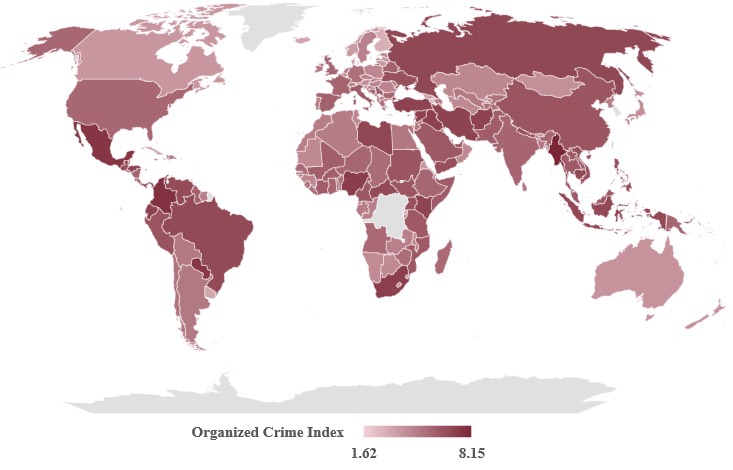
Source: GI-TOC (2023).
In more developed regions, organised crime tends to infiltrate licit markets through mechanisms such as corruption, money laundering, and the misuse of corporate structures, rather than through direct territorial control. In Europe and North America, criminal markets increasingly revolve around cyber-dependent and financial crime activities that often leave few visible traces of violence (GI-TOC 2023). Moreover, high-income countries frequently serve as key destination markets in global trafficking networks. Western Europe, in particular, is a major destination for human and drug trafficking and a hub for financial crimes, and counterfeit goods.
However, as we highlight throughout this review, some of the most severe consequences, such as violence, extortion, human trafficking, and child recruitment, remain concentrated in low- and middle-income countries. Data from GI-TOC shows that Latin America and the Caribbean register high scores on several dimensions of organised crime, especially drug trafficking, extortion, and violence. For instance, the region not only recorded the highest homicide rate of any subregion globally in 2021 (see Figure 2), but also accounted for the largest share of homicides linked to organised crime. The region also reported the highest proportion of homicides involving male victims and firearms. Strikingly, 8 of the 10 countries with the highest homicide rates worldwide were located in Latin America (United Nations Office on Drugs and Crime 2023).
Figure 2: Homicide rate per 100,000 citizens – 2021
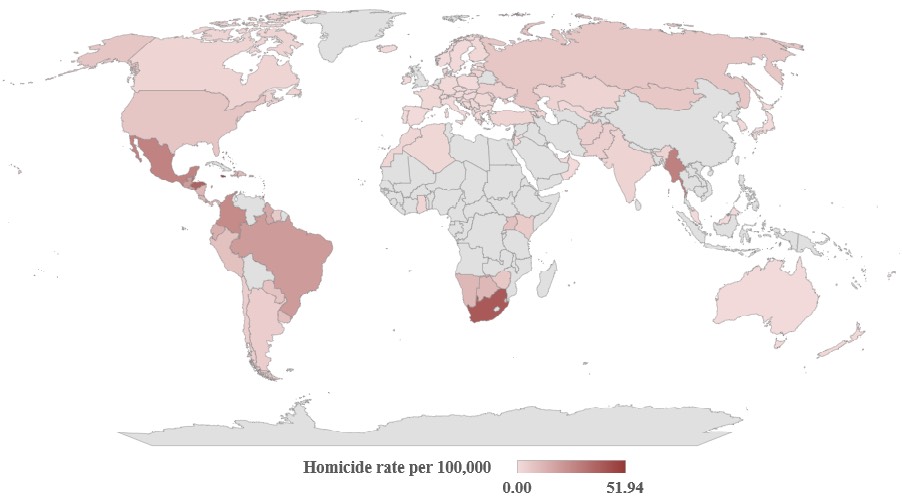
Source: United Nations Office on Drugs and Crime (2023).
Furthermore, studying this region, scholars illustrate how organised crime undermines development through violence, weakened institutions, and the exploitation of vulnerable populations. In Mexico, enforcement strategies that targeted cartel leaders and competition for drug trafficking markets led to fragmentation and turf wars, fuelling sharp increases in violence (e.g. Dell 2015, Calderon et al. 2015, Castillo et al. 2020, Sobrino 2019). Central American nations, especially El Salvador, Guatemala, and Honduras, contend with gangs that emerged partly because of deportations from the United States and weak state capacity due to the past civil conflict (Sviatschi 2022b, Kalsi 2018, Melnikov et al. forthcoming). Brazil’s favelas have experienced armed conflict between drug gangs and the police, with harmful effects on the community’s well-being (Magaloni et al. 2020, Monteiro and Rocha 2017). Scholars also point out that organised crime in these settings has expanded its functions by governing local territories where the state is absent or mistrusted, thus filling a vacuum in security and basic services (Blattman 2025, Lessing 2021).
Moreover, beyond violence, a common feature of criminal organisations in less developed contexts is territorial control for their illicit businesses and the recruitment of children into their ranks (Alarcón Barrera and Sviatschi 2025). Although systematic data on recruitment remains limited, numerous qualitative reports and statements from government officials identify this practice as one of the most pressing challenges. In Peru, increased returns in the illegal sector – particularly in coca-producing regions – have been associated with higher school dropout rates and long-term incarceration risks among boys aged 11 to 14 (Sviatschi 2022a). More recent journalistic and policy reports suggest a growing involvement of minors in organised crime, with 8 out of 9 arrested hitmen in 2024 identified as adolescents and a 36% increase in the national homicide rate (InSight Crime 2025, Infobae 2025). In Ecuador, despite limited academic research, emerging evidence points to an alarming rise in gang-related violence. Between 2019 and 2023, child homicides surged by 640%, a trend linked to targeted killings and expanding gang activity (UNICEF 2024). The recruitment of minors not only perpetuates cycles of violence but also disrupts human capital formation across generations, with long-term consequences for individuals and communities (Castro et al. 2025, Blattman and Annan 2010).
Comparable dynamics are beginning to draw attention in other regions, particularly in West Africa, where organised crime has similarly evolved into a multifaceted threat to governance and development (UNODC 2013). This is mainly due to the contraband flow of cocaine, which meets the rising demand in Europe and whose wholesale value upon arrival often exceeds the national security budgets of many West African countries. However, the report also highlights other threats to the region, including methamphetamine production destined for East Asia, migrant smuggling, firearms trafficking, and maritime piracy (UNODC 2013). Despite the growing concern, there remains a lack of causal evidence on how these criminal dynamics affect broader development outcomes such as state capacity, public service provision, and economic growth.
These cases highlight a broader pattern: despite the significant threat organised crime poses in many low- and middle-income countries, scholarly research in crime has largely focused on developed contexts. As a result, regions facing high levels of violence, child recruitment, and institutional fragility remain underexplored. This review aims to centre the literature on these contexts, while drawing, when appropriate, on insights from research in developed settings to assess how they can be applied – or adapted – to these more contemporary and complex environments.
This review proceeds as follows. Section 2 examines the root causes behind the emergence of organised crime, focusing on the presence of weak states, the role of social identity dynamics, economic incentives, and the unintended outcomes of deportations and incarceration policies. Section 3 looks at consequences for economic development, labour markets, firm behaviour, social outcomes such as violence and human capital, as well as public health, political institutions, corruption, trust, and stability. Section 4 outlines policy interventions, including law enforcement and policing, city council dismissals, prison reforms, and community-based initiatives. We conclude with a discussion of limitations and suggestions for future research.
For full reference list see the end of the conclusion chapter.
Contact VoxDev
If you have questions, feedback, or would like more information about this article, please feel free to reach out to the VoxDev team. We’re here to help with any inquiries and to provide further insights on our research and content.