




Stalin’s forced deportation of educated ‘enemies of the people’ inadvertently concentrated human capital in Gulag towns, fostering inter-generational prosperity and long-term development despite the destructive intent of the repression.
Editor's note: The authors have made slides available to accompany this research here.
In his dystopian novel 1984, George Orwell depicts mornings beginning with a ritual “two-minute hate” video:
“The Hate had started. As usual… the Enemy of the People had flashed on to the screen... a clever face, and yet somehow inherently despicable.”
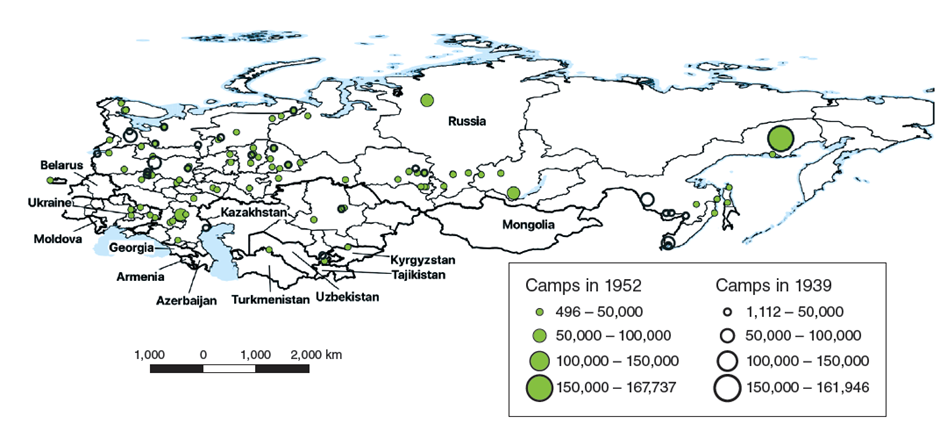
Branding opponents as ‘enemies of the people’ to dehumanise and suppress them is one of the oldest tactics of dictators – and remains in use by today’s rising autocrats. It was Lenin and Stalin, however, who made it stick. Stalin had it written into law in 1927 to prosecute millions of intellectuals, scientists, politicians, and businessmen deemed threats to the Soviet regime. Among them was the economist Nikolai Kondratiev, remembered for his work on business cycles. Like millions of others, he was deported to the forced labour camps scattered across the Soviet Union – what Aleksandr Solzhenitsyn (1973) memorably called the Gulag Archipelago (Figure 1).
Figure 1: The Gulag Archipelago
Identifying the role of human capital in fostering growth
This dark episode of history offers important lessons about the role of human capital in fostering growth. Human capital has long stood at the core of economic research, yet its effect on development has proven difficult to isolate across locations. Recent contributions shed light on this question: Hanushek et al. (2017) use country-of-origin achievement tests to show that cognitive skills explain 20–30% of the variation in GDP per capita across US states, while Hendricks and Schoellman (2023) calibrate macro models and find that human capital accounts for 50–75% of cross-country income gaps. Other work relies on historical natural experiments of human capital allocation to identify its causal impact. Easterly and Levine (2016) document how the human capital of European colonisers raised incomes in their host countries. Rocha et al. (2017) show that Brazilian regions receiving highly skilled immigrants around 1900 enjoy higher schooling and income today, while Escamilla-Guerrero et al. (2025) show that it boosted agricultural productivity. Droller (2018) finds that European settlers boosted literacy and industrialisation in Argentine counties.
Our setting adds to this evidence base by providing a natural experiment in which educated ‘migrants’ neither self-selected into migration nor chose their destinations, and where strategic placement across locations did not occur.
‘Enemies of the people’ did not select into being enemies of the people to begin with, as there was randomness in who was designated an enemy among the educated class. As Shalamov (1980) writes, “Arrests of 1930s were arrests of random people. These were victims of false and chilling theory about kindling class warfare at the strengthening of socialism”.
The drawings of Baldaev, a Gulag guard, provide a vivid account of this dark era. In one sketch depicting the secret police rounding up enemies (Figure 2), an agent instructs his colleagues as follows: “We’ve been ordered to round up twelve enemies of the people. With the engineer, the doctor woman, and the old professor we only have ten. Take any two people from the first-floor apartments – workers or kolkhozniks, it doesn’t matter. We just need twelve in total. That’s an order. Off you go.”
This not only captures the targeting of the educated elite but also the random nature of the arrests. There was hence no selection into migration either. Enemies were only targeted for being educated and forcibly resettled. And this made the camp locations more intensive in human capital than the Soviet Union as a whole. Individual data from Memorial, an NGO focused on remembering Stalin’s crimes (available from Zhukov and Talibova 2018), suggests that 14.7% of ‘enemies’ had a college education, compared to 0.6% of the adult population in the Soviet Union in 1939. The share with high-school degrees (25.7%) was more than three times higher than among the population.
Figure 2: Rounding up random enemies of the people
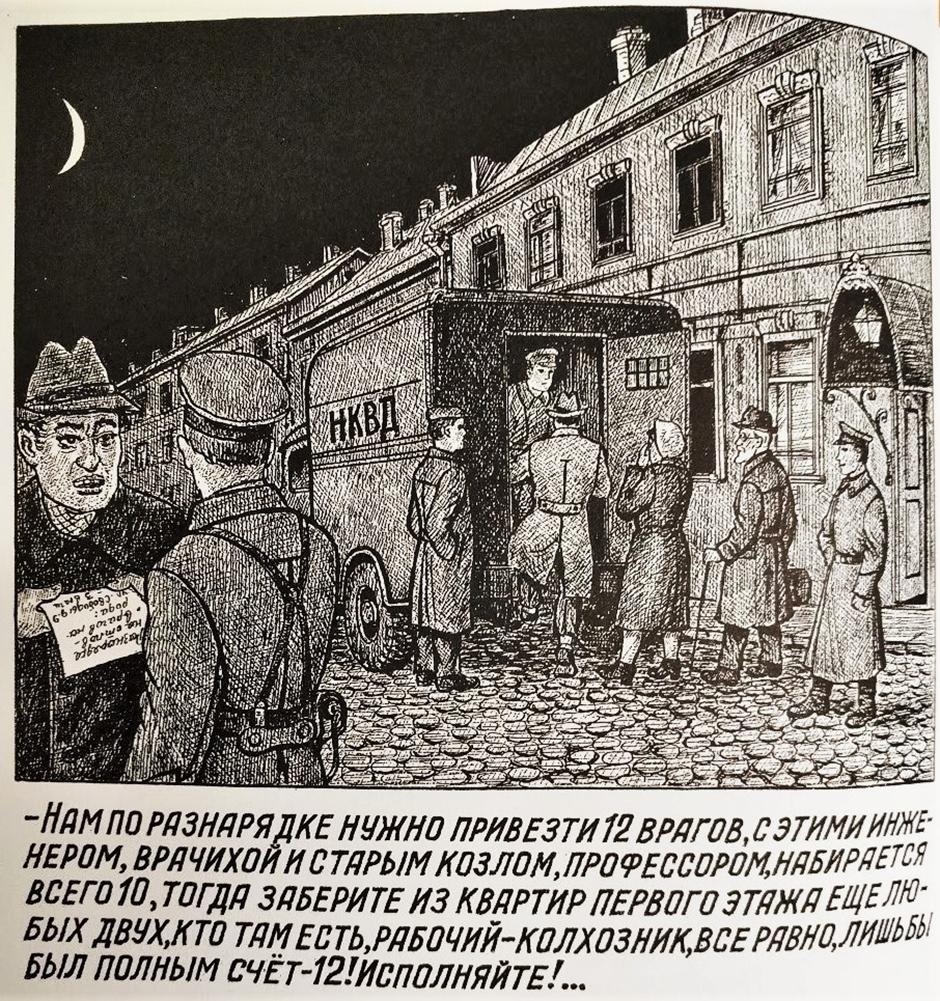
Source: Baldaev (1993).
There was also no endogenous location choice by either migrants or planners. The annihilation of ‘enemies of the people’ was a political act, not an economic development strategy. While the Gulag was linked to industrialisation, the relocations were driven primarily by political motives (Khlevnyuk 2003). Ertz (2008) emphasises that “arrests in the Soviet Union were never determined by a hypothetic need for forced laborers, but driven by political and ideological considerations. From the viewpoint of the camp system administrators, then, the number of inmates constituted a basically exogenous variable, often subject to unforeseeable vacillations that caused managerial problems.”
What’s more, we find that neither economic activities in Gulags nor favourable geographic attributes predicted the share of ‘enemies of the people’ across camps, confirming the quasi-random dispersion of human capital. What’s more, by focusing on localities within Russia, we hold formal institutions constant, addressing concerns from the human capital versus institutions debate in the growth literature (Acemoglu and Angrist 2001, Glaeser et al. 2004, Easterly and Levine 2016).
Enemies of the people and long-run development
This setting allows us to compare the long-run development outcomes across Gulag locations and attribute part of these differences to the varying levels of ‘enemies of the people’ among prisoners.
To do so, we combine data on camps with data on economic activity today. The heart of our empirical investigation is a dataset on Gulags we collected from microfilms at the State Russian Archive that allows us to document this episode of terror. Crucially, we collect data on the type of crimes committed by Gulag prisoners, enabling us to capture the enemy composition of the camps. We then spatially match the locations of camps with current economic activity, which we measure using a dataset covering the universe of Russian firms. This allows us to compare current economic outcomes across locations within the Gulag system affected by inflows of enemies of varying intensity.
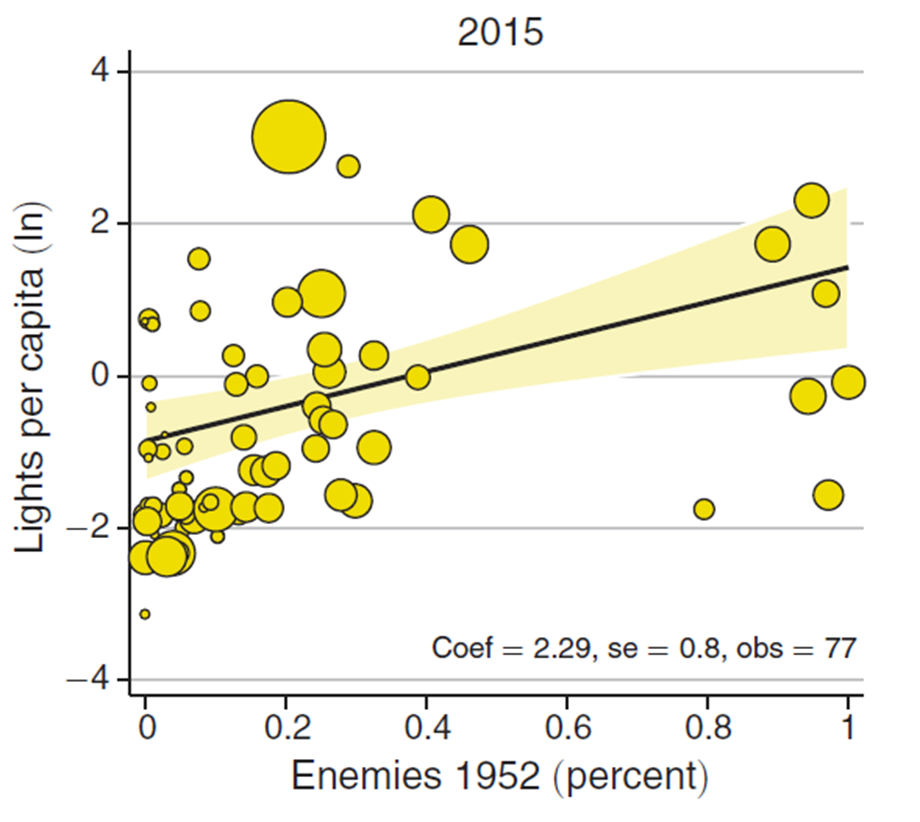
We find that in 2018, among firms located near former Gulags, those near camps which were populated by a higher share of ‘enemies’ pay higher wages and earn higher profits per employee. This effect is quantitatively similar when we use night lights per capita as a proxy for local prosperity (Figure 3). Moving from a town near a Gulag where enemies accounted for 19% of prisoners, i.e. the average across camps at the end and peak of the Gulag system, to one near a camp with 47% enemies increases night lights per capita by 46%, profits per employee by 14%, and average wages by 22%. This would translate to an increase of around US$1,540 a year, given an average annual salary of $7,000. If we translate the effect of ‘enemies’ into a long-run return-to-education parameter, a 1 percentage point increase in the share of college-educated people in 1952 increases night lights per capita by 21% in 2010, profits per employee by 7%, and average wages by 11% in 2018.
Figure 3: Enemies of the people and long-run development across Gulag locations
Enemies of the people and the persistence of education across generations
How can these deportations still shape local development, half a century later, a period scarred by communism and continued repression?
To answer this question, let’s consider the case of Magadan. A port city in the far east, founded in the Gulag era as a camp and entry point to the Kolyma region camps. In Kolyma Tales, Shalamov (1980) writes about the “Professors, party officials, military men, engineers, peasants, factory workers, who filled the prisons of that era to the fullest”.
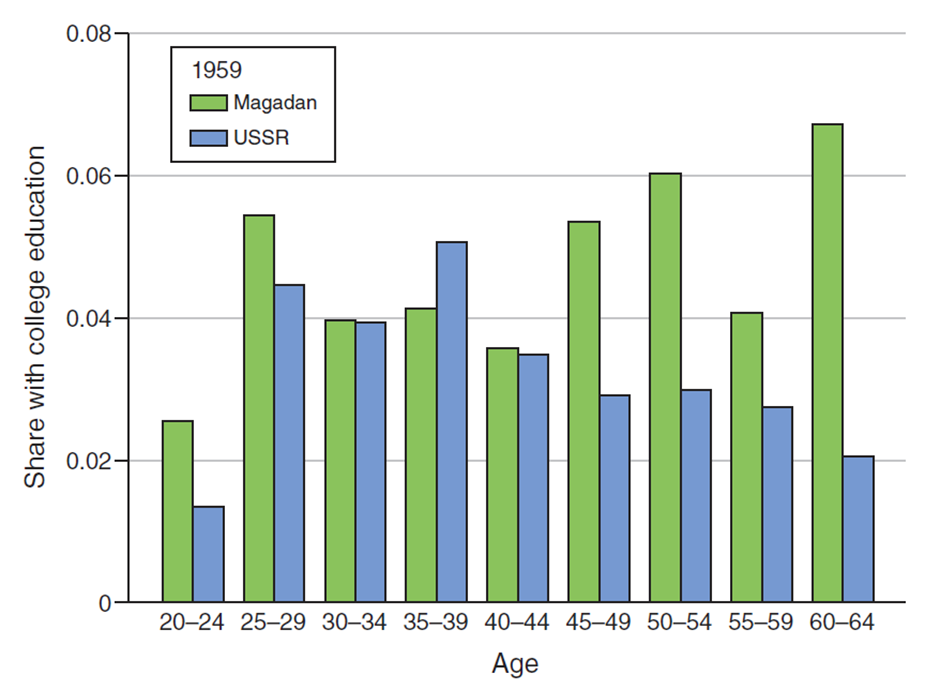
This resulted in an educated city. Figure 4 shows the high share of the college educated in Magadan in 1959, a few years after the death of Stalin and end of the Gulag system. Among those above 60 years old, more than 6% had college education; that share was only 2% in the whole USSR. This education level persisted, and Magadan became a prosperous city. A famous Russian stand-up comedian, Ruslan Bely, explains why Magadan feels special. He describes how the city has a “well-mannered audience that laughs at the subtle jokes”, noting that “after serving their sentence, they [enemies of the people] simply stayed in Magadan. Therefore, from the point of view of human resources, it turned out to be a very cool city” (Vdud 2018).
Figure 4: Education levels in Magadan in 1959
So, why did the ‘enemies of the people’ remain after they were freed? Stalin had never intended for them to be allowed to return home, and strict limits on mobility were imposed. But it’s also because the camps became industrial cities, and provided jobs. Managers actively recruited ex-prisoners with the required technical skills (Barenberg 2014). It’s also because Gulag towns had become a way of life, and survivors simply had nowhere to return.
“Years of imprisonment had destroyed everything associated with ‘home’ - family, career, possessions, and their mental and physical health... Some exiles had already started new families with other exiles and ‘free’ spouses... Millions of survivors thus chose to remain, now as free citizens and paid employees, in the vast region of the dismantled Gulag empire... Indeed, so many did so that their liberated presence dramatically changed the demographic, social, and political character of several former administrative centers of the Gulag” (Cohen 1983).
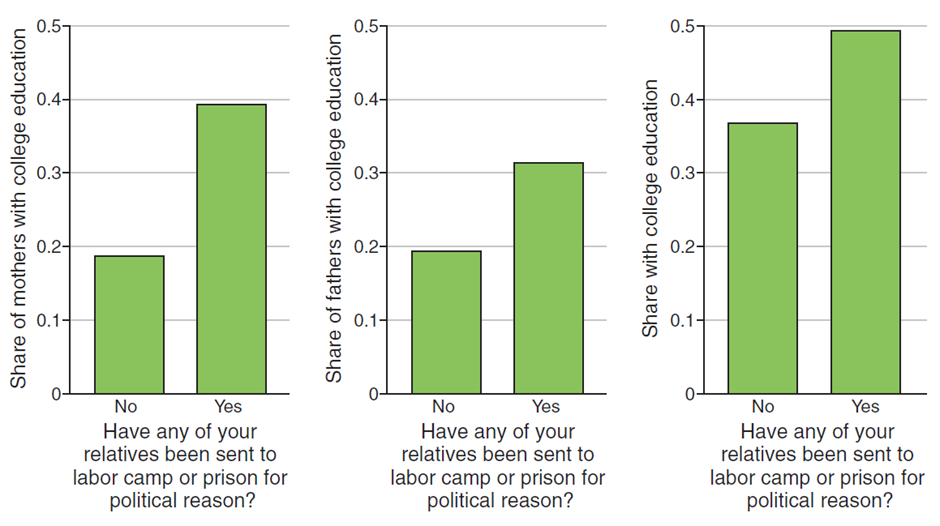
Using individual data from the EBRD’s Life in Transition Survey (LiTS 3), we show that the higher education levels linked to political repression persisted across generations. The survey asked 19,341 individuals in ex-USSR countries in 2016 about their income and education but also whether their relatives had been sent to labour camps or prisons for political reasons during Soviet times. The latter allows us to compare the education of the descendants of the ‘enemies of the people’ to that of others.
Figure 5 shows that survey respondents who identify as ‘enemies of the people’s’ descendants are more likely to have a college education than others in the same area. Among those who had relatives that were sent to labour camps for political reasons during Soviet times, the share with college education was close to 50%, whereas it was around 37% for others. What’s more, parents of the respondents are also more likely to be more educated.
This human capital can make a difference. Researchers have documented that educated workers increase firms’ productivity (Abowd et al. 2005, Ilmakunnas et al. 2004, Haskel et al. 2005, Fox and Smeets 2011), notably via technical knowledge but also better organisation and management (Bloom et al. 2019) and because new technologies are complementary with skilled labour (Violante 2008).
The effect of migration on growth may also be due to the fact that migration itself, especially forced migration and uprootedness, may give people an incentive to invest in human capital. Michalopoulos et al. (2025), for instance, look at the resettlement of 1.2 million Greek Orthodox from Turkey to Greece in the 1920s, suggesting that refugees eventually caught up and surpassed natives in terms of education.
Figure 5: The persistence in education across generations
Policy implications for education and long-term development
Our findings underscore the critical role of education in shaping long-term prosperity. Higher education can have persistent effects across generations, raising local productivity, wages, and overall economic outcomes.
Our research also underscores a darker reality: the destructive actions of despots can shape local development trajectories for generations. The deportation of the ‘enemies of the people’ did not enhance long-run growth in the Soviet Union (Cheremukhin et al. 2017). While their higher educational attainment did foster local prosperity, its potential was unlikely to be fully realised under such conditions. By contrast, as de Pleijt and Frankema (2025) demonstrate in Southeast Asia, the long-term accumulation of human capital – particularly higher education – combined with internal migration enabled talent to flow to places where it could be most productive. This suggests that policies promoting mobility, such as investments in urban infrastructure, can amplify the developmental impact of education policies.
Barriers such as limited school infrastructure and authoritarian tendencies can prevent human capital from reaching its full potential. Investing in education remains one of the most reliable paths to long-term development.
References
Abowd, J M, J Haltiwanger, R Jarmin, J Lane, P Lengermann, K McCue, K McKinney, and K Sandusky (2005), “The relation among human capital, productivity, and market value: Building up from micro evidence,” in Measuring Capital in the New Economy, C Corrado, J Haltiwanger, and D Sichel (eds.), 153–204, University of Chicago Press.
Acemoglu, D, and J Angrist (2001), “How large are human capital externalities? Evidence from compulsory schooling laws,” in NBER Macroeconomics Annual 15, B S Bernanke and K Rogoff (eds.), 9–74, MIT Press.
Baldaev, D (1993), Drawings from the Gulag.
Barenberg, A (2014), Gulag Town, Company Town: Forced Labor and Its Legacy in Vorkuta, Yale University Press.
Bloom, N, E Brynjolfsson, L Foster, R Jarmin, M Patnaik, I Saporta-Eksten, and J Van Reenen (2019), “What drives differences in management practices?,” American Economic Review 109(5): 1648–1683.
Cheremukhin, A, M Golosov, S Guriev, and A Tsyvinski (2017), “The industrialization and economic development of Russia through the lens of a neoclassical growth model,” Review of Economic Studies 84(2): 613–649.
Cohen, S F (1983), Social Dimensions of De-Stalinization, 1953–64, National Council for Soviet and East European Research.
de Pleijt AM and E Frankema (2025), “The deeper roots of human capital formation and economic development in Southeast Asia, 1900–2000,” Journal of Development Economics 176: 103506.
Droller, F (2018), “Migration, population composition and long-run economic development: Evidence from settlements in the Pampas,” Economic Journal 128(614): 2321–2352.
Easterly, W, and R Levine (2016), “The European origins of economic development,” Journal of Economic Growth 21(3): 225–257.
Escamilla-Guerrero, D, A Papadia, and A Zimran (2025, February 14), “The effects of immigration in a developing country: Brazil in the age of mass migration,” Unpublished manuscript.
Ertz, S (2008), “Making sense of the Gulag: Analyzing and interpreting the function of the Stalinist camp system,” Unpublished manuscript.
Fox, J T, and V Smeets (2011), “Does input quality drive measured differences in firm productivity?,” International Economic Review 52(4): 961–989.
Glaeser, E L, R La Porta, F Lopez-de-Silanes, and A Shleifer (2004), “Do institutions cause growth?,” Journal of Economic Growth 9: 271–303.
Hanushek, E A, J Ruhose, and L Woessmann (2017), “Knowledge capital and aggregate income differences: Development accounting for US states,” American Economic Journal: Macroeconomics 9(4): 184–224.
Haskel, J, D Hawkes, and S Pereira (2005), “Skills, human capital and the plant productivity gap: UK evidence from matched plant, worker and workforce data,” Unpublished manuscript.
Hendricks, L, and T Schoellman (2023), “Skilled labor productivity and cross-country income differences,” American Economic Journal: Macroeconomics 15(1): 240–263.
Ilmakunnas, P, M Maliranta, and J Vainiomäki (2004), “The roles of employer and employee characteristics for plant productivity,” Journal of Productivity Analysis 21(3): 249–276.
Khlevnyuk, O (2003), “The objectives of the Great Terror, 1937–1938,” in Stalinism, D L Hoffman (ed.), 82–104, Wiley.
Michalopoulos, S, E Murard, E Papaioannou, and S O Sakalli, “Uprootedness, human capital, and skill transferability,” Unpublished manuscript.
Orwell, G (1949), Nineteen Eighty-Four.
Rocha, R, C Ferraz, and R R Soares (2017), “Human capital persistence and development,” American Economic Journal: Applied Economics 9(4): 105–136.
Shalamov, V (1980), Kolyma Tales, W.W. Norton, New York.
Solzhenitsyn, A (1973), The Gulag Archipelago, 1918–56: An Experiment in Literary Investigation, Harper & Row, New York.
Toews, G, and P L Vezina (2025), “Enemies of the people,” American Economic Journal: Macroeconomics 17(1): 310–342.
Vdud (2018), Interview with Ruslan Bely, YouTube.
Violante, G L (2008), “Skill-biased technical change,” The New Palgrave Dictionary of Economics, 2nd edition, 1–6.
Zhukov, Y M, and R Talibova (2018), “Stalin’s terror and the long-term political effects of mass repression,” Journal of Peace Research 55(2): 267–283.