

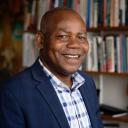
Leonard Wantchekon’s journey demonstrates how activism, rigorous scholarship, and institution-building can work together to strengthen democracy, rebuild trust, and promote locally led development across Africa.
Editor's note: This episode of VoxDevTalks is also available on Spotify, Apple Podcasts, and YouTube.
In this episode of VoxDevTalks, Leonard Wantchekon reflects on a life that bridges activism, scholarship, and institution-building. He recounts how formative experiences of injustice in Benin shaped his research agenda, discusses his influential research in political economy, and sets out his mission for the African School of Economics (ASE) – which he founded to cultivate a new generation of Africa-based researchers.
Throughout, he argues that rigorous methods, local knowledge, and civic engagement are complementary, rather than competing, foundations for better policy and politics.
From village solidarity to political activism
Wantchekon situates his early activism in the community he grew up in Benin. Poverty was real, but so were ambition and mutual support.
“People, despite low income being low income, were very proud, very determined. They value education extremely highly.”
Early exposure to injustice, combined with leftist ideas brought home by Beninese students returning from France, propelled him into organising while still at school.
But activism had its consequences. As a university student, Wantchekon helped lead uprisings against an autocratic military regime. Arrested and tortured, he learned a form of disciplined, strategic communication that became a survival strategy and later a research instinct.
“If you want to survive torture, you need to be able to focus on not the moment, but also what you want to accomplish.”
A rapid, rigorous academic ascent
As a student, Wantchekon initially pursued mathematics before shifting towards political economy, which he discovered could be studied rigorously using economic methods.
His activist energy translated into academic intensity, allowing him to finish his PhD in less than three years, emphasising how a strong sense of purpose accelerates research. He also laments a drift in academia towards treating scholarship as “just a profession”, urging young researchers to keep meaning and public engagement at the centre of their work.
Rethinking campaigns: What really moves voters?
One of Wantchekon’s signature contributions is his field experiment during Benin’s 2001 election. Working with political parties, he compared a programmatic ('normative') campaign – rooted in policy platforms and citizen deliberation – with a clientelist, highly targeted approach prioritising private benefits.
“An ideal political campaign is when you have a programme… and then you share this agenda with the public… and you get them to participate, to take ownership of your agenda.”
The findings were sobering and nuanced. As he puts it, “the opportunistic, the unethical, campaign strategy works better” but not uniformly: its effect is weaker among women, those living in cosmopolitan areas, and people who travel often.
The results suggest a path forward – making principled campaigns specific, participatory, and locally grounded – rather than conceding to clientelism. Building on this, Wantchekon adapted deliberative methods to local government oversight, inviting citizens to debate audit reports behind closed doors to curb corruption. The broader lesson is pragmatic optimism:
“You can be talking about things of public interest, general interest, and still win, because you try to tailor the message to local conditions.”
The long shadow of history: Slave trade and mistrust
Moving on to his influential research with Nathan Nunn, Wantchekon explains how the transatlantic and Indian Ocean slave trades left a durable legacy of mistrust in parts of Africa. Personal memories of cautionary folk songs and family warnings resonated with historical evidence that coercive systems enlisted local institutions, corroding social ties. The data-backed conclusion is striking but bounded: with slavery explaining 16–25% of the variation in trust.
For Wantchekon, this takeaway is both methodological and moral. Methodologically, economic history must be causal and policy relevant, not merely descriptive. Morally, recognising that mistrust is not ‘genetic’ but historically produced opens the door to rebuilding trust through institutions, transparency, and civic participation.
The African School of Economics
In 2014, Wantchekon founded ASE to address representation, capacity, and intellectual autonomy in African social science. The initiative began on a small scale with just $5,000 to fund a summer school in statistics, but quickly expanded through grants and research partnerships, allowing students to engage in practical research projects from the very beginning.
“Africa must become a full participant in global knowledge production, not just a passive recipient of solutions from elsewhere.”
ASE’s curriculum blends three pillars:
- Rigorous methods: a strong emphasis on mathematics and statistical training.
- Economic history: a requirement that keeps context front and centre.
- Early immersion in research through contracts and field projects.
The School also insists on intellectual breadth: “all the sciences, even humanities, are all together side by side”, challenging external narratives and cultivating scholars who can ask original questions rooted in local realities.
For Wantchekon, this is not just theory but practice: “I’m not just writing about it… I’m doing it.”
What African economists can uniquely contribute
Asked what research ASE students should pursue, Wantchekon argues for frontier-quality work informed by local knowledge. That means asking questions that others overlook, measuring what matters on the ground, and designing interventions with communities rather than for them.
It also means rebalancing the global division of labour in knowledge production, with African scholars leading from Africa, shaping agendas, and building cumulative expertise on institutions, behaviour, and policy. The normative and the technical reinforce each other here: precision in methods enables credibility, proximity to problems enables relevance. Describing his own career path, he explains that his activist commitment sharpened his academic focus, while his scholarly tools helped make his activist aims attainable.
“This is the kind of campaign that we need to see… and then we show rigorously that, in fact, it worked.”
Why this matters now
Wantchekon’s journey offers a unifying argument: democratic quality, development outcomes, and research excellence hinge on participation, trust, and institutions. Programmatic politics can compete if it is deliberative and locally specific, trust damaged by history can be rebuilt by credible, citizen-facing processes, and the next wave of impactful research will come from African institutions that train scholars to be methodologically strong, historically literate, and civically engaged.
It is a vision of economics as a public-spirited craft – one that measures carefully, explains clearly, and empowers people to co-produce their own future.