




Despite extensive investment in development initiatives aimed at building state legitimacy and countering insurgencies, evidence from Afghanistan suggests that such programmes can reduce violence when insurgencies are locally driven but may misallocate resources and even fuel conflict when insurgents are not reliant on local populations for support.
Editor's note: The authors have made slides available to accompany this research here.
In the 20 years following 9/11, the US government spent US$36 billion on governance and development programmes in Afghanistan (SIGAR 2021). These allocations were largely motivated by the theory that improving public services and infrastructure would bolster popular support for the new government and, in turn, weaken the insurgency (Petraeus et al. 2006). Despite substantial investments in programmes aimed at building state legitimacy, the drawdown of NATO forces was swiftly followed by the president’s overthrow and the dissolution of parliament (Blumenstock et al. 2024). The rapid collapse of Afghanistan’s elected government – which undid 20 years of investments in state-building – raises questions about the efficacy of development programmes as tools to counter insurgencies and reduce violence.
The view that development programmes can assume a counterinsurgency function is underscored by the idea that job creation and other benefits reduce the incentive for local men to join insurgent groups, while also mitigating the disenfranchisement that can motivate others to ‘tacitly support’ such groups with shelter, sustenance, and intelligence. By weakening the numerical strength and tactical efficacy of the insurgency, development programmes can reduce violence. However, it is also possible that insurgent groups may anticipate these effects and deliberately target development programmes, resulting in a perverse effect.
Figure 1: Excerpts from the 2006 US Army / Marine Corps Counterinsurgency Field Manual

Development as a counterinsurgency tool
Empirical research on development programmes and conflict reflects this theoretical ambiguity. On the one hand, research on US-funded infrastructure projects in Iraq, conditional cash transfers in the Philippines, and public works projects in India have found that development programmes reduce violence (Berman et al. 2011, Crost et al. 2016, Fetzer 2020). On the other, research on community development programmes in the Philippines, employment schemes in India, cash transfers in Colombia, and US food aid have found the opposite effect (Crost et al. 2014, Khanna et al. 2017, Weintraub 2016, Nunn and Qian 2014). These mixed results suggest that the impact of development programmes on violence potentially depends on the nature of the programme and the local context.
Figure 2: Recognition of potential role of NSP in countering the insurgency in Afghanistan
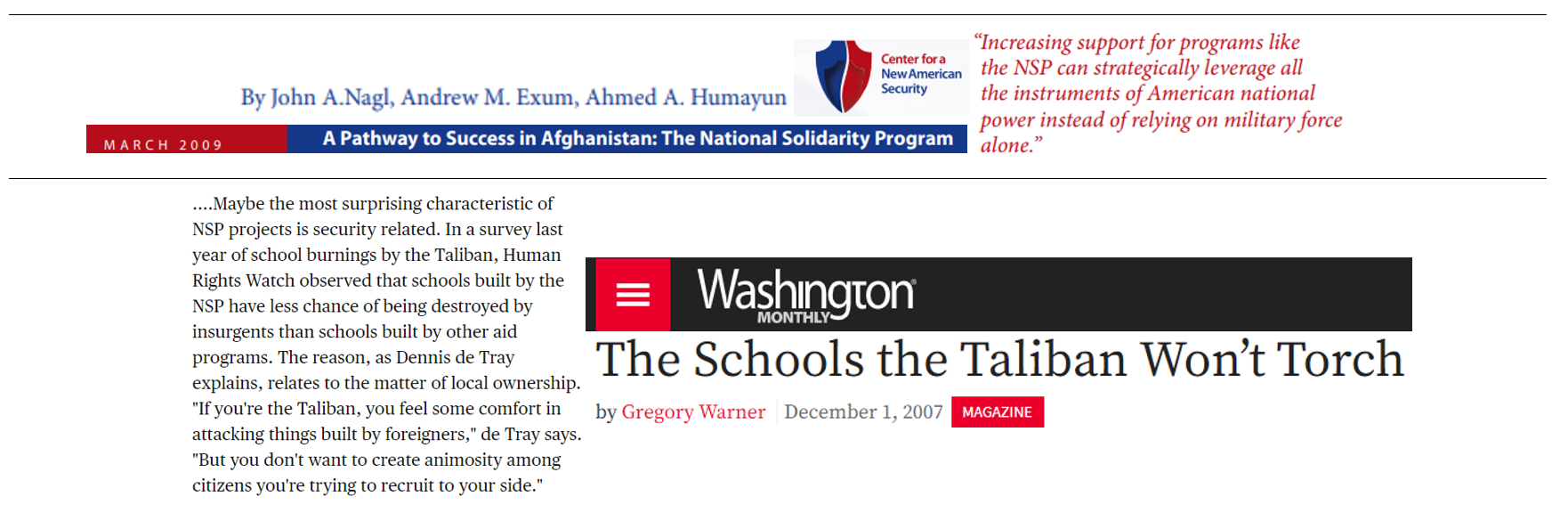
In Afghanistan, no development programme was perhaps as important in building state legitimacy – and potentially countering the insurgency – as the National Solidarity Programme (NSP), the country’s largest development programme over the 2001-21 period (Murtazashvili 2022). Funded by a consortium of foreign donors but executed by the national government, NSP provided block grants of up to US$60,000 per village to finance village-level projects selected by villagers through a participatory process. Given Afghanistan’s violent history, NSP was key to building perceptions of the government as a benevolent provider of public goods and services. As the insurgency gained strength after 2006, military officials, political advisors, and media commentators increasingly viewed NSP as a counterinsurgency tool (Humayun et al. 2009).
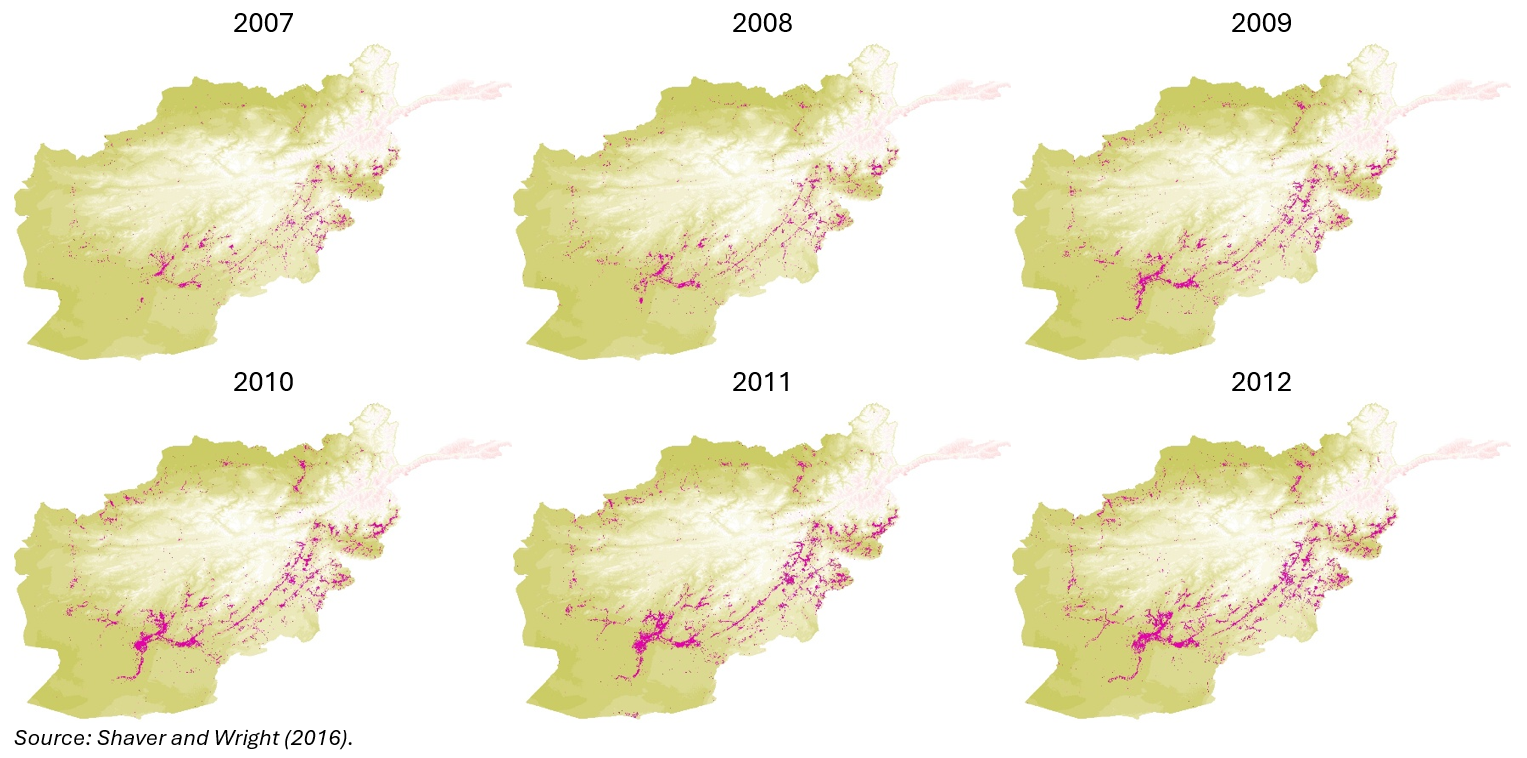
Figure 3: Security incidents, 2007 – 2012
Evaluating Afghanistan’s National Solidarity Programme
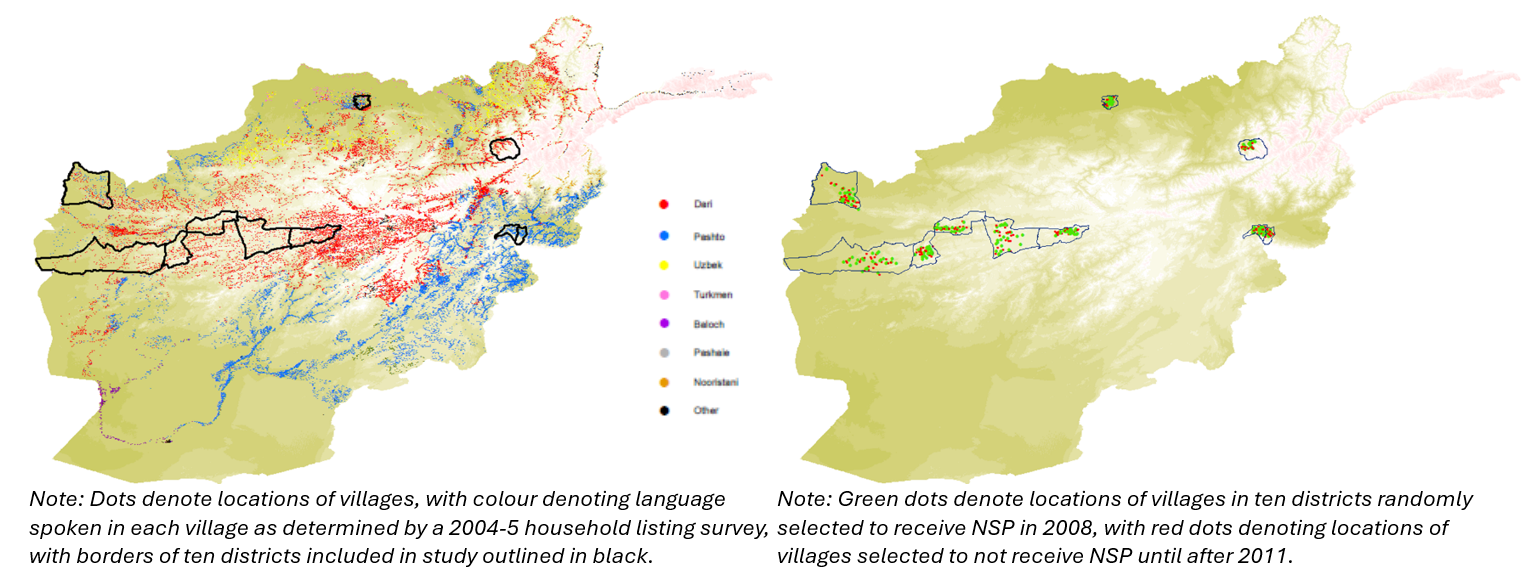
A unique experiment and the declassification of data on conflict incidents provide an opportunity to understand how this unparalleled intervention affected the insurgency. In 2007, 250 of 500 villages across ten districts in Afghanistan were randomly assigned to receive NSP, with the remaining 250 villages not receiving NSP until late 2011 at the earliest. With this ‘randomisation’, we can separate the effects of NSP from other factors – both observed and unobserved – affecting the insurgency. The US military’s Combined Information Data Network Exchange (CIDNE) database – which reports dates, locations, and types of incidents across Afghanistan between 2006 and 2014 – provides measures of insurgent violence. Data on popular perceptions of the local economy, different levels of government, and foreign military forces are provided by three rounds of household surveys conducted in the 500 villages in 2007, 2009, and 2011.
Figure 4: (a) Language spoken by village; (b) 500 villages with treatment status
Development improved governance but not overall security
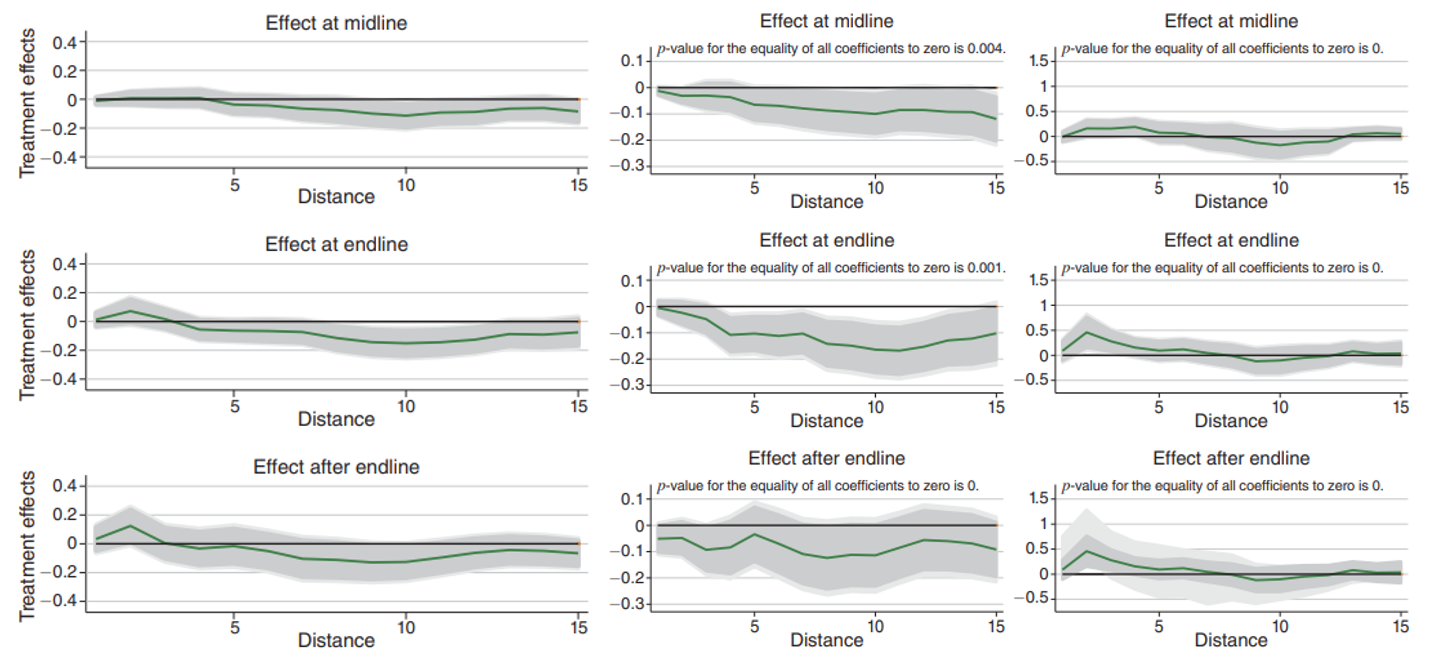
Our analysis of the effects of NSP on popular perceptions and the frequency and nature of violent incidents indicates that while the programme improved both villagers' access to public goods and their view of the government and its partners, these successes did not translate into an overall improvement in the security situation (Beath et al. 2025). Further analysis at the district-level suggests, however, that this overall ‘null’ effect masks substantial heterogeneity.
In the eight districts in northern, central, and western Afghanistan, NSP significantly reduced violent incidents during and after implementation, while also improving economic outcomes and boosting popular support for the government. In the two districts located in the border regions of eastern Afghanistan, however, NSP did not reduce violent incidents and did not improve perceptions of the government, despite projects delivering similar economic benefits to the local population.
Figure 5: Treatment effects on security incidents for different radii around villages
(a) Overall effect across ten districts (b) Non-eastern districts (c) Eastern districts
Structural differences in insurgency
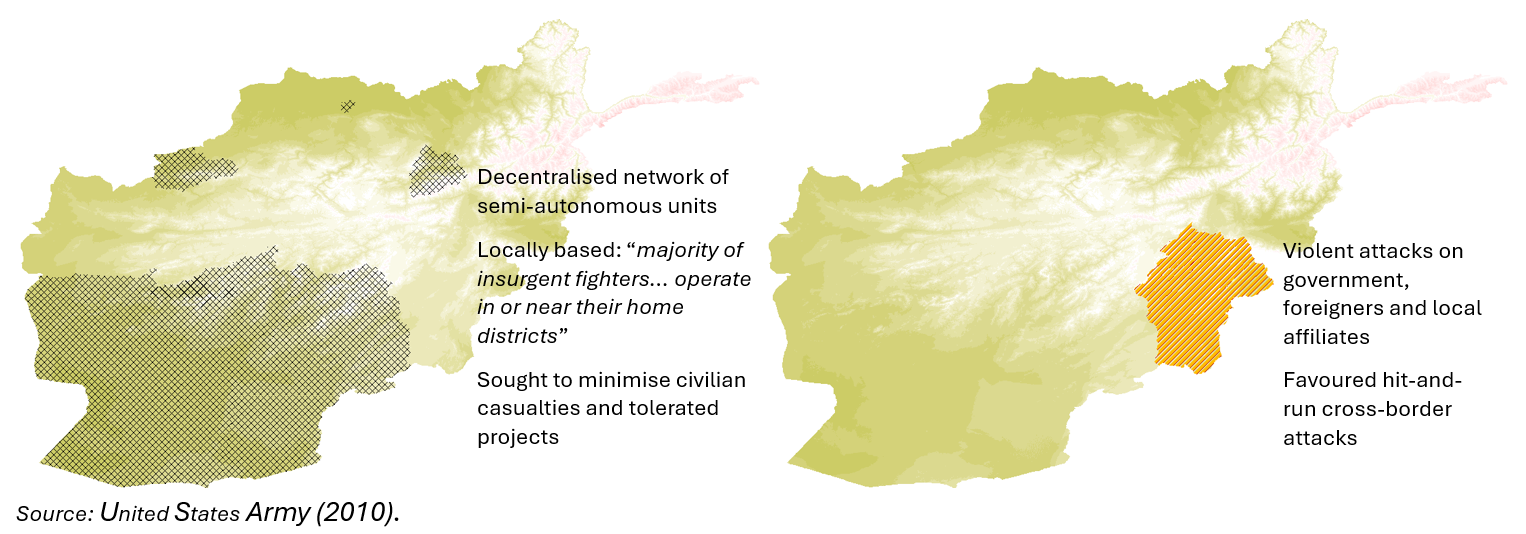
The opposing effects of NSP on insurgent violence in the eastern and non-eastern districts reflect structural differences in the insurgency. Whereas insurgents in non-eastern areas were primarily drawn from and sustained by local communities and were directed to “keep good relationships with… the local people” (Department of Defense 2011), eastern areas attracted foreign insurgents whose cross-border bases made them less dependent on the local population and more willing to use coercion to exact tacit support. While local insurgents largely tolerated development projects, foreign fighters regularly threatened to “kill anyone who cooperated with the Afghan government or foreign aid groups” (Rohde 2007).
Thus, not only did shifts in popular sentiment – affected by NSP – have little scope to reduce the numerical strength or tactical efficacy of the insurgency in the eastern districts, the implementation of NSP projects there incited intimidation by insurgents (Foschini 2011). In other areas of Afghanistan where the insurgency was locally based, the improvements in economic well-being and state legitimacy affected by NSP reduced the willingness of villages to either join or tacitly support the insurgency.
Figure 6: Variation in Afghan insurgency
(a) Local insurgents (b) Non-local fighters
Implications for counterinsurgency and state-building
In examining the effect of Afghanistan's largest development programme on the insurgency, these new results shed light on factors that contributed to the rapid collapse of the elected government. As various commentators have noted, the special characteristics of the insurgency in eastern Afghanistan perverted the effects of counterinsurgency strategies that were effective at ‘winning hearts and minds’ and reducing violence in other parts of the country (Markey 2021).
In this sense, the failure of the Afghan government and its international partners to recognise the diverse objectives, methods, and capabilities of groups within the insurgency – and their varying ties to local communities – and to adapt counterinsurgency strategies accordingly, contributed to inefficient resource allocation and heightened violence in some areas.
References
Beath, A, F Christia, and R Enikolopov (2025), “Can development programs counter insurgencies? Evidence from a field experiment in Afghanistan,” American Economic Journal: Applied Economics, 17(3): 80–116.
Berman, E, J N Shapiro, and J H Felter (2011), “Can hearts and minds be bought? The economics of counterinsurgency in Iraq,” Journal of Political Economy, 119(4): 766–819.
Blumenstock, J, M Callen, A Faikina, S Fiorin, and T Ghani (2024), “Strengthening fragile states: Evidence from mobile salary payments in Afghanistan,” Unpublished manuscript.
Crost, B, J Felter, and P Johnston (2014), “Aid under fire: Development projects and civil conflict,” American Economic Review, 104(6): 1833–1856.
Crost, B, J H Felter, and P B Johnston (2016), “Conditional cash transfers, civil conflict and insurgent influence: Experimental evidence from the Philippines,” Journal of Development Economics, 118: 171–182.
Department of Defense (2011), "Report on progress toward security and stability in Afghanistan."
Fetzer, T (2020), “Can workfare programs moderate conflict? Evidence from India,” Journal of the European Economic Association, 18(6): 3337–3375.
Foschini, F (2011), “Conflicts in the East, Part II,” Afghanistan Analysts Network.
Humayun, A, A Exum, and J Nagl (2009), “A pathway to success in Afghanistan: The National Solidarity Program,” Center for a New American Security.
Khanna, G, and L Zimmerman (2017), “Guns and butter? Fighting violence with the promise of development,” Journal of Development Economics, 124: 120–141.
Markey, D (2021), “America’s perennial Pakistan problem: Why Washington failed to win over Islamabad—and prevent a Taliban victory,” Foreign Affairs.
Murtazashvili, J B (2022), “The collapse of Afghanistan,” Journal of Democracy, 33(1): 40–54.
Nunn, N, and N Qian (2014), “US food aid and civil conflict,” American Economic Review, 104(6): 1630–1666.
Petraeus, D H, J F Amos, and J C McClure (2006), "The U.S. Army/Marine Corps Counterinsurgency Field Manual."
Rohde, D (2007), “Foreign fighters of violent bent bolster Taliban,” The New York Times.
Shaver, A, and A Wright (2016), “Are modern insurgencies predictable? New evidence from Afghanistan and Iraq,” Unpublished manuscript.
Special Inspector General for Afghanistan Reconstruction (SIGAR) (2021), "Quarterly report to the United States Congress."
United States Army (2010), "Insurgent regions in Afghanistan and Pakistan.jpg."

Weintraub, M (2016), “Do all good things go together? Development assistance and insurgent violence in civil war,” Journal of Politics, 78(4): 989–1002.