



When female labour reforms fail to align with employer incentives, they can deepen rather than reduce gender disparities in the labour market, as shown by Iran’s 2016 reform.
Editor’s note: For a broader synthesis of themes covered in this article, check out Issue 2 of our VoxDevLit on Female Labour Force Participation.
Reducing gender disparities in labour markets remains a critical global challenge (Heath et al. 2025). Despite decades of reforms, the 2025 Global Gender Gap Report indicates that achieving full gender parity, especially in economic participation and opportunity, could take over a century. The need for effective interventions is most urgent in countries where women face the greatest barriers to economic inclusion. Yet evidence on the impacts of labour market policies in highly discriminatory settings remains limited.
Research from high-income economies shows that family-friendly policies can raise women’s labour supply (Baker et al. 2008, Blau and Kahn 2013, Brewer et al. 2022), though extended leave or protection schemes may slow wage growth and skill accumulation (Rossin-Slater 2017, Olivetti and Petrongolo 2017, Kleven et al. 2024, Bailey et al. 2025). Evidence from developing countries also shows both promise and risk: childcare and training programmes have raised women’s employment in Uganda, Kenya, and Indonesia (Bandiera et al. 2020, Clark et al. 2019, Halim et al. 2022), but some reforms have backfired – protective laws in Bangladesh and a minimum wage hike in Morocco reduced women’s access to formal work (Buchmann et al. 2023, Paul-Delvaux 2024).
Iran, one of the world’s lowest-ranked countries for gender equity, provides a particularly critical setting for examining the effectiveness of labour policy interventions. Despite high educational attainment, women face deep structural barriers to work. Ranked 146th out of 148 countries for economic participation and opportunity in the 2025 Global Gender Gap Report, women’s labour force participation fell from 19% in 2016 to 13.4% in 2024, and unemployment is more than twice that of men.
In Chen and Ebadi (forthcoming), we examine the effects of Iran’s 2016 female labour reform, introduced as a measure to ensure “the social security of vulnerable women.” Our analysis shows that while the reform modestly reduced the working hours of eligible women, it led to significant declines in formal employment among both the targeted mothers and non-targeted women of childbearing age. Targeted households also experienced reductions in expenditures, especially in education spending, which may have long-term consequences for the economic opportunities of affected women and their children.
Iran’s 2016 female labour reform
In July 2016, Iran passed the Reduction of Office Hours Act for Women with Special Circumstances, cutting eligible women’s weekly work hours from 44 to 36 while keeping full pay. Targeting mothers of young children and female household heads, it was framed as protecting vulnerable women’s social security, even though an examination of the legislation suggests its main motivation was to address declining fertility rates.
The bill was passed after amendments shifted the costs to employers. This is not unique to Iran. Approximately 30% of countries worldwide, particularly those with higher gender disparities, require employers to bear full or partial costs of female labour benefits (World Bank 2023).
The implementation of the law encountered significant challenges. Within the first two months, complaints emerged regarding employers’ refusal to comply with the legislation. Meanwhile, many women were reluctant to apply for the programme or challenge non-compliance, fearing retaliation or job loss. Employers also expressed dissatisfaction with the government’s compensation measure, which offered only to reduce mandatory employee insurance premiums.
While some viewed the reform as a step forward in addressing work-life balance for Iranian women, it drew criticism for potentially deepening women’s economic marginalisation. We evaluate the effects of the reform not only on targeted women’s working hours and earnings – outcomes explicitly regulated by the policy – but also their broader access to employment opportunities, particularly in the formal sector.
Assessing Iran’s female labour reform
We evaluate the impact of Iran’s 2016 female labour reform on women’s labour outcomes and household consumption behaviour using detailed quarterly household income and expenditure surveys conducted by the Statistics Centre of Iran during 2014–2017. Leveraging rich microdata on demographics, employment, earnings, and expenditures, we address data gaps in less developed labour markets. To establish the effects of the reform and address potential confounding labour supply factors, we construct and trace cohorts of mothers based on the year they gave birth and compare outcomes for policy-eligible cohorts with control cohorts who had children slightly older than the age threshold but exhibited similar labour supply characteristics. Using a set of difference-in-differences estimates that account for time-varying industry and location factors, we estimate the impacts of the reform on women’s labour market and expenditure outcomes.
Women’s formal work declines
Our results show that the working hours of targeted women decreased by 21–60 minutes per week after the reform, with no significant changes in pay. Working hours among targeted mothers started declining in the second quarter, with the reduction intensifying over time and reaching 2.3% (60 minutes) after five quarters (Panel a, Figure 1).
Moreover, employment rates, particularly in the formal sector, fell by 2-5% from the rates before the reform. The decrease, initially modest, grew more pronounced over time, reaching 0.6 percentage points or equivalently 5% after five quarters (Panel c, Figure 1). At the same time, the rate of labour force participation also fell significantly. These results suggest that the reform reduced targeted women’s access to employment opportunities, especially in the formal sector, and induced a transition of female labour from formal to informal sectors.
Figure 1: Effects of the reform on targeted mothers of young children
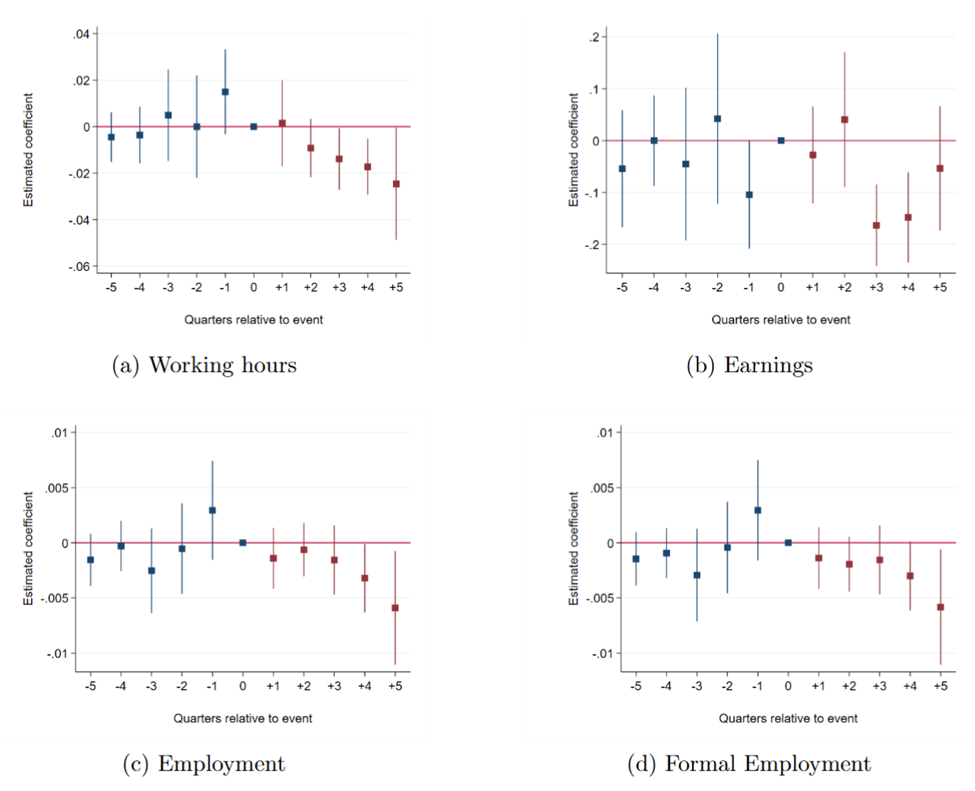
Notes: The event study figures depict the dynamic effects of the reform on labour market outcomes for the mothers of young children versus the non-targeted mothers with broadly similar labour supply characteristics.
Women of childbearing age at a disadvantage
Strikingly, the reform’s impacts extended beyond the targeted female population. We find that despite their ineligibility for the programme, women of childbearing age who did not have children also experienced diminished employment opportunities.
Figure 2 shows that the reform led to a significant decrease in employment rates, including a decrease in formal employment, despite the group’s ineligibility for the programme at the time. This suggests that employers, anticipating potential future regulatory costs, became less willing to hire women of childbearing age, even though these women were not covered by the reform at the time.
Figure 2: Spillover effects of the reform on non-targeted childbearing-age women without children
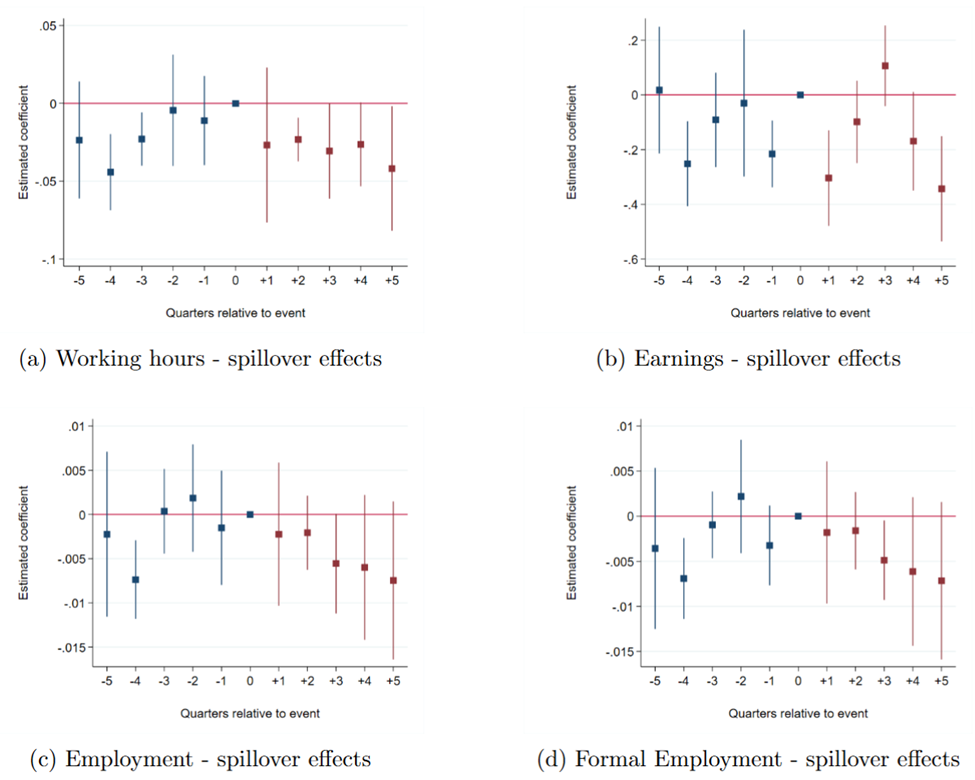
Notes: The event study figures depict the dynamic effects of the reform on labour market outcomes for the adult women aged 45 or younger without children versus a group of women aged 46–50, also without children and ineligible for the programme.
Falling education investment
In addition to labour market distortions, the reform also influenced household consumption behaviour. While the reform did not significantly affect overall household spending or spending on necessities, it caused a 3.5% drop in household investment in education. This decline is particularly concerning, as it undermines the accumulation of human capital needed for better-paying jobs in the future, potentially limiting the long-term economic mobility of targeted women and their children.
Implications for labour policy and protection
These findings offer important lessons for labour market reforms. Reforms that reduce working hours without addressing employer incentives can backfire and ultimately harm women’s employment opportunities. Effective policies must account for the potential responses of employers and provide adequate incentives to align their behaviour with policy objectives. Policymakers should also consider the broader household-level impacts of such reforms, particularly on investments in education, as labour market reforms shift household beliefs about the returns to female education.
References
Bailey, M, T Byker, E Patel, and S Ramnath (2025), “The long-run effects of California's Paid Family Leave Act on women's careers and childbearing: New evidence from a regression discontinuity design and US tax data,” American Economic Journal: Economic Policy 17(1): 401–431.
Baker, M, J Gruber, and K Milligan (2008), “Universal child care, maternal labor supply, and family well-being,” Journal of Political Economy 116(4): 709–745.
Bandiera, O, N Buehren, R Burgess, M Goldstein, S Gulesci, I Rasul, and M Sulaiman (2020), “Women’s empowerment in action: Evidence from a randomized control trial in Africa,” American Economic Journal: Applied Economics 12(1): 210–259.
Blau, F D, and L M Kahn (2013), “Female labor supply: Why is the United States falling behind?,” American Economic Review 103(3): 251–256.
Brewer, M, S Cattan, C Crawford, and B Rabe (2022), “Does more free childcare help parents work more?,” Labour Economics 74: 102100.
Buchmann, N, C Meyer, and C D Sullivan (2023), “Paternalistic discrimination,” Unpublished manuscript.
Chen, M, and E Ebadi (2026), “Good from far, far from good: The impacts of the 2016 female labor reform in Iran,” Journal of Development Economics 178: 103572.
Clark, S, C W Kabiru, S Laszlo, and S Muthuri (2019), “The impact of childcare on poor urban women’s economic empowerment in Africa,” Demography 56(4): 1247–1272.
Halim, D, H C Johnson, and E Perova (2022), “Preschool availability and women’s employment: Evidence from Indonesia,” Economic Development and Cultural Change 71(1): 39–61.
Heath, R, A Bernhardt, G Borker, A Fitzpatrick, A Keats, M McKelway, A Menzel, T Molina, and G Sharma (2025), “Female labour force participation,” VoxDevLit 11(2).
Kleven, H, C Landais, J Posch, A Steinhauer, and J Zweimüller (2024), “Do family policies reduce gender inequality? Evidence from 60 years of policy experimentation,” American Economic Journal: Economic Policy 16(2): 110–149.
Olivetti, C, and B Petrongolo (2017), “The economic consequences of family policies: Lessons from a century of legislation in high-income countries,” Journal of Economic Perspectives 31(1): 205–230.
Paul-Delvaux, L (2024), “Minimum wage and gender gaps: Evidence from Morocco,” Unpublished manuscript.
Rossin-Slater, M (2017), “Maternity and family leave policy,” Unpublished manuscript.
World Bank (2023), “Women, business and the law.”