

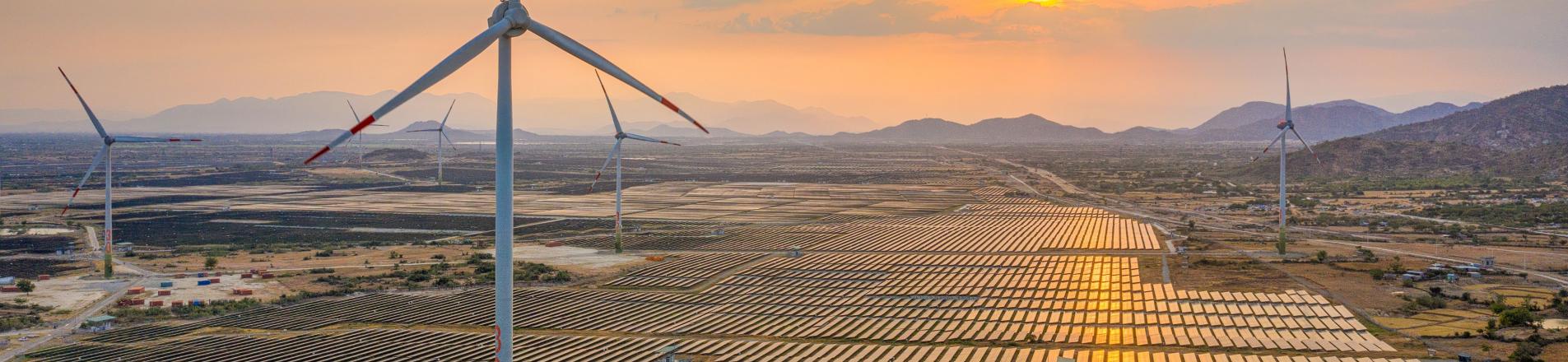




Vietnam's solar boom was built on three key pillars: foreign direct investment (FDI) (mostly from China), access to subsidised Chinese inputs, and productivity spillovers from multinationals to domestic suppliers.
A global solar panel boom
A global boom in solar panels is powering the world's clean energy transition. Industrial policies, including support for technological innovations and demand expansion by the US, Japan, Germany, and more recently China, have played a major role in lowering costs and scaling up production. In China for example, local subsidies helped solar panel firms grow by 76% per year between 2004 and 2013 (Banares-Sanchez et al. 2024).
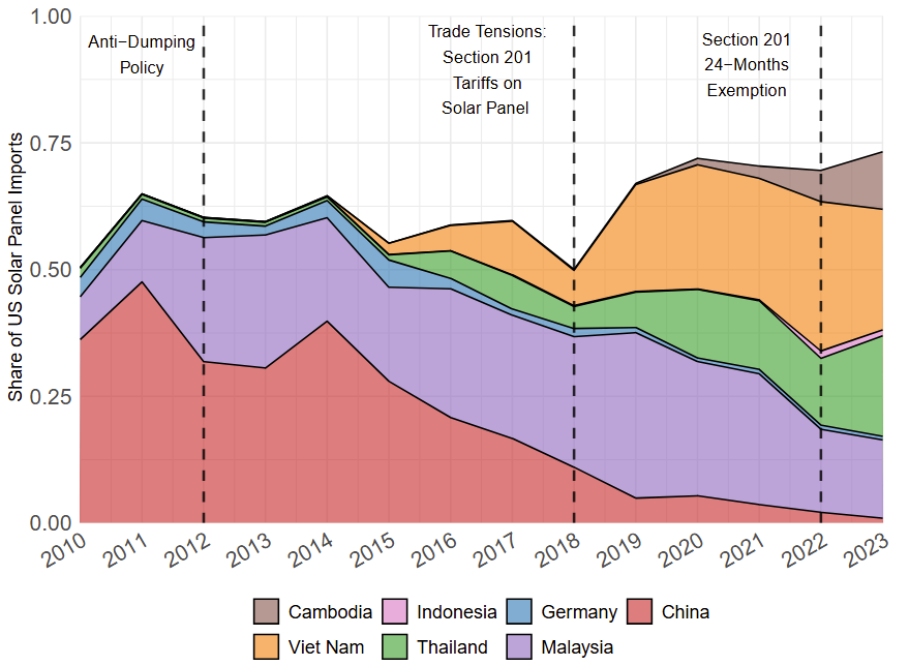
As trade and industrial policies continue to reshape production and trade flows, Vietnam has emerged as a solar panel manufacturing success. From 2018, its solar panel industry experienced remarkable growth, with the country overtaking Malaysia to capture over a quarter of US solar imports by 2022 (Figure 1). How exactly did Vietnam achieve this export success?
Figure 1. US imports of solar panels (Share by exporting country)
Our research (Ngov et al. 2025) reveals that Vietnam's solar boom was built on three key pillars: foreign direct investment (FDI) (particularly from China), access to subsidised Chinese inputs, and productivity spillovers to domestic suppliers. Using firm-to-firm product-level transaction data and Vietnam’s firm census, we trace the solar value chain in Vietnam and uncover how industrial policies in one country can have significant cross-border effects on developing economies.
Chinese FDI: Large firms and export prowess
We first show that foreign investment, particularly from China, plays an outsized role in Vietnam's solar panel industry. To do so, we start from transaction-level data from Panjiva (S&P Global) covering 2018-2022 which allows us to identify the firms based in Vietnam exporting solar panels. We then identify the origin country of FDI firms by manually looking up each firm's online business directories to identify their legal representatives, whose nationality typically corresponds to the source country of investment. This systematic approach revealed the dominant presence of Chinese firms in the sector.
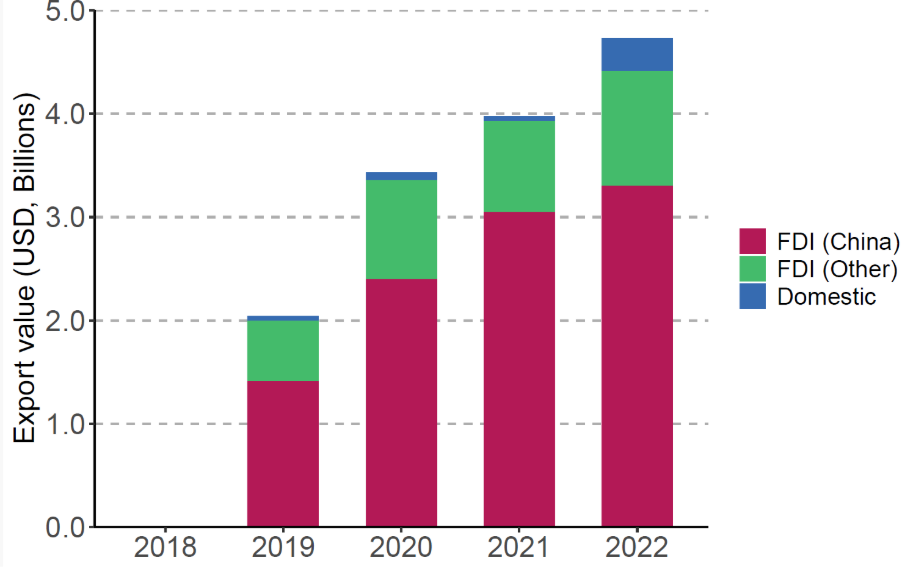
We find that Chinese FDI firms account for 25 of the 79 firms producing solar panels in Vietnam in 2022 (Figure 2a), for around 75% of Vietnam's solar panel exports (Figure 2b), and around 50% of total employment among solar panel firms. Importantly, this export prowess may be due to the solar panels exported by Chinese FDI firms being around 38% cheaper than those sold by other solar panel exporters in Vietnam. This price advantage may also reflect established export networks that Chinese firms bring to Vietnam as well as Chinese subsidies at the firms’ headquarters. Montti (2025) suggest US trade policies may have contributed to this inflow of Chinese FDI in solar panels in Vietnam.
Figure 2. Solar panel firms in Vietnam
- Number of firms, by type

- Solar panel exports, by type of firm
Chinese inputs and the spillovers of industrial policy
We then show that Chinese components lie at the heart of Vietnam's solar industry. We start by compiling a list of 161 solar panel inputs at the HS 6-digit level by combining information from Rosenow and Mealy (2024), who provide a list of solar panel inputs based on the academic literature and industry reports, with data from Fetzer et al. (2024), who used AI to measure input-output relationships in production. We then examine Vietnam’s imports of these 161 inputs using transaction-level data from Panjiva. The Panjiva data covers all transactions, both exports and imports, by firms located in Vietnam. Because solar panel producers are based in Special Economic Zones (SEZs) that require local transactions to clear customs, this data captures transactions with domestic suppliers as well, allowing us to trace almost all of Vietnam's solar panel value chains.
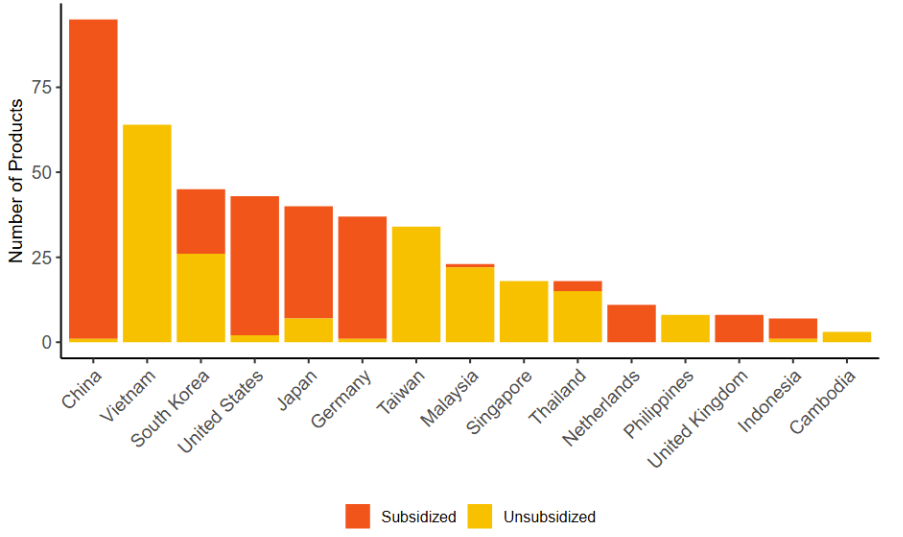
We show that China accounts for most input supplies to Vietnam's solar manufacturers, with more than 600 Chinese firms exporting around 100 different inputs to Vietnam. Crucially, data from Global Trade Alert reveals that all those products are covered by subsidies in China (Figure 3). This matters for prices. We find that Vietnam's imports of solar panel parts and components are around 50% cheaper when sourced from China compared to other countries, and around 30% cheaper when sourced from countries that provide subsidies compared to those without.
We also find Vietnamese firms to be the second most important source of solar panel inputs. This share has increased from 2018 to 2022, reflecting increase local value added in Vietnam’s solar panels.
Figure 3. Vietnam imports of solar panel parts and components, by origin
Importantly, all solar panel exporters in Vietnam – whether domestic or foreign-owned – use a similarly high share of inputs from China. This widespread access to competitively priced Chinese components may thus represent a form of indirect subsidy that benefits the entire Vietnamese solar industry, not just Chinese-owned firms. This benefit from Chinese subsidised cheap inputs would be in line with previous evidence that subsidies in upstream industries enhance downstream export performance (Rotunno and Ruta 2024). It also suggests that when one country subsidises the production and innovation of green goods, it may make it easier for other countries to also produce those goods by joining their global value chains.
Productivity spillovers: Benefits for local suppliers
Beyond direct employment and exports, Chinese FDI may create important linkages with domestic firms. Our data reveals that by 2022, the solar industry had expanded to about 400 firms and 51,000 jobs, with Chinese firms and their suppliers accounting for half of employment. The rise of domestic inputs share, as well as the large number of jobs in local suppliers, represent a form of backward spillover that suggest that the solar panel industry is more than simple transshipment of Chinese solar panels, in line with Schulze and Xin (2025).
Figure 4. Number of firms supplying parts and components to solar panel exporters
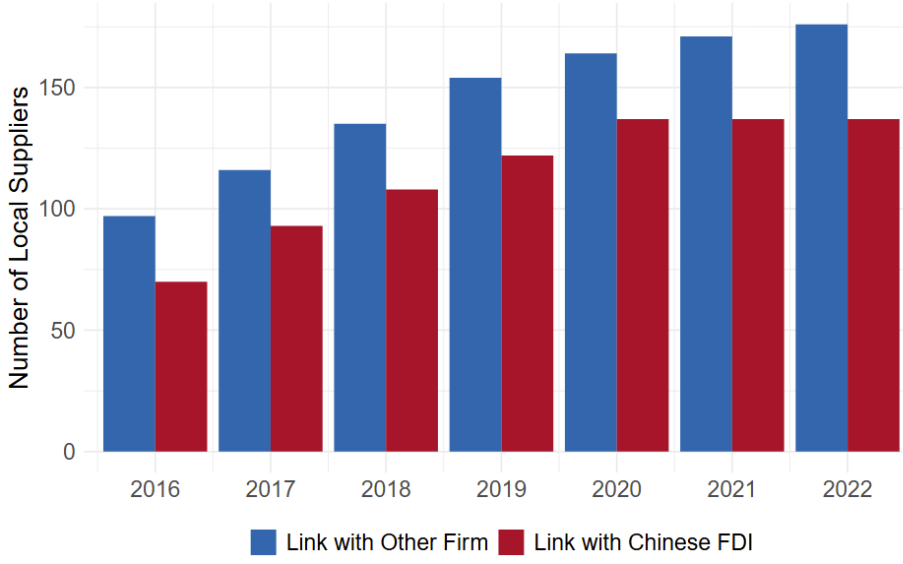
To further investigate the possible backward spillover effects of Chinese FDI, we follow the approach of Alfaro-Urena et al. (2022) and Amiti et al. (2024), who showed that supplying inputs to FDI firms is associated with employment and productivity gains in Costa Rica and Belgium.
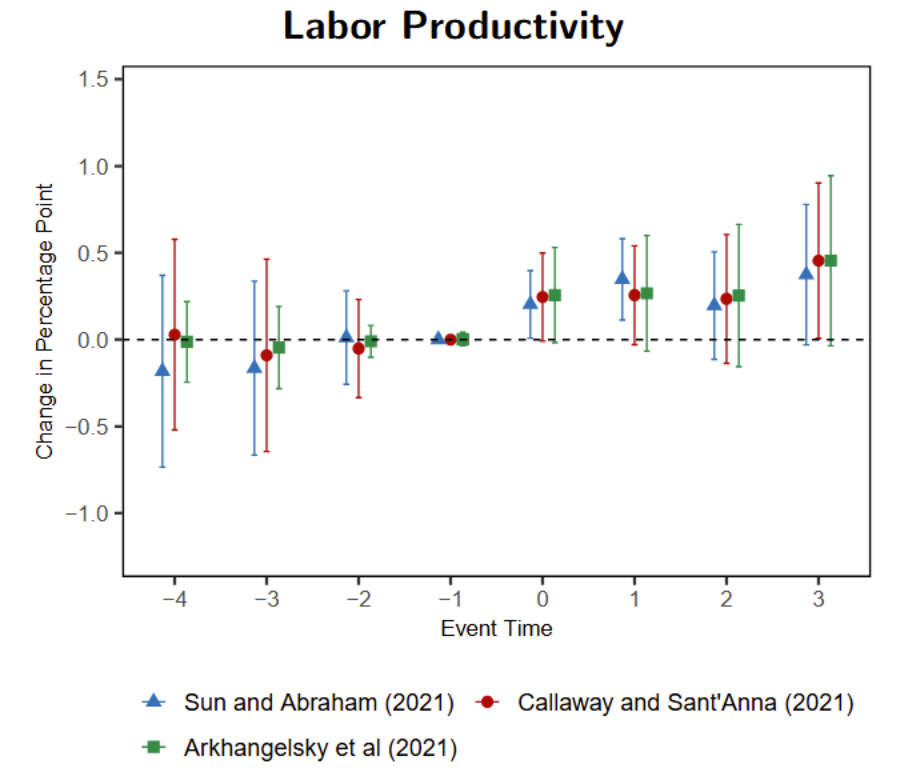
We estimate the causal effect of supplying to Chinese FDI solar panel producers using difference-in-differences methods (Callaway and Sant'Anna 2021 and Sun and Abraham 2021) as well as synthetic difference-in-differences (Arkhangelsky et al. 2021). We find that establishing a new supplier link with a Chinese FDI solar panel producer increases the labour productivity of a domestic input supplier by 33% in the three years after the link was established, compared to other solar panel input suppliers (Figure 5). This effect is specific to Chinese FDI – we find no positive spillovers from supplying to FDI firms on average. We also find positive effects on sales and wages, yet these are not statistically significant. Perhaps surprisingly, we find no significant employment effects.
Figure 5. The effect of supplying Chinese FDI on suppliers’ productivity
Policy implications
Our result that Chinese firms and inputs are crucial ingredients in Vietnam’s export success highlights that developing countries can participate in advanced manufacturing and gain access to export markets by attracting FDI and importing parts and components.
Importantly, we also suggest that there are potential cross-border effects of green subsidies. While Chinese local subsidies have helped solar panel firms boom in China, which accounts for more than 80% of solar panel manufacturing across the value chain, our research suggests that these policies also created opportunities for Vietnam to participate in solar manufacturing – not despite Chinese dominance, but partially thanks to it.
The cross-border spillovers we identify complement other research on international effects of green subsidies. Gerarden and Melstrom (2024) for example find that help-to-buy schemes for solar panels in Germany had positive spillovers across countries, while Barwick et al. (2024) show that consumer subsidies on electric vehicles lead to learning-by-doing in battery production that benefits EV producers globally. Our work adds a new dimension: how production subsidies in one country can facilitate industrial development in another through cheaper inputs.
The importance of Chinese firms in Vietnan solar panel industry also illustrates what Garred and Yuan (2025) call "relocation with Chinese characteristics": Chinese firms relocating production abroad while maintaining strong supply chain links to China. As documented in a recent VoxDev column (Tafese et al. 2025), Vietnam's Special Economic Zones have been instrumental in attracting such investment and facilitating these global value chain linkages.
The case of Vietnam's solar industry demonstrates both the benefits and challenges of joining global value chains in industries shaped by industrial policy. While Vietnam gained employment, exports, and productivity improvements, the industry remains heavily dependent on Chinese inputs and investment – a dependence that has recently attracted scrutiny from US trade authorities concerned with tariff circumvention. Geopolitical tensions may make such form of industrialisation hard to emulate in the future.
The authors have made slides available to accompany this research here.
References
Alfaro-Ureña, A, I Manelici, and J P Vasquez (2022), “The effects of joining multinational supply chains: New evidence from firm-to-firm linkages”, Quarterly Journal of Economics, 137(3): 1495–1552.
Amiti, M, C Duprez, J Konings, and J Van Reenen (2024), “FDI and superstar spillovers: Evidence from firm-to-firm transactions”, Journal of International Economics, 152: 103972.
Arkhangelsky, D, S Athey, D A Hirshberg, G W Imbens, and S Wager (2021), “Synthetic difference-in-differences”, American Economic Review, 111(12): 4088–4118.
Banares-Sanchez, I, R Burgess, D Laszlo, P Simpson, J Van Reenen, and Y Wang (2024), “Chinese innovation, green industrial policy and the rise of solar energy”, Working Paper.
Barwick, P J, H-S Kwon, S Li, and N B Zahur (2025), “Drive down the cost: Learning by doing and government policies in the global EV battery industry”, NBER Working Paper 33378, National Bureau of Economic Research.
Callaway, B and P H Sant’Anna (2021), “Difference-in-differences with multiple time periods”, Journal of Econometrics, 225(2): 200–230.
Fetzer, T, P J Lambert, B Feld, and P Garg (2024), “AI-generated production networks: Measurement and applications to global trade”, Unpublished manuscript.
Garred, J and S Yuan (2025), “Relocation from China (with Chinese characteristics)”, Journal of Development Economics, 176: 103510.
Gerarden, T D (2023), “Demanding innovation: The impact of consumer subsidies on solar panel production costs”, Management Science, 69(12): 7799–7820.
Montti, A O (2024), “Effects of trade barriers on foreign direct investment: Evidence from Chinese solar panels”, Available at SSRN 4788049.
Ngov, M Y, P-L Vézina, T T Tran, and G Nayyar (2025), “The rise of Viet Nam’s solar panel industry: Inputs, FDI, and spillovers”, Available at: https://drive.google.com/file/d/1aC1XkCajPvH8PS2w1kWMGnd0Fv2lac0f/view.
Rosenow, S K and P Mealy (2024), “Turning risks into reward: Diversifying the global value chains of decarbonisation technologies”, Unpublished manuscript.
Rotunno, L and M Ruta (2024), “Trade spillovers of domestic subsidies”, IMF Working Paper 2024/041, International Monetary Fund.
Schulze, T and W Xin (2025), “Demystifying trade patterns in a fragmenting world”, IMF Working Paper 2025/129.
Sun, L and S Abraham (2021), “Estimating dynamic treatment effects in event studies with heterogeneous treatment effects”, Journal of Econometrics, 225(2): 175–199.
Tafese, T, J Lay, and V Tran (2025), "The role of Special Economic Zones in Vietnam's economic success", VoxDev.