



The development of the wind energy sector in Brazil improved employment in recipient municipalities—with workers under the age of 40 and those without high school degrees benefitting the most.
The development of renewable energy generation is key to reducing greenhouse gas emissions from the electricity sector (Gonzales et al. 2023). In addition to reducing greenhouse gas emissions, these renewable energy projects also have the potential to increase employment in areas in which they are built. These employment effects can be direct, for example, in the construction of the projects, or indirect, in related sectors in the same geographic areas. While there has been evidence of increases in jobs related to renewable energy projects in high-income countries (Curtis and Marinescu 2022, Fabra et al. 2024), evidence from low- and middle-income countries remains scarce.
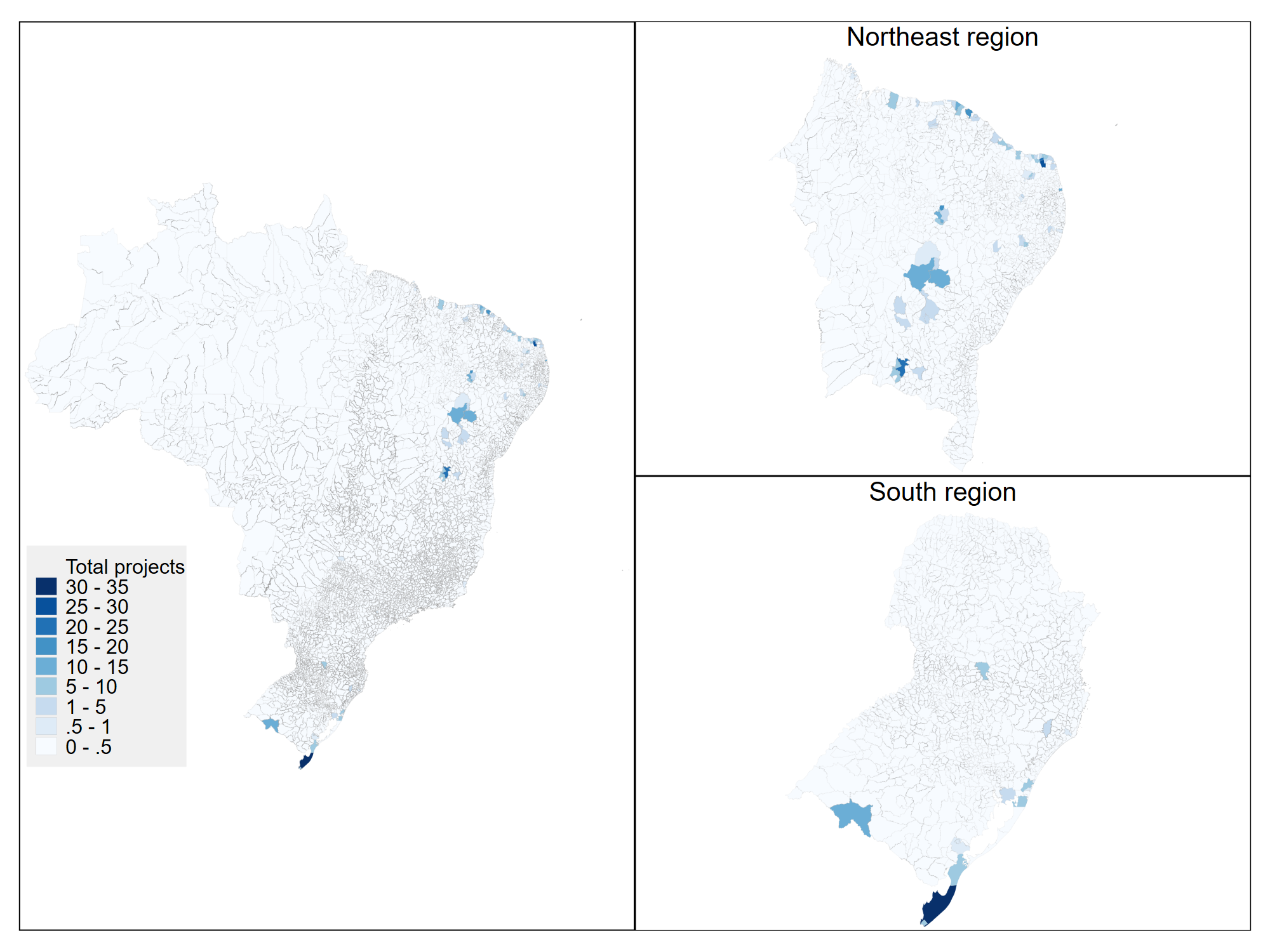
In recent research (Hernandez-Cortes and Mathes 2025), we find that wind energy projects increase the number of local jobs and firms in Brazil across all sectors. Brazil is a compelling setting to study this question given that, between 2006 and 2017, Brazil’s wind power capacity grew from 0.23 to 12.4 GW and this growth has been concentrated in geographic areas with very high wind potential. Our research combines data from the universe of employed workers with information on the development of wind energy projects in Brazil to understand impacts of the development of renewable energy projects on employment. We find that employment gains are highest in occupations related to electricity, construction, and transportation, and are concentrated among relatively younger workers.
Figure 1: Location of wind energy projects in Brazil
Renewable energy projects increase employment in receiving areas
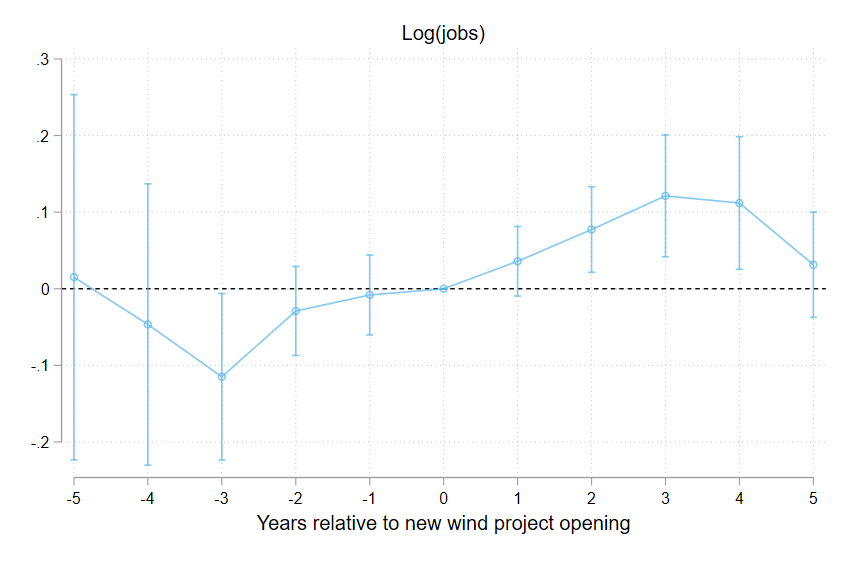
Throughout our study period, Brazil’s energy regulatory agency (ANEEL) auctioned off long-run contracts for building and operating new renewable electricity generators with guaranteed per-unit prices for electricity, thereby creating incentives to build in locations with the highest wind potential. Leveraging the staggered development of wind energy projects, and using a robust difference-in-difference estimator, our research finds that wind energy projects have positive effects on employment at the municipality level. We find that the opening of a new wind energy project increases total employment and average monthly wages in areas that receive wind energy projects. These effects are even larger in occupations related to electricity, construction, and transportation.
Figure 2: Effect of new wind energy projects on employment in receiving municipalities
Some workers and firms benefit more than others
We find that these positive employment effects are driven by workers younger than 40 years of age and that gains in employment are twice as large for workers without high school degrees. We also find that employment grows significantly at existing firms, especially in firms that are related to the energy industry. Interestingly, we find larger employment effects in areas with high shares of informality. Understanding whether renewable energy projects could reduce informality in some areas is an important question for further study.
What is driving the employment effects of wind energy projects?
Understanding why renewable energy projects increase employment is important to quantify the economic benefits of decarbonisation policies. Our paper explores three potential mechanisms driving these results:
- Electrification: One potential concern is that these projects are not necessarily causing employment to increase, but rather, increases in electrification driven by these projects could generate economic activity and thus increase employment. We explore this by comparing municipalities that experience grid expansions to those that did not experience grid expansions during our study period. We find stronger employment effects in areas that did not experience any grid expansions, suggesting that electrification is not one of the main drivers of the increases in employment. This is perhaps unsurprising since in 2005, before the beginning of our study period, over 97% of the population already had access to electricity in Brazil, ahead of the upper-middle income country average at the time (ESMAP Electrification Dataset).[1]
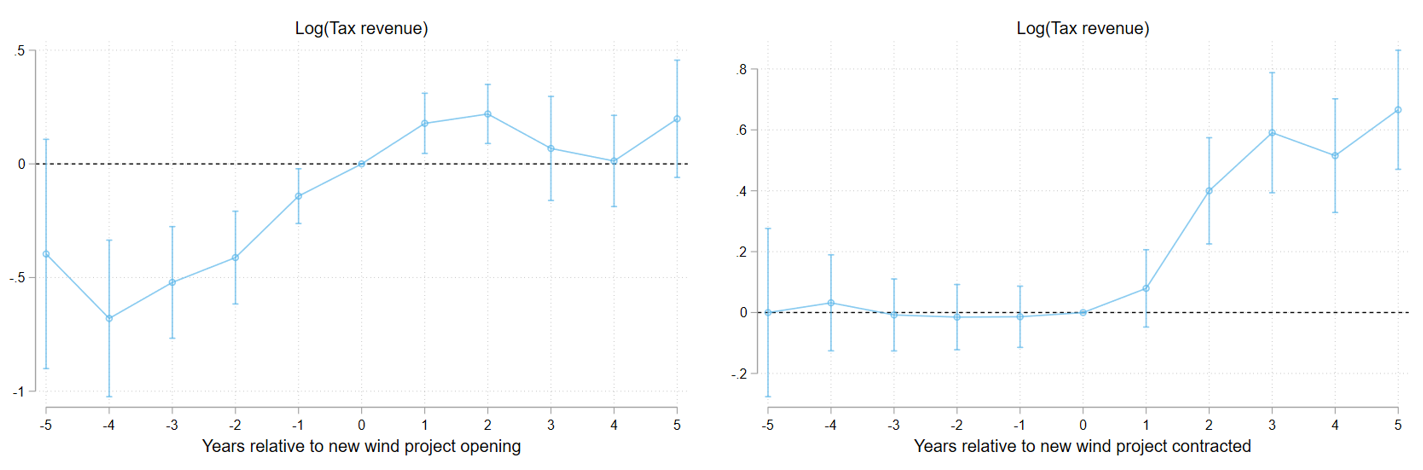
- Windfall profits from land leases: Renewable energy projects can generate windfall income for local landowners, which can invest these gains into the local economy (Fabra et al. 2024). While we do not have direct data on land lease agreements, we explore this mechanism by examining the impacts of wind energy projects on municipal tax revenues from different sources such as local service, property, and real estate taxes. To explore this mechanism, we compare the results of when we consider the ‘opening’ of a wind energy project (i.e. start of the generation) to the ‘contracting’ of the wind energy project (i.e. date in which the contract of the project was signed). We find that, in contrast to the rest of our results, total tax revenues increase before the opening of the wind energy project; indeed, they start increasing after these projects are contracted. The tax revenues increase is driven by the local service tax, which is consistent with increases in business activity related to wind energy projects.
Figure 3: Effect of wind energy projects on municipal tax revenues
Policy implications: What are the economic gains of renewable energy projects?
To summarise, our research finds that renewable energy projects increase local employment, which directly benefits local economies. However, it is important to keep in mind that some workers benefit more than others. Indeed, our results suggest that increases in employment were higher for relatively younger workers. Employment gains were highest among young workers without high school degrees, while wage gains were highest for young workers with high school degrees. This underscores the importance of complementary policies such as job training opportunities for workers that may not have experience in the renewable energy industry.
Importantly, our research does not examine whether workers employed in fossil fuel sectors transition towards renewable energy jobs, which is a potential transition cost of decarbonisation policies. However, during our study period generation capacity grew in Brazil for all types of electricity generation, including fossil fuels. Thus, it is unlikely that our results reflect movements from the fossil fuel energy sector to the renewable energy sector. Understanding these transition costs is imperative to identifying the total economic impact of renewable energy projects when they are intended to replace fossil fuel generation.
Based on industry insights and media reports, we suspect that land lease income to local landowners play a major role in explaining our findings—particularly since wind parks require more land than fossil fuel plants, though we lack data to confirm this. At the same time, the government does not directly finance the investment but facilitates contracts between generators and distributors. Consumer prices are then updated by the regulator based on the payments distributors make to generators. Exploring these mechanisms and other impacts of renewable energy projects are excellent topics for future research in Latin America countries.
References
Curtis, E. M. and I. Marinescu (2023), “Green energy jobs in the United States: What are they, and where are they?”, Environmental and Energy Policy and the Economy, 4(1): 202–237.
Fabra, N., E. Gutiérrez, A. Lacuesta, and R. Ramos (2024), “Do renewable energy investments create local jobs?”, Journal of Public Economics, 239: 105212.
Gonzales, L. E., K. Ito, and M. Reguant (2023), “The investment effects of market integration: Evidence from renewable energy expansion in Chile,” Econometrica, 91(5): 1659–1693.
Hernandez-Cortes, D. and S. Mathes (forthcoming), “The effects of renewable energy projects on employment: Evidence from Brazil,” Journal of the Association of Environmental and Resource Economists.