





New projections highlight the feedback loop between lower growth and increased conflict risk in Africa under climate change.
Editor's note: The authors have made slides available to accompany this research here.
Climate change threatens many aspects of human society, ranging from agricultural productivity, to migration, to infant mortality. Poorer countries tend to be especially susceptible to these threats due to greater exposure to warming, macroeconomic structure, and limited resources to facilitate adaptation. The multitude of risks that developing nations face as a consequence of climate change generate many chances for interactions and feedback loops to exacerbate effects. In recent research (Ferguson et al. 2025), we explore how economic growth and civil conflict incidence in African countries jointly evolve in response to climate change.
How could a climate-conflict poverty trap arise?
Three previous research findings suggest that climate change may induce poverty-trap style dynamics, in which countries’ economies grow especially slowly or even contract, due in part to increased civil conflict incidence. First, warming will tend to slow economic growth in African countries (Burke et al. 2015). This macroeconomic impact is likely mediated by many mechanisms, but in our analyses we attempt to isolate effects that are unrelated to conflict. Second, poorer countries in Africa suffer from especially large increases in conflict risk in response to temperature shocks, whereas richer countries experience almost no change (Burke et al. 2024). Third, conflict itself is disastrous for growth, in addition to its massive human and social costs. These three findings suggest a vicious cycle: warming increases conflict risk in poor countries while conflict and warming both slow growth. If these effects are strong enough, and warming persistent enough, countries can be pushed into a low-growth, high-conflict equilibrium.
Warming, growth, and conflict in Africa: 1960-2023
The first step to understanding whether the three relationships we describe above are strong enough to substantially reduce growth and increase conflict incidence is to measure them. To this end, we put together a panel dataset describing temperature, economic growth, and civil conflict incidence for 51 African countries spanning 1960-2023.
Our findings generally align with previous results. As demonstrated in our earlier work (Burke et al. 2024), poorer countries experience greater increases in conflict risk in response to a temperature shock. The likelihood of civil conflict increases by 10 percentage points for each degree C of warming in the poorest African nations, whereas the richest do not experience any increase in conflict risk.
The vast majority of African nations also experience slower growth as a consequence of increased temperature, even after excluding the effects of conflict. We find that a year with an average temperature of 30° C is expected to have about 4 percentage points slower growth than a year at 18.9° C. While still substantial, this effect is notably smaller than previous estimates (Burke et al. 2015), likely due to our exclusion of the conflict mechanism.
Finally, we find that civil conflict incidence slows growth. The typical conflict event reduces the growth rate of GDP per capita by 1.5 percentage points, nearly eliminating growth for the average country in our sample. While these effects are short lived on average, only occurring in the year of incidence, conflict is persistent. We find that conflict risk is about 63 percentage points higher in the year following a conflict event.
Simulating growth and conflict under climate change
We use the three key estimated relationships described above to simulate how income per capita and civil conflict incidence evolve out to 2100 under RCP 7.0, a benchmark climate change scenario. We run 1000 simulations to incorporate uncertainty from our estimates along with climate change projections from different global circulation models. It is important to note that these simulations do not incorporate any model of global macroeconomic shocks, nor do we simulate policy changes that may alter the empirical relationships we estimate. Our simulation findings should be interpreted more as what may happen absent policy changes and major macroeconomic shocks.
Each run also simulates growth and conflict in three additional scenarios. First, we hold temperature constant at its 2023 level, providing us with a “no climate change” baseline. Second, we shut down the direct effect of warming on conflict by using the simulated values from the “no climate change” scenario, but allow for effects of warming on growth. Third, we eliminate warming’s direct effect on growth while allowing for effects on conflict. Using these four sets of simulated growth and conflict, we can decompose the effects of warming into direct effects, indirect effects that arise due to warming’s direct effects on the other outcome (e.g. the effect of warming on conflict due to warming’s effect on growth), and feedback effects that only manifest when climate change can directly influence both growth and conflict risk.
The continent average income per capita and conflict incidence rate series for each simulation are shown in Figure 1. In the absence of climate change, income per capita grows at a nearly constant rate, reaching about twice its level in 2023 by 2100, while conflict incidence falls through the end of the century, from nearly 40% in the early 2020s to about 30%. In contrast, economic growth slows and in many cases reverses under RCP 7.0. Especially concerning are the 13% of simulations in which the average African country has lower income per capita in 2100 than in 2023. This decline in economic growth is accompanied by an increase in conflict incidence, with the average country spending four additional years between 2023 and 2100 in conflict under climate change.
Figure 1: Aggregate income per capita and conflict trajectories under no additional warming and RCP 7.0.
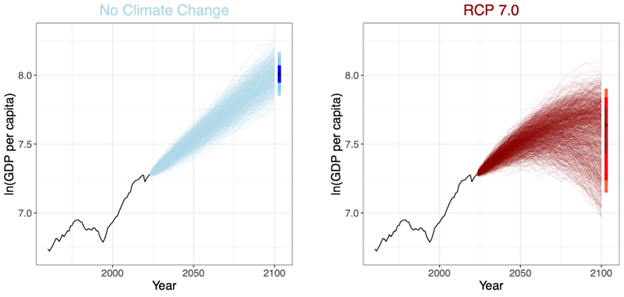
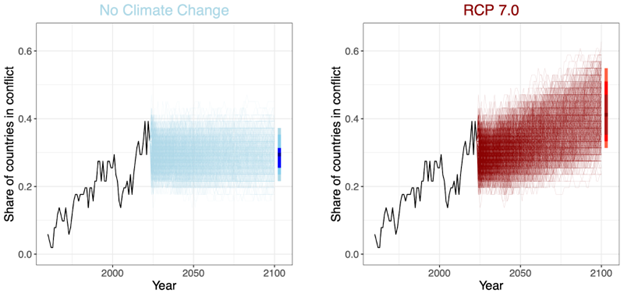
Notes: The top two panels show the natural log of average income per capita across the 51 African countries in our sample. The solid black line shows the observed trajectory and the many light blue or dark red lines show simulated trajectories out to 2100. The bottom panels are similar, but show the share of the sample countries that experience a civil conflict event in a given year. The panels on the left in light blue show simulations with no additional warming in years beyond 2023 and the panels on the right show simulations under RCP 7.0. The bars on the right of each panel display the distribution of simulated outcomes in 2100.
Our decomposition of these effects reveals that 14% of the reduction in income per capita under climate change is due to indirect effects of conflict and feedback effects. This average, however, obscures tail risks in which countries fall into a particularly bad equilibrium. In 7% of country simulations, conflict contributes more than 50% of the decline in economic growth. These findings suggest that at least some countries face a non-negligible risk of falling into a climate-conflict poverty trap.
Strikingly, 82% of the increase in conflict incidence under warming is due to indirect effects through growth and feedback effects. The reason for this is the strong moderating effect of income per capita on the climate-conflict relationship. As countries grow, they become less susceptible to climate-induced conflict. In contrast, when warming slows growth directly and through feedbacks between growth and conflict, conflict is much more responsive to an increase in temperature.
Policy can leverage feedback between conflict and growth for better outcomes
Our findings highlight the important links between broader development policy and peacekeeping. The flip side of the feedback loops and indirect effects which exacerbate the negative effect of climate change on economic growth and conflict is that policy can also exploit these channels to generate additional benefits. Of particular note is the extremely powerful role of growth in determining conflict outcomes under climate change. Our simulations suggest that a 1 percentage point annual growth rate boost more than offsets the increase in conflict incidence under climate change. One interpretation of this is that any growth-promoting policy provides a large additional social benefit in the form of reduced future conflict incidence.
One potentially fruitful path is weakening the relationship between warming and conflict, particularly in poorer countries. We have previously discussed a number of policies that are empirically shown to limit the impacts of temperature shocks on conflict risk, including a stronger social safety net, weakening the link between weather and income (e.g. by irrigating agricultural land), and greater political inclusion. Our analysis here suggests that in addition to any direct effects these policies may have on growth, we can reasonably expect them to yield an additional indirect growth benefit by reducing conflict.
An important negative finding of our paper is that mitigating emissions to limit climate change is not enough to prevent the majority of reductions in growth and increases in conflict we simulate. Under RCP 4.5, a more optimistic climate change scenario, we find declines in GDP per capita about 60% of those under RCP 7.0. While this is in no manner an argument against cutting emissions, it suggests that more needs to be done to limit the massive damages to African nations expected under climate change in the absence of policy intervention.
References
Burke, M, S M Hsiang, and E Miguel (2015), "Global non-linear effect of temperature on economic production." Nature 527.7577: 235-239.
Burke, Marshall, et al. (2014), "Will Wealth Weaken Weather Wars?." AEA Papers and Proceedings. Vol. 114.
Burke, M, et al. (2014), "Will Wealth Weaken Weather Wars?" AEA Papers and Proceedings, 114.
Ferguson, J, et al. (2025), "Climate change, conflict, and the risk of economic collapse in Africa", National Bureau of Economic Research Working Paper No. w34320.