





Digital marketplaces have the potential to eliminate gender gaps in prices and product quality. Evidence from Pakistan shows that while digital marketplaces may reduce discrimination in prices, women continue to face higher non-economic costs that may constrain their participation in patriarchal settings.
Editor’s note: For a broader synthesis of themes covered in this article, check out Issue 2 of our VoxDevLit on Female Labour Force Participation. The authors have made slides available here.
Digital technologies are widely expected to reshape markets by reducing the costs of finding information, comparing options, and coordinating transactions. When communication and search move online, interactions become faster, cheaper, and less dependent on physical presence (Goldfarb and Tucker 2019). For policymakers and platform designers, this creates an appealing proposition: digital platforms could facilitate easier matching between buyers and sellers, standardise interactions, and reduce frictions that often disproportionately affect disadvantaged groups.
These expectations are particularly salient in low-income countries, where women face multiple barriers to participating in markets (Heath et al. 2025). Limited mobility, concerns around physical safety, and social norms often restrict how and where women shop, with whom they interact, and which transactions they feel comfortable engaging in (Jayachandran 2021, Cheema et al. 2025). In many settings, visiting markets involves navigating crowded spaces or interacting with unfamiliar men – experiences that not only carry social or reputational costs but also introduce the real risk of experiencing harassment. Digital platforms, therefore, appear to offer an alternative channel through which women can access goods while avoiding some of these constraints.
Testing whether online markets level the playing field
In recent work (Asad, Ahmad, and Majid 2025), we examine how gender discrimination manifests itself in an online marketplace in a low-income, patriarchal setting. We run a large-scale, well-powered audit study on Facebook Marketplace in Pakistan, using fictitious buyer profiles that clearly signal gender while revealing little else about identity or socioeconomic status. We focus on sellers who use Facebook Marketplace as a commercial channel, where typically small, informal businesses, or self-employed vendors regularly list and deliver products through the platform. Crucially, each seller is approached twice, once by a male buyer profile and once by a female buyer profile. Interactions follow predetermined bargaining scripts, with the order of buyer gender randomised. We then track both standard economic outcomes (quoted prices and product quality) and non-price interactions, including post-transaction unsolicited messages, calls, and friend requests, alongside linguistic features of seller communication.
This experimental design allows us to ask a simple but important question: do online marketplaces attenuate the forms of gender discrimination long documented in traditional product markets? Building on a large evidence base documenting gender discrimination in offline settings, this question is far from trivial. Across a wide range of contexts, women are often found to face higher prices, worse terms of trade, or lower product quality, particularly in markets characterised by bargaining, information asymmetries, or repeated interactions with predominantly male sellers (Ayres and Siegelman 1995, List 2004, Busse et al. 2017). Field evidence from product markets shows that women often pay more for identical goods, are quoted less favourable prices, or receive lower-quality products, reflecting a combination of taste-based discrimination, statistical discrimination, and unequal bargaining power (Kricheli-Katz and Regev 2016, Fitzpatrick 2017).
No gender gaps in prices or product quality
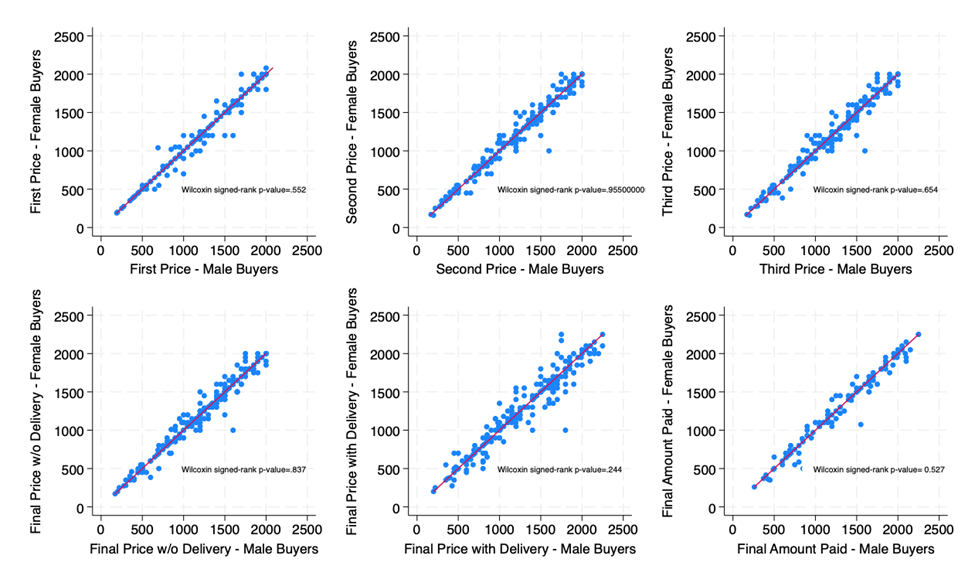
Against this backdrop, our results are striking. We find no evidence of price discrimination. Women do not face higher prices compared to men at any stage of the transaction. Female buyers are quoted the same initial prices, negotiate to the same final prices, and ultimately pay the same amounts as male buyers. Moreover, they receive products of comparable quality, with no detectable differences in delivery outcomes or final condition. Figure 1 illustrates these findings graphically, plotting prices quoted to female buyers against those quoted to male buyers for the same listings across multiple stages of bargaining. Across all dimensions, outcomes lie close to the 45-degree line, indicating parity in pecuniary outcomes.
Figure 1: Comparison of quoted prices to male vs. female buyers
Unequal non-price costs
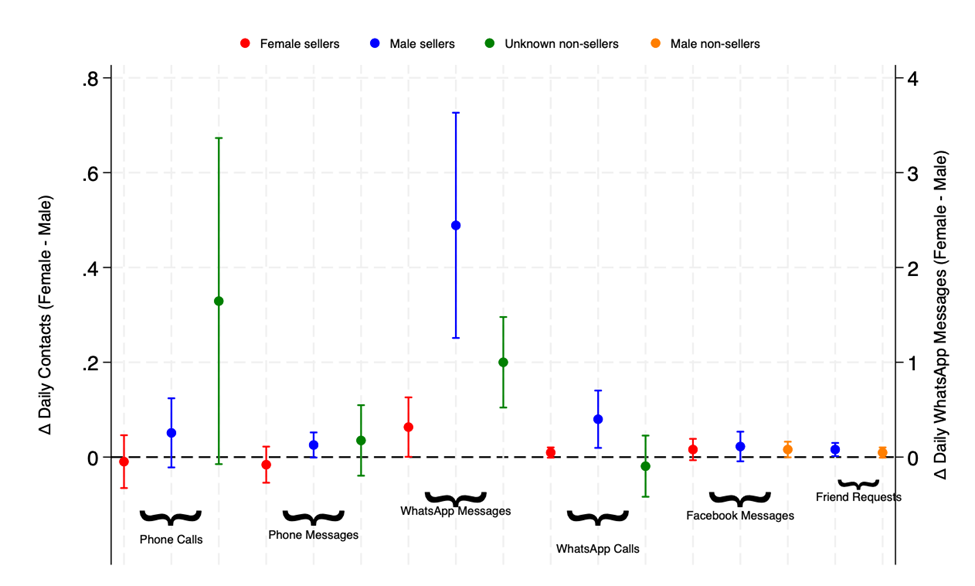
However, parity in prices does not translate into parity in experiences. While male and female buyers face identical prices and receive products of comparable quality, pronounced gender differences emerge on non-pecuniary dimensions of interaction. Female buyers receive substantially more unsolicited contact than male buyers across a wide range of communication channels, including phone calls, text messages, WhatsApp messages and calls, Facebook messages, and friend requests. These differences are large, precisely estimated, and driven overwhelmingly by male accounts – both sellers and non-sellers. Sellers also communicate differently with female buyers: their messages are more verbose and exhibit slightly higher levels of enthusiasm, friendliness, and flirtatiousness, once again driven by male sellers. Figure 2 summarises these patterns by plotting the difference in average daily unsolicited contacts received by female versus male buyers, disaggregated by communication channel and initiator type. Across nearly all channels, female buyers are contacted significantly more than male buyers, revealing systematic gender differences in how buyers are approached and engaged beyond prices.
Figure 2: Gender differences in unsolicited communication
These non-pecuniary differences matter because, in patriarchal settings, they can impose real and asymmetric costs on women’s participation in markets. In contexts such as Pakistan, women’s economic interactions are closely scrutinised, and unsolicited contact from unfamiliar men – whether messages, calls, or friend requests – can trigger social suspicion or reputational concerns even when interactions are not overtly inappropriate. Participation in online commerce often requires sharing personal information, including phone numbers and home addresses, making such interactions difficult to fully avoid or contain. Even when interactions are not overtly inappropriate, their frequency and persistence can increase the perceived risks of participation, leading women to limit engagement, withdraw from certain transactions, or avoid platforms altogether. As a result, while digital marketplaces may equalise economic outcomes, they appear to leave intact social frictions that continue to constrain women’s access and participation.
Policy takeaways: Women’s equal participation in the marketplace
Taken together, our findings highlight both the promise and the limits of digital marketplaces in expanding women’s participation in economic spaces. By reducing search and information frictions, online platforms can eliminate discrimination in prices and product quality, even in settings where such disparities are common in offline markets. Yet, equal economic terms do not guarantee equal participation. In patriarchal contexts, non-pecuniary frictions embedded in everyday interactions can continue to shape who bears the costs of market engagement. Understanding and addressing these less visible barriers is therefore essential if digital platforms are to fulfil their potential as tools for inclusive growth, rather than merely shifting gendered constraints from physical markets to digital spaces.
References
Asad, S A, H F Ahmad, and H Majid (2025), “Price and prejudice: Gender discrimination in online marketplaces,” Journal of Development Economics, 177: 103540.
Ayres, I, and P Siegelman (1995), “Race and gender discrimination in bargaining for a new car,” American Economic Review, 85: 304–321.
Busse, M R, A Israeli, and F Zettelmeyer (2017), “Repairing the damage: The effect of price knowledge and gender on auto repair price quotes,” Journal of Marketing Research, 54: 75–95.
Cheema, A, A I Khwaja, M F Naseer, and J N Shapiro (2025), “Glass walls: Experimental evidence on constraints faced by women in accessing valuable skilling opportunities,” Journal of Political Economy.
Fitzpatrick, A (2017), “Shopping while female: Who pays higher prices and why?” American Economic Review, 107: 146–149.
Goldfarb, A, and C Tucker (2019), “Digital economics,” Journal of Economic Literature, 57: 3–43.
Heath, R, A Bernhardt, G Borker, A Fitzpatrick, A Keats, M McKelway, A Menzel, T Molina, and G Sharma (2025), “Female labour force participation,” VoxDevLit, 11(2), October.
Jayachandran, S (2021), “Social norms as a barrier to women’s employment in developing countries,” IMF Economic Review, 69: 576–595.
Kricheli-Katz, T, and T Regev (2016), “How many cents on the dollar? Women and men in product markets,” Science Advances, 2: e1500599.
List, J A (2004), “The nature and extent of discrimination in the marketplace: Evidence from the field,” Quarterly Journal of Economics, 119: 49–89.