







Existing efforts to promote upward mobility in low-income countries focus on broadening access to education. However, evidence from Ethiopia shows that professional socialisation (learning professional norms) may be a key constraint to this mobility, even among highly educated people.
Editor’s note: For a broader synthesis of themes covered in this article, check out our VoxDevLit on Barriers to Search and Hiring in Urban Labour Markets. The authors have made slides available here.
Over the past few decades, formal education has expanded rapidly across developing countries. Young urban jobseekers are now far better educated than their parents and aspire to professional, white-collar roles. What professional attributes do employers actually value, and how are those attributes shaped by family background and professional experience?
Professional socialisation and labour market inclusion
In Abebe, Fafchamps, Koelle, Quinn and Schwantje (2026), we develop a novel methodology to measure managerial traits, defined as the common patterns in a manager’s demonstrated management style. We show that such traits – an important dimension of professional skills – are strongly linked to both socioeconomic background and labour market history. In a sample of highly educated young professionals in Ethiopia, those with less educated parents display systematically different managerial traits than young professionals with more educated parents – and, because of this difference, are rated as lower-quality candidates for entry-level managerial positions by Ethiopian human resources managers.
Strikingly, a one-month randomised managerial placement – implemented several years earlier – helped young professionals from less educated families adopt the managerial style that employers most value.
How we measure managerial traits
We work with 982 young professionals, sampled to reflect the upcoming generation of managers in Ethiopia’s growing firms: they are, on average, 31 years old, nearly 80% hold a university degree, two-thirds work in a professional position, and 17% are already in a managerial role. At the same time, socioeconomic backgrounds vary substantially, with 48% growing up in households where neither parent completed primary school. On the employer side, we work with HR managers from medium-sized and large Ethiopian firms, with a median of 58 employees and operating in a wide range of industries.
To measure managerial traits, we designed a role-play experiment for our young professionals. Participants watched short videos depicting common workplace situations – such as an employee asking for a pay rise – and we video-recorded them responding to these studio vignettes as if they were managers. We used these responses to create a measure of managerial styles and then (with our respondents’ permission) showed these to the HR managers to better understand what styles different firms value.
To analyse the video responses, we asked two experienced Ethiopian research assistants to transcribe four key attributes of each response: (i) the action, (ii) justification for the action, (iii) source of authority used, and (iv) tone. We then used a clustering algorithm, Latent Dirichlet Allocation, to identify the common behavioural patterns that make up management styles: bundles of the four attributes that are often exhibited together. These are idealised styles, and each respondent displays a combination of these ‘pure’ styles. Figure 1 shows both the combination of attributes that each style draws from, and the distribution of individuals over these styles.
Figure 1: The four management styles

Our algorithm identifies four distinct managerial styles. We label these styles based on their attributes (the left part of Figure 1) and the language respondents use in their responses (Figure 2):
- The rule-based style (Type 1) implements the rules set by the firm. They tend to decline requests, rely on formal policies and the firm’s interests, and communicate in an assertive tone. They often use words like ‘policy’, ‘company’ and ‘according to’ in their responses.
- The affiliative style (Type 2) seeks shared ground. They are more likely to agree, appeal to shared interests and personal relationships, and speak calmly. They use words such as ‘accepted’, ‘future’ and ‘health’ (a theme in some role-play scenarios) in their responses.
- The power-based style (Type 3) implements their personal objectives. They say no, but lean heavily on personal authority and their own private interests to justify these decisions. Their responses often use phrases like ‘don’t accept’ and ‘cannot’.
- The discretion-based style (Type 4) does not provide a clear explanation for their decisions. They often say no without offering much justification, and do so calmly. Their language is more varied, including phrases like ‘wait’, ‘period’ and ‘won’t accept’.
The right panel of Figure 1 shows what combinations of these four styles different young professionals draw from. Styles 1, 3, and 4 are similarly common (25–28%), while fewer respondents act with an affiliative style (19%).
Figure 2: Words predicting management styles
Type 1: Rule-based Type 2: Affiliative

Type 3: Power-based Type 4: Discretion-based
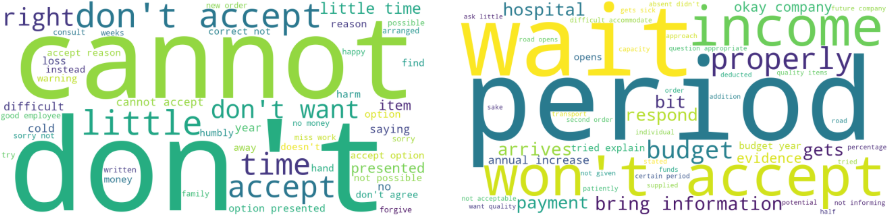
Note: The figure shows the words most characteristic of each style, with larger words indicating stronger associations with that style. We work with an Ethiopian AI company, Hasab AI, to transcribe the responses.
Importantly, individuals’ broader backgrounds and labour market experiences are correlated with which management style they adopt. Respondents who use the rule-based style are more likely to be men, have a university degree, report stronger labour market outcomes – such as higher earnings and more time spent in permanent employment – and have held a managerial role before. They are also more likely to have at least one parent who completed primary school. In contrast, there is not much difference in the observable characteristics associated with the other three styles.
What managerial styles do Ethiopian firms value?
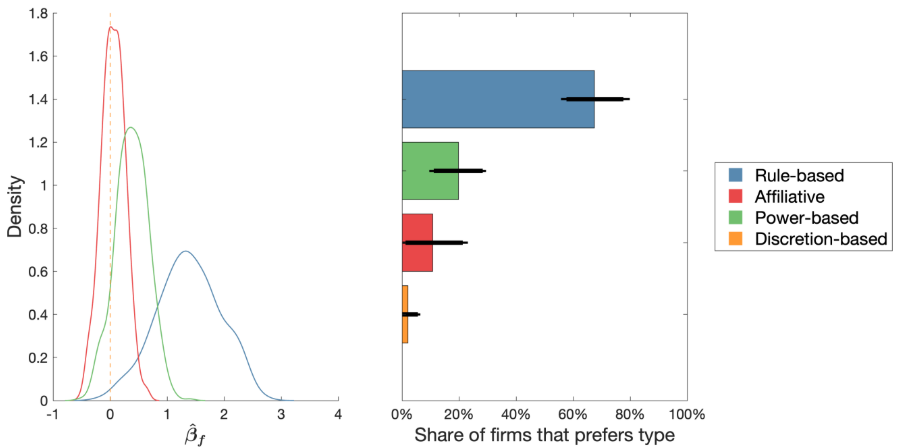
To understand the demand for management styles in the market for managers in Ethiopia, we showed these videos to HR managers at medium-sized and large Ethiopian firms in an incentivised ranking task. The HR managers each ranked three different young professionals for their suitability as an entry-level manager in their firm (separately for each vignette), based on their video responses to the same fictitious situation. In a way, this mimics hiring decisions based on ‘assessment centres’ that are common for professional roles in many countries.
We find that a clear majority (70%) of firms prefer the rule-based management style compared to under 20% for the second most-preferred style, the power-based style (Figure 3). We repeat this analysis for the managers’ ranking of a respondent’s potential as an entrepreneur (instead of a manager in their own firm) and find broadly similar results.
Figure 3: HR managers’ demand for management styles
What managerial style do workers value?
Do firms and workers agree or differ in their preferences for management styles? To answer this question, we ran smaller-scale focus groups with the types of employees that an entry-level manager would be managing to see whether employees share this preference for the rule-based management style, or instead prefer a more affiliative manager.
We find that employees clearly prefer managers with a rule-based style, who they perceive as more fair and likely to be consistent. Employees actually value the affiliative style the least; qualitative discussions indicate that employees were concerned that such managers would ‘play favourites’.
The equalising effect of professional experience
Finally, we examine the causal effects on management style of professional and managerial experience. About five years prior to this study, half of the respondents were exposed in a randomised way to a one-month firm placement that allowed them to shadow senior managers. Those who had this experience were more likely to adopt a rule-based managerial style and less likely to adopt a discretion-based one.
Strikingly, this effect is entirely driven by participants whose parents had not completed primary school – roughly half of our sample – and there is no effect of this early exposure to professional managers for those with more educated parents. For the first group, the placement fully closes the gap in management style relative to peers from better-educated families. This suggests that professional socialisation – learning how ‘business is done’ in a workplace – partly reflects informal learning at home, and that short workplace exposure to senior professionals can substitute for that.
Policy takeaways
Our findings highlight the role of professional socialisation – learning workplace norms and managerial behaviour – as a key mechanism for upward mobility and exclusion from high-quality jobs. Expanding education remains vital, but equalising labour market opportunities may also require exposure to professional environments, such as internships, mentorships, or short-term management placements, for young professionals from disadvantaged backgrounds.
References
Abebe, G, M Fafchamps, M Koelle, S Quinn, and R Schwantje (2026), “Management style under the spotlight: Evidence from studio recordings,” Unpublished manuscript.