




Import competition from China can increase productivity among Indian firms not by lowering costs, but by encouraging innovation through quality upgrading.
Editor’s note: For a broader synthesis of themes covered in this article, check out Issue 2 of our VoxDevLit on International Trade.
The rise of Chinese manufacturing is the headline trade story of the 21st century. While access to cheaper Chinese produced goods has the potential to benefit consumers, China’s rise has also been met with demand for increased protection – via tariffs or quotas – from what many view as unfair competition from abroad. Should we be protecting domestic industries is the hopes that they can eventually catch up, or should we let competitive forces play out?
Competition and innovation in theory: Laggards and the frontier
While there are many different criteria one could use to evaluate whether increased imports from China are desirable, for developing economies it’s useful to ask whether Chinese imports help or hinder domestic firms’ innovation. Since sustained innovation is often necessary for long-run economic growth,[1] whether competition from abroad encourages domestic firms to upgrade their technologies is of paramount importance.
Aghion et al. (2005) provide one well-known framework for determining whether competition encourages innovation. This model hinges on the innovating firm’s initial technology level relative to its rivals. When domestic firms and foreign competitors operate at similar technology levels, competition encourages innovation, since domestic firms are well positioned to outcompete their rivals with a successful innovation. On the other hand, competition decreases innovation for laggard firms with less sophisticated technologies than their new foreign rivals. This is because laggard firms have less to gain by innovating, as becoming productive is likely to make these firms more similar to highly productive foreign firms, rather than better.
In recent work (Orr and Tabari 2025), we find that these predictions may not hold for large Indian manufacturing firms. Since China has been at the frontier of manufacturing in the 21st century, while India has mostly lagged, the Aghion et al. (2005) model implies that Chinese import competition should decrease Indian innovation. Instead, we find that firms that operate in industries that are more exposed to Chinese imports experience larger increases in productivity and/or total factor productivity (TFP) – a common proxy for innovation – than firms operating in less exposed industries. While these results are not always statistically significant, the fact that we never find the expected negative innovation effects is surprising given the theoretical evidence. How do we make sense of this phenomenon?
Innovation and productivity: Conflating costs and quality
A missing component to this analysis is that not all competitors, or innovations, are equal. Rather, there are at least two conceptually distinct ways a firm might innovate to be successful. First, a firm might develop new techniques of production that allow them to produce a given good or service at lower cost. Alternatively, a firm might develop a new good or service that better satisfies consumer demand in some way. These two distinct patterns of innovation – cost-based innovation versus quality-based innovation – can both in principle help firms survive when faced with increased competition from abroad. Perhaps more importantly, if China’s comparative advantage in manufacturing is primarily cost-based, i.e. they can produce standardised goods at cheaper prices – innovation need not imply that laggard Indian firms become more similar to Chinese producers as in the Aghion et al. (2005) model – rather, they could choose to upgrade the quality of their goods to service a different segment of the market. Such a response to Chinese competition was in fact recommended by the Secretary General of India's Textile Machinery Manufacturers Association:
“The only hope for companies is to upgrade to high-tech machinery and command a better price so as to compete with China”. (Khan 2014)
Quality-based innovation responses can explain our measured increases firm-level productivity because standard approaches to measuring TFP conflate these two separate margins. This is because TFP measures productivity by examining how many units of output a firm produces per unit of input; for example, number of carpet threads per worker hour. Such a measure, should, in principle, only capture the cost-based, rather than quality-based, innovations highlighted above. However, economists rarely actually have access to meaningful output quantity data (e.g. the number of carpet threads) since this information is usually not required to be reported for accounting documents nor government censuses. Rather, economists will usually use revenue – which is often recorded in balance sheets as well as government censuses – as a proxy for output. However, as famously shown by Klette and Griliches (1996), using revenues as a proxy for quantities will generate TFP measures that increase due to cost-based and quality-based innovations for any given level of production.
Luckily, the Prowess dataset that we use to explore the question of innovation and competition in India is more detailed than many related datasets. Not only are output quantities recorded for a variety of different goods but so are their revenues and prices. This allows us to disentangle how much revenue-based productivity is driven by cost-based TFP increases or quality improvements. From there, we can ask whether Indian firms innovate in response to Chinese import competition by increasing their cost-based advantages or the quality of their goods. Unfortunately, we need to deal with the fact that firm-level TFP conflates many other margins as well.
Firm-level TFP conflates many other margins
Firm-level revenue-based TFP measures revenues per unit of input. While this measure can increase due to cost or quality-based upgrading, it can also increase for reasons unrelated to innovation whenever firms produce many products. For example, revenue productivity can increase if firms drop low performing products in response to import competition (Eckel and Neary 2010) or simply reallocate a larger share of resources to their biggest selling product (Mayer et al. 2014, 2021). Neither of these margins requires that these firms innovate at all. Unfortunately, since large firms tend to produce many goods (Bernard et al. 2010, Rachapalli 2021), we cannot rule out these margins driving our observed increase in revenue-based TFP without a more detailed empirical exploration.
Decomposing the margins that drive competition-induced productivity gains
Figure 1 provides such an analysis. At the top, we report the point estimate (diamond) for the effect of Chinese import competition on revenue-based productivity (‘TFP’). Using our detailed product-level quantity data, we then separate the contribution of quality upgrading (‘Quality’), cost-based technology improvements (‘Technical Efficiency’), reallocations of inputs to the highest performing products (‘Reallocations’), and firms dropping lower productivity goods (‘Dropping Products’), to overall revenue-based productivity growth.[2] These effects are reported to the right of our TFP effects in Figure 1. We find, consistent with the discussion above, that Chinese import competition leads firms to upgrade the quality of their goods. On the other hand, the cost, reallocation, and product dropping margins are generally negative, close to zero, and statistically insignificant.
Figure 1: Estimated Chinese competition effects
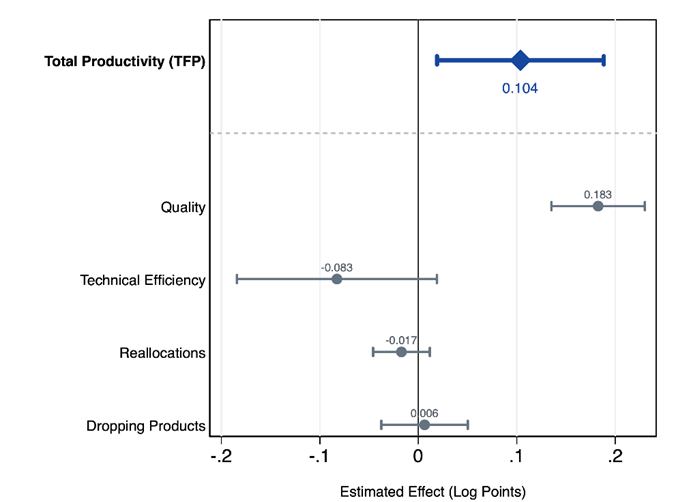
Note: Whiskers represent 90% confidence intervals.
Policy implications for competition and productivity
Overall, our results suggest that competition induced productivity gains may be possible, even for lagging economies, as long as firms are able to differentiate themselves from their foreign rivals with high quality goods. As a result, policymakers in developing economies may be better off ignoring calls for protectionist trade policies, as allowing competitive to play out international markets can be an important driver of domestic innovation.
References
Aghion, P, N Bloom, R Blundell, R Griffith, and P Howitt (2005), “Competition and innovation: An inverted-U relationship,” Quarterly Journal of Economics, 120: 701–728.
Bernard, A B, S J Redding, and P K Schott (2010), “Multiple-product firms and product switching,” American Economic Review, 100: 70–97.
Eckel, C, and J P Neary (2010), “Multi-product firms and flexible manufacturing in the global economy,” Review of Economic Studies, 77: 188–217.
Khan, T (2014), “Chinese imports hitting Indian small manufacturers hard,” Business Today.
Klette, T J, and Z Griliches (1996), “The inconsistency of common scale estimators when output prices are unobserved and endogenous,” Journal of Applied Econometrics, 11: 343–361.
Mayer, T, M J Melitz, and G I P Ottaviano (2014), “Market size, competition, and the product mix of exporters,” American Economic Review, 104: 495–536.
Mayer, T, M J Melitz, and G I P Ottaviano (2021), “Product mix and firm productivity responses to trade competition,” Review of Economics and Statistics, 103: 874–891.
Nobel Prize (2025), “Press release,” Unpublished manuscript.
Orr, S, and M Tabari (2025), “Decomposing the within-firm productivity gains from trade: Evidence from India,” Review of Economics and Statistics, 1–44.
Rachapalli, S (2021), “Learning between buyers and sellers along the global value chain,” Unpublished manuscript.