



Citizen training that builds households’ practical capability to segregate waste can deliver large, persistent and socially amplified improvements in waste management, making it a highly cost-effective climate policy in resource-constrained cities.
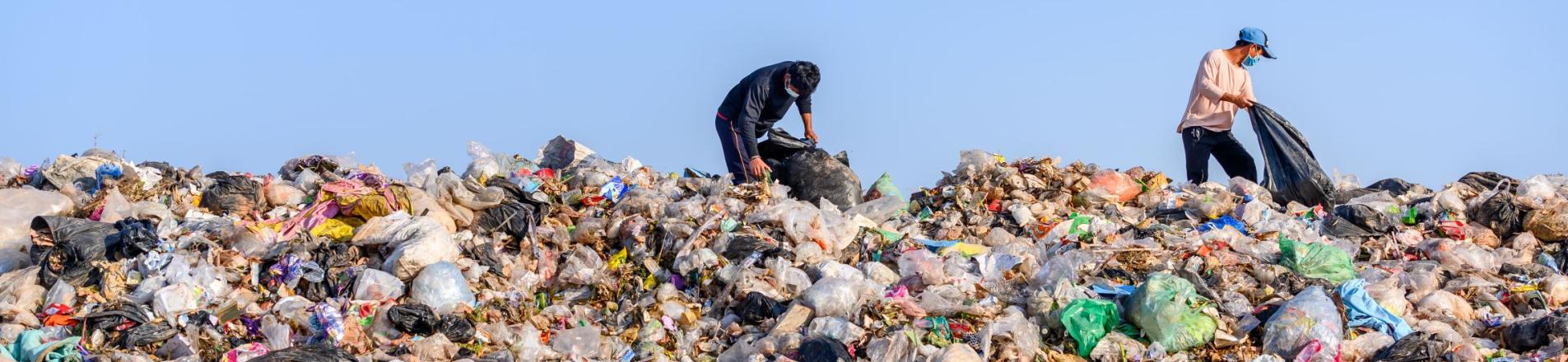
Managing the urban waste footprint is one of the most pressing challenges facing rapidly growing cities (Bryan et al. 2020). Poorly managed waste contributes to local pollution, public health risks, and climate change – particularly through methane emissions from landfills, which are rising rapidly in many low- and middle-income countries. Waste management is also among the largest spending items in municipal budgets, especially for cities with limited fiscal capacity.
In response, many countries have introduced policies requiring households to segregate waste at source, typically separating wet (such as food and green waste) from dry waste (such as paper and plastics). Such policies are widely viewed as best practice, as segregation enables recycling and composting while reducing the volume of waste sent to landfills (UNEP 2015). Yet compliance remains low in many cities, even where segregation is legally mandated, and waste segregation practices are limited despite being crucial for reducing landfill use, saving resources, and fighting climate change.
Why do these policies fall short, and what can be done to make them work?
Beyond mandates and information
Waste remains a highly understudied environmental challenge, particularly in the developing world. Rapid consumption growth and urbanisation have created a burgeoning waste burden that technologies from advanced waste systems – such as sanitary landfills or waste-to-energy plants – are often unable to address at scale. While segregation-at-source policies are increasingly being adopted in law, there is still limited evidence on why they have yet to reach their potential in reducing landfilling and emissions.
This question is particularly salient in low- and middle-income countries, where fiscal, monitoring, and enforcement constraints limit the effectiveness of standard regulatory tools. Recent work emphasises that many high-return climate mitigation opportunities in these settings remain underexploited precisely because they rely on instruments that are difficult to implement at scale (Glennerster and Jayachandran 2023). Policies that generate self-enforcing citizen participation are therefore particularly valuable in these settings.
One overlooked constraint is household capability. Segregating waste is not costless: it requires time, space, coordination with collection systems, and an understanding of what should be separated and why. If households lack practical skills, segregation policies may impose high effort costs, reducing compliance even when awareness is high. When there is a lack of knowledge, other factors compound the problem, such as space constraints, inconsistent rules, prohibitive costs and habit behaviour.
This raises an important policy question: can improving citizens’ skills, rather than relying solely on enforcement or price incentives, deliver meaningful environmental gains?
Evidence from a large-scale experiment in Patna
New evidence from the city of Patna, India, suggests the answer is yes. In collaboration with the Patna Municipal Corporation, we studied a large-scale citizen training programme designed to improve waste segregation at source (Dhingra and Machin 2025).
The programme trained more than 10,000 households through door-to-door visits. Crucially, the intervention went beyond passive information provision. Trainers demonstrated how to segregate waste in practice, explained how segregation affects landfill operations and environmental outcomes, and helped households set up waste management routines in their homes.
The programme was rolled out using a staggered randomised design, allowing for credible causal evaluation. Waste outcomes were measured through direct observation of household waste disposal along waste truck routes, rather than self-reports – a major advantage in settings where reporting may be unreliable.
Large, persistent, and contagious effects
Before the intervention, only around 10% of households in Patna segregated their waste. Citizen training increased segregation by 4.5–6 percentage points among treated households – an increase of roughly 50% relative to baseline levels.
However, despite these sizable improvements, a striking finding is that the effects did not stop there. Households living near trained neighbours also changed their behaviour, even before receiving training themselves. These spatial spillovers more than doubled the overall impact: once spillovers are accounted for, waste segregation increased by around 12 percentage points.
Importantly, waste segregation rates persisted and continued to grow over time. After the full rollout of training, segregation rates continued to rise, reaching nearly 30%, and remained elevated months later. This pattern suggests that training generated persistent self-enforcing compliance.
Why training works
Why does citizen training succeed where many recycling campaigns fail?
The evidence points to training acting as a productivity-enhancing investment. By reducing the effort required to segregate waste correctly – through skills, routines, and understanding – training lowers the ongoing cost of compliance. Once households learn how to manage waste efficiently, segregation becomes easier to adopt and sustain.
This mechanism also helps explain the large spillovers. When neighbours observe trained households segregating waste successfully, they learn from them. In dense urban environments, these spatial interactions can substantially amplify policy impacts and improve cost-effectiveness.
Climate and fiscal implications
Improved waste segregation has important climate benefits. By diverting organic waste away from landfills, methane emissions from household waste fall by approximately 26.5%. Methane is a particularly potent greenhouse gas, making such reductions highly valuable for climate mitigation. Scaling the effects linearly to urban households nationwide implies potential emissions reductions of over 6.5 million tonnes of CO₂e annually, which is roughly equivalent to avoiding the combustion of about 15 million barrels of oil.
From a fiscal perspective, the intervention is also highly cost-effective. Reduced landfill use alone is sufficient to recover programme costs within about 18 months. When the climate benefits of lower methane emissions are valued using carbon prices, the estimated benefit-cost ratio rises into double-digit multiples.
This makes citizen training a rare example of a negative-cost climate policy – one that delivers environmental gains while saving public resources.
Urban waste management has long been seen as an intractable problem in developing cities. Our evidence suggests that relatively simple, well-designed and clearly implementable interventions can make a substantial difference in managing the urban waste footprint of cities in the developing world.
References
Bryan, G, E Glaeser, and N Tsivanidis (2020), “Cities in the developing world,” Annual Review of Economics, 12(1): 273–297.
Dhingra, S, and S Machin (2025), “Citizen training and the urban waste footprint,” Unpublished manuscript.
Glennerster, R, and S Jayachandran (2023), “Think globally, act globally? Opportunities to mitigate greenhouse gas emissions in low- and middle-income countries,” Journal of Economic Perspectives, 37(3): 111–136.
UNEP (2015), "Global waste management outlook."