






Electricity clearly improves people’s quality of life. But in Rwanda, even one decade after communities were connected, rural electrification had limited effects on incomes, employment, and broader economic development.
Expanding electricity access is a cornerstone of development policy. Across sub-Saharan Africa (SSA), governments and donors are investing heavily in grid extension, motivated by the belief that electricity catalyses economic growth and poverty reduction. For example, the Mission 300 initiative, led by the World Bank and the African Development Bank, aims to connect 300 million people in SSA to the grid in order to help lift them out of energy poverty and drive economic growth (World Bank/AfDB 2025). In Rwanda, the Electricity Access Roll-Out Program (EARP) increased national electrification rates from just 6% in 2009 to over 50% by 2023. But does rural electrification deliver on its economic promise?
Most rigorous impact evaluations in SSA examine outcomes two to three years after communities are connected (Meeks et al. 2025). These studies often find disappointing results: many households do not connect, electricity consumption remains very low, and measurable impacts on income or employment fail to materialise (Bernard and Torero 2015, Chaplin et al. 2017, Lee et al. 2020, Lenz et al. 2017, and Peters et al. 2011). A common concern is that these evaluations are conducted too early – that adoption, appliance use, and development effects simply take more time.
Our recent research (Masselus et al. 2025) puts this hypothesis to a rare long-run test. We revisit 41 rural Rwandan communities on average 8–9 years after grid connection and ask a simple question: what does electricity adoption and use look like a decade on? To investigate this, we use two data sources, very detailed self-collected data and administrative consumption data, both at the household level.
Ten years later, many households are still unconnected
The first striking finding is that electrification does not translate into universal connection, even after so many years. For a well-informed examination of connection rates, it is important to distinguish between all households that live in communities connected by the medium-voltage grid, and households in those ‘grid-covered’ communities that live in the vicinity of the low-voltage distribution lines, which we call ‘under-grid’ households. This distinction is important since only ‘under-grid’ households can connect at subsidised connection fees. In communities that are officially ‘grid-covered’, about half of all households are still not connected to the electricity grid (see Figure 1, Panel A). Even among ‘under-grid’ households connection rates plateau at around 80%.
Crucially, these rates have barely changed since the short-run evaluation conducted about three years after electrification (Lenz et al. 2017). Households that did not connect early on do not seem to connect later. This challenges the idea that low initial adoption is merely a transitional phase that resolves itself over time.
This matters from the perspective of the policy goal to provide universal access to electricity as formulated in SDG 7 (UN 2015). Extending the grid to a community does not automatically translate into near-universal household connections, even under relatively favourable conditions such as Rwanda’s comparatively low connection fees and relatively reliable supply.
Figure 1: Electricity adoption over time
Panel A: Connection rates Panel B: Appliance ownership
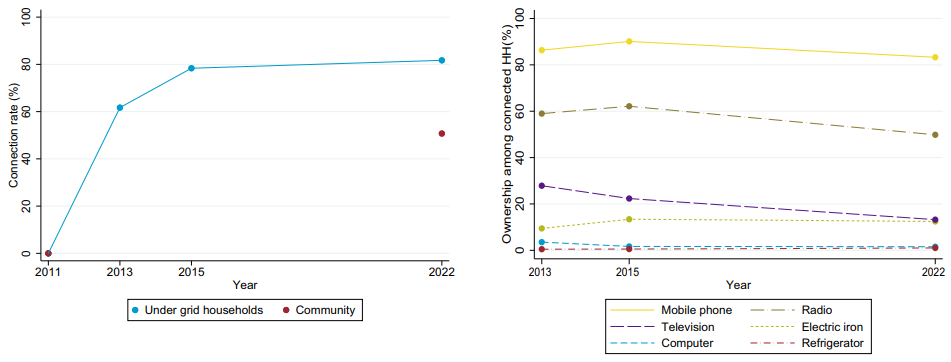
Note: Panel A shows the connection rates over time. A household is considered grid-connected if they have a connection plus installation in their home, regardless of whether they consume any electricity. Panel B shows appliance ownership over time. Data comes from the household and community surveys. The sample for both panels consists of thirteen covered communities in 2013 and 2015 and 41 covered communities in 2022.
Electricity use remains very low
Among households that do connect, electricity consumption is extremely low – and remains so even a decade later. The average connected household consumes around 8 kWh per month. To put this in perspective, this is roughly enough to power a few lightbulbs and charge mobile phones, but little else.
Administrative data from Rwanda’s national utility confirm this pattern and show no upward trend over time. If anything, consumption tends to peak shortly after connection and then declines slightly. Even households in the top decile of electricity users show no evidence of sustained growth in demand.
This lack of growth is mirrored in appliance ownership (see Figure 1, Panel B). Almost all connected households use electricity for lighting and phone charging, many use radios. Only about one in four households owns any appliance beyond these basic items (mostly televisions). Productive use of electricity is rare: fewer than 5% of households report using electric appliances to generate income.
In short, electricity use does not seem to evolve from ‘basic’ to ‘productive’ over time in these rural settings.
Limited transformation of local economies
We also interviewed community chiefs to explore adoption in enterprises and public facilities. In Burkina Faso, grid extension has been found to deliver important community-wide gains through lighting, schools, and water systems (Schmidt and Moradi 2026). In our sample, most small businesses in electrified communities connect to the grid, but their use of electricity is modest. Shops, bars, and hairdressers mainly use electricity for lighting, radios, televisions, or phone charging services. A few new electricity-dependent businesses, such as welders or copy shops, emerge, but these are exceptions rather than the rule.
There is little evidence of broader structural change in local economies. There are no signs of noteworthy enterprise creation, and manufacturing activities are generally rare. Public facilities such as schools and health centres benefit from electricity in important ways – improved lighting, lower energy costs, better administration – but these gains, while valuable, are unlikely to be transformative for local economic development.
Not just a Rwandan story
Comparisons with administrative data and World Bank Multi-Tier Framework surveys suggest that our sample, and Rwanda more broadly, are not outliers. Across several African countries, rural electricity consumption and appliance ownership are similarly low, and demand growth over time is limited.
Rethinking the case for grid expansion
These findings challenge the standard economic justification of rural grid extension. Large infrastructure investments are often defended using cost-benefit analyses that assume benefits will accumulate over decades. Our results suggest that, at least in many rural contexts, such long-run demand growth should be treated as an optimistic scenario rather than a baseline assumption.
This does not mean that rural electrification is a failure or should be abandoned. Electricity clearly improves quality of life: better lighting, easier communication, and enhanced public services are meaningful gains. It also deserves positive mention that short-term impacts – even if at low levels – sustain over a decade. But they may not be sufficient to justify grid expansion everywhere on purely economic grounds. As countries and donors push towards universal access under initiatives like Mission 300, it is crucial to align expectations with evidence – and to design electrification strategies that are context-specific and realistic about what electricity can and cannot deliver on its own.
References
Bernard, T, and M Torero (2015), “Social interaction effects and connection to electricity: Experimental evidence from rural Ethiopia,” Economic Development and Cultural Change, 63: 459–484.
Chaplin, D, et al. (2017), “Grid electricity expansion in Tanzania by MCC: Findings from a rigorous impact evaluation,” Unpublished manuscript.
Lee, K, E Miguel, and C Wolfram (2020), “Experimental evidence on the economics of rural electrification,” Journal of Political Economy, 128: 1523–1565.
Lenz, L, A Munyehirwe, J Peters, and M Sievert (2017), “Does large-scale infrastructure investment alleviate poverty? Impacts of Rwanda’s electricity access roll-out program,” World Development, 89: 88–110.
Masselus, L, J Ankel-Peters, G Gonzalez Sutil, V Modi, J Mugyenyi, A Munyehirwe, N Williams, and M Sievert (2025), “Adoption of electricity in rural Rwanda 10 years after connection,” Nature Communications, 16: 10942.
Meeks, R, and M Mahadevan (2025), “Electricity infrastructure,” VoxDevLit, 15(1).
Peters, J, C Vance, and M Harsdorff (2011), “Grid extension in rural Benin: Micro-manufacturers and the electrification trap,” World Development, 39: 773–783.
United Nations (2015), “Transforming our world: The 2030 agenda for sustainable development.”
World Bank / AfDB (2025), “Mission 300 is powering Africa: Overview.”