



Electrification is often seen as the spark for development. But in much of Africa, the biggest benefits may come not from households plugging in, but from the community services that light up around them.
Editor’s note: For a broader synthesis of themes covered in this article, check out our VoxDevLit on Electricity Infrastructure.
Around 600 million people in Africa still lack electricity, and achieving universal electrification in the region by 2040 would require investments of approximately US$60 billion annually (IEA 2022). Policymakers are drawn to electrification projects because results are clearly visible: new poles, wires, and substations provide tangible signs of progress. But this only represents the supply side. Demand side questions remain harder to address – how households, firms, and communities actually use electricity once it arrives (Meeks and Mahadevan 2025). Timing also matters: adoption and economic adjustments unfold gradually, and short-term snapshots risk missing much of the story.
Electrification as a silver bullet?
For years, policy reports portrayed electrification as a silver bullet – the missing bottleneck that could set economies on a higher growth path (World Bank 2008). Yet the evidence remains mixed. While research often finds positive effects in Asia (Kassem 2024), in Africa the impacts are more modest – from increased women’s labour market participation in South Africa (Dinkelman 2011) to almost no short-term welfare gains in Kenya (Lee et al. 2020).
This mixed record raises a central policy question: is large-scale rural electrification the best use of scarce development funds?
Beyond household connections
Electricity access is usually measured at the household level. But communities benefit in many ways even when few homes connect. Shops, schools, and health centres can run on electricity, street lighting improves safety, and firms with power can create jobs. When evaluating rural electrification programmes, it is therefore important to consider these wider community effects, not just private household gains.
Electrification rollout in Burkina Faso
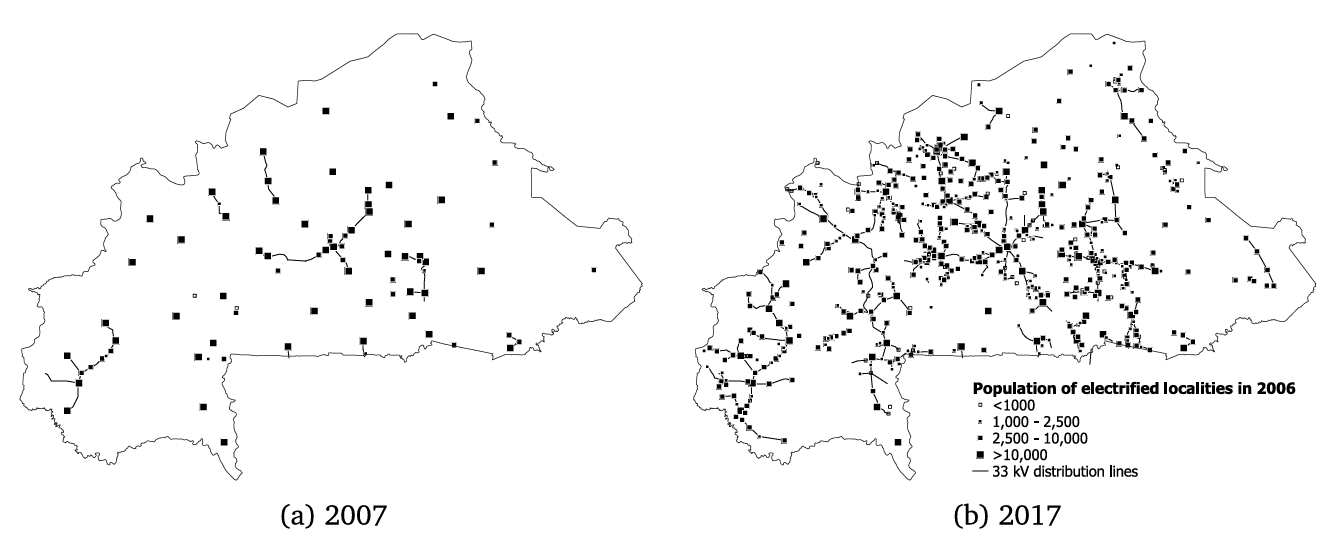
We study a nationwide grid expansion in Burkina Faso that rapidly transformed electricity access (Schmidt and Moradi forthcoming). In 2008, only 81 localities – mostly large towns and cities – were connected. Over the next decade, the grid extended to 578 peri-urban and rural settlements, shifting coverage from urban centres to smaller communities (Figure 1).
Planners prioritised localities with strong economic potential, but the timing of connections was shaped mainly by infrastructure and engineering constraints. This staggered rollout allows us to identify the community-wide effects of electrification.
Figure 1: Electrified localities and grid network
Electrification uptake was slow
Household connections remained limited: only about one in ten households connected immediately, and just one in five after six years (Figure 2, left panel). Still, electrified communities saw more households owning appliances such as phones, radios, televisions, and refrigerators.
Figure 2: Households with electricity (left panel) and illuminated localities (right panel)
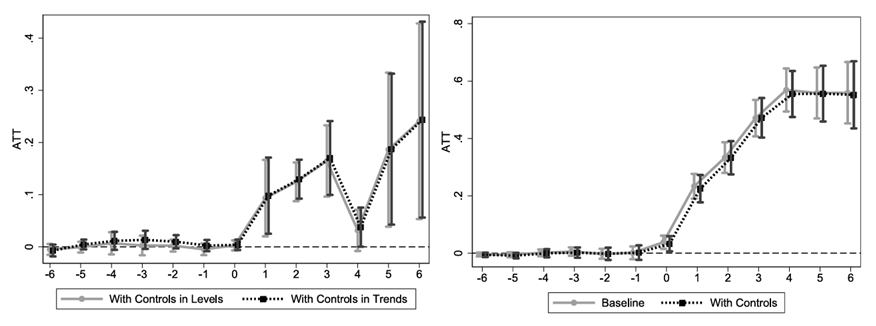
Notes: The figure shows average effects by years of exposure to electrification. Year 0 marks the year of connection. The left panel shows the proportion of households reporting electricity; the right panel shows the proportion of localities with nightlights detected by satellites.
Powering public goods
Satellite data shows a strong increase in night-time luminosity in the four years after electrification (Figure 2, right panel). This likely reflects both street lighting – a public good that improves safety – and greater economic activity.
We also find a marked rise in grid-powered drinking water systems within five years of connection. Crucially, these systems were managed locally, showing how communities themselves used new electricity access to expand public services. Grid power reduced costs compared with solar panels or generators, enabling more public water points and piped water directly into homes.
Community spillover effects of electrification
Benefits even extended to households without direct connections. Mobile phone and radio ownership increased among the unconnected, as people could charge devices at shops or neighbours’ homes.
Households in connected areas were also more likely to own a bank account. Mobile phones enabled access to mobile banking, supporting financial inclusion in places where formal banking was absent.
Electrification and complementary investments
To maximise impact, electrification needs to be paired with complementary investments. In practice, coordination was limited: while some schools gained electricity, there was no simultaneous rise in school facilities or inputs. Similarly, grid energy did not replace solar as primary energy source for electric water pumps.
Policy implications: Rural electrification
Our findings show that the benefits of rural electrification extend well beyond the households that connect. Even with relatively low uptake, grid expansion can deliver important community-wide gains through lighting, schools, and water systems, as well as spillovers such as access to phones and banking.
This has two implications for policy:
- The cost-effectiveness of electrification looks more favourable once these wider public benefits are taken into account. Evaluations that focus only on private household gains or on increasing household connection rates within electrified communities risk underestimating the value of grid investments.
- Electrification on its own is not enough. To maximise impact, it needs to be complemented by measures that encourage household uptake, make appliances more affordable, and coordinate investments in public services.
For African governments and donors, the message is clear: electrification is not a silver bullet, but with the right complementary policies it can be a powerful catalyst for safer, better served, and more connected communities.
References
Dinkelman, T (2011), “The effects of rural electrification on employment: New evidence from South Africa,” American Economic Review 101(7): 3078–3108.
International Energy Agency (IEA) (2022), “Africa energy outlook 2022.”
Kassem, D (2024), “Does electrification cause industrial development? Grid expansion and firm turnover in Indonesia,” Journal of Development Economics 167: 103234.
Lee, K, E Miguel, and C Wolfram (2020), “Experimental evidence on the economics of rural electrification,” Journal of Political Economy 128(4): 1523–1565.
Meeks, R, and M Mahadevan (2025), “Electricity infrastructure,” VoxDevLit 15(1).
Schmidt, M, and A Moradi (2026), “Community effects of electrification: Evidence from Burkina Faso’s grid extension,” Journal of Development Economics 178, 103556 [forthcoming].
World Bank (2008), “The welfare impact of rural electrification: A reassessment of the costs and benefits.”